

In recent years, comics have proven as fruitful a medium for biography as prose. Mimi Pond’s Do Admit: The Mitford Sisters and Me(Drawn & Quarterly, 2025) and Ken Krimstein’s Einstein in Kafkaland: How Albert Fell Down the Rabbit Hole and Came Up with the Universe(Bloomsbury, 2024),to name two examples, ably demonstrated how stylized art can evoke the inner life of a book’s subject.
But for some graphic novelists, a unique challenge arises when attempting to chronicle the lives of other comics creators. It’s one thing to choose a particular artistic and narrative style for a biography; it’s another to find a complementary art style for a book about, say, Will Eisner, whose own comics have a distinctive look and feel.
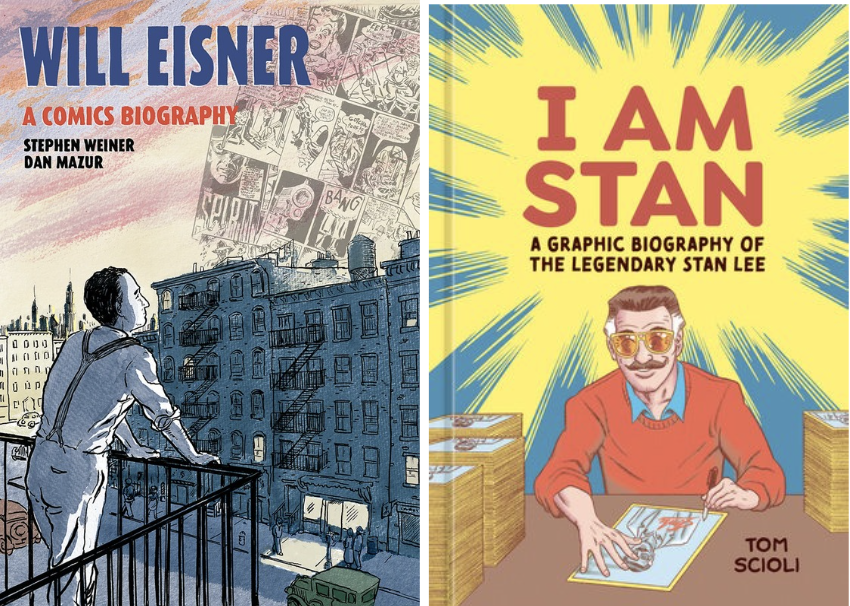
In Will Eisner: A Comics Biography(NBM), writer Stephen Weiner and artist and cowriter Dan Mazur largely avoided direct references to Eisner’s distinctive style.
Because Eisner had already created an autobiographical graphic novel, 1985’s The Dreamer, in his own style, and is otherwise considered a master of the form, “there was less need to emulate his style, which I would have had a hard time doing anyway,” Mazur said.
Mazuer and Weiner wanted instead to reach “an audience that doesn’t already know Will Eisner’s work that well. It’s my visual style, but it’s really got more to do with independent comics today.”
It helps that Weiner personally knew Eisner. The trailblazing comics creator, best known for his masked crimefighter the Spirit and for popularizing the graphic novel format with A Contract with God, even wrote the introduction to Weiner’s 2003 book Faster Than a Speeding Bullet: The Rise of the Graphic Novel.
“I met Will in 1990, and I knew him for the last 15 years of his life,” Weiner told PW. “We were collaborators—not on comics themselves, but on the initiative to bring comics to a wider audience. I was a librarian and I was advocating bringing graphic novels into libraries, which they weren’t at that time, and he was the most willing to help me because he was the most committed to that. And so we became friends.”
Eisner’s The Dreamer, which looks back on his early years in comics, was cited by Weiner and Mazur as a reference point—but not for the reasons one might expect.
“I felt like that book was really very insincere, and I felt like he had not done himself justice, he hadn’t really portrayed how hard it was,” Weiner said. “I really wanted to focus on how difficult the challenges that he faced were in trying to jumpstart this industry—because there really wasn’t an industry before he joined it in 1936.”
In revisiting Eisner’s major works like The Spirit (which ran from 1940–1952), Weiner and Mazur faced one especially confounding problem: How to contend with Ebony White, the racist caricature who acted as the Spirit’s sidekick? The two men wanted to acknowledge the understandable criticism Eisner faced throughout his career, which Eisner largely minimized in his own work.
“The controversy was alive and active while Ebony was a character,” he added. “It didn’t just come up in the 1960s. There were letters, there were debates, and Eisner was aware of it—and kind of in denial and resistant to it until the very, very end of his life.”
To address the issue, Mazur and Weiner decided, rather than reproducing the racist caricature, to instead quote a 2003 interview in which Eisner reflected on his responsibility for the way Ebony was depicted.
Eisner isn’t the only comics icon to have his life story told in his own medium. Tom Scioli, best known for his works of maximalist science fiction and fantasy, recently completed two biographies of two of the most famous men in American comic book history.
InJack Kirby: The Epic Life of the King of Comics(2020) and I Am Stan:A Graphic Biography of the Legendary Stan Lee (2023), both the formal innovations that Scioli has brought to his madcap genre work is put to a different use
“After I had a decade-plus of experience making comic books, it just made a lot of sense to me to tell these guys’ stories,” Scioli told PW. “Jack Kirby was the person I’d studied the closest. So it made sense to do that and then once I’d done a Jack Kirby book, a Stan Lee book was almost expected as a next step.” After all, the two were close collaborators during their years together at Marvel, co-creating iconic superheroes like the Fantastic Four and X-Men, even though they went their separate ways after an acrimonious split.
Scioli cited an Andy Warhol influence on aspects of his Lee biography—which seems fitting, given that Marvel Comics covers briefly bore the inscription “A Marvel Pop Art Production” in the mid-1960s. A recurring page design in I Am Stan, for instance, features a page made up of images of Lee’s head at various ages, letting the reader trace his appearance across the decades.
The experimental quality Scioli brought to I Am Stan also involved how he drew the book’s subject. “With Stan, I had him start out as a comic strip character, like Hank Ketcham doing Dennis the Menace—which again feels like the right era for a young Stan,” Scioli explained. “And then as he ages, he’s drawn more realistically.”
Scioli isn’t sure if he’ll return to comic book history for another biography, even though people expect him to write about Steve Ditko, the third most famous comics creator of Marvel’s hallowed ’60s era, who co-created Spider-Man and Doctor Strange with Lee.
“I’d enjoy the challenge, but that’s a pretty big challenge,” he said. “I have the benefit of there being decades of interviews and videos of Stan Lee and Jack Kirby there’s nothing like that for Steve Ditko.” A 2016 New York Magazinearticle in which Josephine Riesman failed to get an interview with Ditko ahead of the Doctor Strange movie even after showing up at his office noted Ditko’s penchant for sharing personal information “piecemeal and on his own terms.” Ditko’s fans can only find him in the pages of his comics—for now.
Whether you’re telling a biography in prose or comics, finding the righth, the key to Three Rocks (Abrams ComicArts), his biography of Nancy creator Ernie Bushmiller, was conversations with Bushmiller’s longtime friend Jim Carlsson
“He gave me the essential biographical sketch of Bushmiller that no one else could have done, because he was not only an assistant, he was his right-hand man,” Griffith told PW. “He was Bushmiller’s best friend on top of that. I got a wealth of information from him, and without him, the book would have been a repeat of things that have already been written.”
The last decade has seen an uptick of interest in Nancy due to the work of cartoonists Olige to the strip—an edge that many comics historians havenoted evokes Bushmiller’s own distinctive approach. (Jaimes worked on the strip from 2018 to 2025, with Cash taking it over in 2026.)
Three Rocks is a compelling biography, but it also doubles as an extended lecture about Nancy. Throughout, Griffith frames Bushmiller’s work on Nancy as a window into what the medium can do.
“To me, Nancy defines what comics are in the most basic sense,” Griffith said. “Bushmiller added such an incredible degree of unaware surrealism to that structure, to the way that comics work when you read them, that it was just the best of both worlds.”
Making comics about comics might come with its own set of built-in challenges, but in the hands of creators with command of the medium and confidence in their own style, graphic biographies can offer a glimpse into both history and the future.
