

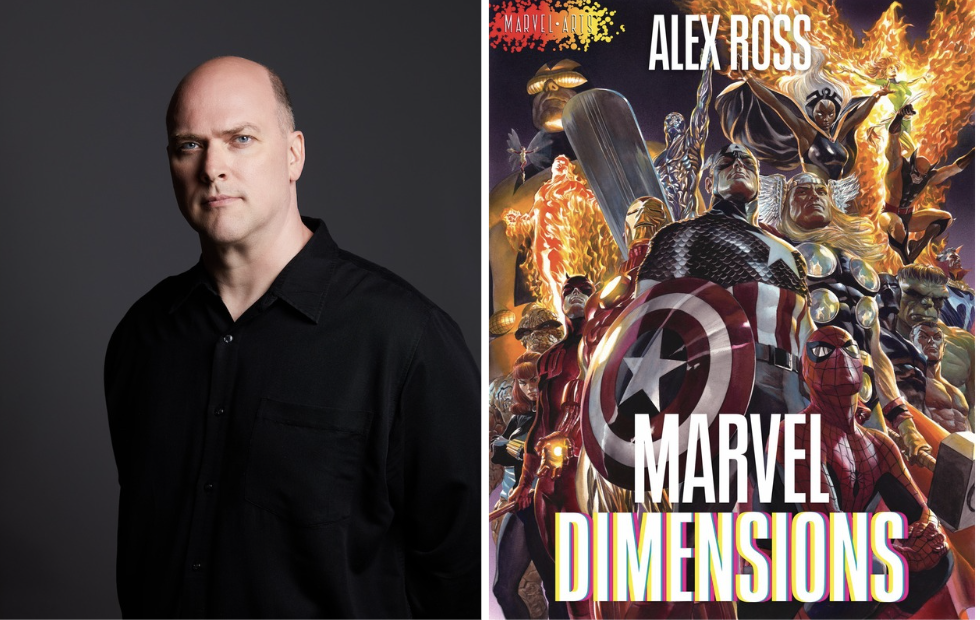
Comic book writer and artist Alex Ross is back with a new passion project centered on iconic Marvel characters. And like his last, 2022’s Fantastic Four: Full Circle, his new book, Marvel Dimensions, is published not by Marvel, but by Abrams ComicArts.
As Abrams editorial director Charles Kochman recently explained toPW, the MarvelArts line allows Abrams to take on “projects that Marvel may not have the bandwidth to do,” and in formats that aren’t Marvel’s forte. Full Circle was, in fact, the inaugural release from MarvelArts.
Like Full Circle, Ross’s newest graphic novel, Marvel Dimensions (Sept.), came from ideas that wouldn’t stop nagging at Ross, he tells PW in a recent joint interview with Kochman.
“In the case of Marvel Dimensions, my urge was having leftover ideas that I wanted to find a place for,” Ross says. “I was basically taking two ideas and jerry-rigging them together.”
The reference to jerry-rigging isn’t just metaphorical. Marvel Dimensions combines two different ideas, represented in different formats. The first half of the book comprises two-page spreads in Ross’s typical painted style, each retelling the origin story of a different Marvel superhero, starting with the original robotic Human Torch and going all the way up to Jean Grey as Phoenix.
The second half is a narrative story, done in pen and ink by Ross in a departure from his usual style, which turns those origins on their head. The narrative is contained within a 32-page comic insert within the hardcover. It’s proof that Ross, a popular superhero artist who could claim a prominent place on any convention show floor, is still trying new things.
“I’ve always wanted to do pen-and-ink for something, but finding the logic of where it would fit within my body of work has always been a challenge,” Ross says. “So we shift context halfway through Marvel Dimensions, and hopefully it feels organic.”
Ross and Kochman both cited Madmagazine reprints as their inspiration for putting two different kinds of comics into one book.
“When Alex was first conceptualizing this whole story, I remember the comic was something that he was going to have inside the book, but not as a separate object,” Kochman says. “But then at one point we threw out the idea, ‘what if we did it as a separate comic?’ Having worked at Madmagazine, I share with Alex a love of those Super Specials where they would bind in a comic.”
“I like to think that with all of Abrams’ books, the content will always dictate the format,” Kochman adds. “This one has a storytelling reason.”
At one point Ross and Kochman wanted to keep the insert comic a total surprise for readers, before Abrams’s marketing team convinced them that it would be a selling point. But they’re reluctant to talk too much about the comic before it hits stands, so that readers can find out its storytelling reason for themselves.
The painted origins in the first half, meanwhile, bring Marvel superheroes back to their origins. One of the main selling points of Marvel superhero comics is that they’re supposed to represent one continuous narrative, with different writers and artists further developing characters and ideas over time. But with the origin stories in Marvel Dimensions, Ross had no interest in synthesizing decades of retcons, or canonizing adaptational changes from the Marvel Cinematic Universe.
“Between the MCU and a lot of the updates that have happened over time with new creators, there’s a seditious endeavor on my part to push back against all those other things where they revise history,” Ross says. “I’m going back to what things had been established in these characters’ early histories. I’m getting to write the history as I’ve known it.”
For instance, in the MCU and Marvel’s 21st-century Ultimate comics, the Hulk’s origin has been revised so that Bruce Banner got his superstrong green alter ego from some kind of serum or chemical. Ross brings him back to the bomb that started it all.
“Bruce Banner was a bomb maker, and so everything that happened to him is a side product of his own invention,” Ross says. “When people want to talk about how he was an abused child and had a bad relationship with his father, that’s beside the point. He was a person doing a thing that led to a certain suffering, and that’s his own burden to carry. Hold the person accountable, which is the whole original crux of the story of the Hulk that’s gotten lost over time. He’s a product of the nuclear age, which is frankly true of a lot of the original Marvel characters.”
There is one character that Ross presents two different origin stories for, and that’s because the discrepancy happened immediately between his original creators.
When Jack Kirby originally envisioned the Silver Surfer, he saw the character as an alien being with no sense of human empathy. When Stan Lee took the character over for a solo series, he gave him an origin as the humanoid alien Norin Radd, who felt guilt for helping the cosmic devourer Galactus. For the Silver Surfer’s spread, Ross presents both versions.
And for the final painted spread, of Jean Grey, Ross changes format, making the spread horizontal instead of vertical.
“That’s an inside joke for Alex and I, because I always have this thing about not turning a book sideways, so of course he had to make one of them like that,” Kochman says. “But I will say, Alex’s instincts almost always work. Even with my predilection against those kinds of pages, in that particular instance it really works because it’s part of the whole aesthetic of this book, which is unpredictable.”

1 Comment
Pingback: How Graphic Biographies Uniquely Capture Comics Legends - Comic Vibe