


Five years ago, I sat down in my apartment in China’s Anhui province andwrote a quick piece about independent video games.
At the time, it really felt like the indies were about to take off. Steam had grown out of its 2019 slump, helped tremendously by small developers. Public sentiment had seriously soured on the dominant live service model, with wide consensus that AAA games had become repetitive and unrefined. Best of all, money was pouring into these small to medium-sized teams, whether from corporate giants acquiring developers or venture capitalists trying to fund the next big breakout.
From five years on, it feels like a different world. It was a time when pandemic measures had turned countless people into developers just to fight the boredom. Tech companies were betting on cloud gaming making the hardware cycle obsolete, while many commentators thought that subscription services were the future. Slop games and machine-generated assets were a distant concern, and the moral panic over in-game communications was still behind the horizon.
In the years since, AAA companies had their best year in decades, only to be followed by a power year for smaller companies. Numerous indie publishers either went out of business or cut operations to the bone. Unity sparked a controversy that opened up the market to newer engines. And after years of turning a blind eye, everyone was talking about China’s growing importance.
And we’re not even to the end of the decade yet.
For this, the sixth edition of State of Indie (SoI), I want to focus on what has changed since 2021. As always, I’m looking at the experiences of the typical developer, not just the big successes that capture all of the attention.
I’d also like to share some experiences of the typical game writer. A hallmark of this series has been the SoI survey that I send out to developers, hoping to get some on-the-ground insight from teams of different sizes, styles, and experience levels. This year? It was a struggle. The response rate was around a third of what I’m used to.
So what explains it? In a word: Scams. I don’t need to tell you that we’re all living in scam-world right now, and that’s true for developers too. While no respondents mentioned it, I know full well that they’re being flooded by people trying to cadge free keys or sell useless services. Much like your instinct to ignore any phone call or email from an unfamiliar person, developers are shutting out all the random people contacting them on Discord.
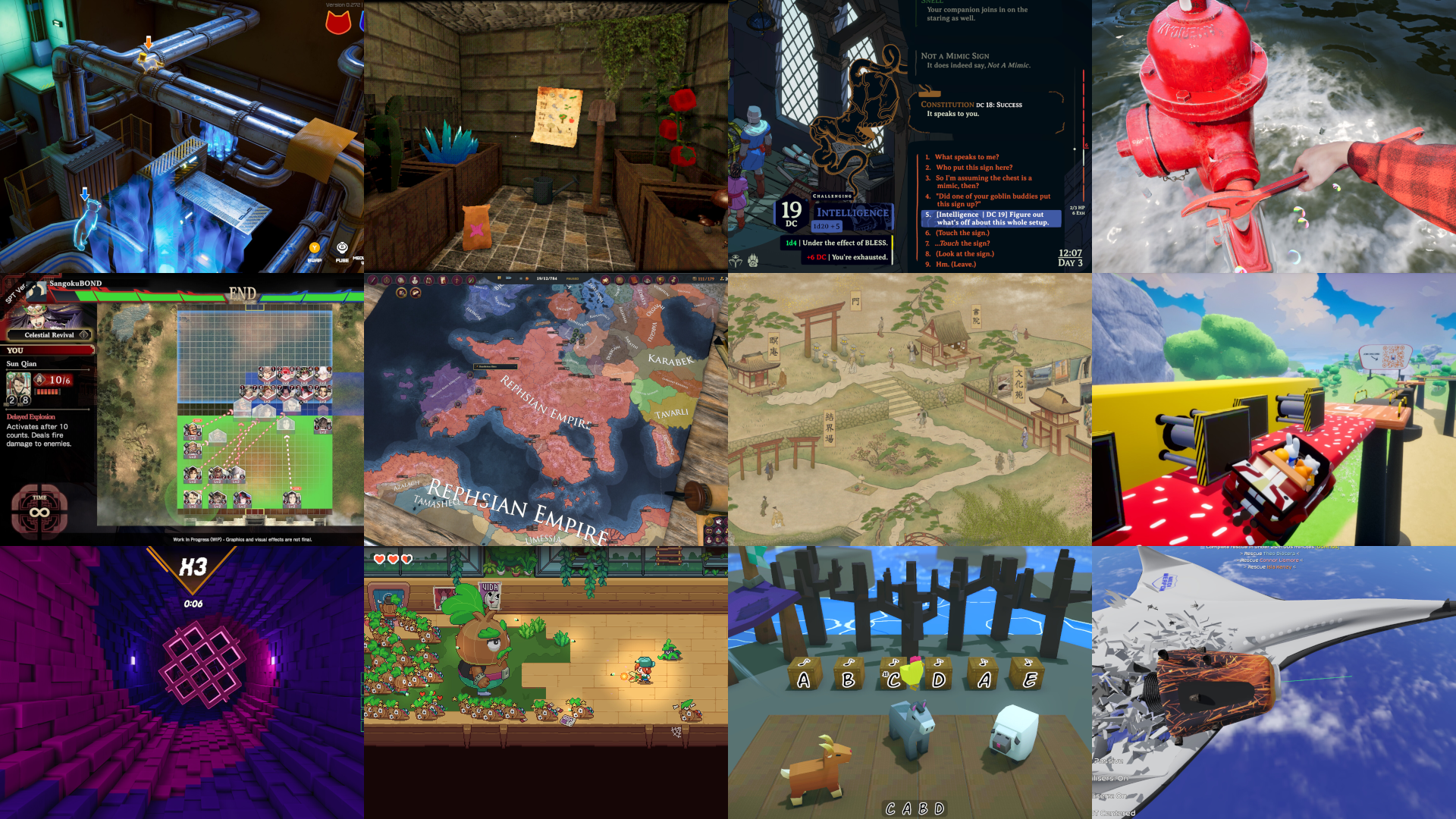
But the people who did respond have plenty to say. This year, that included:
There’s one other change I’ve made. As this article has grown longer, it’s made sense to split it up. This year, SoI will appear in four parts:
- Part 1 will be a high-level look at the indie scene, the winners and losers among genres, and the games that didn’t quite make it.
- Part 2 will cover the economics of indie games, with a special focus on pricing.
- Part 3 will delve into finance and technology, exploring the opportunities available to developers (and the risks that go with them).
- Part 4 will look at indies as a global phenomenon, including emerging markets and the ongoing struggle to get noticed.
This Year in Indies
We’ve had a few strong years for indie games, and 2026 is shaping up to be no different, with some definite diversity among the biggest hits. The top of the charts includes long-awaited sequels like Slay the Spire 2 and Subnautica 2; new IPs from well-known developers such as Mewgenics and Cairn; major debuts such as Mouse: PI for Hire; and surprise viral megahits such as Meccha Chameleon and How to Fish.
But while most attention focuses on these hits, the reality for the typical developer can be far different. Oversaturation has driven down the median revenue while the biggest hits keep getting bigger.
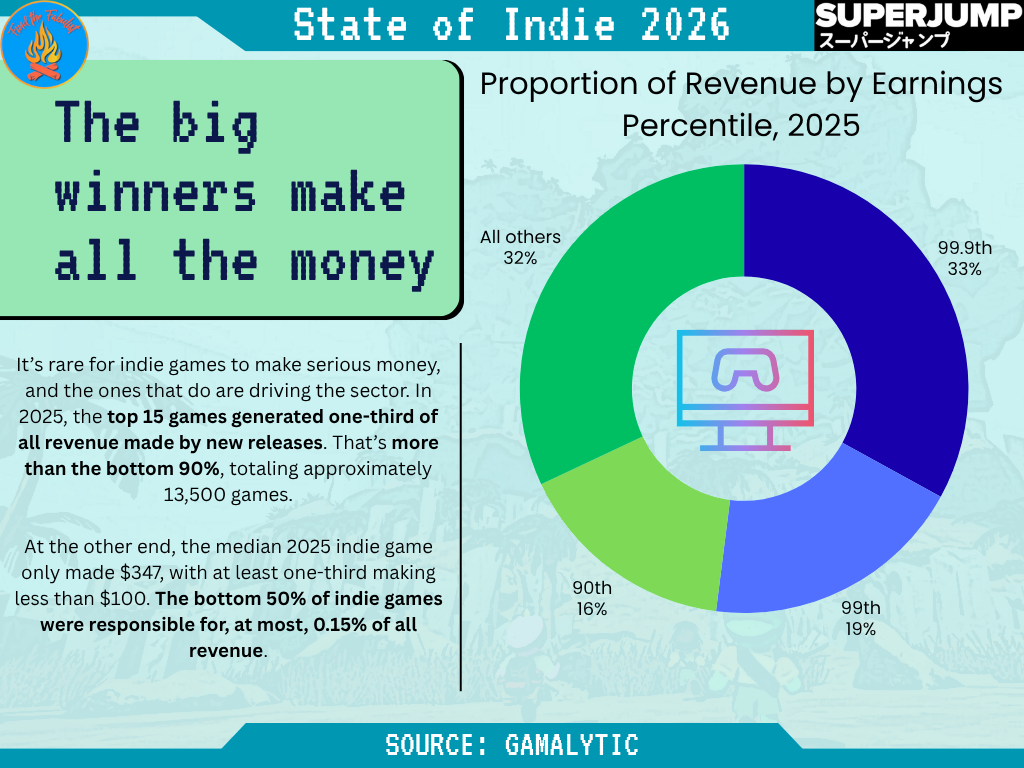
The median revenue for indie games released on Steam in 2025 was $347. Gamalytic, the organization whose stats I’ve been using, suggests this number is skewed downward by an increase in the proportion of free and extremely cheap games, and that the “true” median would be in the thousands. However, these higher numbers might look unimpressive when compared to the roughly $18 million made at the 99.9th percentile, the $1.2 million at the 99th, or even the $33,000 at the 90th.
Not everyone can sell millions of copies, but selling enough to make a living is at least possible. It takes the right approach, though.
Genres: Winners and Losers
Many factors go into whether a game succeeds or fails, but one of the most important is set before development begins. The game’s genre determines its maximum audience, the level of competition, the price a developer can charge, and the standards to which the game will be held.
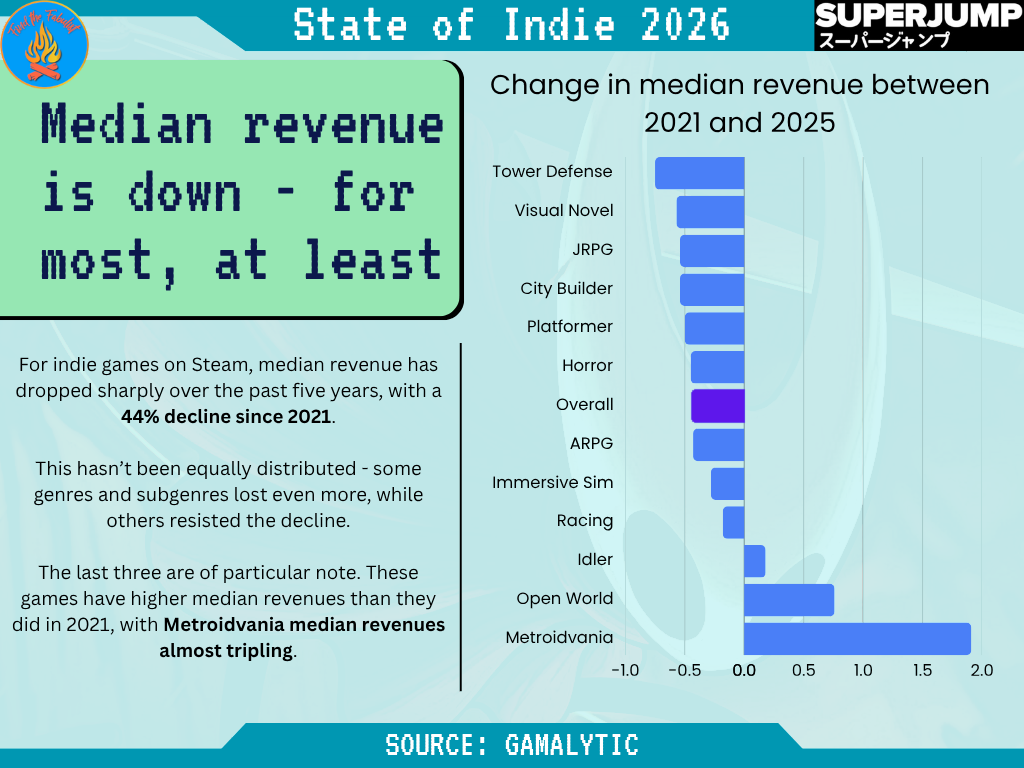
On the surface, the best and worst genres for developers haven’t changed much. AAA-dominant genres (i.e., FPS, action RPG) are far tougher for indie devs than old-school PC genres (i.e., city builders) or new-wave indie styles (i.e., open-world survival). Metroidvanias are hugely popular while other types of platformers seldom break out. The one wrinkle is the idle/incremental game – easy to make with a small team but with a higher average return than many other styles.
Under the surface, things have changed since 2021. As stated above, median revenue for indie games has fallen off a cliff, down 44% over the past five years. But some games have lost much more, while others just kept growing.
It’s not hard to pull a narrative from the numbers. Games that are relatively easy to make (tower defense, visual novels, platformers, horror) are competing with each other and driving down the median return. Meanwhile, games that are more skill- or manpower-intensive (open world, ImSim, Metroidvania) are making more money because those genres are naturally far less crowded. Idlers are a definite exception, but the idler boom is something that few people saw coming, and no one can quite explain.
Sometimes, even a genre that’s having a real moment can be a struggle to promote. “Most indie events do not consider simulator games as games they’d want to feature, so it’s been a struggle to take traditional indie visibility paths,” says Dungeon Bodega Simulator developer Harrison. “That said, I do think people are on the lookout for cheaper games, so I think that has helped.”
Conversely, it’s possible to succeed in a challenging genre with the right approach. “Esoteric Ebb got lucky in a few different ways, each of which allowed it to get a very favorable reception,” says Christoffer Bodegard. “Since Ebb is in a very specific niche – that being narrative RPGs, a niche within a niche – the overall game market trends did not impact it to the same degree as ‘per usual’. Similar to strategy games, RPGs on Steam have a dedicated but very picky audience, so it’s all about getting favorable word-of-mouth in those communities. At least that’s my experience so far!”
The Co-Op Revolution and Its Beneficiaries
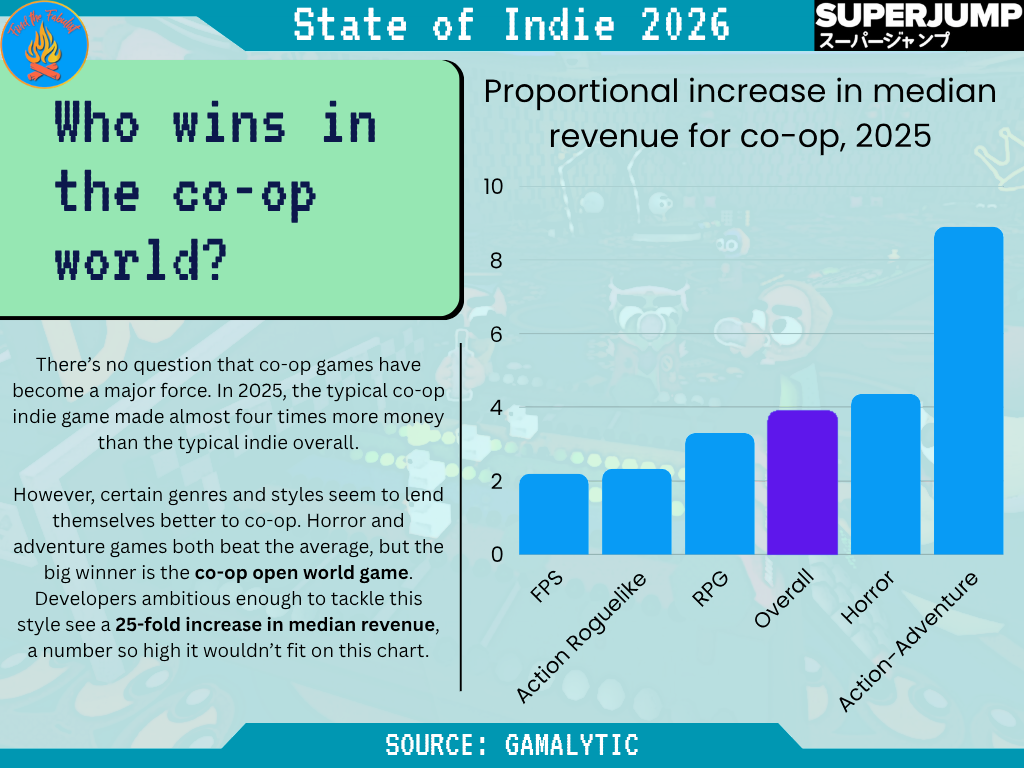
The safest prediction to make in 2025 was that co-op was going to be important. That year, games with the Steam “co-op” tag generated four times the revenue of the median indie, and developers have taken notice. Around 6.5% of games released thus far in 2026 are tagged as co-op games, a significant number but only slightly higher than last year. Look at the top of the sales charts, though, and co-op is massively overrepresented.
The rise of non-competitive multiplayer is very much a phenomenon of the young. An analysis from GameDiscoverCo points toward a distinct age divide, with multiplayer hits trending toward people under 30. This might not come as a surprise to you – after all, Steam is heavy with ultrabudget titles and “friendslop” games narrowly targeted toward minors. However, these same games are still popular among young adults in their twenties, suggesting that kids aren’t changing their playing habits as they age.
The co-op revolution is itself a story of genres. That’s because certain genres lend themselves to co-op but also because specific genres benefit more from it. Most of the 2025 co-op boom came from open-world, action-adventure, and horror games, with other game types enjoying more modest or uncertain benefits.
So while co-op has a lot of upside for developers, the reality of making a co-op game is much more nuanced; genre isn’t the only thing that matters. As we’ll see later, co-op games have their own special dynamics, and this affects every decision, from how they’re priced to where they’re promoted.
The Games That Vanish
But what about the games that aren’t such huge hits? There are a lot of games hitting the market every week, and they can’t all make headlines.
Oversaturation is an evergreen topic with regard to indie games. Steam has set new records for releases in 9 of the past 10 years, and 2026 is shaping up to end the same way. At the current pace, we’re likely to see between 20,000 and 22,000 new releases on the platform.
20,000 games is a lot no matter how you dice it – roughly the equivalent of the first thirty years of the industry. Still, the rate of growth isn’t going up. The wave of machine-generated slop hasn’t manifested, at least not to the extent people feared and nowhere near the magnitude we’ve seen in music or writing.
The bigger issue is that the demand side is not growing at the same pace, and customers aren’t as adventurous as developers might hope. This has resulted in a sharp increase in games that go unnoticed. Almost two in five games sell fewer than a hundred copies in their first year, with nearly three-quarters selling less than a thousand.
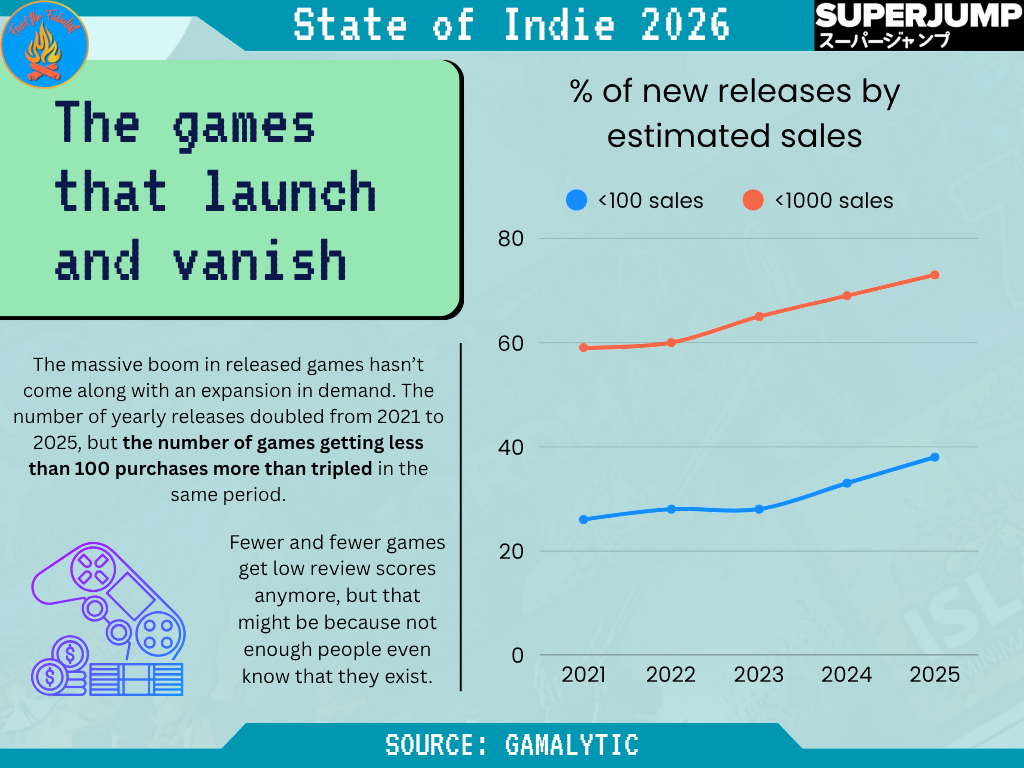
In previous years, I mentioned that the average rating of indie games on Steam has been increasing since 2015. While true, this may be an illusion driven by these low-sellers. Any game with fewer than 10 public reviews isn’t factored into the total. Simply put, the games that would have been raked over the coals in the 2010s are simply being ignored in the 2020s, which means fewer negative reviews are ending up in the stats.
Yet again, this is a story of genres. Make a game in a genre with high demand and low supply, and you’ll do a lot better than if you’re fighting it out in an overcrowded field. That’s probably why 78% of Metroidvanias sell over 100 copies versus less than 50% of standard platformers.
But opting to make a game in a good genre hardly guarantees success. It takes more than that.
Yasuhiro Nishiyama is a producer with a storied history at Sega, where he worked on Skies of Arcadia, the House of the Dead series, and dozens of arcade projects. He is currently the head of Gerappa (Get Wrapped Up), which launched its first game, Sangokuchi BOND (Three Kingdoms:BOND) in July.
“[F]amiliarity with a genre alone isn’t enough — you need to change the experience within it,” says Nishiyama. “My approach is to take a foundation players already understand and add one strong, unexpected idea on top. In this game, that idea is that your deck-building choices unfold in front of you as a massed battlefield.”
In Summary
- An ever-greater proportion of money is going to a few high-profile games, while the overall median revenue has fallen.
- Games in most genres are making less money, with the exceptions being genres that are more difficult to make and are thus facing less competition.
- Co-op is huge, but it’s not suitable for all genres.
- Less successful games are vanishing, with more than a third of all new releases selling fewer than 100 copies.
In Part 2, we’ll look at the death and rebirth of the mid-tier game and ask the burning question…what are indie games actually worth?
