

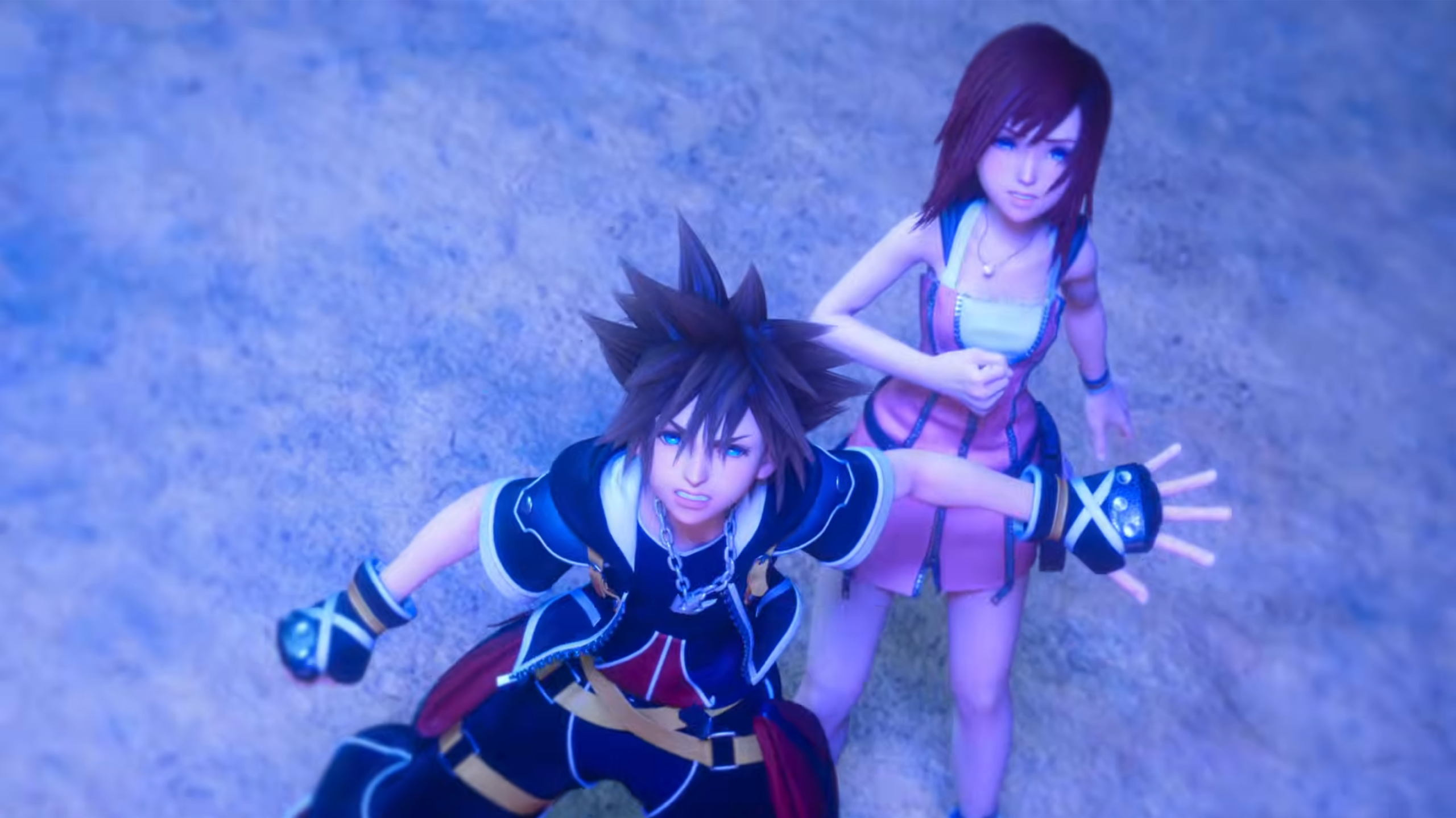
Disney announced at D23 on Friday that Kingdom Hearts is getting its first anime series — and the 39-million-unit franchise it draws from has been quietly dramatizing David Chalmers’ hard problem of consciousness, Antonio Damasio’s somatic marker hypothesis, and Hugh Everett’s many-worlds interpretation of quantum mechanics since its PlayStation 2 debut in 2002. The series will stream on Disney+ and Disney Channel, developed in partnership with franchise creator Tetsuya Nomura and Square Enix — making it a co-production with genuine creative continuity rather than a licensed adaptation, and giving the new anime a philosophical inheritance it will have to decide what to do with.
The announcement came during the Disney Entertainment Showcase at the Anaheim Convention Center, with actor Benjamin Bratt making the reveal. Bratt — who voiced Ernesto de la Cruz in Pixar’s Coco — also confirmed the second major news of the evening: Kingdom Hearts IV will launch in late 2027, and the Land of the Dead from Coco will appear as one of its featured worlds. Benjamin Bratt confirmed he will reprise his role as Ernesto de la Cruz in the game. The timing is not incidental. Coco‘s afterlife operates on a theory of identity that is structurally identical to Kingdom Hearts’ own memory mechanics — and neither franchise knew the other existed when both systems were first designed.
Disney Kids & Family president Ayo Davis said the series will be “unmistakably Kingdom Hearts” while “giving fans a whole new way to experience the world they love.” Nomura, in a statement issued alongside the announcement, said he and the scenario team have been holding extensive discussions about the project and that new character designs have already been created specifically for the series. No premiere date was given; the announcement was accompanied by a teaser poster appearing to show protagonist Sora holding his Keyblade.
Nobodies Were Chalmers’ Zombies Before Anyone Used That Name
In 1995, philosopher David Chalmers published what became the most contested paper in the philosophy of mind: a formal articulation of what he called the “hard problem” of consciousness. The easy problems of consciousness — explaining how the brain integrates information, controls behavior, reports its own states — were tractable: specify a mechanism that performs those functions, and you have your explanation. The hard problem was different. Even a complete specification of every physical process in the brain left open a further question: why does any of this give rise to experience at all? Why is there something it is like to be you?
To dramatize the problem, Chalmers introduced the thought experiment of the philosophical zombie: a being physically and behaviorally identical to a conscious person but with no inner experience. On the outside, indistinguishable. On the inside, no one home.
Kingdom Hearts built its central antagonist mechanic out of this exact thought experiment, seven years later, in a PlayStation 2 game aimed at children.
When a person’s Heart is consumed by darkness in the Kingdom Hearts universe, the Heart separates from the Body and Soul. The Heart becomes a Heartless — a creature of pure affective drive, instinct without cognition. The Body and Soul continue as a Nobody: fully intelligent, capable of complex planning, able to reason about ethics, able to understand what other people feel — but lacking the felt experience of those feelings. Nobodies know what loyalty means. They cannot experience loyalty. They are Chalmers’ philosophical zombies, with zipper belts and anime hair.
Nomura has stated that the tripartite division reflects a deliberate conceptual structure: “To explain it simply, a person has a body, a soul, and a heart. As an image, the soul is the lifemoral experience. Its loss is not the loss of cognition — Organization XIII’s members are some of the most strategically sophisticated figures in the franchise — but the loss of the capacity to feel the weight of what cognition tells them
Neuroscientist Antonio Damasio arrived at an empirical version of this argument through patient case studies rather than thought experiments. The ventromedial prefrontal cortex (vmPFC) integrates emotional signals with cognitive processing during decision-making, a system Damasio called the somatic marker hypothesis. Patients with vmPFC lesions — a population that includes the famous historical case of Phineas Gage — make logically rational decisions but morally impoverished ones. They understand right and wrong as logical propositions. They cannot feel the force of the distinction. They are, in a clinical sense, Nobodies.
The Kingdom Hearts franchise does not credit Damasio. It does not need to. What Nomura designed as a fantasy mechanic about Hearts and darkness maps, with unusual precision, onto what clinical neuroscience found when it looked at patients whose emotional-integration cortex had been severed from their reasoning.
How Does a Gummi Ship Navigate a Quantum Multiverse?
The Kingdom Hearts multiverse is built on a cosmological claim: all of reality was once a single unified World, which shattered in a catastrophic war into dozens of isolated “worlds,” each surrounded by dimensional barriers that prevent communication or traversal. The Lanes Between — the dark interstitial space through which Gummi Ships navigate — connects these isolated worlds without belonging to any of them.
Hugh Everett III proposed a structurally similar model in his 1957 Princeton doctoral dissertation. Rather than the wave-function collapsing at quantum measurement into a single outcome, Everett argued, all outcomes continue to exist simultaneously as non-interacting branches of the universal wavefunction. Every quantum event generates a branching point; every branch is a complete world. The branches do not communicate. Bryce DeWitt popularized this framework in the 1970s under the name the many-worlds quantum interpretation. Modern advocates include David Deutsch, Sean Carroll, and Max Tegmark.
Kingdom Hearts’ dimensional barriers between worlds function identically to Everettian decoherence: causally isolated domains that share a common origin — the shattered primordial World — but cannot interact unless those barriers are deliberately breached. The Heartless that “corrode” the barriers and consume worlds are doing, narratively, what would happen if the decoherence boundary between quantum branches began to fail.
The Lanes Between have a more specific physics analog in Lisa Randall and Raman Sundrum’s brane cosmology, proposed in 1999. In the Randall-Sundrum brane physics models, our observable universe is a three-dimensional “brane” embedded in a higher-dimensional bulk spacetime. Other branes — other universes — exist nearby in the bulk but are causally isolated; the only force that propagates freely through the bulk is gravity. Traversal between branes would require moving through the bulk dimension itself. The Gummi Ship, in this reading, is not a spaceship. It is a brane-traversal vehicle navigating the Randall-Sundrum bulk: a medium that connects isolated worlds without belonging to any world it connects.
Neither Everett nor Randall-Sundrum confirms that Kingdom Hearts’ cosmology is physically accurate. What these frameworks establish is that the franchise’s metaphysics are not arbitrary fantasy elaboration — they are intuitions about the structure of isolated-but-connected realities that theoretical physics has independently formalized.
Sora, Kairi, Riku: What the Names Are Actually Doing
Tetsuya Nomura was born in Kōchi Prefecture in 1970 and joined Square in 1991. His character design vocabulary — asymmetric zippers, oversized shoes, layered belts, visual kei fashion elements — derives from the Shibuya youth culture of the early 2000s: it is documentation, not decoration. But the naming conventions reveal a philosophical intention that predates the visual design.
The three foundational characters are named Sora (空, sky), Riku (陸, land), and Kairi (海, sea). These names encode the Japanese aesthetic concept of ma (間) — the meaningful space between things, the interval that gives adjacent elements their definition. Sky, land, and sea are each other’s context; each exists as the space the others are not. Nomura did not design three characters who happen to have elemental names. He designed a philosophical statement about the nature of identity: that selfhood is constituted by relation, not isolation.
Organization XIII, the franchise’s antagonist collective of Nobodies, follows an anagram convention that encodes the same insight: every member’s name is an anagram of their original human name plus the letter X. Roxas is an anagram of Sora plus X; Axel is an anagram of Lea plus X. The X (a stand-in for the Roman numeral ten, representing incompleteness) marks them as grammatical variants of their former selves rather than different persons. Identity, in Kingdom Hearts, is not a substance but an arrangement — you are the same configuration of letters, minus the animating principle that makes that configuration mean something. This is precisely what philosopher Eric Olson calls the animalism problem in personal identity: the question of whether what persists through radical psychological change is a biological animal or a psychological continuity. Nobodies resolve that debate by making it visible: the Body and Soul persist (the animal, in Olson’s terms) while the Heart — the psychological continuity anchor — is absent.
An anime adaptation will inherit every one of these design decisions. Any episode featuring a Nobody will, structurally, be engaging with the hard problem of consciousness. Any episode featuring world-to-world travel will, structurally, be dramatizing the cosmological question of how causally isolated realities relate to each other. Nomura’s architecture is not separable from his characters.
When Two Independently-Developed Theories of Identity Converge
Coco‘s afterlife operates on a specific mechanic: the living must remember you for you to exist in the Land of the Dead. A photograph on an ofrenda — a Day of the Dead altar — is not a decoration; it is a causal mechanism. The ofrenda keeps a person’s photo present in the world of the living, which preserves their existence in the Land of the Dead. When the last living person who remembers you stops doing so, you experience the “Second Death” — final, ontological absence.
This is a folk-intuitive version of what philosopher Max Tegmark argues in the Mathematical Universe Hypothesis: if reality is fundamentally mathematical structure — informational, not material — then an entity whose information has fully decayed from all other systems no longer instantiates a real entity. You exist, on this view, as long as causal traces of you propagate through the world. When those traces are gone, you are gone — not merely forgotten, but ontologically absent.
Kingdom Hearts built this same model independently, in a different medium, by a different creative team, in a different decade. In Chain of Memories, Sora’s memories are systematically erased and replaced by false ones — a process presented as equivalent to a kind of death, because the Sora who remembers correctly ceases to exist. In the franchise’s cosmology, Hearts are made of memories; to dismantle someone’s Heart is to dismantle the memory-structure that constitutes them.
Coco‘s Land of the Dead and Kingdom Hearts’ Heart-destruction mechanic were not designed in consultation. They were designed by teams in Emeryville, California and in Osaka, Japan, separated by a decade and by completely different creative traditions. They converged on the same model of post-mortem identity: memory is the substrate of existence, and its erasure is the final death.
This convergence is not a creative coincidence. It is evidence that the memory-identity model — the intuition that a person’s continued existence is constituted by the propagation of memory and recognition through a community — is a cross-cultural cognitive universal about consciousness and death. Two teams independently building their fictional universes on this foundation suggests it reflects how human beings, across cultures, intuitively model what it means for a person to persist. The Coco world’s arrival in Kingdom Hearts IV is not merely a thematic delight. It is two independently-derived theories of informational identity making contact for the first time.
What ‘Brand-New Story’ Actually Means for an Anime About This World
Disney’s description of the anime is precise: “brand-new story that will expand on the universe of Kingdom Hearts while celebrating the characters that have captured the hearts of millions of fans around the world.” This is not the same as an adaptation. An adaptation would take the games’ narrative — Sora, Riku, and Kairi leaving Destiny Islands; Organization XIII; the long arc of Xehanort’s ambition — and translate it to animation. A brand-new story can use those characters and that world to tell a story the games have not told.
This creates a specific structural challenge. The Kingdom Hearts universe has a rule that natives of a world are unaware of other worlds — a narrative device that mirrors Everettian decoherence, in which observers in one branch cannot detect the branches adjacent to them. That rule is what makes each world feel self-contained. An anime that navigates multiple Disney worlds through Sora’s eyes must decide, episode by episode, how much of the franchise’s philosophical architecture to surface explicitly, and how much to let it operate as invisible infrastructure.
Nomura’s statement that new character designs have already been created for the series suggests the scenario team is building something structurally distinct from the games — not a condensed retelling, but an original entry point. The dual Disney+ and Disney Channel placement reinforces this: Disney Channel’s core demographic is younger than the gaming franchise’s established fanbase, and a series that requires knowledge of a 24-year lore canon would not function as an entry point. A brand-new story with familiar characters and the same world architecture would.
The franchise’s 25th anniversary falls in 2027, the same year Kingdom Hearts IV is expected to launch. The anime was announced at D23 in a deliberate anniversary beat — a signal that Disney intends the two new releases to function in parallel, with the anime on Disney+ and Disney Channel expanding the franchise’s audience ahead of the game.
No animation studio has been named publicly. No episode count or format has been confirmed. Nomura’s involvement as a creative partner — with the scenario and art teams engaged — is unusual for a Western-produced adaptation of Japanese IP; it is the equivalent of a studio hiring the original architect rather than commissioning a knockoff building.
What Is Quadratum, and Why Does the Coco World Land There?
Kingdom Hearts IV‘s primary setting, Quadratum, has been described in-universe as a “World of Death” — a realm that Sora arrived in following the events of Kingdom Hearts III and the 2021 mobile title Melody of Memory. The June 2026 Nintendo Direct gameplay reveal showed Quadratum as a photorealistic urban environment closely resembling Tokyo’s Shibuya district — glass towers, rain-slicked crossings, Heartless at kaiju scale.
Coco‘s Land of the Dead is the first KH world that is itself an afterlife. That Sora — who is already in what the lore describes as a World of Death — would navigate a world whose entire cosmological premise is built on post-mortem identity represents a deliberate thematic escalation. The D23 trailer showed Sora with calavera face paint alongside characters Miguel and Héctor from Coco, with Heartless appearing in the Land of the Dead itself. Benjamin Bratt confirmed he will reprise his role as Ernesto de la Cruz for the game.
For a franchise whose core metaphysics centers on what happens when the boundary between Heart and Body is dissolved, choosing the one Pixar property whose entire plot is about the boundary between the living and the dead — and the precise conditions under which the dead cease to exist — is not arbitrary. It is a thematic statement about where the Lost Master arc is heading.
Frequently Asked Questions
What will the Kingdom Hearts anime be about?
Disney’s official description says it will tell “a brand-new story that will expand on the universe of Kingdom Hearts while celebrating the characters” fans know from the games. Nomura confirmed in an August 2026 statement that the scenario team has been in extensive discussions and that new character designs have already been created specifically for the series. Beyond that, no story details have been released — the announcement came with a teaser poster only. The series is not a direct adaptation of any existing game in the franchise.
What is the hard problem of consciousness, and why do Nobodies demonstrate it?
Philosopher David Chalmers’ hard problem of consciousness asks why physical processes in the brain give rise to subjective experience at all — why there is “something it is like” to be a person. The corresponding thought experiment is the philosophical zombie: a being physically and behaviorally identical to a conscious person, but with no inner experience. Kingdom Hearts’ Nobody characters are philosophical zombies in narrative form: cognitively intact, strategically sophisticated, capable of understanding emotions as logical propositions — but lacking the felt experience of those emotions. Neuroscientist Antonio Damasio’s clinical research on vmPFC-lesioned patients — who make rational but morally impoverished decisions — provides an empirical parallel to what Nomura designed as a fantasy mechanic.
What is the Coco world doing in Kingdom Hearts, and why does it matter philosophically?
Coco‘s afterlife operates on a memory-substrate theory of identity: a person exists in the Land of the Dead as long as living people remember them. When the last memory is gone, so are they — the “Second Death.” Kingdom Hearts independently built an almost identical model: Hearts are made of memories, and dismantling someone’s Heart is the franchise’s equivalent of final identity erasure. These two systems — designed by separate teams in different decades — converged on the same informational theory of consciousness and death. The fact that two independently-developed fictional universes arrived at the same model suggests the memory-identity intuition may be a cross-cultural cognitive universal, not a creative coincidence. Their meeting in Kingdom Hearts IV is the first time these two independently-derived theories of informational death have shared narrative space.
Do the Kingdom Hearts games’ physics — dimensional barriers, the Lanes Between — correspond to any real physics frameworks?
More precisely than you might expect. The many-worlds interpretation of quantum mechanics, proposed by Hugh Everett III in 1957, holds that every quantum measurement causes the universe to branch into non-interacting worlds — causally isolated domains that share a common origin but cannot communicate. Kingdom Hearts’ world-barriers function identically. The Lanes Between — the interstitial dark space Gummi Ships navigate — map onto the bulk spacetime in Lisa Randall and Raman Sundrum’s 1999 brane cosmology: a higher-dimensional medium connecting isolated universe-branes without belonging to any of them. Neither framework validates Kingdom Hearts as accurate physics. Both frameworks establish that the franchise’s intuitions about isolated-but-connected realities have independent physical formalizations.
ⓒ 2026 TECHTIMES.com All rights reserved. Do not reproduce without permission.
