


Getting your Trinity Audio player ready…
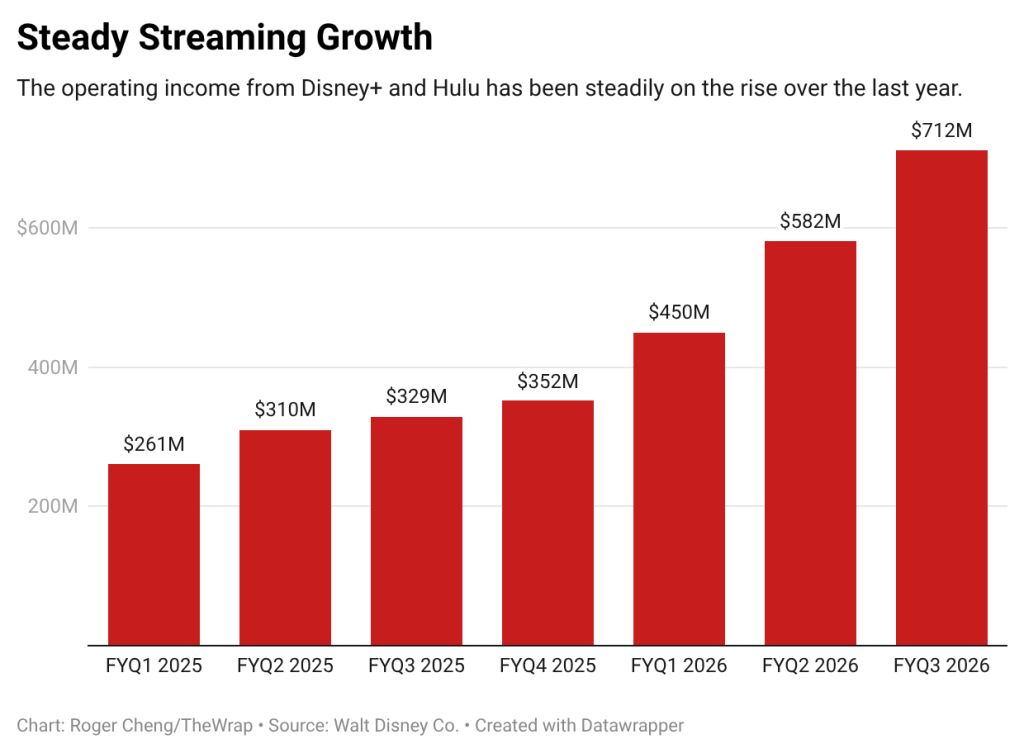
If there were any questions about how Disney is prioritizing its Disney+ service, CEO Josh D’Amaro chased them away after reporting fiscal third-quarter results buoyed by its growth.
Once again, D’Amaro teased Disney+’s place as the “digital centerpiece” of the company, and said transformation of the app into a more “comprehensive membership ecosystem” would begin next year with elements getting introduced in the spring.
The comments came amid investors questioning whether Disney+ can sustain its growth with new customers (its ceased disclosing subscriber numbers) and compete with deep-pocketed giants Netflix and Amazon. It’s why Paramount is keen to scale up through its deal to buy Warner Bros. Discovery and Fox is spending $22 billion on Roku.
In response, the company on Wednesday reported that Disney+ and Hulu’s combined profit more than doubled to $712 million and entertainment streaming revenue grew 11% to $5.5 billion, driven by a 15% increase in subscription revenues and 3% bump in ad revenue, subscriber growth, price hikes and reduced subscriber turnover driven by product and technology improvements.
Crucially, the streaming business has overtaken Disney’s linear business in terms of revenue contribution, setting a blueprint for how a traditional media company manages the transition to digital.
Looking ahead, Disney+ and Hulu remain on track to become a unified standalone app by year end. Executives teased that Disney+ is also exploring a free streaming product to boost subscriber growth and said the service is “well positioned” to become an aggregator of third-party streaming services through both bundles and add-ons, much like Amazon serves as a home for various streaming options.
Over the next three years, Disney+ also will triple the number of local original series available on the platform to drive new sign-ups internationally and reduce churn. The company is also launching a pilot with TikTok in the U.S. in the coming months that will bring Disney-centric fan-created content to Disney+’s Verts feed.
The earnings conference call also marked D’Amaro putting his stamp on the company. He’s already done so with actions like ABC’s more forceful pushback against the Federal Communications Commission over its early license review. He did it again on Wednesday with how he addressed the questions about streaming
When asked about whether Disney had weighed going back to licensing its content out, D’Amaro was clear in his response.
“A shift to a purely licensing model it could sacrifice all of that strategic value,” D’Amaro told investors. “Content licensing is by nature it’s a lumpy business. It’s subject to supply and demand dynamics in the marketplace at a given time.”
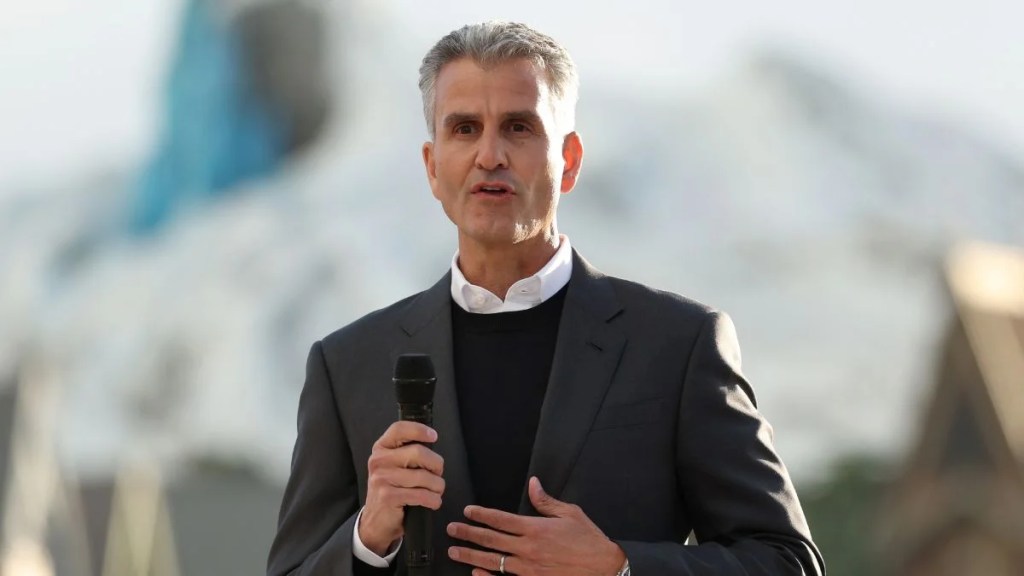
Overall, Disney posted a profit of $2.6 billion, or adjusted earnings of $2.06 per share, and revenue growth of 7% to $25.25 billion. In addition to streaming, the gains were fueled by Disney’s experiences divisions and the performance of “Toy Story 5.” The quarterly results topped Wall Street earnings expectations, but slightly missed revenue estimates.
Weighing on Disney’s growth for the quarter was softness in its Asia theme parks, which is expected to continue in the fourth quarter. Content sales also fell 6% to $1.6 billion, driven by an 8% decrease from TV/VOD and home entertainment distribution revenue. Additionally, Disney’s sports division saw profits tumble 17% to $858 million due to four-game sweeps in early rounds of the NBA Playoffs and the impact of a network carriage dispute, despite segment revenue climbing 4% to $4.5 billion.
Despite the mixed results, Disney’s shares climbed over 2% during Wednesday’s trading session.
Disney Entertainment a bright spot despite ‘The Mandalorian and Grogu,’ live-action ‘Moana’ underperformance
Disney’s Entertainment division grew revenue 6% to $11.35 billion and profits rose 64% to $1.68 billion.
Total entertainment subscription and affiliate fees grew 12%, driven by the Fubo deal, higher rates and subscriber growth, while ad revenue fell 1% due to lower rates, offset by the Fubo deal and more impressions. Streaming operating margin came in at 13% for the quarter, benefitting in part from the timing of marketing and programming spend.
Disney is currently generating more from its streaming business than it is from linear TV and expects that shift to continue to grow over time. It also continues to anticipate a double-digit entertainment streaming operating margin and remains on track to spend $24 billion on content across the company for 2026.
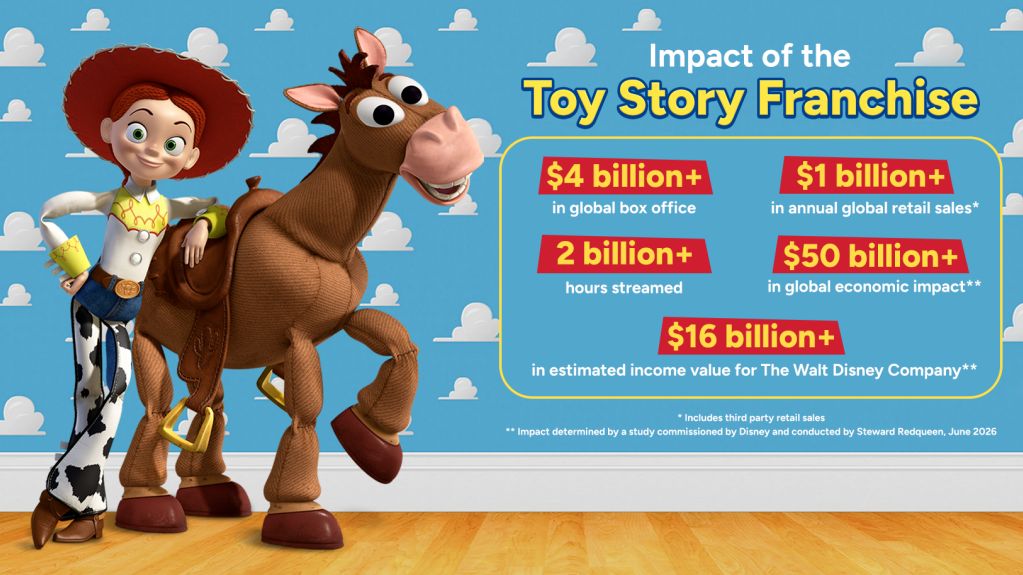
On the film side, Disney touted the performance of “Devil Wears Prada 2” and “Toy Story 5” during the quarter, the latter of which has surpassed $1 billion at the global box office and brings the franchise’s lifetime global box office to more than $4 billion. Following the latest installment’s debut, the “Toy Story” franchise has generated more than $16 billion in estimated income for the company and over $50 billion in global economic impact. It has also seen over two billion hours streamed on Disney+ and over $1 billion in annual retail sales.
Meanwhile, “The Mandalorian and Grogu” underperformed expectations, but contributed to value creation through the update for “Millennium Falcon: Smuggler’s Run” in Disneyland and Disney World and “healthy retail sales” for the Star Wars franchise during the quarter. The live-action “Moana” also underperformed, but is expected to be a strong title on Disney+ and extend the franchise’s reach, which includes three films, a theme area in EPCOT and a robust global merchandise business.
Disney addresses M&A strategy amid Fox-Roku deal, NBCUniversal spinoff
When asked how Fox’s pending $22 billion Roku acquisition and NBCUniversal’s planned spinoff from Comcast could impact Disney’s M&A strategy, D’Amaro told analysts that the company would continue to focus on leveraging its own IP and owning the consumer relationship through its various businesses.
“We just fundamentally believe that owning that relationship gives us the data, the consumer insight, the pricing control to keep improving the value proposition over time,” he continued. “We don’t see Comcast restructuring or Fox’s acquisition of Roku as moves that will change our own strategic path. In fact, the way that I see it is there’s there’s actually opportunity in these developments. A more consolidated industry is really a better investment backdrop and we have a long history of partnering in streaming. We believe that we can just keep building on that.”
Though D’Amaro acknowledged that Disney would look at opportunities as they come up, he argued the company has a “good hand to play.”
“I like where we sit,” he added.
However, Disney notably sold its 50% stake in A&E Global Media to joint venture partner Hearst for $1.2 billion. The proceeds will be used to buyback Disney stock, with share repurchases in 2026 expected to now total at least $9 billion.
Disney+ adding more games from ESPN
As Disney looks to transform ESPN into the “front door” for sports fans, it has struck partnerships with the NFL, MLB, Fox One and The CW Network. The latter partnership will see more than 800 annual hours of CW Sports stream live on the ESPN app for viewers with an ESPN Unlimited subscription plan.
It also plans to deliver a “more robust subset” of ESPN games for Disney+ subscribers starting this fall, anchored by additional college football simulcasts alongside “College GameDay,” as it looks to drive greater engagement on the service and help upsell subscribers to its trio bundle, which includes ESPN Unlimited.
In its second quarter, sports segment subscription and affiliate fees increased 8% to $3.14 billion, with half of the growth coming from its NFL Network acquisition. Ad revenue grew 5% to $1.2 billion, due to higher impressions. The company sold out ad inventory for Super Bowl LXI as its closed its upfront negotiations for 2026.
ESPN also recorded its best month ever in June for digital and social engagement, reaching nearly 230 million unique fans and over 80% of the U.S. internet population.
Disney domestic theme parks and Disneyland Paris, cruises and consumer products offset Asia softness
Disney Experiences grew revenue 10% to $1.68 billion and profits 20% to $3.02 billion, fueled by “Toy Story 5” and “Star Wars: The Mandalorian and Grogu” merchandise sales and strength in the domestic parks, cruise line, consumer products and Disneyland Paris.
The segment’s results included a tariff refund of approximately $100 million during the quarter. Though it may receive additional refunds in upcoming quarters, the company said the dollar amounts are expected to be insignificant.
Attendance at Disney’s domestic theme parks grew 3% versus the prior-year quarter, primarily driven by Walt Disney World, domestic tourists and annual passholders, summer promotions and new experiences, as well as Disneyland Paris following the opening of World of Frozen. While Disney continues to face headwinds from international attendance at its domestic theme parks, those trends moderated from the prior quarter.
Forward bookings at Walt Disney World remain robust and Disney expects another quarter of global guest growth in the fourth quarter, despite consumer softness in Asia. Executives added that there’s been “very little” impact from oil price fluctuations due to the ongoing conflict with Iran.
The third quarter was also the first full quarter since the launch of the Disney Destiny and Adventure cruise ships, which increased stateroom capacity by approximately 50% compared to the prior-year quarter. The company remains encouraged by current occupancy and forward bookings and plans to bring additional cruise capacity online in the years ahead.
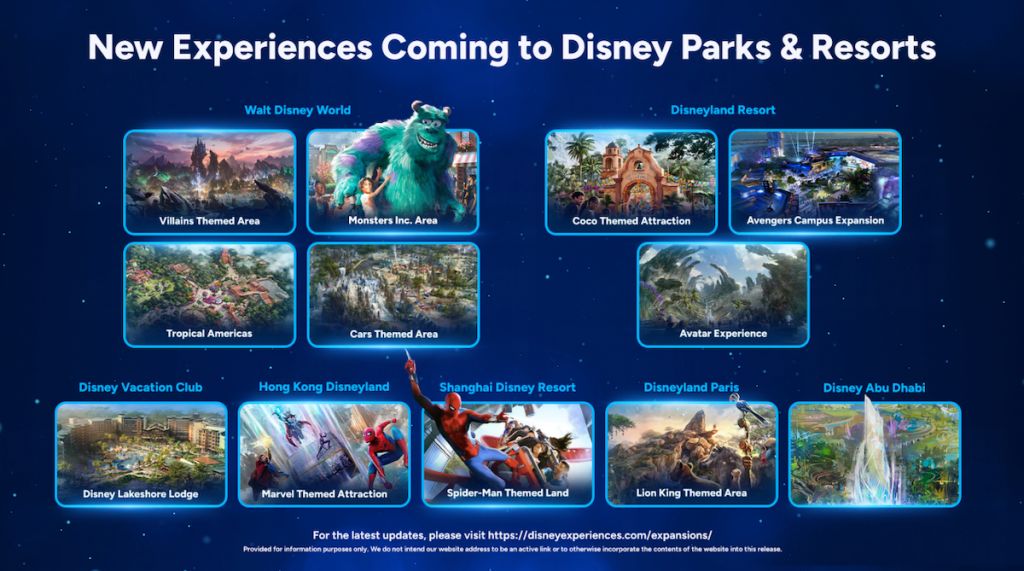
Upcoming experiences in the coming years include Disney Villians, Monsters Inc., Cars and Tropical Americas-themed areas coming to Walt Disney World and the opening of Disney Lakeshore Lodge; an Avengers Campus expansion, Avatar experience and Coco-themed attraction coming to Disneyland; a Marvel themed attraction coming to Hong Kong Disneyland; a Spider-Man themed land coming to Shanghai Disney, a Lion King-themed area coming to Disneyland Paris and the opening of Disney”s Abu Dhabi theme park.
The Disney Believe cruise ship will launch in late 2027, followed by its eleventh and twelfth cruise ships and an Oriental Land Company ship in 2029 and a thirteenth ship in 2030.
Disney also noted that AI is accelerating how the company designs, builds and operates its attractions, with a J.A.R.V.I.S. AI tool made available to its more than 2,000 Imagineers earlier this year. It is also using AI-powered digital twins and simulation tools to design and stress-test new attractions, including for its upcoming the Abu Dhabi park, and using the technology to simplify vacation booking and planning and give its cast members tools to better serve guests.
Disney shifting consumer products to entertainment division, teases more layoffs and cost cuts
Looking ahead, Disney is forecasting fourth quarter operating profit of $4.9 billion and adjusted earnings per share growth of approximately 16% in fiscal 2026.
The Experiences unit is expected to come in at the high end of its prior high-single-digit operating profit guidance for the fiscal year. It also anticipates sports operating profit in the mid-single digits for the year and double-digit entertainment operating profit. However, its fourth-quarter entertainment results will reflect the impact of the disappointing live-action “Moana,” as well as a softer-than-expected advertising environment, particularly in domestic streaming.
In fiscal 2027, Disney anticipates double-digit adjusted earnings per share growth. Most of Disney’s consumer products business will also shift from the experiences segment to the entertainment segment starting in the first quarter of 2027 to better reflect the returns from the content it produces.
The company also remains focused on reducing costs across the company, including through additionallayoffs and selling, general and administrative expenses. Disney is currently “mid-stream” in this effort and will provide future updates on its progress.
