

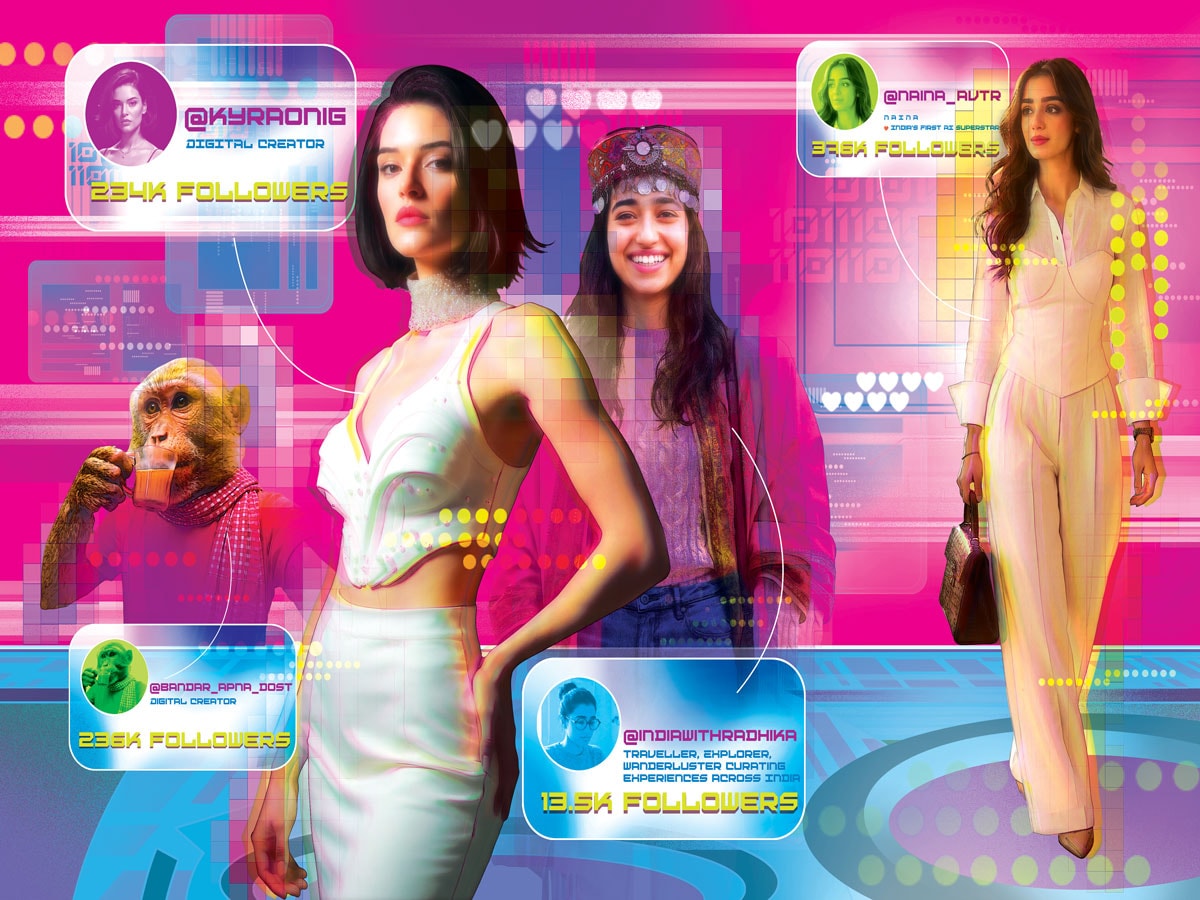
I, influencer: The rise of virtual characters on social media
AI-generated influencers are evolving from curiosities and marketing gimmicks to long-term intellectual property. But can efficiency of scale beat the human factor?
BySiddhant Konduskar
Last Updated: Jul 03, 2026, 12:23 IST10 min
From the 02 July, 2026 issue
intentNew
Prefer us on Google
AI influencers are evolving into scalable, controllable IP, projected to reach $163B by 2034. While efficient, they challenge human creators and spark debate over authenticity, creativity, and ethical use.
Launch Rapid Reads→AI-POWERED
In a scene that looks like a crowded market in Gaya, Bihar, with a hot plate of litti chokha, Radhika Subramaniam narrates the history of the place and the dish. Her voice is soft and measured, much like the narrator of documentaries. Her viewers—she has 1.35 lakh followers on Instagram—respond with varied comments: “Where is this place?”, “What should I try first?”, “Come to Kolkata next”
The only catch: Subramaniam does not exist in the real world. Like many other social media influencers, she is an AI-generated virtual character created by talent and media company Collective Artists Network in 2025. She is the host on Chaat Masala, a travel-and-food series that documents local cuisines and the stories behind them. The world she inhabits, her every gesture, expression, frame and dialogue are digitally generated
Digitally created personalities are gaining traction across social media platforms, appearing in brand campaigns, hosting virtual shows and engaging with followers in different languages, thus functioning more like media businesses and not just marketing or entertainment experiments. This is validated by the fact that the global virtual influencer market was valued at $8.76 billion in 2025 and is projected to reach $163.22 billion by 2034, growing at a CAGR of 38.4 percent, according to Straits Research.
The first global breakout virtual personality—long before the emergence of generative AI tools or social media influencers—was Lil Miquela, who appeared in 2016, built by Los Angeles startup Brud. Miquela amassed millions of followers, collaborated with brands like Prada and Samsung, and appeared in a widely discussed campaign alongside supermodel Bella Hadid for Calvin Klein in 2019. Around the same time, there was the immensely popular Lu do Magalu, a female digital character who also appeared on the digital edition cover of Vogue Brazil in 2022, and Japan’s Imma and Shudu, who secured collaborations with global brands and fashion publications.
Advertisement
First Published: Jul 03, 2026, 12:39
Become a Subscriber
Get your hands on our editions for as less as Rs. 1200 a year!
- Home
- Life
- I-influencer-the-rise-of-virtual-characters-on-social-media
/
/
Latest News
Advertisement
Advertisement
On Everyone’s Radar
- #1NSE’s upcoming IPO and its valuation puzzleByNasrin Sultana
- #2Growth is a byproduct. We must first get the product right: Vikas OberoiBySarthak Choudhury
Advertisement
