

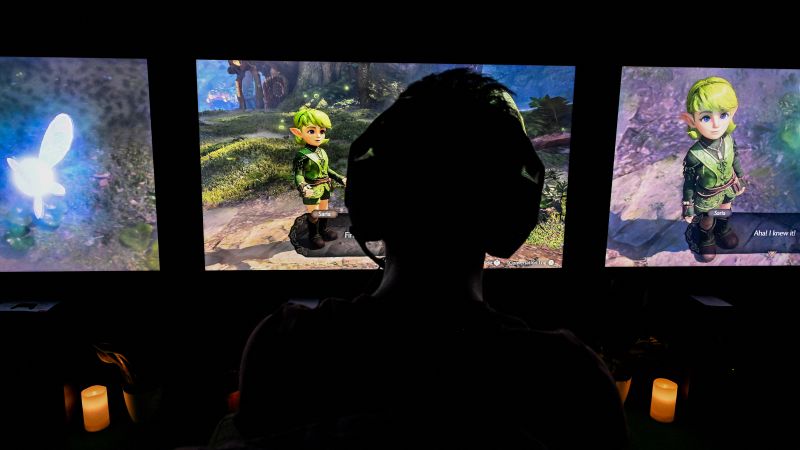
“The Legend of Zelda: Ocarina of Time” is being played at Nintendo’s headquarters in Frankfurt, Germany, on September 15.
See all topics
“Saturday Night Live” poked fun at characters from two of the holiday season’s most anticipated video game releases last month: Link from the upcoming remake of “The Legend of Zelda: Ocarina of Time” and Jason from “Grand Theft Auto VI.”
The segment, which aired on October 3, highlighted how different the two games are: Link, in his green tunic, described how he started his day in Hyrule by buying magic beans and playing his ocarina, a wind instrument. Jason, seated next to him with a bandaged bloody arm, bragged about stealing cars and spending $1 million at a strip club.
Beneath the humor, the sketch hit on a key point. Nintendo is the only gaming company willing to go toe-to-toe with GTA VI, which is expected to be the biggest game launch of all time. It’s a testament to Nintendo’s faith in its strategy over the last four decades: bringing backits mainstay characters in new formats across console generations. It’s a tactic that’s recently expanded to movies, concerts and theme parks.
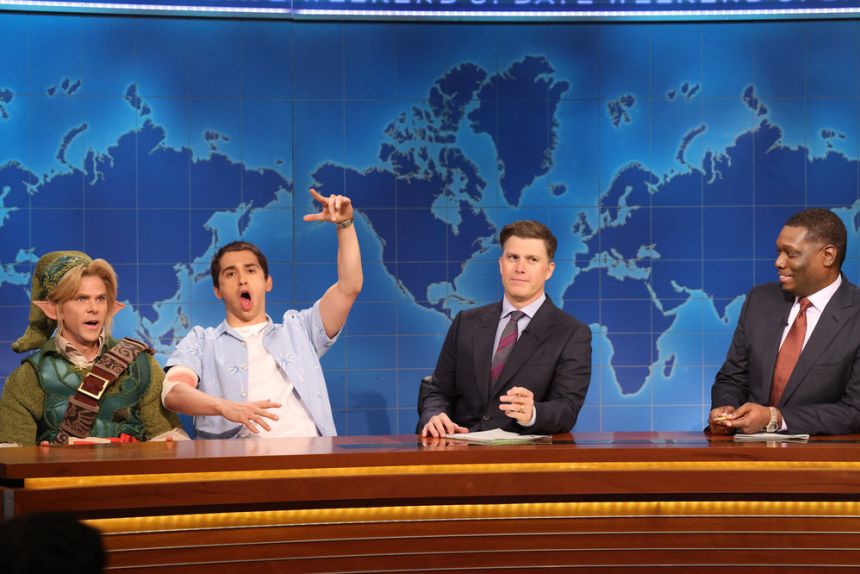
From left, Mikey Day as Link; Marcello Hernández as Jason from GTA VI; and anchors Colin Jost and Michael Che during “Saturday Night Live’s” Weekend Update segment on October 3.
And it’s paying off: The gaming giant reported a 52% year-over-year increase in gross profit during its second-quarter earnings, despite declining sales of its latest Switch 2 console. This was thanks in part to surging income related to its “Super Mario Galaxy Movie.”
Still, gaming still accounts for most of Nintendo’s business. Between skyrocketing memory prices and increased competition from free games that aren’t on Nintendo devices, like Roblox, it can be a tough time to be in the console gaming business. Nintendo is betting that its remake of “The Legend of Zelda: Ocarina of Time” will help drive Switch 2 sales this holiday season.
“The stakes are high for Nintendo, and they have to come across come out of this holiday season very strong,” said Joost van Dreunen, a professor at New York University’s Stern School of Business who has published a book about the gaming industry.
The Nintendo Switch 2 was off to a strong start, with roughly 24 million consoles sold since its June 2025 launch. But Nintendo needs to keep giving fans reasons to upgrade, especially with such a broad library of games available for its predecessor, the first-generation Switch.
Nintendo said in its most recent earnings report that Switch 2 hardware sales declined 34.4% year-over-year, but that’s largely because many gamers bought the system last year when it launched.
Its roster of exclusive games is key to that push. After launching with “Mario Kart World,” Nintendo has trickled out new games in popular franchises like “Donkey Kong Bonanza,” “Fire Emblem: Fortune’s Weave” and “Pokémon Pokopia.”
But while those franchises all have their fans, they’re not Mario or Zelda.
The original “Ocarina of Time” was released in 1998 for the Nintendo 64 and is “recognized as one of the best games ever made,” said Mat Piscatella, executive director of games coverage for market research firm Circana. He expects the majority of Switch 2 owners to buy the new version.
It’s not the first time Nintendo has re-released “Ocarina of Time”; the game was also released for the GameCube, Wii U and 3DS. But the new version isn’t just a direct reboot; Nintendo has updated the controls, dialogue, graphics and other elements, bridging the classic story and familiar characters with the more modern gameplay introduced in newer Zelda games like “Breath of the Wild” and “Tears of the Kingdom.”
The Nintendo stand during the Paris Games Week in Paris on October 22.
Nintendo also launched a 40th anniversary edition Zelda-themed Switch 2 console in late October, which is currently sold out. A Zelda orchestra concert and movie are planned for next year.
It’s part of Nintendo’s classic playbook: betting big on the characters its fanbase grew up with.
“It’s a broad opportunity to provide different experiences that connect with the players and fans, and then open up the door to Zelda for new generations of players to come in,” Devon Pritchard, president of Nintendo of America, said in an interview with CNN.
The new Zelda game is launching just before GTA 6, which is expected to break sales records. However, NYU’s van Dreunen says Nintendo likely won’t have to worry about the competition because the games appeal to very different audiences. But that may not always be the case.
“Over time, it’s like, yeah, what are you going to offer this aging audience, the generation that grew up playing Nintendo? At some point, they’re going to want more mature content,” he said.
Nintendo’s strategy has worked for decades. But like other gaming companies, it is grappling with rising prices in video games.
A shortage in memory has caused Nintendo and other console makers to raise their prices, with Nintendo increasing the Switch 2’s price from $450 to $500 in September. Consumer spending on hardware across all console makers is down 9% so far in the US this year compared to last year, Circana’s Piscatella said.
And video games themselves now cost around $70 to $80. (The digital version of the new Zelda game is $60, and the physical edition is $70).
That could make it harder to convince players to shell out for games, especially as free-to-play multiplayer games like Fortnite have grown in popularity.
“You have increasingly sort of a velvet rope in the games industry, where there is the crowd that can afford it early and for a high price and is willing to pay a premium to have great hardware, great experiences, and then there’s everybody else,” van Dreunen said.
Nintendo is better positioned to weather the memory shortage because its consoles don’t require as much computing power as those made by Sony and Microsoft
Microsoft and Sony also sell pricier consoles than Nintendo; the Xbox Series X digital edition is listed at $750 on Microsoft’s website, while the PlayStation 5 starts at $649. Microsoft also sells a cheaper version of the Xbox called the Series S for $500. Those costs reflect price hikes announced by both companies earlier this year.
But the shortage has made it more challenging for companies to produce cheaper electronics, an audience that Nintendo has traditionally catered to. After the first Switch’s launch in 2017, Nintendo released the less expensive Switch Lite in 2019 as a cheaper alternative for those who just wanted to game on the go.
Pritchard said Nintendo was focused on the Switch 2 platform and didn’t comment on whether the company has plans for a Switch 2 Lite. Nor did she say how long Nintendo plans to support the first-generation Switch, which makes up the majority of Switch users with about 156 million units sold.
When I sat down with Pritchard, our conversation started with a simple question: What game am I playing right now? That’s the kind of impact Nintendo wants its games to have, regardless of the console or platform.
“It goes back to that relationship with the player and fan,” she said. “We want to build these experiences that connect with people that they want to come back to time and time again.”

1 Comment
Pingback: Flutter Entertainment (NYSE:FLUT) reports sales below analyst estimates in Q3 2026 earnings - Comic Vibe