

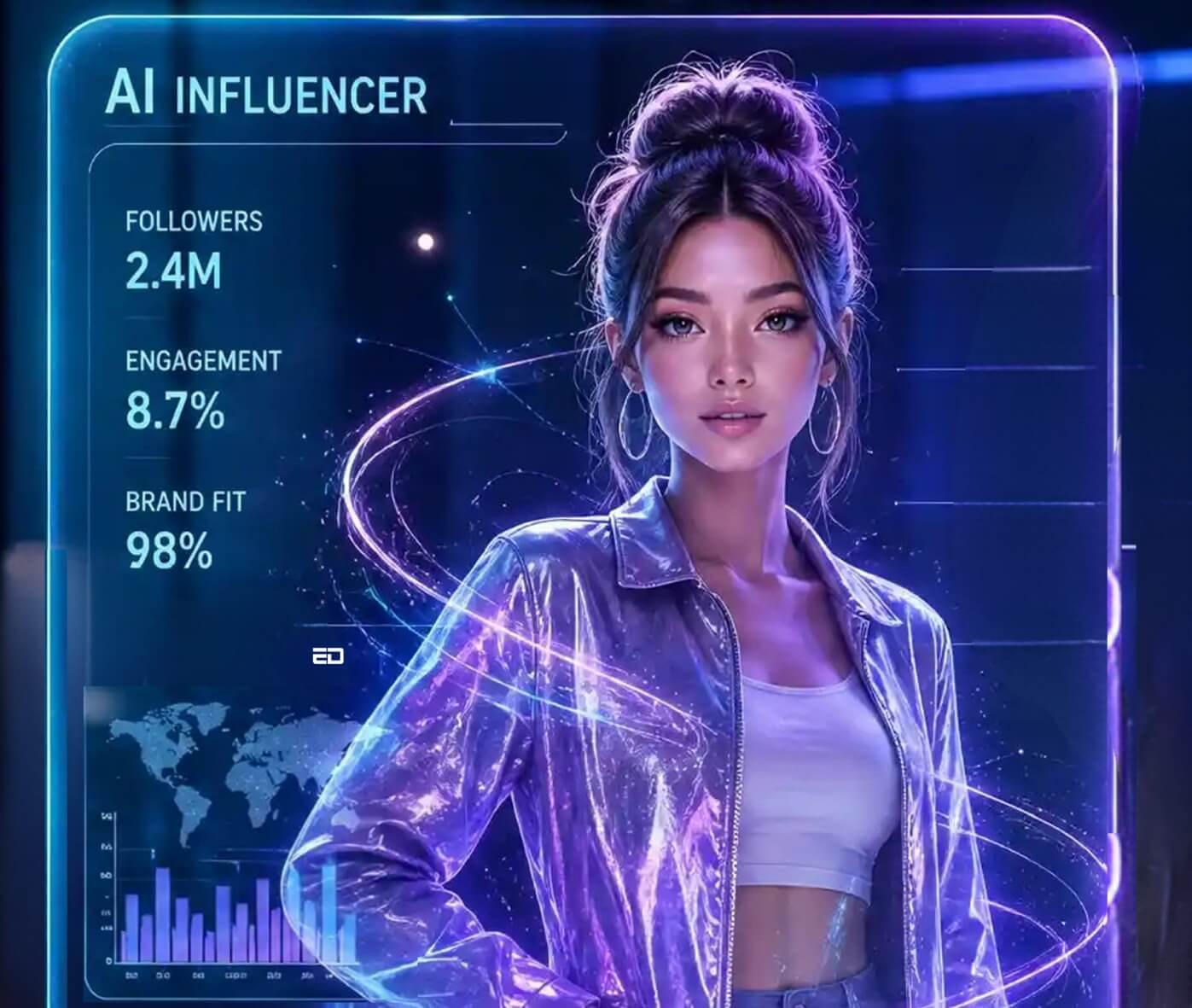
Artificial Intelligence, or AI, has already infiltrated many aspects of the entertainment sector. You’ve got AI-generated movies, shows, vertical shows, and special effects, and now there are AI influencers as well.
Honestly, this last one might be the least surprising, considering the hints were already there from AI robots, the Metaverse and how female AI-generated models were being created. Today, we have moved so far past that silly time when AI was just being used to generate photos of a person in historical times or as a cartoon.
AI, in current times, is a very big part of our society. It’s there in your search results, your customer service chats, your Instagram feed, your workplace, and your messaging platforms.
The tech magnates never stop stressing that AI is here and to stay, and everyone just needs to get used to it or be left behind.
The rise of the AI influencers, though, has been a very interesting phenomenon.
What Are AI Influencers?
An AI influencer, also called a virtual or synthetic influencer, is a fictional character built with computer graphics or generative AI. The developers then give it a face, name, a voice, and even a backstory at times. Then, their social media pages are set up just like any other human influencers.
The technology then runs their social media platforms just like usual, posting at scheduled timings, replying to comments, and managing the social feeds, just like a human creator would. Only the ‘person’ doing all this is not a real person but a piece of technology being handled like a puppet by a team of developers and producers.
There is no second-guessing what to post, no untimely random stories about some personal issue, no heat-of-the-moment commenting sprees.
No matter how dystopian this sounds, it hasn’t affected the rise of AI influencers, especially for marketing.
According to KlugKlug, an influencer marketing company, globally there exist over 150,000 AI influencers, with India alone having over 2,000.
As per a Moneycontrol report, some of the most well-known AI influencers in India include:“Myra Kapoor, the AI brand ambassador for Manforce with over 5,100 followers; Naina, which has over 378,000 followers and has won AI creator awards from NDTV WhosThat360 and Mid-Day; and Vijay Koliwad, who has 235,000 followers and an engagement rate of about 10%.”
It is not just that there is an increase in AI influencers, but brands willing and wanting to work with them have also increased, with Qoruz estimating that around 80-100 Indian brands are experimenting with this concept.
Co-founder and CEO of KlugKlug, Kalyan Kumar, explained that “Brands have already moved beyond asking if they should experiment. They’re now asking where AI influencers fit within the marketing mix.”
According to data compiled by The Business Research Company, the virtual influencer segment alone is expected to reach $11.74 billion in 2026 and $150 billion by the early 2030s.
A study by Influencer Marketing Hub also revealed that brand adoption of virtual influencers has jumped from 60% to 73% of all surveyed companies worldwide in the space of a year. The Fortune 500 marketers also showing interest have increased more than three times their 2023 rate.
Why Are Brands Choosing Them?
It doesn’t take a genius to understand why so many companies are either using or extremely interested in AI influencers. The reasons are threefold and basically are all things that human influencers cannot give, which are: cost efficiency, control and consistency.
Consistency in that AI influencers can basically be programmed to a particular posting schedule, and, unlike human influencers, could create endless posts in a single day. Human content creators, on the other hand, require time to build the idea, write a script, shoot and edit it, then send it forth.
This excludes the back-and-forth between the company and the influencer to get the final product just right.
According to Kumar, “From a pure scalability standpoint, AI influencers have almost unfair advantages. They can create content 24×7, speak multiple languages, localise for hundreds of audience segments simultaneously and evolve at internet speed. That makes follower growth potentially explosive. A single human or entity can design hundreds or even thousands of avatars with their respective personas and launch them into social media at an unthinkable cost.”
AI influencers also won’t be derailed by emergencies or unforeseen events, vacations, or sickness, thus remaining consistent in their posting schedule without the company needing to do constant check-ins.
This brings us to the aspect of control.
With human creators, companies could not possibly extend the level of control they could with AI influencers. With the latter, though, they can provide exact prompts and specifications on who the influencer should be, what they can talk about, how they can talk about topics, which topics are absolutely restricted, and, even for the ones allowed, what tone and wording should be used.
Furthermore, they can be really specific about how they want the AI influencer to look, behave, sound like, what settings they should be, among others.
They will also have control so that a virtual influencer will never go off-script, never have an off day, and never have some old, inconvenient social media post resurface. A PitchBook report also pointed out that virtual influencers would not be subject to “working hours, unionisation, and other physical and legal constraints.”
Finally, the biggest reason most companies make any decision ever is cost efficiency. Reports suggest that AI influencers would be more cost-effective compared to a human influencer.
Speaking to the Guardian, Clarissa Mansbridge, a former celebrity manager who now produces AI-influencer imagery for brands, said, “Brands want high-end photography, but they don’t want to pay $20,000 to $70,000 for a traditional photoshoot.”
She added, “Unfortunately, human influencers killed the market for themselves. Brands are moving to AI to cut out issues like bad press, personal opinions, hourly rates and photographers.”
The era of AI influencers might still be in its early stages, with brands preferring to shell out the big bucks for human influencers.
Ritesh Ujjwal, founder of Kofluence, speaking with Moneycontrol, said, “We’re still at the pilot stage with AI influencers, not a committed media line yet. Most of what brands are spending is coming out of existing social, content, or innovation budgets rather than a dedicated AI influencer allocation. Briefs that specifically request AI or virtual influencer formats are increasing, but they arrive alongside human creator rosters, not in place of them.”
Ujjwal also added that the audience trust missing with AI influencers is what keeps brands coming back to human influencers.
He explained, “Their consistency drives reach efficiently, but it doesn’t yet drive the audience trust that converts engagement into action at the level established human creators deliver.”
The rise of such influencers for user-generated content (UGC) has resulted in a concerning paranoia about what is real and what is computer-generated. Regular people are especially worried, considering they are putting a level of trust into the influencer and don’t want to be misled or scammed.
The regulation of AI and AI-generated content is slowly taking place across the globe; however, the pace is disturbingly slow compared to how fast AI itself is moving.
Although the European Union (EU) has its Artificial Intelligence Act coming into effect in August, that would require all AI-generated content, including audio, video and deepfakes, to be labelled as such; however, several other countries don’t have these provisions.
Given the public distrust over AI, though, brands and companies are currently trying to bypass any backlash by claiming that they are just in a ‘pilot phase’ or ‘simply experimenting’.
As per a report by The Guardian, Maket, an Maket AI is an AI platform for interior design, said, “AI-generated influencers have been one of several ways for us to test creative concepts and marketing hooks at a small scale before investing in broader campaigns. This is not a core part of our marketing strategy, but rather an experiment to better understand what resonates with audiences across channels, including influencer, social media and email campaigns.”
Ashle, a Dubai-based fashion business, also posted a photo of a woman who, while wearing clothes by the brand at a restaurant, had an extra finger.
During the Guardian’s investigation into this post, the brand deleted that post and its spokesperson said: “To clarify, all Ashle pieces are real garments that are handmade to order. We are not selling AI-generated products. Some early marketing imagery utilised AI during our initial launch phase to showcase designs.”
“The images that have been removed were taken down because those particular designs are no longer part of the collection, not because they were AI-generated.”
Lisa Barber, editor of Which? Tech, a UK-based consumer organisation, said,“It is concerning that consumers are not able to trust the content they are seeing online. Companies must be transparent when content has been created using AI, particularly if AI-generated influencers are appearing in the content.”
Clarissa Mansbridge also reported to the Guardian that “I’m going to say about 40% to 60% of the content out there from some of the big brands is actually being made through AI, but a lot of the creators are under NDA,” and how“If you sign with a brand, they’ll make you sign an NDA saying you can’t talk about the fact they’re using [AI], because consumer trust is still being built. I call it plausible deniability.”
This post is tagged under: AI generated influencers, AI generated influencers instagram, AI generated influencers, ai generated influencer content, brands, AI influencers, AI influencers, AI influencers making money, AI influencers 2026, social media, social media marketing
Disclaimer: We do not own any rights or copyrights to the images used; these images have beenoval, please contact us
Other Recommendations:
ED Voxpop: We Asked Gen Z, Is AI Making Your Generation Dumber?
Previous articleMILT Congress 2026: India’s Corporate Buyers Are Rewriting the Rules of MICE and Luxury Travel
