

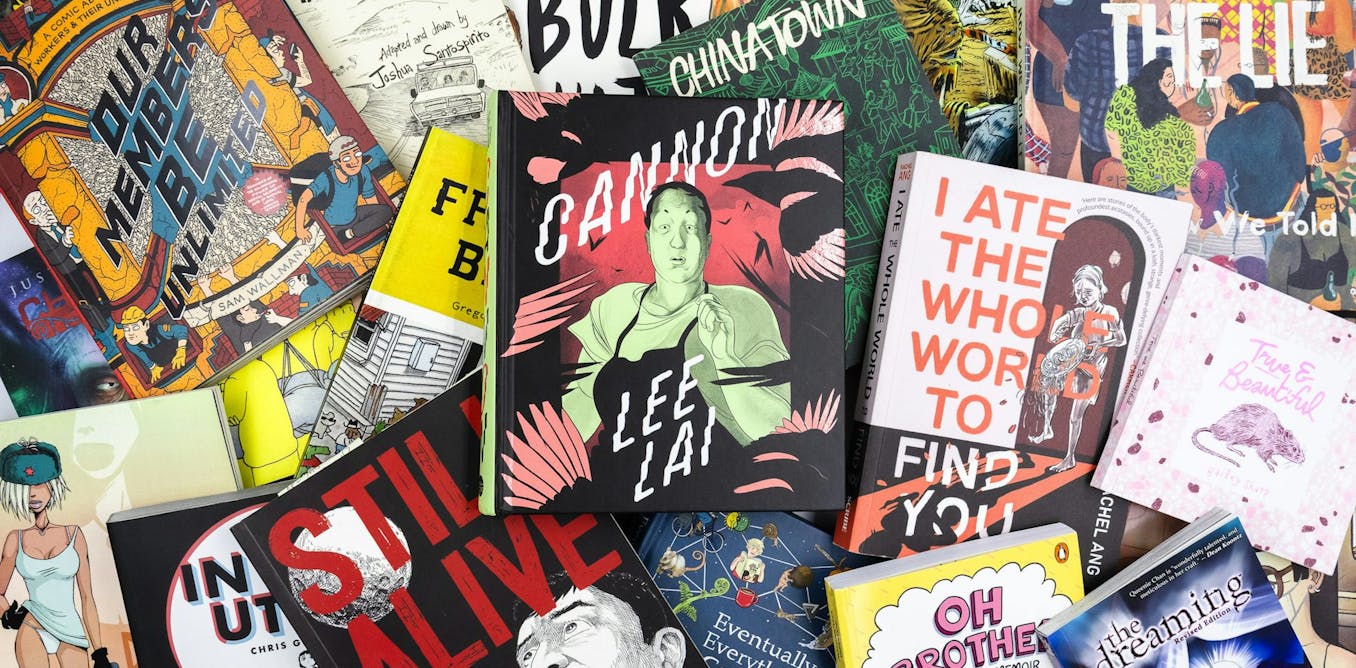
The graphic novel Cannon by Lee Lai was awarded this year’s A$60,000 Stella Prize, establishing historic firsts in more than one area. Cannon is the first graphic novel, and Lai the first non-binary author, to win this major literary prize. The same weekend, Lai was named a Sydney Morning Herald Best Young Australian Novelist, the prize’s first awarding to a comics maker in its 30-year history.
Does that make Cannon Australia’s great graphic novel? Is there such a thing?
Australia’s tight-knit community of unreasonably obsessed comics creators are celebrating Lai’s honours as a watershed moment. Cannon both enters and meaningfully expands conversations around the graphic novel and its place on the bookshelf – the idea of a comic that can meet traditional benchmarks of literary excellence, and appears on the recommendation lists of readers who “don’t usually read comics”.
Since the graphic novel first appeared as a genre, creators and readers have been searching, finding and searching again for the “great” graphic novel – mirroring the ongoing search, since at least the 1880s, for “great” novels of various stripes. (Most famously, the “great American novel”.)
The American “graphic novel” first appeared in the 1980s, with the publication of several important books. They included Art Spiegelman’s Holocaust memoir (casting Jews as mice and Germans as cats), Maus, Alan Moore and Dave Gibbons’s morally complex superhero story, Watchmen, and Frank Miller’s pitch-dark Batman and Joker book, The Dark Knight Returns. The decades following their release saw a rising uptake of the graphic novel.
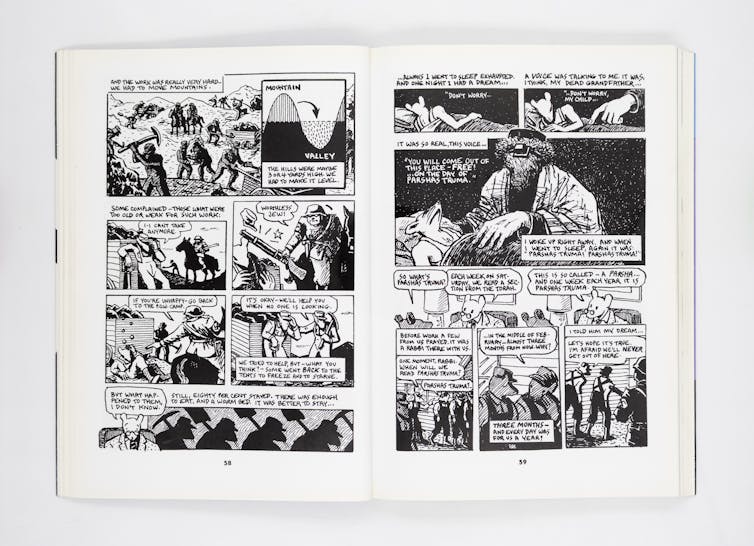
This new kind of comic book created a “big stage” for the language of comics, creating new readerships and new opportunities for comics creators. For some, the graphic novel – as opposed to the comic, the comic book, the cartoon or just comics – was a signal of literary value; a call to arms for creators with sophisticated ambitions. For others, the term graphic novel was more practical: a convenient container for comics that became a useful bookselling category.
Graphic novels can use playful and experimental visual language to explore weighty themes like the Holocaust, the Iranian revolution or life in detention. Ideally, perhaps, they have something to offer that can only be accessed through the juxtaposition of words and images.
Our research team, Folio, has been collecting stories of Australian comics from 1980 to now, spending five years talking in depth with more than 30 creators, including Lai.
We have tracked the appearance of the graphic novel, its rise as a literary form, and the way Australian comics creators have responded to its call. We learned that comics are not always thought of as literature: just as often, artists speak of comics as a kind of art, a cousin of film and animation, or a branch of visual communication.
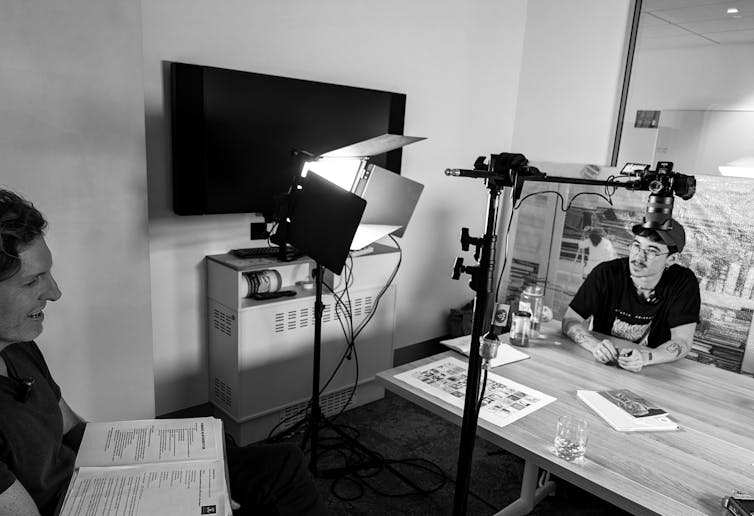
Meg O’Shea/Folio
The search for literary greatness
Comic artists in Australia still operate like a subculture, tucked away in the literary underground.
A member of our team, Pat Grant, published his first graphic novel, Blue, in 2012. Like Lai’s Cannon, it was published overseas by a comics publisher, and in Australia by Giramondo – a publisher mainly known for poetry and experimental literature.
Pat remembers the early 2000s as a time when creating a graphic novel that broke through to the literary market was a major motivator for artists.
A boom of single-authored comics pitched at literary markets by creators like Nicki Greenberg (The Great Gatsby), Bruce Mutard (The Sacrifice), and Mandy Ord (Rooftops), all published by Allen & Unwin in the early 2010s, was seen to herald a “way forward” for Australian comics.
The emblematic Australian comic from just before this period is The Arrival by Shaun Tan, published by Hodder in 2006. It won the Children’s Book Council of Australia book of the year, and in the coming years, Tan won an Oscar for best animated short, and the 2011 Astrid Lindgren Memorial Award, worth 5 million Swedish krona (which would be about A$736,200 if won today). The Arrival celebrates liberal values in a globalised and troubled world: it’s a close study of migration, settlement and belonging.
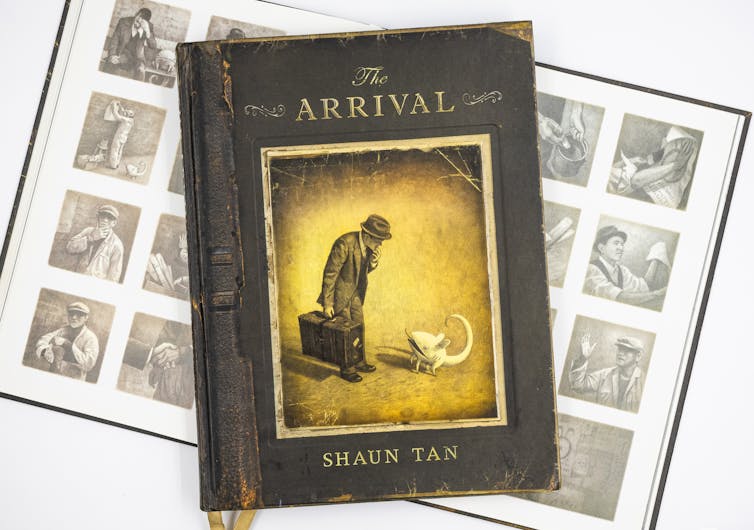
It was influenced by international graphic novels such as American Chris Ware’s Jimmy Corrigan the Smartest Kid on Earth and Japan’s genre-defining samurai epic manga, Lone Wolf and Cub.
In 1992, Art Spiegelman’s Maus caused a stir by winning a special Pulitzer Prize, which avoided the problem of categorising it as “fiction” or “nonfiction”. Last year, the general Pulitzer Prize for memoir or autobiography was won by Tess Hulls’ comic, Feeding Ghosts. It’s the first graphic novel Pulitzer since Maus, but in that span of 34 years, shortlists, longlists and winners of literary awards have become reliable places to find graphic excellence.
Nick Drasno’s bleak realist Sabrina became the first graphic novel to be nominated for the Booker Prize in 2018. In Australia, Mandy Ord’s When One Person Dies the Whole World Is Over became the first comic to make the Stella longlist in 2020. Lai’s earlier graphic novel, 2022’s Stone Fruit was shortlisted for the Stella, as was Eloise Grills’s Big Beautiful Female Theory in 2023.
Safdar Ahmed’s Still Alive: Notes from Australia’s Immigration Detention System, a book of graphic reportage that covers the lives and experiences of people living in Australian detention centres (co-published by a member of our team, Elizabeth MacFarlane), won the overall Book of the Year at the 2022 NSW Premier’s Literary Awards. It also won a Children’s Book Council of Australia Award.
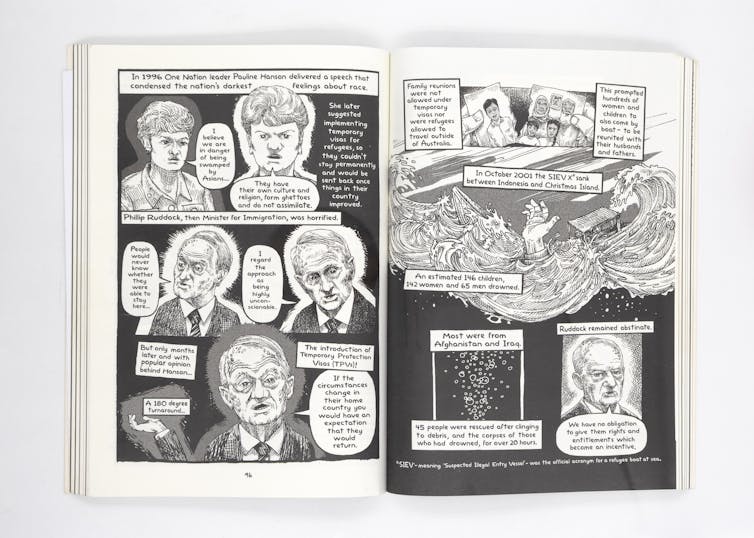
There has always been an aspiration to “greatness” built into the idea of the graphic novel. Many graphic novels are celebrated for their ambition in terms of thematic maturity, artistic seriousness and depth – but they are also celebrated for a kind of greatness we’d argue only comics can enable.
Still Alive, for example, borrows from the hard-nosed tradition of comics journalism. But when looked at merely as reportage, we don’t quite get a handle on it as an artistic or literary object. The book assembles its rhetoric using the visual language of self-published zines, leftist graphics, and the DIY traditions of heavy metal and punk music. Ahmed speaks about issues that concern all Australians, but from a specific subcultural perspective.
Still Alive foregrounds itself as a product of community organising and DIY cultural production – and gives us something of the flavour of Australian comics that our team has uncovered in our research.
Experimental, ‘baffling’ gems
Our conversations with artists often revealed that a life in comics is about experiments, collaborations and small works that become big works, just as much as a bookshelf of complete, novelistic texts. When invited to discuss a great or influential comic, creators were just as likely to cite a small, self published “mini-comic” or an obscure out-of-print pamphlet as they were to point to a graphic novel, whether by themselves or someone else.
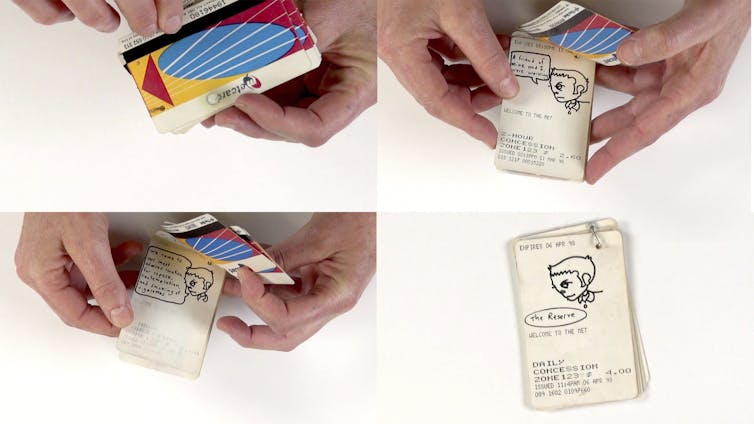
Mandy Ord presented a comic by Gregory Mackay, drawn by hand on the back of a stack of bus tickets and bound into a single-issue booklet. Perth Artist Elizabeth Marruffo cited a tiny comic created by her colleague Sarah Firth: smaller than a credit card and beautifully printed on a single piece of paper. Out of context, these objects may seem baffling. But they serve as symbols of community connection.
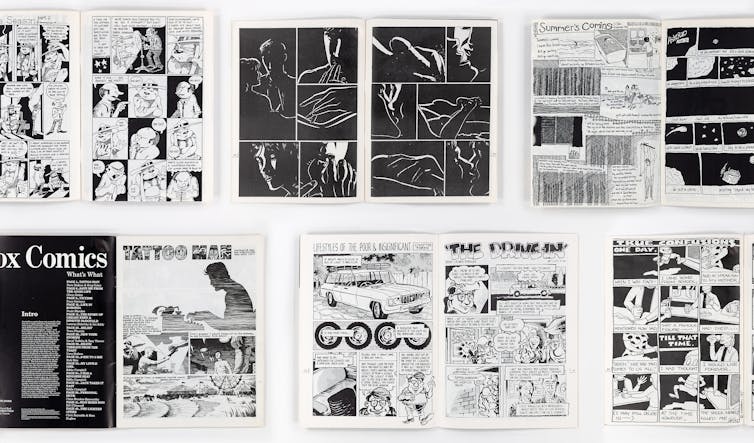
There were many noteworthy publications that do not fit the mould of the graphic novel but are important, in that they became rallying points for communities of creators.
One example was Fox Comics, an ambitious anthology of short works edited by David Vodicka. In its early incarnations, it was printed on a photocopier belonging to his father.
Fox Comics was a rare instance of an antipodean comic that crossed over into the American “direct market”, but it was also a testing ground for the future Australian graphic novel. Tony Thorne, one of Fox’s contributors, told us: “We were really interested in doing work that was sophisticated, that was adult. We were still asking questions like,‘How do you do longform comics?’”
Comics is ‘its own world’
Many of the stories we heard from Australian creators described this challenge of fitting their ongoing comics practice into the form of a great graphic novel.
Gary Chaloner, another artist whose career spanned the 1980s to now, has specialised in short form and serialised stories in the formal tradition of The Phantom, or other superhero titles.
“There’s a growing swag of creators in this country that are getting book deals,” he told us, describing some of the pressures to work in the graphic novel form. “Old-fashioned book deals with real publishers that allow them to finish the work, and give them appropriate time and space and hold their hands through the whole process.”
But we found that while the graphic novel seems a good fit for publishers, libraries and readers, it seems to be less often suited to the lives and practices of the people who make comics in Australia.
Sometimes, we even found heartbreaking stories about the wreckage left in the aftermath of campaigns to the pursue comics in the “great graphic novel” mode.
Bruce Mutard is arguably one of the most successful and prolific graphic novel creators in our country. He told us about two massive, multiyear projects that “just fell over” and left him with severe health issues.
“Most of my work is in a bottom drawer,” he told us. “For every page I’ve put out there, there’s potentially three to four others I haven’t finished.”
“Doing self-contained graphic novels is something that is totally alien to me,” Chaloner told us. “You need to have super-willpower to buckle down and get those things done.”
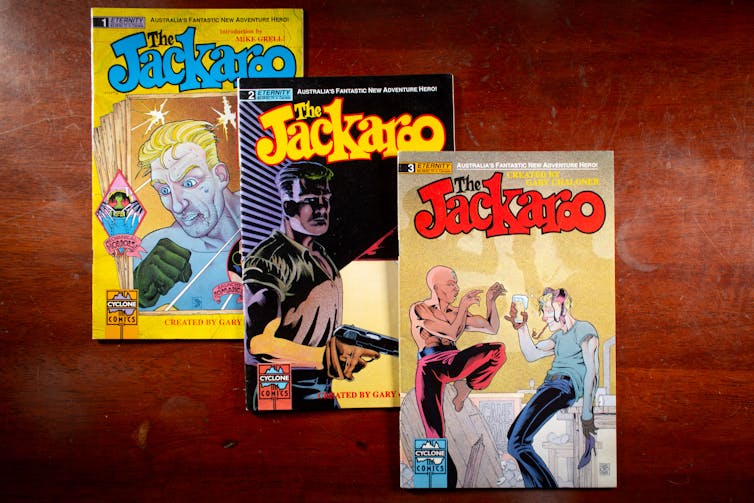
Chaloner is also responsible, with Tim McEwen, for establishing the format of the Comic Arts Awards of Australia, previously called the Ledgers, which has been the key award in Australian comics since 2005. The awards format ranks Bronze, Silver, Gold and Platinum winners, and mostly recognises projects rather than creators (like pencillers, inkers and colourists).
Chaloner told us it has been a topic of interest and controversy among comics-makers over the years. “We’ve been approached several times by people wanting to change the format, and we still haven’t been completely convinced.”
Everything about these long-established awards, down to the woolly longlists, which contain all submitted works, show that Australian comics is its own world, with its own set of values, set by its readers and creators. Comics is also much more explicitly about a community of fellow creators than most forms of literature.
Melbourne artist Michael Fikaris described his community as a scenius – a concept that “greatness” in creative fields is more accurately conceived as a product of the intuition of strong communities than by the private epiphanies of gifted individuals. The concept, often attributed – somewhat ironically – to lone genius Brian Eno counteracts the “lone genius myths” that dominate our understanding of music and art.
In fact, the first great graphic novels of the 1980s, such as Maus, had similar roots in smaller, self-determined communities.
Cannon’s many forms of greatness
Yes, Cannon is a truly great Australian graphic novel. It’s complex and fluid, perceptive and nuanced, epic and human. Each of the relationships Lai explores are gorgeously observed, with expectations built over the course of the story, just so it can elegantly subvert them.
Beyond the form of comics, so much about its Stella Prize win is also subversive. Although the Stella doesn’t have the infamous stipulation of the Miles Franklin that the winning book explore “Australian life in any of its phases”, it tickles us that Cannon is about Canadian characters who face issues highly significant to Australian life and culture. Each of them live in a complex web of class, race, family history and personality that impacts how they interpret questions of justice and value, fairness and grace and authority.
A comparison with the reception of Tan’s The Arrival 20 years ago reveals much about the broad acceptance of the Australian graphic novel.
The Arrival appeared in a literary market that really didn’t know what to do with comics. Just as often as it was read as a comic, it seemed to gain meaning through being read alternately as a children’s book, or as a parable with clear social messaging. All these things are true, but they all somewhat belie the book’s complexities.
Cannon is celebrated for its adult themes, literary ambitions and unflinching faith in the language of comics to do complex conceptual work. Lai has been an accomplished and beloved working artist for over a decade. Her deep love of community, craft and form are front and centre in the media around Cannon’s Stella win, where she joked the comics community is “endlessly doing fundraisers and passing around the same $20 bill”.
It’s thrilling, even bracing, to see Lai express a slightly tongue-in-cheek preference for the term “comics” over “graphic novel”, and to see media describe her as an Australian “cartoonist”. It feels like a lesson in how the relationship between comics and literature has changed, as well as an example of how an artist might set the context for how their work is celebrated and discussed.
Our own study of Australian comics began as an attempt to make a “history” of comic books and graphic novels. Instead, we ended up piecing together a partial picture of a community, sometimes separated through time and space – but linked through a love of an eccentric form.
The next great Australian comic might come in the form of a beautiful, thick graphic novel whose excellence is recognisable to literary readers.
Or it might be a political poster on a union office door, a slightly not-safe-for-work web comic your teenager is reading obsessively, something projected on a screen at a live reading night in an underground bar, or a baffling pamphlet bought at a market stall.
Researcher Meg O’Shea helped write this article as part of the Folio team.
