

It wouldn’t be out of line to argue “The Traitors” is potentially the defining reality TV franchise of the 2020s. The Peacock version — launched for American audiences in 2023 — revitalized the social deduction and deception format, riding a wave of such shows that seemingly began in the 2020s (not incidentally, this period directly followed the unprecedented popularity of the social deduction video game “Among Us” during COVID).
However we got here, “The Traitors” has undeniably won the grand prize in its field. That doesn’t mean those programs it outlasted aren’t worth watching. Indeed, there are several shows that try to emulate “The Mole” in different, interesting ways that will intrigue fans of “The Traitors.” Those same fans will also surely be captivated by the series big and small that preceded and perhaps even inspired this era of programming — and at least one new show that already cites “The Traitors” as a core inspiration.
It’s genuinely eerie how much these shows have in common. Celebrity casts, duplicitous personalities, murderous and theatrical aesthetics, and — in several cases — a posh European host with enough charisma to rival Alan Cumming.
The Anonymous
Our first contestant comes from Studio Lambert, the production company that not only created the U.S. version of “The Traitors,” but also the wildly popular social media strategy game “The Circle.” “The Anonymous” works as a fast-paced combination between the two shows.
Premiering on USA Network in 2024, the series primarily continues and tweaks the exploration of parasocial online dynamics seen in “The Circle.” Twelve players are tasked with competing with one another in a live-in social dynamics game, in which they manage both a face-to-face, “human” persona (ostensibly their own, dubiously genuine self) and an anonymous online persona. Unlike those on “The Circle,” contestants on “The Anonymous” are not sequestered from each other. They all live together in the same compound and spend a large part of the game socializing in person. They then retreat into underground pods where they can attempt to manipulate other players unseen. This format is explicitly meant to evoke how many people treat others one way in person and another way online. With weekly eliminations and $100,000 on the line, players are incentivized to emulate the viciousness of the wild web.
“The Anonymous” was sadly canceled by USA after a single season. Fans of “The Traitors” will still enjoy its deception and social deduction mechanics, which have a level of complexity clearly tailored to reward such viewers. It’s a successful crossover between two very different programs, and it’s impressive it works as well as it does.
Escape the Night
If you’re an older zoomer or millennial and you enjoy watching “The Traitors” because of its surprising celebrity casts, “Escape the Night” is a dark horse pick that will make you feel nostalgic, uncomfortable, or (likely) some combination of the two. The YouTube Red original series is an elaborate, lightly staged horror-mystery reality competition with elements of improv comedy, puzzle solving, and social deduction. It’s “The Traitors” crossed with the British comedy series “Murder in Successville” (or its American counterpart, “Murderville”). Every episode claims a new victim, killed in elaborately horrifying fashion.
Perhaps the biggest twist is the cast — all of whom were pulled from the biggest names in online content creation (circa 2016). Joey Graceffa, who created the program, is the only overarching star, serving as both contestant and host. Season 1 (set in a “Great Gatsby”-inspired 1920s party mansion) pulls out all the stops in terms of casting. YouTubers of widely varied contemporary social standing compete, including Shane Dawson, Justine Ezarik (iJustine), 100 Thieves founder Matt Haag, and GloZell. It’s a menagerie of 2010s internet celebrities that turns the show into a fascinating time capsule for a particular audience, similar to how “The Traitors” is partially compelling because of the (sometimes bygone) reality TV heroes and villains it excavates and throws together.
As campy as it is, the show also boasts some surprisingly scary effects work and direction. It aspires to the same level of theatricality as “The Traitors,” and is able to get there when it takes itself seriously.
House of Villains
For those who aren’t extremely online, E! and Peacock’s “House of Villains” is still the standard bearer for star-studded reality TV. “The Traitors” is certainly more popular, and is a better show overall, but “House of Villains” makes an absolute feast of this amusing gimmick in a way no other show can.
Premiering on E! in 2023, the series is essentially an all-star social competition in which reality TV’s most hated personalities try to maintain standing in a shared house. Some contestants choose to play nice for the first time in their careers; others choose to lean harder into their villainous persona than we’ve ever seen. That tension is what makes “House of Villains” psychologically satisfying. What could easily have devolved into a stage for attention-hungry celebrities to play up their worst qualities unexpectedly becomes a meta exploration of how reality TV personas are created, maintained, and shed. The show constantly calls attention to the fact that it’s as staged as any other reality program, capturing genuinely candid moments of the cast breaking the fourth wall and including moments where the production doesn’t quite go as planned. In this environment, the audience gets to see what these people are actually like — whether they’re genuinely evil or were just pretending to be for our entertainment.
Like “Escape the Night,” you’re gonna see some faces you don’t want to see. Fortunately, longtime reality TV commentator Joel McHale is there to knock them down a peg when necessary.
The Hustler
In many aspects, “The Hustler” feels like a test run for the U.K. version of “The Traitors.” Premiering in 2021 on ABC, the Studio Lambert co-production shares a lot in common with its much more successful counterpart — it’s a social deduction and deception game with a “hustler” (or “traitor”) hidden in plain sight, with the lavish set design of a dark mansion (maximally decorated to look like one of the rooms in the “Clue” mansion) and an eccentric Scottish host (former “Late Late Show” host Craig Ferguson).
What makes “The Hustler” fun to watch for “Traitors” fans is its truncated pace. Instead of extending the drama across an entire season, “The Hustler” plays everything out in a single episode, each week introducing a new set of five players. As they answer a series of 10 questions, four of the contestants are trying to determine who among the five is the hustler. Meanwhile, the hustler attempts to keep themselves hidden while derailing the game and eliminating players. Each episode ends with the three-way showdown, where the two faithful contestants must unite to identify the hustler, or allow them to walk away with as much as $180,000 in winnings.
ABC canceled “The Hustler” in 2022 after two seasons, along with other titles from its reality game show slate. That same year, Studio Lambert debuted the U.K. version of “The Traitors.”
Million Dollar Secret
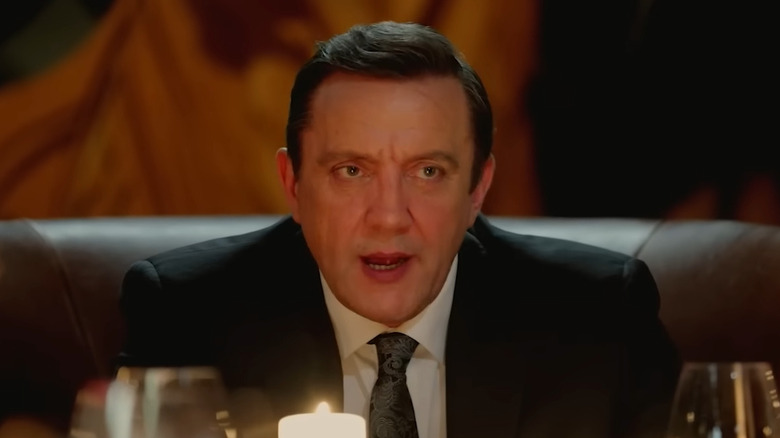
Whoever had the idea of making Peter Serafinowicz a reality game show host deserves their own million-dollar cash prize — or three months of a Netflix subscription, whichever winds up being more expensive by the time this is published. The beloved British character actor is a worthy contender for Alan Cumming’s spotlight on the streamer’s own social deception game, “Million Dollar Secret.”
The game takes place in a mansion (dramatically named “The Stag”) rather than an old Scottish castle, though the vibes are suspiciously similar. It features an entirely celebrity-free ensemble of 12 strangers. When they arrive, one of them already has $1 million in their possession — once they’re discovered and sent home, the money is secretly transferred to another player. The last one holding the bag gets to take it home.
The pretense that anyone actually has the money (it’s not like they can walk out with it at any moment, right?) is valiantly deployed as a gimmick to sell this as distinct from “The Traitors.” The closeness between the shows in terms of tone, aesthetic, and gameplay is sure to be a feature for our readers who are fans of the Peacock series. Even “Million Dollar Secret” creator Glenn Hugill has excitedly invited the comparisons, telling TV Guide in 2025, “I f***ing love ‘The Traitors!’… It’s the Sistine Chapel of reality shows.” If you’ve exhausted every season and variation of “The Traitors” and find yourself still in search of another new season, “Million Dollar Secret” is as close as you’ll get.
The Mole
Of course, there would likely be no “Million Dollar Secret” or “The Traitors” or most other shows of this kind without the original social deduction game: ABC’s “The Mole.” Based on the Belgian series of the same name, this 2000s reality show is responsible for popularizing deceit as a form of competition within reality TV. It was originally hosted by Anderson Cooper and ran irregularly from 2001 to 2008 on broadcast television, before being revived for two seasons on Netflix from 2022 to 2024.
Its premise is a lot simpler than what we’ve discussed so far, but no less captivating. Players work together as a team to compete in challenges that will raise the grand prize only one of them can take home. One of them, however, is a… betrayer, you might say, whose sole purpose is to sabotage challenges at the behest of the show’s producers. “The Traitors” introduced a team of villains; “Million Dollar Secret” sent the money around to keep the target in flux — both are simply twists on the formula of “The Mole.”
What also sets “The Mole” apart, for better or for worse, is how the titular player is compensated. They don’t get to take any part of the prize pot home regardless of how well they play, and are instead paid by production as a well-paid actor/crew member. It makes the deception feel less toxic and messy, which may be a plus or a minus depending on how sadistic a viewer is.
Murder Island
If you’ve had enough of these straight-up clones of “The Mole,” you might be willing to take a swing on “Murder Island.” The 2021 Channel 4 series was marketed as part reality program, part docuseries, seemingly because it aims to sincerely explore what detective work is like.
Over the course of six episodes, four pairs of citizen investigators attempt to solve a fictional murder mystery (ostensibly written to be plausible by acclaimed crime novelist Ian Rankin). The amateurs are mentored by real detectives, who hold their skills of evidence gathering and deduction to somewhat realistic standards. Though there are no secret liars among them, it still functions as a social experiment about the average person’s ability to find the truth when given the resources and evidence.
To be upfront, this is the biggest departure from “The Traitors” on this list, and not just in terms of format. Despite its pulpy title, “Murder Island” takes itself surprisingly seriously, to the extent that the gruesome crime it depicts might rub some “Traitors” fans the wrong way. That said, it is the show for fans of “The Traitors” who mostly appreciate the play-along investigative work and the moody Scottish setting. If nothing else, it’s only a six-hour time commitment.
Snake in the Grass
“The Traitors” wasn’t the only show to compete with “The Mole” after its 2022 revival. Rather than expand the roster of villains to a team of backstabbers, “Snake in the Grass” decides to keep the original series’ focus on a single saboteur — instead, the twist is that this social deception game also takes part of its inspiration from “Survivor.”
The short-lived USA Network series sends a small handful of players into the jungles of Central America, where they have just 36 hours to survive the elements, compete in challenges, and root out the slithering viper among them. The winners take home a prize pot of $100,000. It has an episodic approach similar to “The Hustler,” with each episode introducing a new cast and snake that would be resolved within the hour. For fans that love the drama of the final vote, this type of show is dangerously entertaining.
At the same time, changing the cast each episode didn’t stop “Snake in the Grass” from attempting the same stunt casting that would later become the signature move of “The Traitors.” Most episodes feature at least one prior reality show contestant. Fans of “The Traitors” who want to try out a single episode first should watch Episode 5, which has “Traitors” alums Cirie Fields, Janelle Pierzina, Rachel Reilly, and Stephenie Kendrick. “Snake in the Grass” was a cult hit, and one that might’ve inspired some casting on “The Traitors” down the line.
Unan1mous
“Unan1mous” is only for the most vicious “Traitors” fans. Premiering in 2006, it is an early and underrated successor to “The Mole.” It bafflingly achieves a strikingly similar copy without copying the secret saboteur element — instead, they just brought over the stress of the final vote and extended it over a torturously “indefinite” number of episodes.
The Fox series is a pure social experiment with no meaningful or encouraged elements of deception, deduction, or overt manipulation (beyond the individual secrets revealed during the season). It traps nine people in an isolated bunker, not even allowing them the pleasure of interacting with their host in person (creator J.D. Roth provides guidance via video tablet). All these people have to do to see the outside world again is unanimously decide which one of them should receive the $1.5 million prize pot. Of course, anyone can leave voluntarily if they’d like, but Fox will cut the pot in half if they do. The game pitched itself as having no designated endpoint beyond the players’ ability to make a decision or successfully oust their competition. It’s as fascinatingly dystopian as reality TV can get — J.D. walked so MrBeast could run.
What’s perhaps most fascinating about the series is how manipulative it all feels. No one is told to lie, but their arguments for why they or another player should walk away with the cash often feel every bit as diabolical as what you see on “The Traitors” — except, in this case, pretty much everyone deserves a black cloak.
Whodunnit?
Like “Murder Island,” “Whodunnit?” is a murder mystery series that drops its contestants in the middle of an investigation (but with the camp of “Escape the Night”). What aligns the show much closer with “The Traitors” is the element of deception. One of the 13 investigators is actually a killer in disguise, attempting to sabotage the case while claiming their next victims one by one.
The ABC series (created by “CSI” creator Anthony E. Zuiker) only lasted a single season, but was still one of the most unique, entertaining, pure-fun reality game shows of the 2010s. It leans hard into the community “Clue” vibe that “The Traitors” gestures to — though the latter show isn’t shy about borrowing the whole “breakfast with a side of murder” thing. Every night, the contestants on “Whodunnit?” try to explain who the murderer is and how they managed to commit that day’s crime based on the evidence gathered during challenges. Whoever is furthest off gets marked for elimination the following day.
The best part about the show is how theatrical it is despite having a civilian cast. Everyone commits to the bit wholeheartedly, even when they’ve already been eliminated. This allows the show to stage their “deaths” in shocking and spectacular ways — like, for example, having one of them get maimed by a mountain lion during breakfast with the unsuspecting survivors. Of all the series on this list, “Whodunnit?” is the only one that can claim to be enjoying itself even half as much as Alan Cumming enjoys hosting “The Traitors.”
