

![[VRChat] An 1-hour experience of interplanetary travel: Everything is just too grand – Project Lost Worlds experience report](https://comicvibe.com/wp-content/uploads/2026/07/c9d26a6d988532db41676fc3c11bb612-kix.qmffh7cab0xh.webp "[VRChat] An 1-hour experience of interplanetary travel: Everything is just too grand – Project Lost Worlds experience report")
The sci-fi adventure world “Project Lost Worlds,” which was released at the end of June on the social VR platform “VRChat,” is attracting a lot of attention. This world is the latest work by Fins, a creator famous for sci-fi worlds such as “District Roboto” and “Paradisa.” It has already become a popular world with nearly 300,000 visitors.
“Project Lost Worlds” is set in a world where humanity has acquired interplanetary travel technology and can leave Earth and travel to other star systems. The estimated playtime is approximately 1 hour.
Up until now, Fins’s worlds have mostly been “exploration-type” worlds where players load worldviews and files scattered throughout the field. However, “Project Lost Worlds” is characterized by its abundance of visually stunning elements, making it a world that could be described as a “VR movie.”
<img src="https://comicvibe.com/wp-content/uploads/2026/07/66f02c3804bc00b09dcf180450041399-kix.7q565af54w9z-300×169-1.webp” alt=””>
【連載 映えるVRChatワールド】一度は訪れるべき屈指の名作「Complex 7」 大型アプデで街は新たな表情を見せる
ソーシャルVR「VRChat」では、友人と遊べるゲームワールドから、ゆっくりするのに最適な風景系ワールドまで、様々なコンテンツが日夜公開されています。本連載では、膨大なワールドの中から、特に“映える”ワール…
VRChat2026.01.17
バカンスはいかが? 人気作者の最新ワールド「Paradisa」は、見事な“猫パラダイス”だった
夏の終わりも近づいていますが暑い今日この頃。ソーシャルVR「VRChat」では、「Paradisa」と呼ばれる“バカンス系”ワールドが注目を集めています。 「Paradisa」は、海に面した地中海風のカラフルな街を舞台に [&h…
VRChat2025.09.04
Upon entering the world, you will find yourself at the entrance of a house standing in front of a lake. After walking a short distance to the lake, a panel will appear allowing you to “play” the content.
This world incorporates many elements such as NPC dialogue and narration, all of which are in English. You can switch the subtitles to Japanese in the settings panel, so be sure to change the settings before pressing the Start (Ready) button.
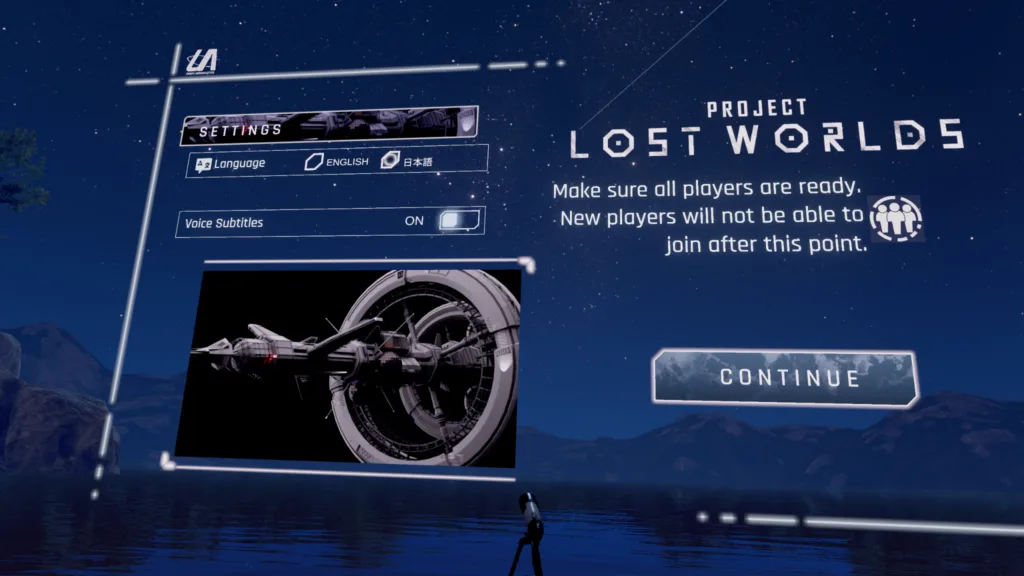
(You can change the subtitles to Japanese from this setting.)
“Project Lost Worlds” depicts a character’s childhood and their eventual departure from Earth. As the story begins, a man’s voice can be heard from somewhere. Although he is not visible, he appears to be a resident of a house by the lake, reminiscing about his childhood.
As the mother’s voice rings out, “Someday, you will go there. Not just to look at the stars, but to walk on them,” a rocket is launched into the distant sky.
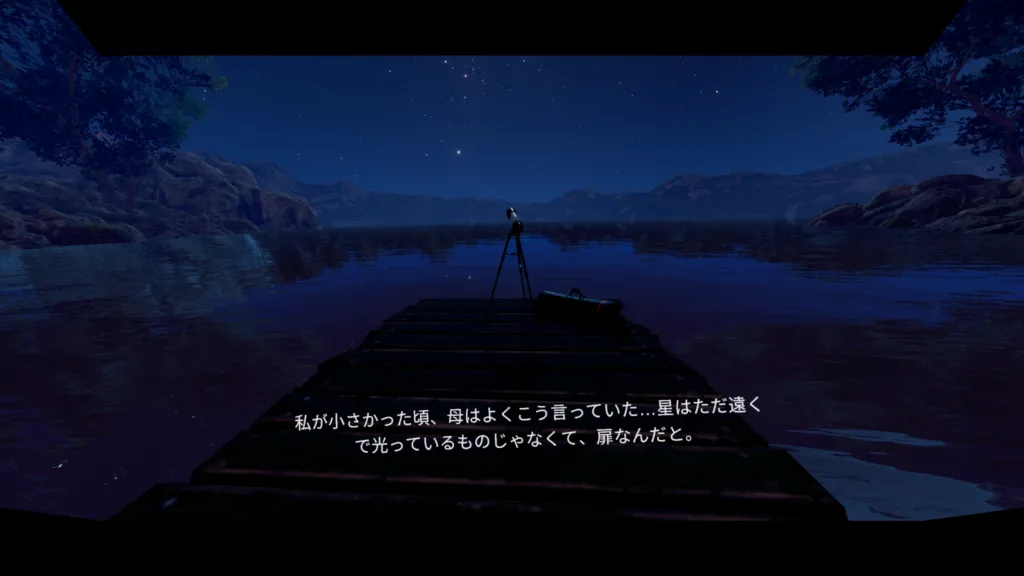
(Subtitles are displayed at the bottom of the screen like this.)
Once this prologue ends, the story jumps forward 38 years. The next place the protagonist “awakens” is Spaceboat 37, a spaceport belonging to an organization called Union Space Atoria” on its 800th launch, heading for “Stellara,” the closest star system to Earth, located 2 light-years away
In the fictional world, space-related technology seems to have advanced significantly in the last few decades, making it possible for ordinary people to travel freely through space for tourism purposes. After the briefing, there are no additional tests, and the group heads straight to the launch area.
Unlike the lakeside location we were just at, the briefing venue has a very high-tech feel. There are miniature models and holograms of the shuttles we’ll be boarding, “Bolt” and “Astoria,” so it’s a good idea to take a look around while you’re taking a break.
You reach “Bolt” by riding on an “automatic scaffolding,” and along the way you can see the humans and robots working on the launch. Even in still images, you can see that it’s quite gorgeous, but experiencing it in VR is something else entirely. It’s amazing how naturally you get the feeling that “I’m about to board a spaceship…!”
After boarding, the Bolt reaches orbit, and the long-awaited Astoria appears before your eyes.
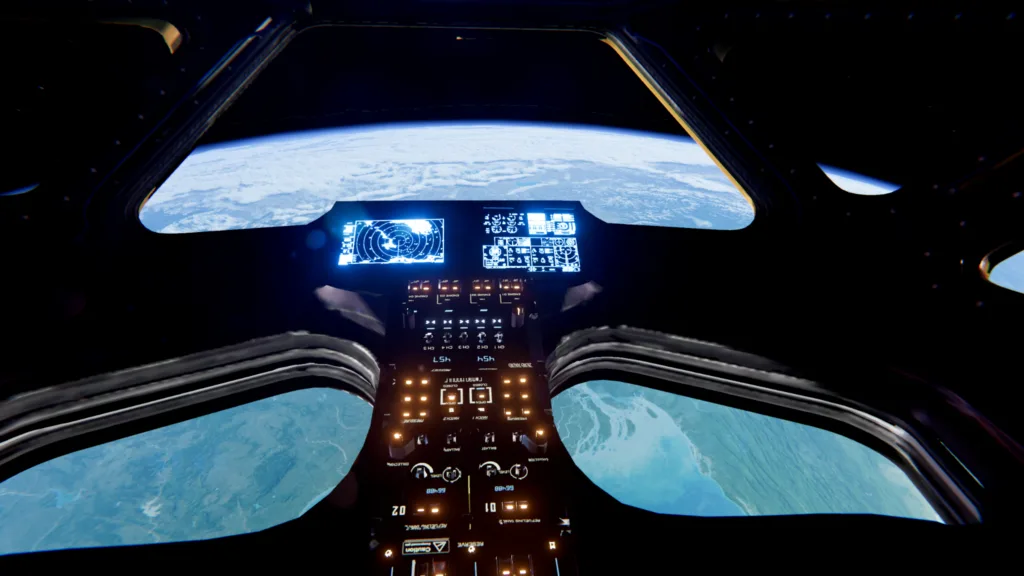
(Some time after the launch sequence…)
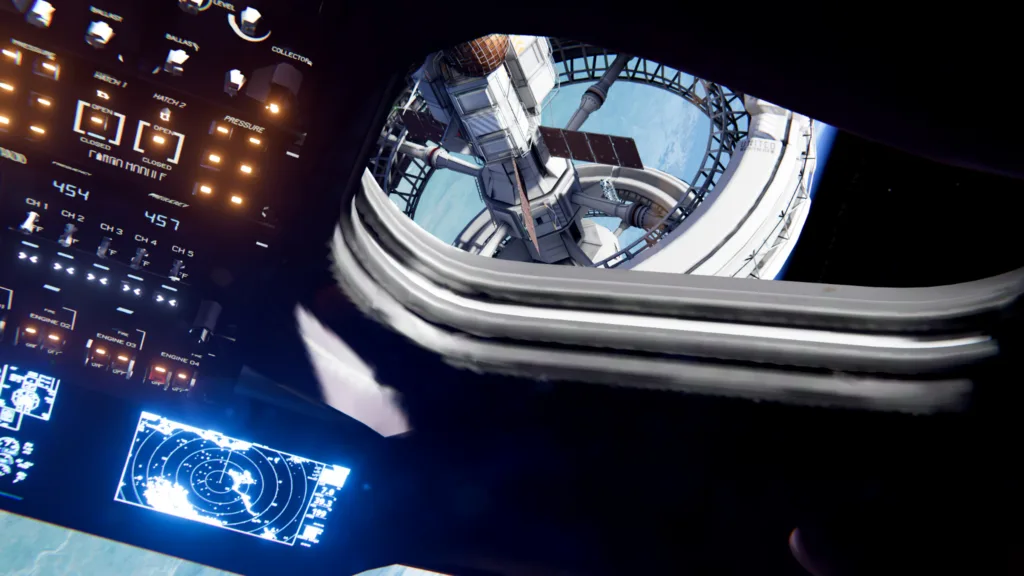
(Astoria will gradually come into view!)
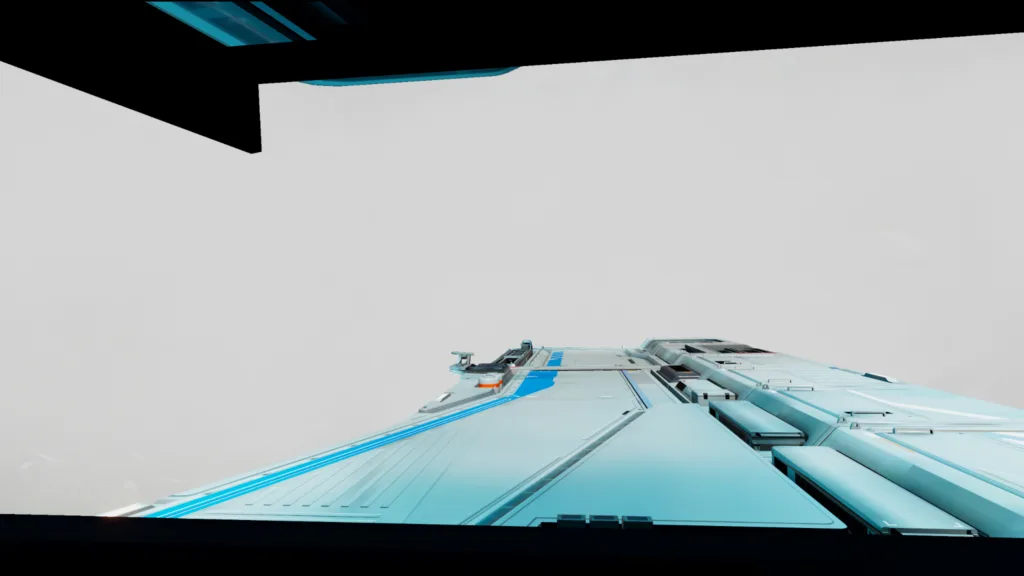
The front of the “Bolt” has a frame with a window set in it, which functions as a “theatrical device” that prevents you from seeing the full view of the “Astoria.” While playing, I found myself leaning over like a tourist, engrossed in the task of finding the best photo angle.
Once boarding is complete, a “time jump” of several months occurs, and the “Astoria” arrives in the “Stellara” star system. The protagonist’s destination is Helios, the second moon of the giant gas planet Stratos, and their first task is to head to a landing craft to descend.
The room the protagonist was staying in appeared to be a suite, with quite extensive amenities. As is typical of Fins’s world, there were also cats living there (presumably pet cats). You’ll need a boarding ticket to take the dropship, so don’t forget to take it with you when you leave the room.
The journey to the cabins and the landing craft is guided by a route that introduces the interior of the “Astoria” and the “Stellara” star system, allowing passengers to learn more about their destination and the world it inhabits. For example, the explanatory panels inside the cabin state that the gas giant Stratos protects Helios and its other moon, Onilon, from debris and radiation.
Furthermore, some of the passageways are designed like a “botanical garden,” suggesting that plants were brought in from other planets, which reinforces the feeling that this is a science fiction world close to an unknown star system.
As you pass through the spacious main corridor and approach the boarding area, you arrive at a space where various dinosaur-like creatures are displayed as holograms. These creatures are the protozoa of Helios. Helios is the place in the “Project Lost Worlds” universe where humanity first came into contact with intelligent life.
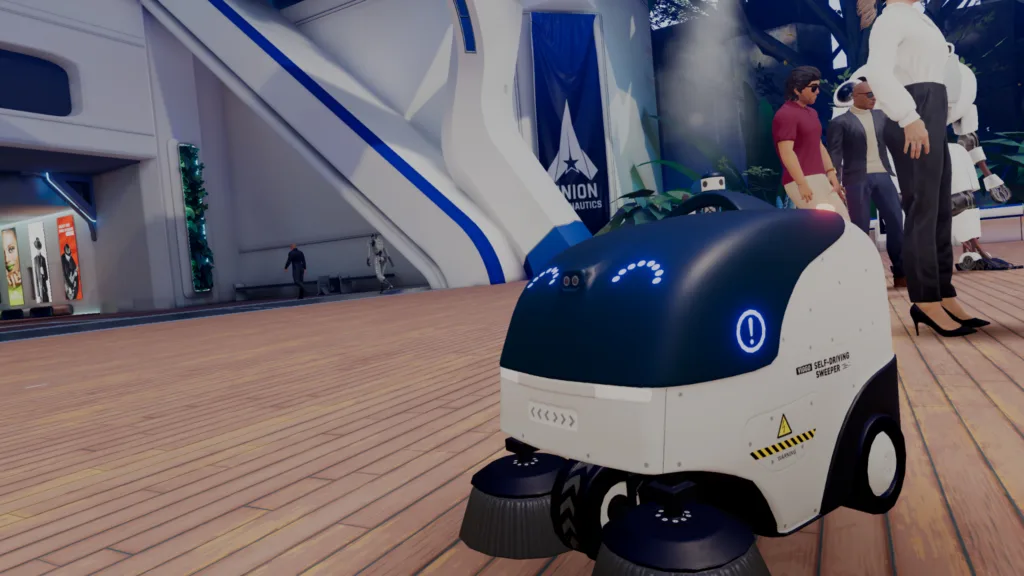
(Many robots are working inside the ship.)
Further inside, Reginald, your guide for this trip, awaits you. Hand your ticket to Reginald, and he will take you to the dropship, the Hercules.
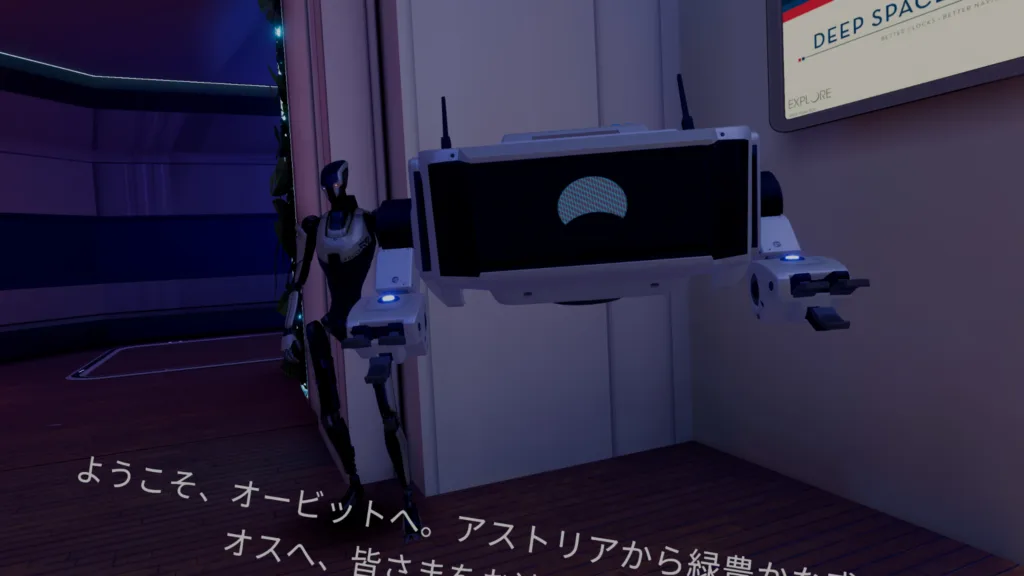
(Reginald, our guide and companion)
Unlike the Bolt, the Hercules will re-enter the atmosphere. What’s great is that the front of the bridge is made of wide glass. You can enjoy the outside scenery without missing anything.
After the scene of the ship’s hull turning red as it re-enters the atmosphere, the sky of Helios comes into view…and this is where I was completely blown away. First, take a look at this image.
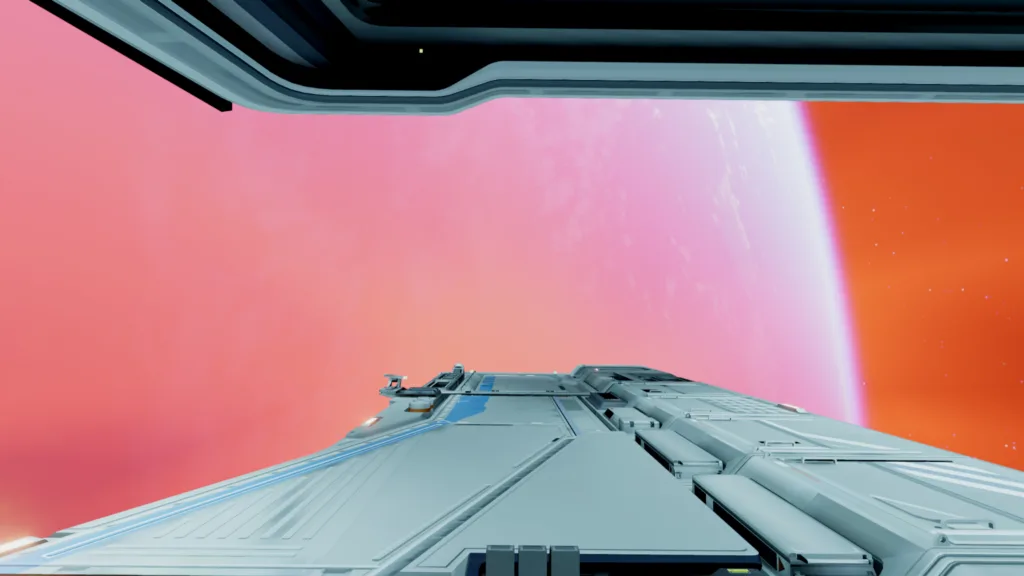
(Upon re-entering the atmosphere)
(When the protective shield opens)
Hercules flies through a “sky canyon.” In the sky, manta ray-like creatures soar, and on the ground, holographic dinosaurs roam freely, appearing as if they are actually alive. It’s a landscape straight out of the movie “Avatar.” Coincidentally, I had just watched the latest installment of the series a few days before writing this article, and while enjoying “Project Lost Worlds,” I also felt as if I had landed on Pandora, the satellite from the movie.
You’ve landed at the landing zone, and now your adventure in Helios is about to begin! …or so you might think, but unfortunately, this is as far as the implemented content goes. In fact, “Project Lost Worlds” is planned to unfold in two parts (two worlds). It seems that the exploration of Helios is planned to be included in the second part.
This world was already packed with so much to see and do in just the first half, leading up to the descent onto the stars. I can’t wait to see what adventures await in the second half.
Regarding the final Helios descent section, after disembarking, it felt like it put a considerable load on the PC, and on my system (RTX 3060), the frame rate remained below 30 FPS for a long time. If you are worried about your PC’s specs, you might want to try it in desktop mode first.
