

Getting your Trinity Audio player ready…
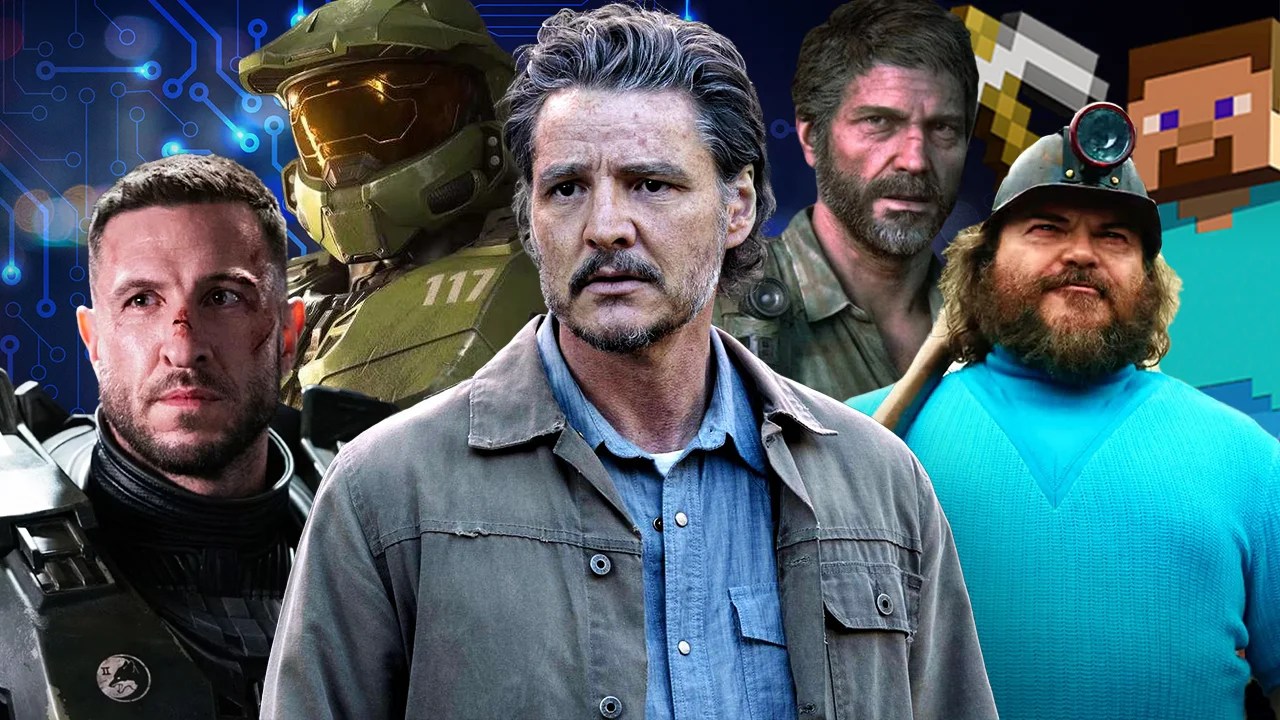
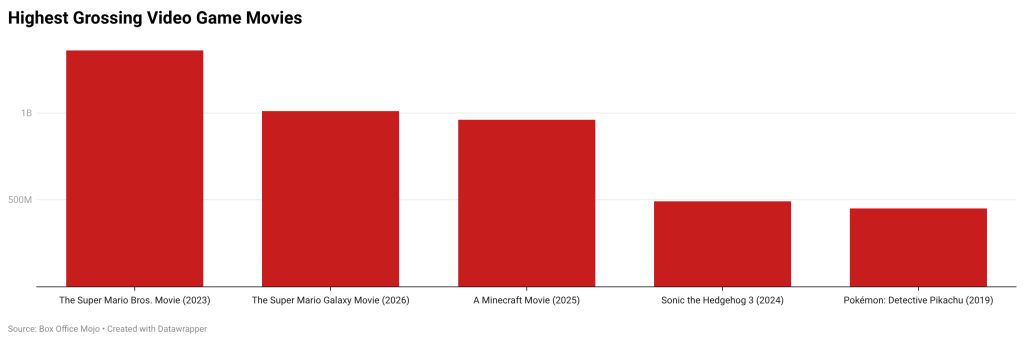
Last spring, theaters were full of audiences screaming “chicken jockey!” alongside Jack Black as “A Minecraft Movie” soared to become the fifth highest-grossing movie of the year, earning $960 million worldwide. A little more than a year later, the parent company behind the video game the film was based on is no longer celebrating.
Earlier this month, Microsoft said Xbox, which owns the studio behind the uber-popular game, would be laying off 20% of its teams between this summer and fiscal year 2027. Roughly 3,200 people are expected to lose their jobs in the latest rounds of sweeping cuts for an industry that is struggling to stay ahead of changing consumer habits.
It’s a juxtaposition that shows two drastically different sides of video games and game adaptations. As movies and shows like “Super Mario Galaxy Movie,” “Sonic the Hedgehog 3” and “Fallout” prove Hollywood has finally figured out how to successfully adapt video games — after years of failure so deep a “video game movie curse” moniker was coined — the makers of those games are in disarray.
But it’s a stressful time that could prove to be a boon for Hollywood as smaller independent gamemakers make for less red tape when Hollywood comes calling to adapt. Plus, the entertainment industry is in the midst of a booming partnership with the most popular games of all, free-to-play platforms like Fortnite and Roblox, where everything from the Oscar-winning “Sinners” to Christopher Nolan’s “The Odyssey” appear in a bid to reach young audiences where they are. While the gaming industry itself may be at a low, Hollywood’s video game adaptation pipeline has never been more fruitful.
“I actually think the disruption strengthens the pipeline,” Adrian Askarieh, a film producer known for adapting the Hitman video game series and the CEO of Prime Universe Films, told TheWrap. “The gaming industry is going through the same market correction Hollywood experienced after the streaming boom. Companies are becoming more disciplined about where they invest, which naturally forces them to look for additional ways to maximize the value of their intellectual property. Film and television have become one of the most effective ways to do that.”
Casper Daugaard, the founder and CEO of Delphi Interactive, agreed that an increase in independent studios could accelerate the adaptation process. Delphi Interactive is a game development and publishing company that specializes in games based on existing properties and franchises. The company worked in collaboration with IO Interactive on the critically acclaimed James Bond origin game, 007 First Light. Daugaard sees the current chaos in the gaming industry as a course correction after the COVID years inflated interest in the medium.
These shifting tides are coming as Hollywood’s relationship with gaming has drastically changed. Instead of looking at video games as an afterthought, which was the case for decades when studios used to crank out hastily made tie-in games for every buzzy movie or show, the film and TV industries have started to take this medium seriously. That means meeting gamers through integrations with games like Fortnite, Roblox and Minecraft. It also means ensuring that key elements of these games are reflected in their adaptations.

That’s the role Ben Mattes, the creative officer for Angry Birds at Rovio, occupies. Mattes knows the mobile game so well, he’s known in the industry as “Mr. Angry Birds.” But, as “The Angry Birds Movie 3” prepares for a release later this year, this third installment is the first time Mattes has been directly involved in helping make an adaptation. As an executive producer on the movie, his job has nothing to do with character development or financing. Rather, he’s responsible for making sure the movie includes elements that gaming fans will want to see.
“Transmedia offerings have evolved away from this idea of ‘We’re going to launch a movie, and we’re going to try and retell that story inside a game’ and towards this idea of ‘We’re going to use live service games, whatever they might be, to drive excitement towards the movie,’” Mattes told TheWrap. “You get into that cycle where you’re a lot more likely to turn players into viewers and turn viewers into players.”
“The actual effect on producers and opportunities in film and TV would be very long term, if at all — five to 10 years at least, given the development cycle of these types of projects,” Daugaard said.
Xbox and PlayStation’s current chaos, explained
Though Xbox’s mass layoffs are part of a company reset that Xbox Executive Vice President and Chief Executive Officer Asha Sharma announced earlier this month, the current troubles the company is facing can be traced back to 2023. That’s when Microsoft acquired Activision Blizzard — the studio behind Call of Duty — in a deal worth $68.7 billion that was designed to expand the console’s number of first-party titles.
For decades, the gaming industry was defined by consoles. You chose whether to spend hundreds of dollars on a gaming system depending on what exclusive titles Xbox, PlayStation or Nintendo offered. In the digital era, that exclusivity has largely fallen away as even the biggest titles are released for nearly all systems.
The acquisition of Activision Blizzard was supposed to help Xbox win the much-discussed console wars, but instead the purchase was followed by thousands of layoffs and multiple studio closures. Three months after that deal, 1,900 people were laid off from Microsoft’s video game division, a figure that represented almost 9% of all Xbox employees. By the end of 2024, around 2,550 people had been laid off from Microsoft’s gaming divisions in total. The segment was then impacted again last year when Microsoft laid off less than 4% of its workforce, a cut that amounted to about 9,000 axed positions.
These cuts have also led to multiple studio closures and game cancellations. In its announcement this month, Microsoft said that four of its studios — Double Fine (known for Psychonauts 2), Compulsion (South of Midnight), Ninja Theory (the Hellblade series) and Undead Labs (State of Decay) — will exit Xbox as part of this reorganization. Arcane, which is known for the Dishonored series, Deathloop and the upcoming game Marvel’s Blade, will also be leaving Xbox, but the French studio first has to go through a lengthy review and consultation process in its home country.
While Xbox descended into restructuring chaos, the Sony-owned PlayStation tried to slip in some industry-changing news of its own, announcing in early July that the gaming console will stop selling physical discs in 2028. The announcement caused a massive uproar from users, who complained that the move could lead to players losing access to games they paid for thanks to server shutdowns or account bans while also creating a Sony-controlled monopoly on the price of PlayStation games.
It didn’t help that the announcement came shortly after the company said PlayStation users in the U.K. would no longer be able to access digital titles from StudioCanal they previously purchased — a stark reminder of the potentially ephemeral nature of digital content.
For its part, PlayStation has argued that its monthly paid subscription service, PlayStation Plus, gives consumers access to the library titles they would likely purchase on the secondhand game market.
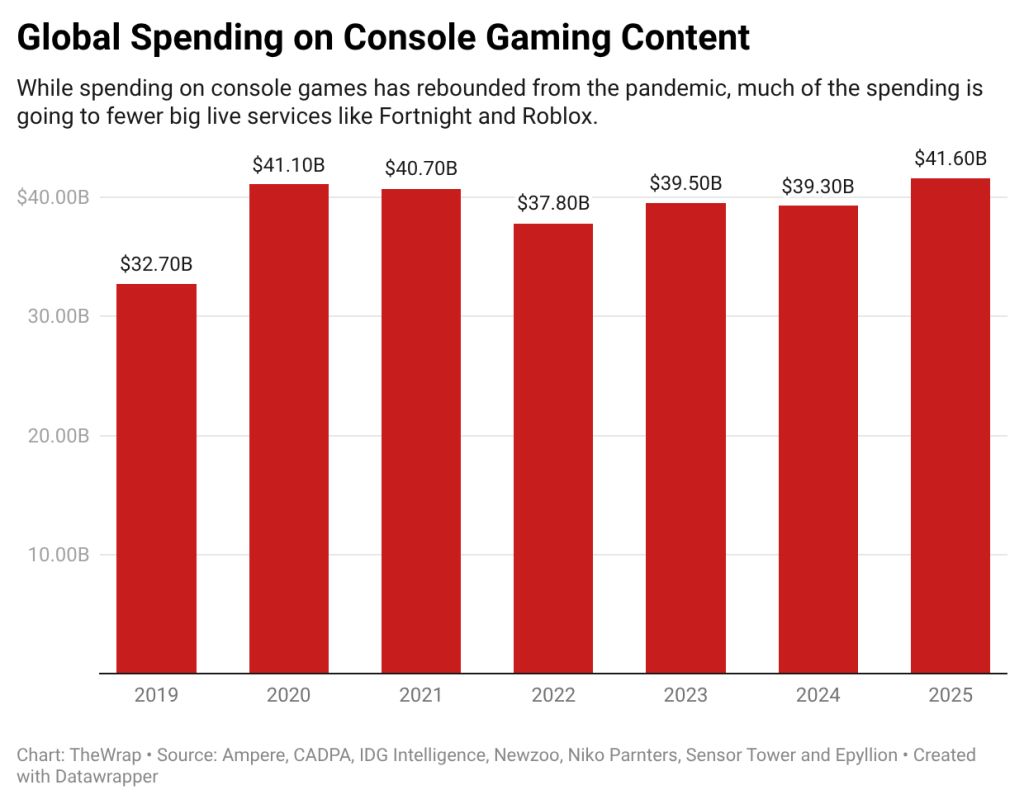
Outside of the console ecosystem, nearly everyone in gaming is scrambling, both due to the threat of AI and behemoths like Fortnite and Roblox: free-to-play game platforms that continuously provide players with new updates and generate massive monthly audiences, particularly among younger generations. Excitement around a new Fortnite season or a user-generated Roblox game now often replaces the joy gamers once had for a new multi-million dollar AAA gaming title.
The value of adaptations and “blackhole games”
Successful movie and show adaptations of popular video games can help breathe new life into franchises. Prime Video’s highly lauded “Fallout,” for example, led to an estimated $40 million revenue increase for Bethesda Game Studios in game units alone. Fallout 5, the first mainline title in the franchise since 2015, is now in pre-production thanks in part to the success of the Prime Video drama. A more recent example is “The Super Mario Galaxy Movie” and its scene-stealing cameo by Glen Powell’s Star Fox, which Nintendo followed with a remake of the 1997 game Star Fox 64.
But because the development cycles for movies and games are wildly different, those coinciding releases are now more the exception than the rule. “Today, a successful adaptation doesn’t have to launch alongside a game. It simply has to expand the audience for the franchise,” Askarieh said.
It’s a format that’s led to an entirely new form of storytelling that’s a delicate balance between giving fans what they want and not rehashing the same story beat for beat. The Sonic movies may be wildly different from the games, but they retain the zany, zippy tone of that franchise. Even more serious examples, like The Last of Us, don’t have to follow their source material exactly. However, they do need to stay true to the tone of those games while expanding on the small moments hidden in the corners of this series, like Nick Offerman’s Emmy-winning turn as a survivor named Bill.
“That’s the million-dollar transmedia question: What is the right way to do a transmedia adaptation of a video game, or conversely, what is the right way to do a transmedia video game adaptation of a linear story?” Mattes asked.
Hit adaptations like “Fallout” and “The Last of Us” seem to indicate the key is to hire esteemed creatives and let them put a “prestige TV” flourish on the project. To that end, HBO has already tapped “The Last of Us” mastermind Craig Mazin to shepherd an adaptation of the Hasbro franchise Baldur’s Gate.
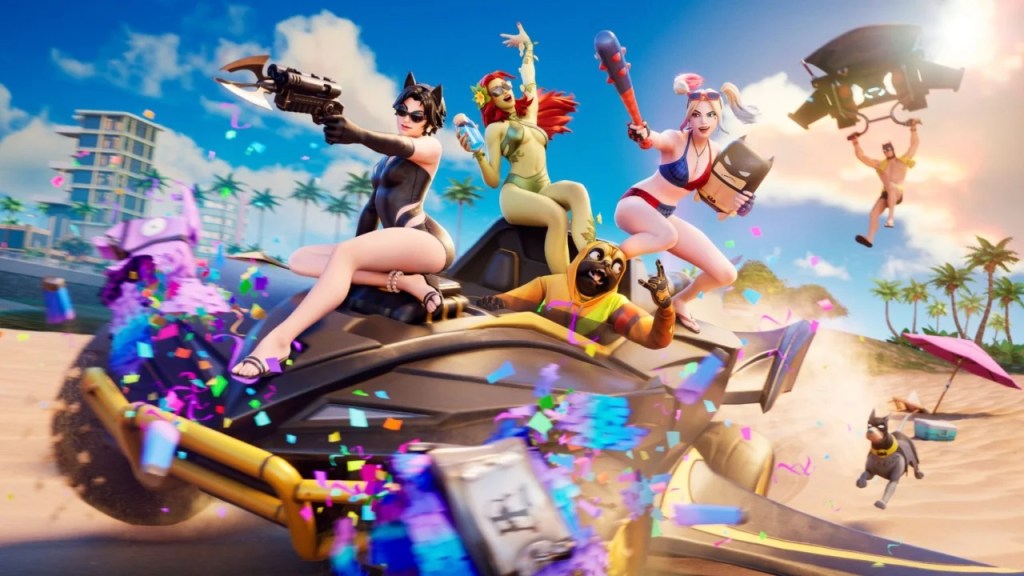
At the same time, the promotional role that games used to occupy for Hollywood has been filled by what Mattes refers to as “blackhole games” — live service games like Fortnite, Roblox and Minecraft. As TheWrap has covered before, integrating characters from properties like “The Simpsons” or “Squid Game” into these games exposes these properties to a vast gaming audience at a much lower cost than developing a tie-in game from scratch.
“You see some really interesting collaboration initiatives that are sort of like the modern day ‘game of the movie,’” Mattes said.
“Platforms like Roblox are creating something Hollywood has never really had before: massive, real-time testing grounds for original intellectual property,” Askarieh said. “I don’t think every successful Roblox experience becomes a movie, but I absolutely believe platforms like Roblox will become one of the industry’s most important discovery engines for future franchises.”
Delphi Interactive takes its IP adaptations a step further. In addition to collaborations with platforms like Fortnite and tie-in games, the studio specializes in making curated, franchise extending games that live outside of their show or movieifferent in the Spider-Man games versus the movies, Delphi’s take on 007 is different from the film franchise
“We talked about not trying to adapt the latest James Bond film or actor into a game. It was creating its own gaming franchise, the defining feature here being that it was an origin story,” Daugaard said.
Hollywood’s love affair with gaming isn’t slowing down
No matter what’s happening at Xbox or PlayStation right now, Hollywood seems gung-ho on investing in video game adaptations.
In addition to “Fallout,” which is in production on its third season, Prime Video has a God of War adaptation in the works and “Tomb Raider” starring Sophie Turner. HBO will be releasing a third season of “The Last of Us,” and Noah Hawley and Rob Mac are working on a Far Cry series for FX. Following the success of its two Mario movies, Nintendo is working on a live-action The Legend of Zelda movie. A24 has an Elden Ring movie written and directed by Alex Garland as well as a Death Stranding movie directed by Michael Sarnoski. And in September, Resident Evil will return to theaters in a new movie from buzzy “Weapons” and “Barbarian” director Zach Cregger, while Paramount launches a colorful take on “Street Fighter.” There’s also Taylor Sheridan’s take on “Call of Duty” set up at Paramount and a Michael B. Jordan-fronted “Battlefield” adaptation sparking a bidding war.
Just this week, Askarieh’s Prime Universe Films scored the adaptation rights to Tormented Souls alongside ZQ Entertainment and Longevity Pictures in a competitive bidding process. Like Among Us and Five Nights at Freddy’s before it, it’s an acquisition that proves there isn’t solely interest in the most expensive or popular games.
“For years, Hollywood chased almost exclusively AAA franchises because they had the biggest brand awareness. Today, that’s changing. Independent developers are creating incredibly sophisticated worlds with compelling characters, passionate fan bases, and original mythology,” Askarieh said. “The next generation of great adaptations won’t come exclusively from the mega publishers. Independent games have become every bit as
It’s not all virtual fireworks. When it comes to smaller projects, there’s always a chance a game studio may fold before an adaptation or expansion is ready. But at least for now, it seems as though Hollywood’s relationship with the gaming industry is leveling up to something more mature. No matter where the industry is going, Mattes sees the increased collaboration and respect between gaming and Hollywood as a net positive for studios, developers and consumers.
“Time will tell whether or not this is exactly the right strategy, but I certainly believe in this a lot more than [telling directors] ‘Do whatever you want. You don’t have to think about the games,’” Mattes said.
