

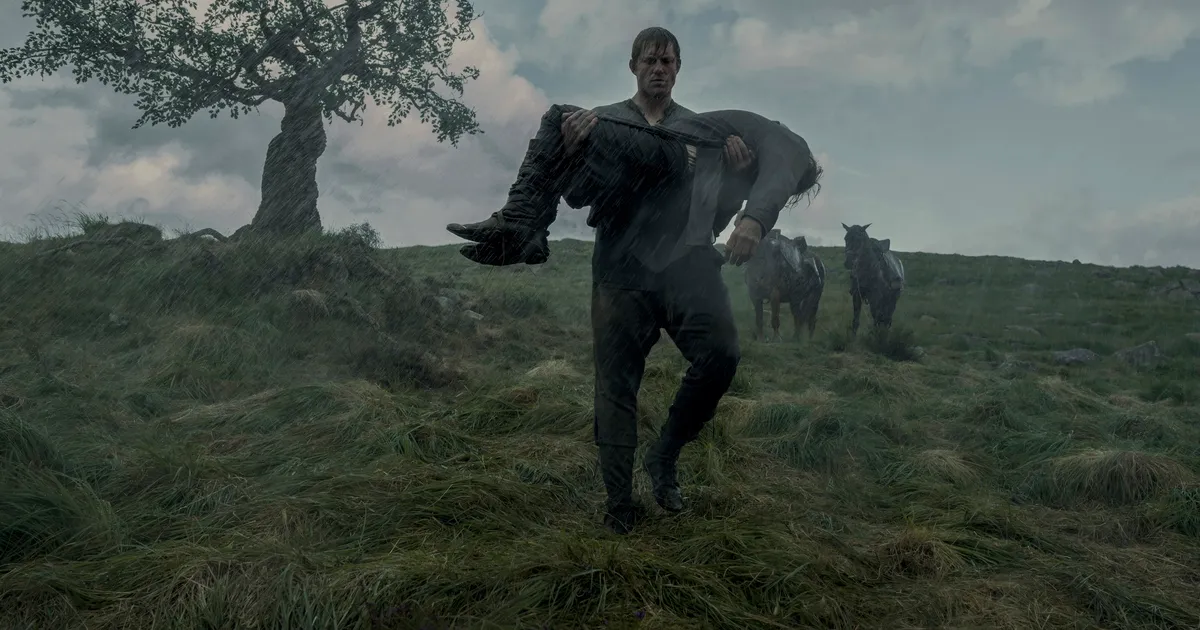
The latest Game of Thrones spin-off follows the lovable loser as he introduces us to a different side of Westeros. Photo: B) Stephen Hill 2024
When we first meet the tall Lord Duncan (Peter Claffey) at the beginning of A Knight of the Seven Kingdoms, he is busy burying his childhood squire, Sir Erlan of Pennytree (Danny Webb). “Dunk” claims to be a knight and has been knighted by Sir Arlan. True, there were no witnesses. Indeed, few in Westeros remember Ser Arlan, including his former employers. Dunk himself also comes across as an incredibly naive person, trapped in a fantasy version of chivalry that doesn’t correspond to the real world.
But he’s a big guy, our dunker. It’s even huge. Regardless of his equipment and reputation, he at least has the body of a knight. By the end of the first episode, he even acquires a small bald boy called “Egg” (Dexter Sol Ansel) as a squire. Never mind that Dunk may be more childish in nature than Egg. Sometimes you have to go to battle with the heroes in front of you.
George R.R. Martin first introduced Dunk and Egg in his 1998 novella The Hedge Knight (also the title of the first episode of Knight of the Seven Kingdoms). At the time, Martin had just published Game of Thrones, the first novel in the A Song of Ice and Fire series, and was months away from publishing the second, Clash of Kings. The world of Westeros was still relatively unknown to anyone outside of fans of fantasy novels, and Martin’s vast tales had not yet become a carefully plotted, densely populated, lore-heavy literary behemoth.
Even compared to the relatively streamlined Game of Thrones, The Hedge Knight is very simple. The story is that a young and inexperienced Dunk participates in a jousting tournament and gets into the kind of trouble that only Egg can save him from. That’s it. The plot spans just a few days and features only a few characters.
Yes, Knight of the Seven Kingdoms probably seems small-scale compared to HBO’s sometimes overwhelming Game of Thrones and House of the Dragon. But that’s by design. This is a lighter, sweeter, and often funnier A Song of Ice and Fire.
The show even acknowledges its modest ambitions in its opening scene. As Dunk picks up his former master’s sword and speaks to the horses about proving himself in the upcoming tournament at Ashford Meadow, the soundtrack swells with the familiar Game of Thrones theme song…and then abruptly cuts out when Dunk suddenly feels the need to empty his bowels. A cheerful little bird watches over him as he relieves himself by the tree where Sir Arlan was buried. This is by no means a heroic ballad.
Dan Romer is responsible for most of the music for Seven Kingdoms, and the music can only be thought of as a conscious echo of Ennio Morricone’s Spaghetti Western music. Sir Duncan, like Sir Arlan, is a wandering swordsman for hire known as the “Knight of the Hedge,” and although he does not enjoy the favor of any particular lord, he is sworn to protect the weak and serve the kingdom. The Hedge Knight is similar to the traveling gunslinger from Pulp Fiction, but with a stricter moral code. Rohmer’s stripped-down, folksy soundtrack, interwoven with low, whistling melodies, recalls old films about heroic loner characters.
A large part of this first episode is about establishing Dunk’s character. Claffey works with the show’s costume department and writers to understand Sir Duncan’s humility and politeness. He is dressed like a farmer’s boy, a knight, with a belt made of rope and patchwork clothes that smell no matter how many times he is washed. His wounded puppy eyes and unwavering seriousness make him easy to sympathize with. The concubine couple who tease Dunk at Ashford Meadow also feel bad when they see how hurt Dunk is. (One of them describes the Hedge Knight as “like a knight, but sadder.” As he walks away, Dunk mutters that sadness doesn’t have to “rise to the level of comment.”)
Ira Parker, the series’ co-creator and head writer (with Martin), cleverly establishes who Dunk is by having him appear in scenes with more experienced people in a Westeros fashion. In the premiere’s longest sequence, Dunk enjoys the hospitality of Lord Lionel Baratheon (Daniel Ings), but he struggles to understand this towering fool. The mercurial Sir Lionel, with his ridiculously large horned helmet and devilish grin, initially seems to want to make an example of Dunk eating Baratheon’s food without giving anything in return. However, Dunk is so dumb and so kind that Sir Lionel takes pity on him and invites him to join in an awkward and aggressive dance in the middle of the pavilion instead. Dunk is too unlucky to hate.
This is the main idea here, and it’s expressed very snappily. So we’re dealing with a likable underdog story. Dunk may or may not be the underdog in the Ashford Meadow jousting tournament. (There’s still no evidence one way or the other.) But it’s clear he’s at the bottom of the social order. As Dunk explained to Sir Lionel, he has no title or inheritance to fall back on. If you lose in the first round, you must give up your horse to pay a “ransom.”
And that’s assuming he’s cleared to compete. The game master warns Dunk that there are “princes” in Ashford Meadow and that he “can’t just let the selling swords in there.” Dunk’s only hope may be if he can be vouched for by Lord Manfred of House Dondarrion. Sir Manfred’s father once assisted Sir Arlan in hunting the Vulture King in the Red Mountains on the border of Druun. However, Sir Manfred is too preoccupied with the prostitutes (including those who mocked Dunk) to be of any use. This story may end before it even begins.
Although “Seven Kingdoms” is set some 80 years after the events of “House of the Dragon” and about 90 years before “Game of Thrones,” you don’t need to know anything about Baratheon, Dondarrion, Dorne, the Septon, “The Seven,” or any other myth of ice and fire. I certainly don’t know much about dunks. He was born into a poor family, and learned most of what he knew about the nobility of Westeros from Ser Arlan, who was himself a near-novel.
In other words, the series doesn’t look at Westeros from the perspective of the Iron Throne. Dunk is a person whose only option is to sleep outside, with bug bites and pouring rain. He was rescued from the slums of King’s Landing by a man who frequently “squeezed his ears” for even the slightest infractions (as seen in a darkly hilarious montage). Nothing is ever easy for our dunks.
But he had a stroke of luck in the series premiere. Early in the episode, when he stops at an inn for a meal on his way to Ashford Meadow, he meets Egg, whom he considers to be a stable boy. Egg secretly follows him to a tournament and sets up a camp in the forest, complete with a bonfire and freshly caught fish, to prove his worth as a potential squire. He knows Dunk isn’t the most impressive of knights, but he’s the one who needs help, and with his exceptional dexterity, he’ll let the eager Eggs hang around.
The episode ends with Egg giving a pep talk to an exhausted and depressed Sir Duncan, telling him that the other knights that night are lazing around in their tents and aren’t lucky enough to look up at a shooting star. Dunk told the boy to shut up. But Dunk is an impressionable young giant, so the idea certainly cheers him up. After all, as he had told himself earlier that day, having good thoughts is not a crime against the realm.
• Let’s talk about spoilers! I’ve read all three of Martin’s Dunk & Egg novellas, so I’ll bring in my thoughts on the books as needed. However, I won’t spoil the plot points before they appear on the show…and this includes one major element of these stories. If you’ve read the book (or the show’s Wikipedia page), you’ll know what I’m talking about. The basic premise of the entire Dunk & Egg series isn’t fully revealed until about two-thirds of the way through the first novella. This show won’t give you any surprises until about episode 4. Until then, I will remain a mother. (But fair warning: there’s no way to guarantee that the comments section won’t contain spoilers.)
• This is a scaled-down, low-budget Westeros show, but it’s not cheap. The set is incredibly detailed and packed with extras. The show’s creative team makes the locations vivid and realistic, right down to the lighting in the Baratheon Pavilion. The lights in the Baratheon Pavilion cast a warm candlelight, softly illuminating the surrounding darkness.
• Is Dunk actually a knight? I don’t see him being knighted. In a montage of memories with Sir Arlan, his former master never reveals his intentions. When Dunk is asked about his knighthood by the Games Master, he claims that the only witness was a bird…the same bird that Dunk saw while dumping, just after he brandished Ser Arlan’s sword and said how well it fit his hand. Did this songbird “witness” him knighting himself?
• Notable Characters: As Dunk walks through Ashford Fields, he is challenged to a sparring session by the obnoxious Lord Stephon Fossoway (Edward Ashley). According to his friendly cousin and landowner, Rayman (Sean Thomas), he likes to injure potential jousting competitors during practice. Also returning is the as-yet-unnamed drunken knight at the inn who tells Dunk that he “dreamed of you.” She doesn’t have a proper introduction, but it’s safe to say we haven’t seen the last of Dunk’s female puppeteers, or her giant wooden dragon yet.
• The innkeeper’s words are true. “I didn’t know there was a joust to change the price of eggs.”
• One of Sir Manfred’s concubines frankly and colorfully described Dunk’s jousting ambitions, saying, “He must risk himself for the pleasure of strangers.”
See all
Vulture Newsletter
Check out all the drama from your favorite shows!
Vox Media, LLC Terms of Use and Privacy Notice
