

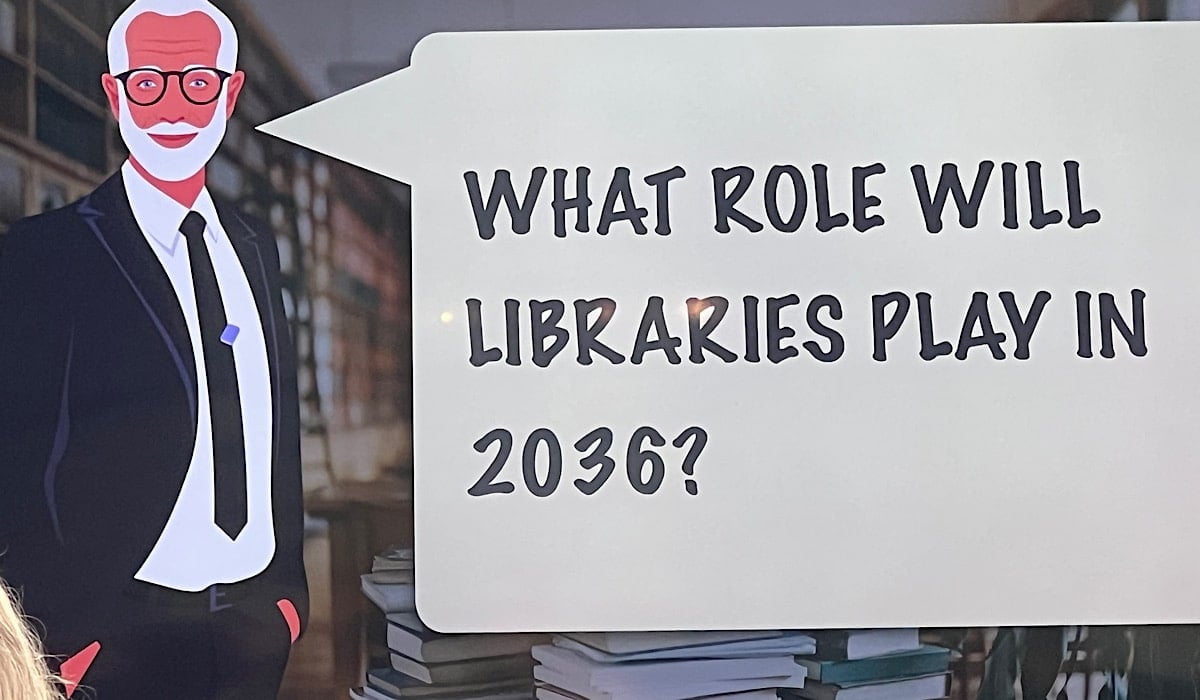

Somewhere between the artist alley and the cosplay lines, futurist Daniel Rasmus spent his week at San <a href="https://comicvibe.com/a-look-inside-absolute-cassandra-cain-at-san-diego-comic/" title="A Look Inside Absolute Cassandra Cain At San <a href="https://comicvibe.com/produce-this-last-nights-bad-idea-comics-san-diego-comic/” title=”Produce This! Last Night's Bad Idea Comics San Diego Comic”>Diego Comic“>Diego Comic-Con doing something that had nothing to do with capes or panels on the next big adaptation: mapping out four possible futures for public libraries in an AI-saturated 2036.
The talk was part of San Diego Public Library’s Comic-Con Conference for Educators & Librarians (CCEL), which has long convened librarians and teachers who rely on graphic novels and manga as core literacy tools—a niche Rasmus, a former Microsoft futurist who now teaches scenario-planning at the University of Washington, keeps returning to (this wasn’t his first Comic-Con, either). Libraries and comics culture already share a bigger, quieter fight: who controls access to content once it’s digital.
That tension persists through all four of Rasmus’s scenarios, adapted from his standard “Future of Work” framework into library terms.
Metered Commons, the first scenario, occurs when access to knowledge is gated behind licenses and identity checks. Cooperative Commons occurs when communities co-govern the platforms that control content. Uncommons reflects situations where automation monitors more than it helps. Stable Commons, the final scenario, occurs when institutions prioritize predictability over speed.
Rasmus pointed to a concrete flashpoint: the Internet Archive’s “Our Future Memory” initiative, an effort to pressure publishers into loosening digital licensing terms. It’s a campaign with obvious stakes for comics readers, too. Digital comics and manga are governed by many of the same licensing restrictions libraries are up against with ebooks and databases, and questions about who gets to preserve, lend, or archive that content aren’t unique to prose.
He also described a strategic planning session with Arizona’s Mesa Library System that produced one of his favorite scenario outputs. It was an “autocratic future” in which librarians quietly built systems—passwords and all—to enable patrons to access banned books. Rasmus didn’t specify formats, but graphic novels and manga consistently rank as some of the most banned books nationally.
“We are storytelling creatures,” Rasmus told the room. “That’s what we do.”
It’s a line that could apply equally to a Comic-Con panel or a library board meeting, which may be exactly why he keeps ending up at both.
Stay tuned to The Beat for more news from SDCC ’26.
