

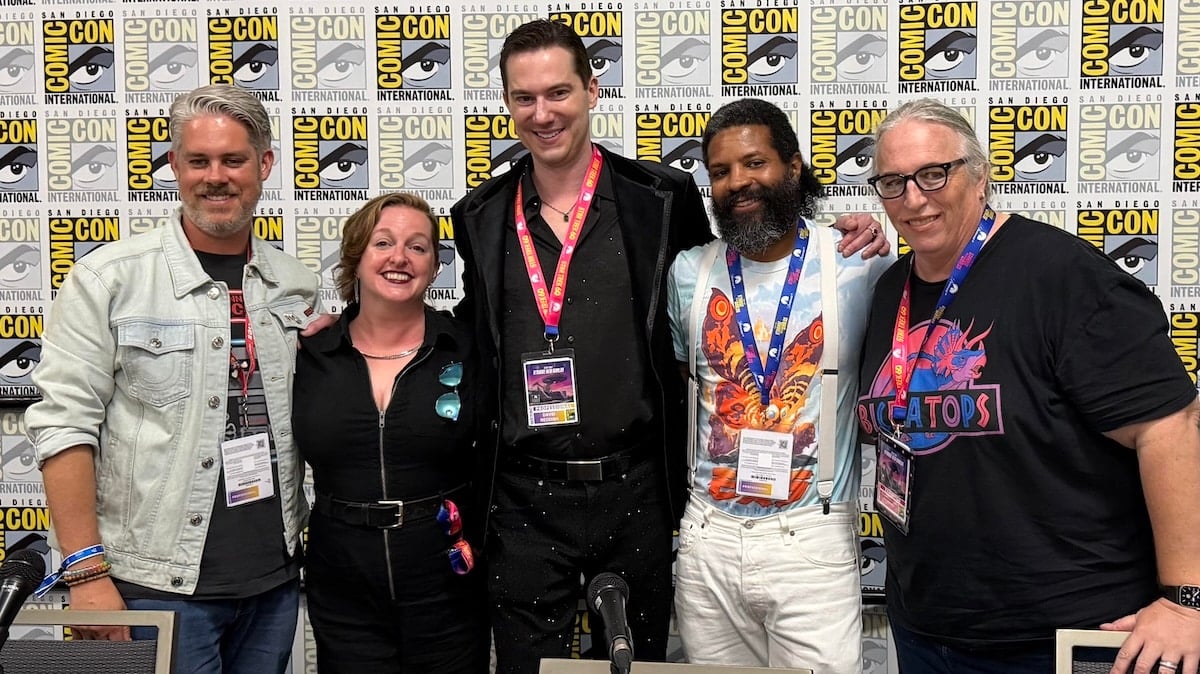
On Friday, July 24,the “LGBTQIA+ Activism in Comics” panel took place at San Diego Comic-Con in Room 4. The panel was moderated by political journalist David Reddish (Occupy Democrats; The David Reddish Show) and featured panelists Sarah Gailey(Upright Woman Wanted; Eat the Rich), David M. Booher (The Real Ghostbusters; Killer Queens), William O. Tyler(We Belong; Theater of Terror: Revenge of the Queers) and Tara Madison Avery (We’re Still Here; publisher, Stacked Deck Press).
According to the official description, the “LGBTQIA+ Activism in Comics” panel set out to ask:
“In a time of polarization when politics has seeped into every corner of popular culture, what is the role of comics creators? How do comic books and pop art comment on the current social and political climates . . . or should they at all?”
IP & Me
“The queer community is under attack,” Reddish stated at the start of the panel. “I say that not to sound hyperbolic, I say it because I’ve left the house recently.” Reddish continued by paraphrasing Frances McDormand’s Shakespearian allusion to the fact that as an artist, one’s work is one’s sword.
Alluding to Gailey’s work on Buffy the Vampire Slayer, Reddish asked Gailey about getting sensitive topics past the “corporate overlords” and into comics based on an established franchise. Gailey responded that they use multiple strategies. They explained: “One of them is the ‘trusting, loving’ pitch, which says, ‘Hey, you and I are both on the side of good, and we both want good things for the communities we love, who support us, who create the arts, who are responsible for every dollar you make and everything you enjoy, and so obviously we want to write stories that support and protect those communities.’ And that works, like, 5% of the time.”
Gailey said they have received pushback every time they’ve worked on a project based on a popular established Intellectual Property, specifically from the aforementioned corporate overlords. Gailey shared another strategy they use, which is accepting the denial from the overlords and then putting it into the comic anyway.
Next Reddish asked Booher about working on Ghostbusters, noting the IP’s singular history when it comes to representation. Had he been saddled with any restrictive writing guidelines? “Ghostbusters as a franchise is actively pushing in a direction beyond the ‘four blue collar dudes in Manhattan fighting ghosts,’” Booher said. “For example, the second storyline I wrote for Ghostbusters, I pitched a story where the kid who is a central character is nonbinary, just figuring that out, and they come out to their father, and their father is a scientist who was trying to, like, scientifically figure out how to help his kid.”
Booher said he pitched the story in “a very heartfelt way that fit together.” Contrasting Ghost Corps and Sony with corporate media juggernaut Disney, Booher said the pitch was embraced without pushback. Booher suggested that part of the success of the pitch was including “ghost pirates,” and then flying the nonbinary character in under the radar immediately afterwards.
Indie Publishing
Reddish next asked Tyler and Avery, who are involved in the indie comics space, if they tried pitching to major publishers before turning to the indie field. “No,” Avery said. She explained that she originally worked on Dirtheads, an online comic. At the time she was out as bisexual, but she wasn’t inclined to include that in her comic work because she was afraid it might alienate potential readers.
Eventually, she had the urge to do something different, and so she had one of the characters come out as bisexual. Soon additional queer characters and storylines were added to the comic and its spinoff, which resulted in the comic getting more views than ever before. So rather than alienating potential readers, including queer rep in her work led to an expanded audience.
“So that was an interesting thing that I discovered then,” Avery said. “And so, I’ve been doing queer shit for twenty years.”
Tyler said he had a similar experience, although he hadn’t been motivated by fear in not including queer elements in his work, but rather his expectations for marketability. “The first few books that I did, I did stories I thought people wanted to see,” explained Tyler. “So they were straight, white stories. And no one was interested, because that’s everything that’s out there.”
Tyler continued, “So I got to a point where I started to books that I wanted to see, and books that I wanted to use to express myself. And they got Blacker and queerer. And then those things are things that have now become more popular.”
Equal but Opposite Reactions?
Next Reddish asked the panelists if they had experienced any backlash as a result of their comics. Gailey said, “My experience has been, across a lot of different types of writing, I started out very similarly, going, ‘Ooo, I need to make sure I’m writing what people want to read.’ And what I discovered really informed my queer lifestyle and identity, which is: there no amount of careful I can be that will make people who think we should not exist like me… The best they want from me is total invisibility. And when I see backlash to queer characters in my writing, it’s people saying the same bullshit that they say in real life, which is, ‘Why is this in my face? I wish that it wasn’t so loud.’”
Booher said he hadn’t experienced much backlash for his work, but he also said this may be in part due to his strategy of not feeding the trolls. While he anticipates someday receiving backlash, that hasn’t happened yet.
Tyler also hasn’t received much backlash, although he noted that the comic for which he received the most backlash was the one he mentioned earlier, which was centered on a straight white couple. However, the supporting characters were gargoyles who Tyler had written as queer. According to Tyler, an image of two male-presenting gargoyles comforting one another was removed from MySpace for being “too sexual.”
Tyler said this gave him the same realization Gailey alluded to earlier: “There’s no safe way to be, so I’m just going to be full out instead. And that impacted all of my work since then.”
Avery said she hadn’t received too much backlash, probably because she works in “such obscure corners.” She said that if you try and “approach people as human beings, you’ll be surprised at who actually responds to you.” Then she shared an anecdote about a Christian comics publisher who, after seeing some of the queer educational coloring books released by Stacked Deck Press, has now released a Jesus coloring book that bears a striking resemblance to those books.
Comic Lovers in a Dangerous Time
As the panel neared the half-hour mark, Reddish directed the conversation in another direction. “This being a political panel, we have to talk a little bit about the current administration,” said Reddish, who then acknowleded the cacophony of resulting groans by conceding, “which I’m sure everyone is sick of hearing about.” Reddish continued, “But we need to, because like I said at the outset of this panel, we are under attack, and so we need to have a plan for defense.”
Reddish asked the panelists whether there was anything specific about the Trump administration that the creators had addressed in their work. Gailey said that it was a complicated issue without an easy answer. They mentioned their recent novel, Make Me Better, which is about high control communities, or cults. Noting that authoritarianism is the dynamic in these communities, Gailey said that we are living under authoritarianism right now. And according to their research, there are a lot of parallels between high control communities and the far right, including indoctrination.
Gailey said that they try to live in the reality that people who have been indoctrinated by cults are capable of finding their way to a different way of thinking. “And I try my hardest to maintain the thought, and hold it and rotate it in my mind, that people who have been indoctrinated into hatred—including hatred of our beloved community—are not beyond repairing themselves into people who can be different.”
As the conversation continued, Booher and Avery discussed the futility of book bans. Noting that they are mostly symbolic and designed to signal allegiances to a certain demographic, since people can find banned books online relatively easily, they also observed that banning a book tends to mean an increase in the book’s sales.
However, Gailey—who works with a national organization called Authors Against Book Bans—noted that book bans can be a tool for interpersonal intimidation in local politics, urging anyone in the room to attend local school board meetings and push back against those who are there to argue that “we’re all degenerates who should be rounded up and killed.” By showing up in numbers, members of the queer community can shut this intimidation down and support local librarians and others at risk of facing consequences because of these bans.
Four Seasons of Fear
Tyler said he hasn’t consciously confronted the Trump administration or its policies directly in his work. However, being Black and queer, two demographics that are politicized, writing about his own experience may nevertheless be construed as such a confrontation.
Tyler mentioned his story in the upcoming Four Seasons of Fear anthology from Stacked Deck Press, a horror anthology that is themed around seasons and holidays. Tyler’s story is about a Black man who is forced to go to his employer’s Juneteenth company picnic, only to discover he is the only Black person in attendance.
“It’s all about how white people will treat Black people, especially when they’re alone,” Tyler said. “We see what’s in the news right now, with a lone Black person being with a group of white people and what can happen from that, and it’s very real, so I do talk about those kinds of things.”
Tyler concluded, “But I don’t talk about Trump directly. I would never draw him.”
Coping with the Current Chaos
Next Reddish asked about how the panelists deal with the “psychological strain” of addressing such complex topics amidst the current (and brutal) atmosphere in the United States.
“Oh, community,” Gailey answered without hesitation. “Community and coalition.” They continued: “I am surrounded by incredible people. I am surrounded by incredible artists. Every time I start to feel like, ‘Oh my god, I’m so exhausted by this work; I’m so exhausted by the intentionally exhausting environment of our country that is designed to wear us down and make us feel that we are alone,’ I just open my eyes and look at the person next to me and say, ‘I’m not doing anything alone.’
“And I’m not doing anything that my elders haven’t been doing for years and years and years and years and years,” Gailey continued. “I look back at the incredible work that my queer elders did in the late ’80s and early ’90s—which you may know was not a great time for us—they did that in the absence of hope; they did it while attending funerals every weekend; they did it with a presidential administration that said it didn’t matter if they died.”
Gailey concluded, “So I can do this. We can do this. And when I can’t do it, I can rest for a minute, because all of you are doing it… It’s not on any one of us. And that’s how keep from having a complete nervous breakdown.”
Booher shared that his method for coping was to put his characters through some of the worst scenarios he could imagine, explaining that he drew solace from the way the characters managed to survive and thrive despite their dire experiences. He brought up his own personal experience of losing his family’s home to fire in January 2025, and how he has made it through to the other side and is currently working through it.
Tyler said that escapism was his strategy. “I love to sit in front of a TV or in a theater and watch a movie and just not think about the real world for a little while,” Tyler said. “But then the other side of escapism is, as a creator, I want to not only explore scenarios I think are important to explore as far as what’s happening in the real world but also explore the world that I want to see – what the world could be – which is not this real world. And so, escaping into worlds like that is very important.”
Avery brought up her work with Prism Comics, the nonprofit, all-volunteer organization that goes to events to support LGBTQIA+ comics and creators. “I feel that that is a way for us to go on offense, rather than always be playing defense, is to show people what we are capable of and invite them to enjoy the fruits of our labor and the fruits of our creativity and engage with them as people who like to read and like to watch shows and watch movies and play games and say, ‘This is where we can come together.’”
And for Reddish, the answer as to how he copes with the current state of the U.S. is simple: “Laughter,” he said. “If you’re laughing you have to breathe, just by default.”
Reflecting on the Semiquincentennial
For the final question, Reddish invoked the country’s semiquincentennial anniversary and asked the panelists what being an American meant to them in this moment, noting that “we are facing more crises of our government than we have ever seen in my lifetime and I’m guessing that you have probably seen in yours.”
Booher answered, “For all the horrible things that we see on a minute-by-minute basis, I take so much hope in the idea that all of you and all of us still feel empowered to come into a room together and commiserate together and be together. And just being here is a statement that no matter how bad or oppressed we get, we’re still going to be here and be together and move forward together.”
Tyler said, “In line with what David just said, I think that there are so many failures in the country, but then there is also us. And we can be grateful, we have to remember that queerness has always existed, even if it wasn’t always seen because the powers that be didn’t want it to be seen. There have always been queer people and there will always be queer people; there is literally no way to eradicate that. And we have to remember that.”
“Maybe this is naïve but I do believe that the basic DNA of American is perfectibility,” said Avery. “It’s expanding the franchise of freedom. We start out with the setup that declares all white men who own property, and then we expand that franchise and we expand that franchise, and it’s imperfect. There are great triumphs and great reversals. But the moral arc of the United States should bend towards inclusion and progress. Maybe that’s the just the Star Trek fan in me talking, but I do think that’s true.
“And as David said, this has been the biggest backlash that I’ve seen in my lifetime,” Avery continued. “To say this is a Trump thing is a mistake, because Trump is doing a lot of things that have been on the conservative movement’s wish list since Goldwater and before. So this is, they’ve finally found someone lawless, ignorant and boorish enough to do it no matter who it hurt.”
Gailey said they weren’t all that into states, countries, borders or national identity. They cited their experiences visiting many communities around the globe. “Region identity is very real, but national identity kinda isn’t,” Gailey said. “I have traveled all over the U.S. and I have gotten to meet queers in every part of this place that we live, and I’ve gotten to meet queers all over the world. And we are united across those regions, and we are everywhere.”
Gailey continued, “My feeling about the American project is that it’s our project. It’s a group project, and it is the only group project I’ve been a part of where everyone shows up. All of us are working on it together all the time, even when we’re resting or we’re tired. And I think that’s the incredible part of the future we’re moving towards.”
I Have Been and Always Shall Be
For the final thought of the panel, Reddish invoked the climax of Star Trek II: The Wrath of Khan. After the death of Spock (Leonard Nimoy), James T. Kirk says, “Of my friend, I can only say this: of all the souls I have encountered in my travels, his was the most human.”
Reddish said, “As I have traveled the world and met people from all over, the thing that stands out to me is Americans are the most human. We’re capable of terrible things, but joy and wonder that the world has never known before. And that’s why it’s important to keep fighting…
“The very first thing in the Constitution: to make a more perfect union. More perfect… What does it mean to build a more perfect union? It means to keep pushing forward. The American dream is not just the white picket fence with two kids and a house, it’s the idea that America can be as good as the people who created it wanted it to be. And it’s their way of saying, ‘You have to make it better. You have to make it better.’”
Stay tuned to The Beat for more news from SDCC ’26.
