

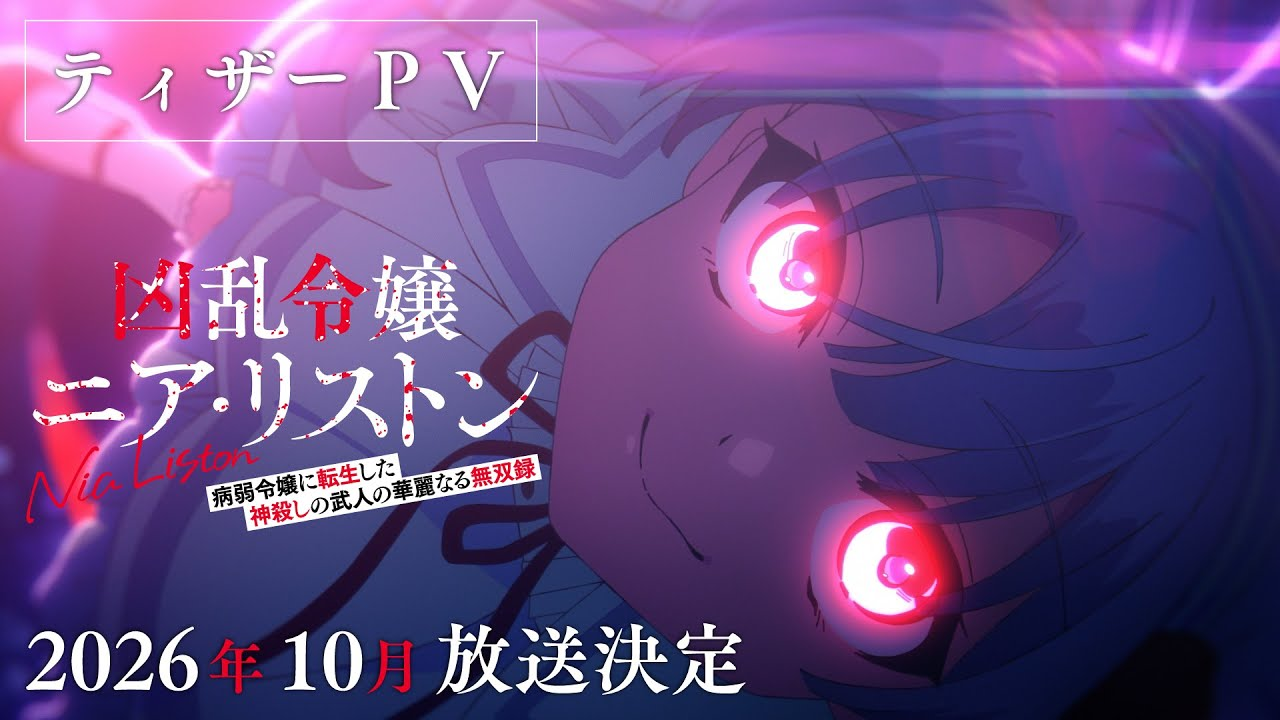
On Tuesday, July 28, 2026, the official website for Nia Liston: The Merciless Maiden — the TV anime adaptation of Umikaze Minamino’s Narou-originated light novel series — confirmed October 6 as its premiere date and dropped its first promotional video alongside a new key visual, expanded cast, and additional staff credits. The announcement answers the question anyone following the Fall 2026 anime season has had since January: Nia Liston now has a specific broadcast window, a full production slate, and enough visual material to evaluate whether a sickly noblewoman inhabited by a god-slaying warrior soul can distinguish itself in an isekai market that, by its own industry’s admission, has a saturation problem.
Nia Liston will air first on Tokyo MX on October 6 at 9:25 p.m. JST (8:25 a.m. ET), followed by BS NTV and MBS. An advance screening of the first three episodes is scheduled for September 22 at the esports TOKYO BAY studio in Japan. No international streaming platform has been announced as of July 29, 2026 — a gap that anyone outside Japan needs to monitor closely before the October premiere window.
The series is produced by Konami Animation, Konami’s in-house anime studio, founded in February 2024 with the stated goal of channeling the company’s game-engine CG technology and production expertise into full animation. Nia Liston represents one of the studio’s first full TV anime productions alongside its Suikoden adaptation — making October 6 a meaningful test date not just for one light novel’s fanbase but for a major game company’s ambition to compete as a serious anime production house.
Narou Pipeline Produces Its 200th Anime — and Nia Liston Is Next
The source material has a specific, documented path. Umikaze Minamino published the web novel on Shōsetsuka ni Narō — Japan’s largest self-publishing fiction platform, which now hosts approximately 2.9 million registered users and 1.29 million works — from May 2019 through January 2021. Over that window, the work accumulated more than 75 million page views, generating the reader-ranking signal that triggers publisher acquisition in this ecosystem. Hobby Japan licensed it and began publishing it as a light novel under its HJ Bunko imprint in September 2022; the eleventh volume arrived June 1, 2026. Square Enix launched the manga adaptation in November 2022 on its Manga UP! service, with Kabuto Kodai as illustrator; eight collected volumes are published, with the eighth out in February 2026. J-Novel Club announced English licensing at its Anime NYC 2023 panel, making digital English editions of both the novels and manga available in North America.
This pipeline — amateur web novel, reader-validated ranking, publisher acquisition, manga tie-in, anime adaptation — is now structurally codified. Shōsetsuka ni Narō passed 200 anime adaptations in May 2026, a milestone the platform specifically documented. Approximately 37% of newly published light novel titles in 2024 originated from Narou or Kakuyomu serializations. Nia Liston, beginning its web novel life in 2019 and arriving as a TV anime in fall 2026, traces exactly this arc.
Warrior Soul in a Sickly Body: What Makes Nia Liston Different From Default Isekai
The isekai tensei genre — stories in which a character dies and is reborn with retained memories in another world — now generates between 8 and 10 new anime titles per season. KADOKAWA, the publishing conglomerate that controls a significant share of the light novel pipeline, listed over-reliance on isekai and narou-kei formulas as a contributor to declining profitability in its published mid-term management plan for fiscal years 2026–2031. Genre saturation is no longer a fan complaint — it is an explicit corporate concern from the industry’s largest buyer.
Nia Liston arrives at this moment with a premise that inverts the genre’s default formula. The standard isekai tensei narrative follows a socially marginal protagonist — often unemployed or overlooked in their original life — who gains extraordinary power through reincarnation. The wish-fulfillment logic is legible: the loser becomes the winner, the powerless becomes the overpowered.
Nia Liston starts from the opposite position. The protagonist of the web novel, nameless in her original life, was already maximal — a warrior powerful enough to have killed a god, who died peacefully on her deathbed regretting only that she never found an opponent strong enough to defeat her. Her desire is not for power but for a worthy challenge. The soul is then transferred, via a forbidden technique called the “Law of Resurrection,” into the body of Nia Liston, a four-year-old noblewoman consumed by respiratory illness, whose parents had employed the technique to save her life. The warrior uses her mastery of ki — the internal energy cultivation central to East Asian martial philosophy — to diagnose and purify the illness from within, then begins her second life as Nia, navigating academy life, the “magivision” entertainment industry, and the ongoing search for a battle worth dying in.
The premise inversion is structurally significant beyond narrative preference. Where standard tensei asks “how will this weak person become powerful?”, Nia Liston asks a more philosophically uncomfortable question: if the soul is the person, and the soul in this body is the warrior’s, then who is Nia Liston? The girl’s family grieves a daughter who is now, in practice, a stranger. The warrior owes gratitude to people she never chose. This is not isekai as power fantasy — it is isekai as identity problem, a question the genre’s dominant formula carefully avoids asking.
Ki, Bioelectricity, and the Body Problem: What Nia Liston’s Premise Assumes About Consciousness
The series invokes two concepts that have substantive parallels in current science — and understanding them sharpens what the show is actually doing with its premise.
The first is metempsychosis: the philosophical claim that a conscious identity can migrate from one body to another at death. Western philosophy’s mainstream position, informed by materialist neuroscience, holds that consciousness is an emergent property of specific brain architecture — synaptic weights, electrochemical signaling patterns, neural connectivity. Under this view, “transmigrating a soul” is equivalent to copying a very specific configuration of neural patterns from one substrate to another. The mechanism is technically extreme but not logically incoherent; the warrior’s memories, tactical knowledge, and personality are the identity, and the fiction treats them as fully portable. Cognitive science’s research on motor memory complicates this: procedural skill — the body-knowledge of combat — is encoded in the relationship between a specific central nervous system and specific peripheral neuromuscular architecture. A concert pianist who loses both hands retains the neural map but not the skill. The narrative’s choice to have Nia rebuild her fighting capacity progressively, rather than instantly deploying her past-life combat ability, is more scientifically grounded than it might initially appear. Declarative knowledge (knowing how a technique works) transfers more readily than procedural execution (performing it with a specific body). Nia starts with the warrior’s mind and must earn back the warrior’s body.
The second is ki — the animating internal energy of East Asian martial philosophy, formalized in Traditional Chinese Medicine as Qi and understood to circulate through invisible meridians whose blockage causes illness. The warrior’s use of ki to heal Nia’s body maps onto a real research area: bioelectricity, the study of endogenous electrical fields that living tissue generates and uses to coordinate cellular behavior. Wound-healing research has demonstrated that the body’s own bioelectric potentials function as directional repair signals — guiding cellular migration and promoting tissue regeneration along electric field gradients. The gap between “bioelectric potentials regulate tissue repair autonomously” and “a trained practitioner can consciously diagnose and remediate pathological states in a foreign body’s bioelectric field” remains large. But the direction of travel — from the body as purely biochemical machine toward the body as electromagnetic regulatory system — makes the ki healing mechanism a coherent scientific extrapolation rather than an arbitrary magic system.
Production and Cast: Konami Animation’s First Major Franchise Test
Motoki Nakanishi directs the series at Konami Animation, with Haruta Segi as assistant director. Nakanishi’s prior credits include Love Is Indivisible by Twins and Summoned to Another World for a Second Time. Gigaemon Ichikawa, whose prior work includes Himitsu no AiPri and three seasons of PuniRunes, handles series scripts. Character design is credited jointly to Yūki Itō (key animator on the Mob Psycho 100 II OAV) and Kana Tosaoka (in-between animator on the Kantai Collection film), reflecting the dual-illustrator lineage of the light novels, where Jishaku drew volumes 1–2 and Katana Canata took over from volume 3. Music composition is by Naoki Endō (Love Live! Nijigasaki High School Idol Club, Nijiyon Animation), with sound direction by Hiromi Kikuta (Aikatsu!, Blue Period, Haikyu!!).
Additional production credits include color design by Ryōta Katsuta and Maki Yamamoto, art direction by Hiroshi Gōroku with background art from Makaria, compositing by Takashi Ōde, and editing by Masayuki Kurosawa.
Honoka Inoue voices Nia Liston, the protagonist. She is joined by Fūka Izumi as Rinokis Funk, Rina Honnizumi as Hildetora Altoir, and Rina Hidaka as Reliared Silver.
Konami Animation established itself in February 2024, specifically to transfer the CG technology and game-production pipeline expertise that Konami Group has built over decades into animation production. Its tagline, “Add (+) Anime to Konami,” signals that the studio positions game-engine fluency — not traditional cel-animation heritage — as its production differentiator. Nia Liston is among the first TV anime at full series length to test whether that game-CG approach produces animation competitive with conventional anime studios. The answer will be visible on Tokyo MX beginning October 6.
Light Novel and Manga Available Now in English — Anime Streaming Not Yet Confirmed
For readers who want to engage with thevel digitally in North America, with nine volumes currently available in English and Volume 10 currently serializing. The manga adaptation by Kabuto Kodai is available
The anime itself has no confirmed international streaming platform as of July 29, 2026. Confirmed Japanese broadcast channels are Tokyo MX (October 6 premiere, 9:25 p.m. JST), BS NTV, and MBS. A platform announcement — likely from Crunchyroll, which covered the series launch in its news coverage, or from an alternative regional distributor — is expected before the premiere window. Readers outside Japan who plan to watch the series from October 6 will need to follow official announcements from the production committee and international streaming partners.
Nia Liston: The Merciless Maiden premieres October 6, 2026, on Tokyo MX. It is the first full TV anime series from Konami Animation adapted from an outside light novel property, and one of the first major tests of whether a Narou- industry itself has identified as a structural problem. The premiere date is confirmed. The streaming destination is not
Frequently Asked Questions
When and where does Nia Liston: The Merciless Maiden anime premiere?
The anime is scheduled to premiere on October 6, 2026, on Tokyo MX in Japan, at 9:25 p.m. JST (8:25 a.m. ET). It will also air on BS NTV and MBS. An advance screening of the first three episodes is planned for September 22 at esports TOKYO BAY studio. No international streaming platform has been confirmed as of July 29, 2026.
Where can I watch Nia Liston outside Japan?
As of July 29, 2026, no international streaming distributor has been announced for Nia Liston: The Merciless Maiden. Crunchyroll covered the series’ premiere announcement but has not confirmed streaming rights. Readers outside Japan should monitor official announcements from the production committee (凶乱令嬢ニア・リストン製作委員会) and major anime streaming platforms for a distributor confirmation before October.
How is Nia Liston different from other isekai reincarnation anime?
Most isekai tensei series follow a protagonist who gains power through reincarnation — the wish-fulfillment premise of the overlooked becoming the exceptional. Nia Liston inverts this: the protagonist was already a god-slaying warrior of maximal power in her first life; her second life’s challenge is not gaining strength but using a sickly body’s limitations to find a battle genuinely worth her ability. The series also explicitly engages the identity problem that most tensei stories avoid: the warrior’s soul inhabiting Nia’s body raises the question of whether the original Nia still exists in any meaningful sense, and what obligations a borrowed identity creates toward a family the warrior never chose.
What is Konami Animation and why does it matter for this show?
Konami Animation is an in-house anime studio established by Konami Digital Entertainment in February 2024, with the explicit goal of applying the company’s game-engine CG technology and production pipeline to animation. Its tagline, “Add (+) Anime to Konami,” signals that the studio treats game-engine fluency as its core production differentiator rather than traditional animation heritage. Nia Liston: The Merciless Maiden is one of its first full-length TV anime adaptations of an outside light novel property, making it an early public test of whether a game company’s CG methodology can produce animation that competes with established studios.
ⓒ 2026 TECHTIMES.com All rights reserved. Do not reproduce without permission.
