

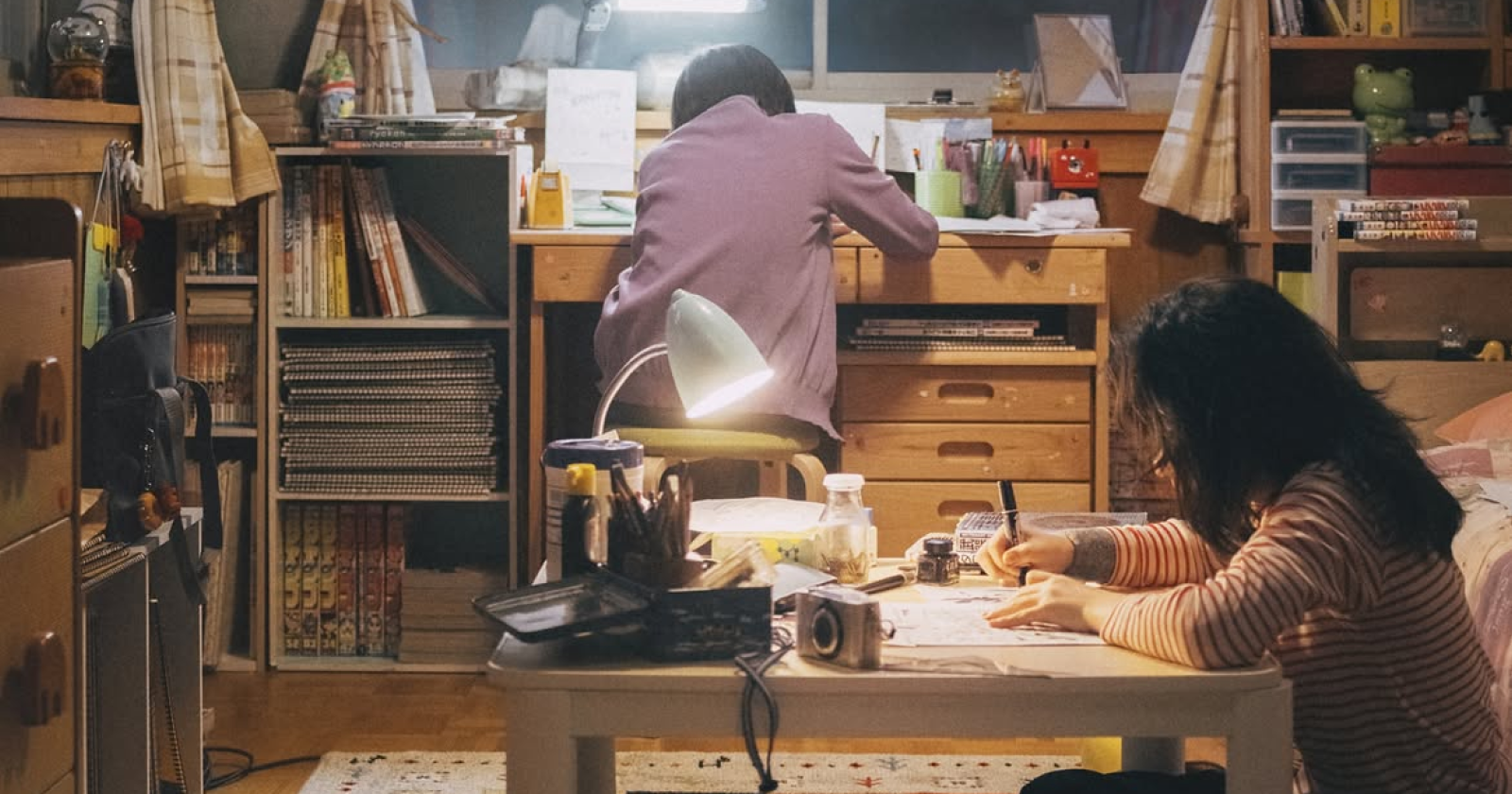
“Look Back” is the story of friendship and competition by Hirokazu Kore-eda From manga to anime and now to live-action, in competition at Venice 83
In 2021, Tatsuki Fujimoto wrote and published the manga Look Back. The story follows the very young aspiring mangaka Ayumu Fujino, who draws strips for the school newspaper — until she stops drawing the moment a young student from another class proves to be better than her. Kyōmoto is a kind of hikikomori: she never leaves the house, and since she never attends school, she draws and draws and draws, producing backgrounds and settings worthy of comparison to those of the great masters. The two, after a fateful encounter, begin working together, forging a friendship with a single goal: to create a manga so successful it will be adapted into an anime.
Stories sometimes become reality. In this case, it concerns the protagonists’ aspirations coming true — when in 2024 Tatsuki Fujimoto’s manga comes to life on screen in animated form. Then, in 2026, it takes a further step. Hirokazu Kore-eda, a veteran of Japanese and world cinema, takes the reins of the narrative, adapting — just two years later — the encounter between Ayumu Fujino and Kyōmoto in a work that speaks both to the original text and to its anime version, finding elements of both within itself, while also pairing with delicacy with the director and screenwriter’s own cinematic sensibility.
Kore-eda’s Look Back: a review of the film in competition at Venice 83
Look Back, premiering in competition at Venice 83, is built around a few carefully chosen narrative threads: drawing, friendship, and fate. The meeting in early youth between Fujino and Kyōmoto profoundly shapes the course of their lives, with the film showing how fate ultimately reigns supreme — and how, because of this, all one can do is fully savour the time we are given, especially with the people who come into our lives along the way. Within a concise span of time (the anime runs under an hour; Kore-eda’s film, an hour and forty minutes), Look Back precisely sketches the characters of its protagonists, speaking of affection and talent, of what it means to truly care for someone and how far one is willing to push oneself to achieve one’s goals.
Competition is a driving force in Look Back, gradually transforming into an exchange between the protagonists and their way of growing up. It is a thorny feeling, but a genuine one — particularly when you are young, you cannot explain it, you simply feel it; and when it resurfaces in adulthood, you must learn to turn it into fuel to give your best, whether alone or alongside others. It becomes a mirror in which to see oneself — and for the characters, especially Fujino, it becomes the greatest challenge she must overcome.
Friendship, talent and competition at the heart of Look Back
@emasasic In the room for the world premiere of Hirokazu Koreeda’s Look Back, which earned a 12-minute standing ovation and brought the cast to tears! #venicefilmfestival#lookback#koreedahirokazu#standingovation#filmtokoriginal sound – Ema Sasic
And if for a moment goals can converge, one must be ready for when they end up diverging, clashing, no longer able to align — which is simply what growing up means. And so one must grow, study, improve. Measure up to the people beside you, with whom you have chosen to share a piece of art and of life, as well as your dreams — even when those dreams can no longer overlap.
The ever-refined gaze of Hirokazu Kore-eda makes Look Back a work that says a great deal without ever raising its voice, even when the dramatic weight of the story might seem to demand it. A touch that remains faithful to his own cinema while paying homage to another pillar of the national and international landscape — with Studio Ghibli’s backgrounds cited and even celebrated through the film’s landscapes, which add that extra hint of tenderness that the original story already called for. He is one of those directors who, much like Kyōmoto thanking Fujino for bringing her out of her room, we should always thank for bringing us out of ours and leading us into a theatre to discover (his) cinema.

5 Comments
Pingback: Why 'Furious,' 'Lanterns' and 'The Bear' are 3 best TV shows to stream - Comic Vibe
Pingback: PlayStation 3 emulator RPCS3 now lets you play games straight from discs - Comic Vibe
Pingback: Television Host and Entertainment Journalist Josh McBride signs with WME and secures exclusive Acast partnership as The McBride Rewind podcast accelerates national growth - Comic Vibe
Pingback: Taiwanese manga creators win gold, bronze at Kadokawa World Manga Contest - Comic Vibe
Pingback: Old Delhi's Public Spaces Come Alive with Community Art Initiative - Comic Vibe