

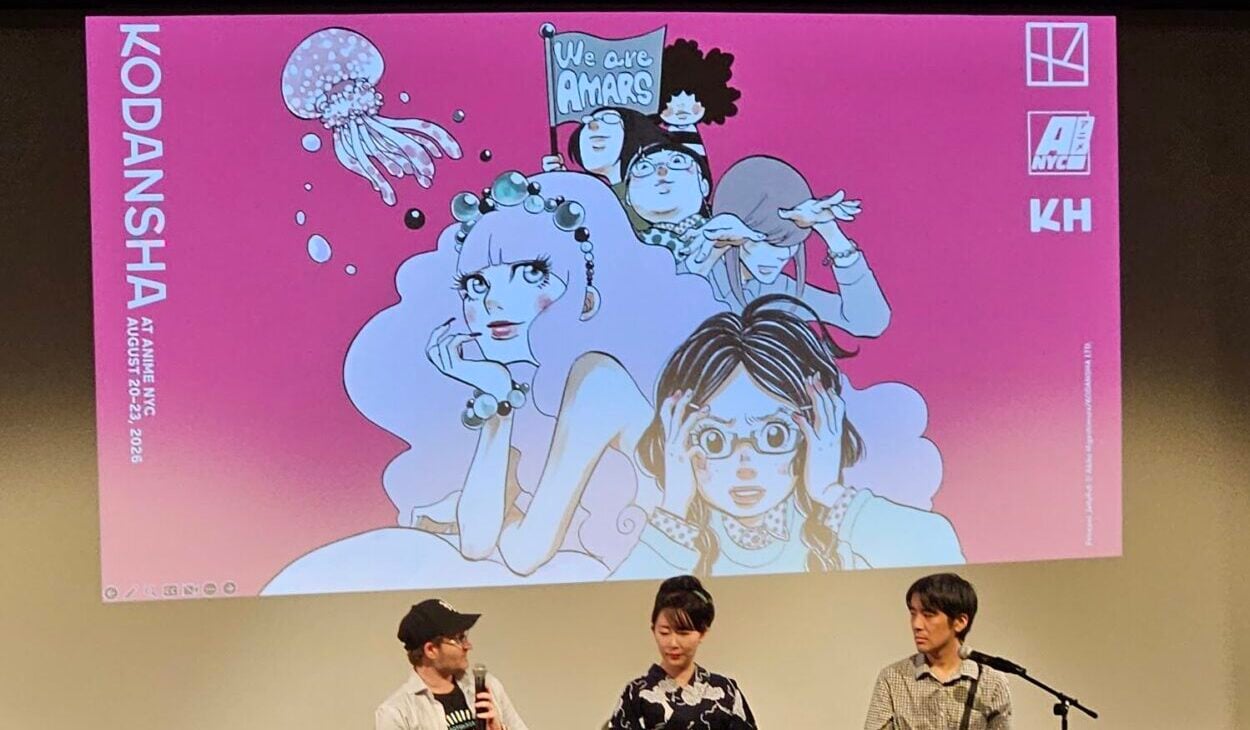

Akiko Higashimura received the 2026 American Manga Award of distinction for her long career in manga. Her series published in English include Princess Jellyfish, Tokyo Tarareba Girls,and Blank Canvas: My So-Called Artist’s Journey,and additional titles by Higashimura are now available as part of Shueisha’s Mangamillion website. Besides manga, she also wrote and directed the drama The Vacation Principle,now available on Netflix worldwide, and art-directed the live-action adaptation of Blank Canvas,which the Japan Society screened on Saturday, August 23rd, along with a book signing and a Q&A session after the movie.
During the screening, The Beat had the pleasure of interviewing Higashimura about her career.
THE BEAT: I understand you work with a large team of assistants to produce your manga. How has your workflow changed over time as collaboration technology and digital art tools and collaboration tools have evolved?
AKIKO HIGASHIMURA:Right now, me and all my assistants use iPads, and it’s mostly remote work. Since COVID, a lot of Japanese manga artists have transitioned to remote work.
THE BEAT: Do you like working remotely with your assistants more than having everyone in the same place, or what do you prefer?
HIGASHIMURA:Remote work gets a little lonely at times, but the work efficiency increases a lot. When everyone gets together, we tend to play around a little too much, so there’s a very noticeable work efficiency improvement when working remotely. Nowadays we just get together to go drinking. Workwise, the quality of the work is a lot better.
THE BEAT: Speaking of working digitally, you made a webtoon a few years ago, which is a different format from manga. What was that process like, and do you think you’d want to try it again?
HIGASHIMURA:The webtoon was in full color, and back when I was working on it, I felt that it took a lot of effort, but I felt like maybe in the future, full colorization would be inevitable. But if you look at the popularity of manga like Demon Slayer or Jujutsu Kaisen, it’s clear black and white is here to stay. I don’t think you have to overwork yourself to try something new. But now that I’ve tried new things, I think I’ve been able to reach some readers who don’t read my stuff usually, so I think that was a great opportunity. If, internationally, that’s an easier way for people to read my work, then I’d like to try it again.
THE BEAT: I know some people who don’t like reading things in black and white, so that makes perfect sense to me.
THE BEAT: On the subject of trying new things, I know your Netflix drama [The Vacation Principle] came out recently, and I know a lot of your manga has been adapted into live action, but what was it like to write and direct a drama from scratch? Is that something you would want to do again?
HIGASHIMURA:As I worked on live-action adaptations of manga, I began to see a lot of the issues that come up when adapting manga into live action from just doing them on my own. There’s two sides to the process, the manga industry and the movie industry, and from working on the movie side of things I found out that it’s very hard for them to work together. It’s not that they don’t really get along, it’s that the flow of time is different between the two industries. When it comes to creating new pieces or new adaptations, I feel like I would like to put more of my input into that process.
THE BEAT: You’ve done autobiographical work, purely fictional work, and work based on historical events, but what types of stories would you say are the ones you find easiest or most fun to write?
HIGASHIMURA:It might be surprising, but I think historical works are the easiest to write. The story is already decided because it’s just events from the past, and everyone’s wearing kimono, so it’s very easy to draw. Kimonos are all the same. When it comes to shojo manga, thinking of the clothing design is sodifficult.
THE BEAT: But your characters are known for being very fashionable, so I think you’re very good at it.
HIGASHIMURA:It’s so much work… It’s so much work.
THE BEAT: I know you make seinen, shojo, and josei manga, what is it like to create work for different demographics at the same time? What do you have to do differently for different magazines?
HIGASHIMURA:For me, there’s a story I want to write about, and I just think about which magazine would fit that story most. So I just decide what store to put my product in. I have a story in mind, and the story comes first. Japan has so many magazines that have so many different demographics, age, gender, and I think it’s a great thing that Japan has so many different times. Only Japan has manga magazines targeted towards just businessmen or just female high schoolers or just elementary school boys, and I think that’s a great thing that Japan can pinpoint the target demographics in this way.
THE BEAT: What are you most excited to be working on right now?
HIGASHIMURA:My kimono manga Gintaro-san, Much Obliged.
THE BEAT: Oh, it’s onMangamillion. There’s about 20 episodes on there right now.
HIGASHIMURA:Wow. Well, that’s what I’m working on the most right now. It’s about kimono, and I’ve been drawing a lot of it, and it’s very popular in Japan and I’d love for more people to read it on Mangamillion.
Higashimura passes the shikishi she’s been working on to her son to fill in the hair with a marker.
THE BEAT: I actually know a comics writer who also has her son work as her assistant. Amy Chu, she’s a writer for Marvel and DC.
DEB AOKI:Her son comes with her to all her conventions, and I think he’s about the same age as your son.
THE BEAT: That kind of leads into my next question. Which of your manga would you like to see published in English that hasn’t been picked up yet?
HIGASHIMURA:Goro Akechi, Epicurean Private Eye. It’s a murder mystery, with gourmet, and it’s a lot of fun.
AOKI:It’s also a J-drama on Viki.
THE BEAT: I hope the publishers pick it up.
What kind of manga have you been reading lately? Are there any newer mangaka you think are doing interesting work?
HIGASHIMURA:I’ve been a judge for a lot of manga awards, so I’ve been reading a lot of manga from younger artists. Recently, Cocoonby Machiko Kyo made a big impression on me. Machiko Kyo publishes in the same magazine as I do, and it’s a fantastic work. Once I read it, I couldn’t stop thinking about it for over a month. After I finished reading it, my tears wouldn’t stop flowing.
THE BEAT: It was really good. I also read it.
HIGASHIMURA:She’s such a great artist. She graduated from Tokyo University of the Arts. I’m a big fan of her work.
THE BEAT: This is kind of a cliche last question, but what advice do you have for young artists and young manga creators early in their careers?
HIGASHIMURA:For the next five years, make one piece of work every month, and show it to your friends, and try to continue that as much as possible. It’s a very simple but very arduous task to do. Just keep doing that as much as possible. Don’t start posting online immediately, try to get better before you post online. Once your friends tell you “this could be a professional work,” that’s when you can post it online. Nowadays, people start posting their work online a little too early, and they become dejected when strangers start insulting it.
THE BEAT: I started posting my comics online when I was thirteen, so I have experienced that.
HIGASHIMURA:Even if you receive compliments, those are empty compliments. You have to actually see, in-person, the live reactions of the people reading your piece. You need to see your friends live reactions to your work. You have to see them laugh or be surprised at your scenes, you have to see all of that.
Right now a lot of people will say “Oh, you can just post that online now” but I really think that’s completely meaningless. First and foremost, your friends, and especially your delinquent friends.
Thank you to Deb Aoki and The Japan Society for making this interview possible and Jiay Shida for interpreting.
