

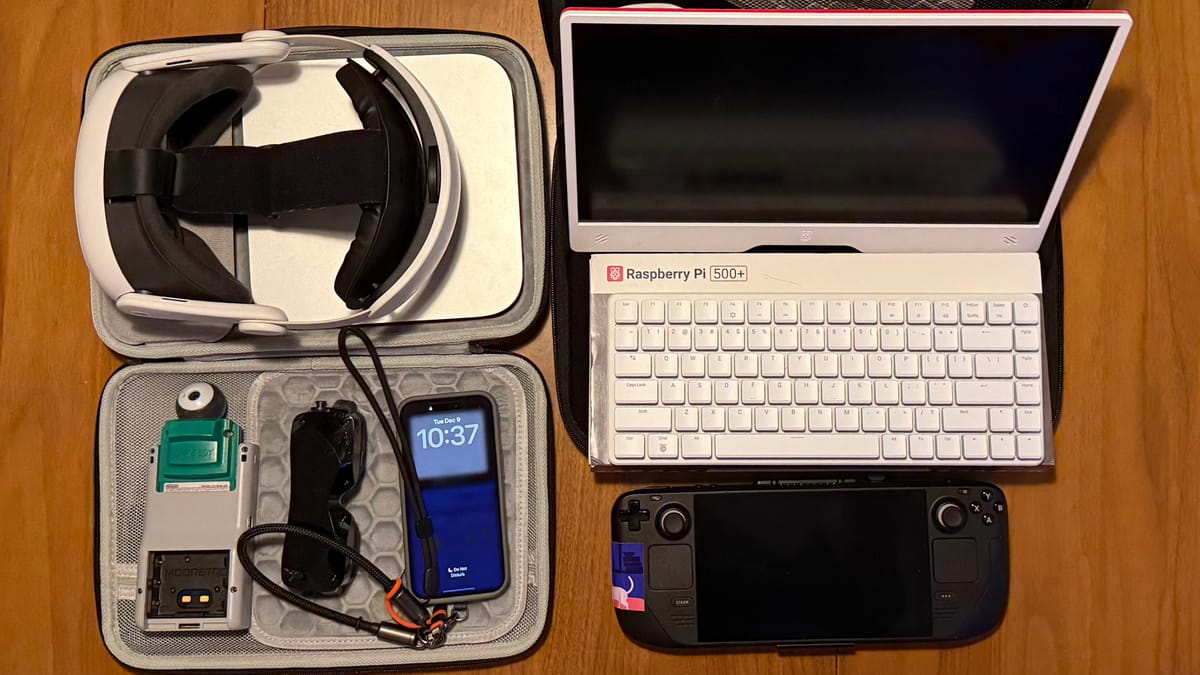
William Gibson’s 1984 novel Neuromancer depicts a man who uses a “custom cyberspace deck” to project his “disembodied consciousness” into a “consensual hallucination” of the Matrix. The hardware needed to spend time in VR is a “cyberspace deck” that appears to “bump” against the protagonist’s waist.
In 2026, Reddit’s “Realworld cyberdecks” page, with hundreds of people offering new rigs every week, says, “As the era of virtual reality is here, so is the era of cyberdecks.”
If the “era of virtual reality” is here, and “cyberspace decks” are the means to get there, what will the first “real world” decks look like? What will their capabilities be?
Unlock digital data in VR by locking it into the real world
What is Cyberdeck?
My custom deck starts with several terabytes of local storage for videos, photos, music, games, and other personal files. Since around 2016, it has been possible to access this data store in VR using virtual desktops. However, I don’t buy much software from Microsoft, so my data doesn’t fit within Windows. In the future, I would like to build data on a Framework laptop and drive VR directly on Linux. In the meantime, I work with file systems using macOS, iOS, Windows 11, SteamOS, and various flavors of Android.
Many of us carry at least 50 gigabytes of storage on our phones wherever we go. Is it really that hard for us to imagine that in a few more years, most of us will be able to take advantage of the terabytes we carry around?
After using headsets for about a decade, from the Gear VR in 2014 to the Quest 3 in 2023, when the Vision Pro arrived in 2024, I experienced for the first time a standalone system unlocking terabytes of digital information for use in VR. Sure, Apple introduced apps from my iPad and iPhone, but I also started wirelessly browsing my personal data stores on local drives through Mac Virtual Display. This feature turns off your Mac’s screen in the “real world” and opens a resizable virtual panel in VR instead. If someone else is looking at my screen, my data will no longer be visible there. In some scenarios this is a bug, but in many scenarios it is a feature.
Gibson’s novel understood the value of cyberspace before “The Matrix” actually existed. VR is now a consumer reality, and our model for personal storage of digital content collides with Gibson’s ideas about the deck and technological provision of cyberspace. For example, applying personal computing to life without the limitations of a specific platform shows the limitations of digital keepers. The FAT gods command us not to store files larger than 4 gigabytes. Also note that the file name contains special characters.
In my opinion, a “custom deck” starts with funneling personal data into a portable device. MicroSD cards can be read by Steam Deck and Steam Frame, and thumb drives include a universal connector. So you can start building your deck with a $15 thumb drive or MicroSD card and build it over time to a multi-thousand dollar laptop with the latest graphics card for cyberspace.
entry level deck
Hanging in a bag in the corner of my office is Raspberry Pi’s newest personal computer. Billed as a “premium desktop computer,” the Raspberry Pi 500+ is a $200 keyboard with a 256-gigabyte solid-state drive running Linux.
Just send USB-C power to your Raspberry Pi and the keyboard will start computing. Using the tools that came with the 500+, I removed the screws on the bottom of the keyboard and replaced the drive. The custom computer boots to the desktop quickly and packs 4 terabytes of storage under satisfying mechanical keys.
Now you just need a place to display your files.
Conceptually, the Raspberry Pi and I have assembled a custom deck of hardware and software that is cheaper and more portable than Apple’s offerings. The Pi doesn’t take me to cyberspace, but I can see it there and access it from a floating device like a Mac. And all of this takes place in the space traditionally occupied by the keyboard used to operate personal computers.
Wi-Fi and Bluetooth emanate from the keyboard. On the back, Ethernet, USB, and micro HDMI ports connect physical accessories. The biggest problem is that, even though it’s 2026, the easy-to-use software needed to access deck files wirelessly in virtual reality doesn’t exist. Instead, I hack my keyboard PC into VR by any means necessary. This means dealing with things like VNC, IP addresses, or capture cards that cause delays.
Steam Deck provides access to Linux in a more user-friendly handheld console-like form factor compared to the Pi or Mac. If logging into Steam online is too restrictive before you can do anything fun with your computer, you can build your own deck of hardware and software and only log in online when you need to.
Framework for the future
Readers who have invested thousands of dollars in personal computing equipment know that $200 or even $500 doesn’t really buy a “luxury desktop computer.” If the Raspberry Pi can only display a flat screen in VR, the Framework laptop should be able to fully embrace the Cyberdeck concept with an NVIDIA RTX 5070 and 64 gigabytes of RAM.
My ideal configuration for a personal computer would basically match the price of a top-of-the-line headset on a top-of-the-line deck that can be upgraded for years. To me, it doesn’t really matter whether a “deck” starts with data on a thumb drive in a well-structured folder system, or whether there is a complex operating system, graphics card, and central processor with a virtual assistant managing the data. Once I put in my data, the computer becomes “custom” and “personal.”
The goal is to take your personal computing with you wherever you go. What I’m really concerned about is moving the data deck and hardware. Not in a cafe or on a plane. Of course those locations would be great, but the most important place the deck will be used is in VR.
Everyone already owns a cyberdeck that doesn’t directly support VR
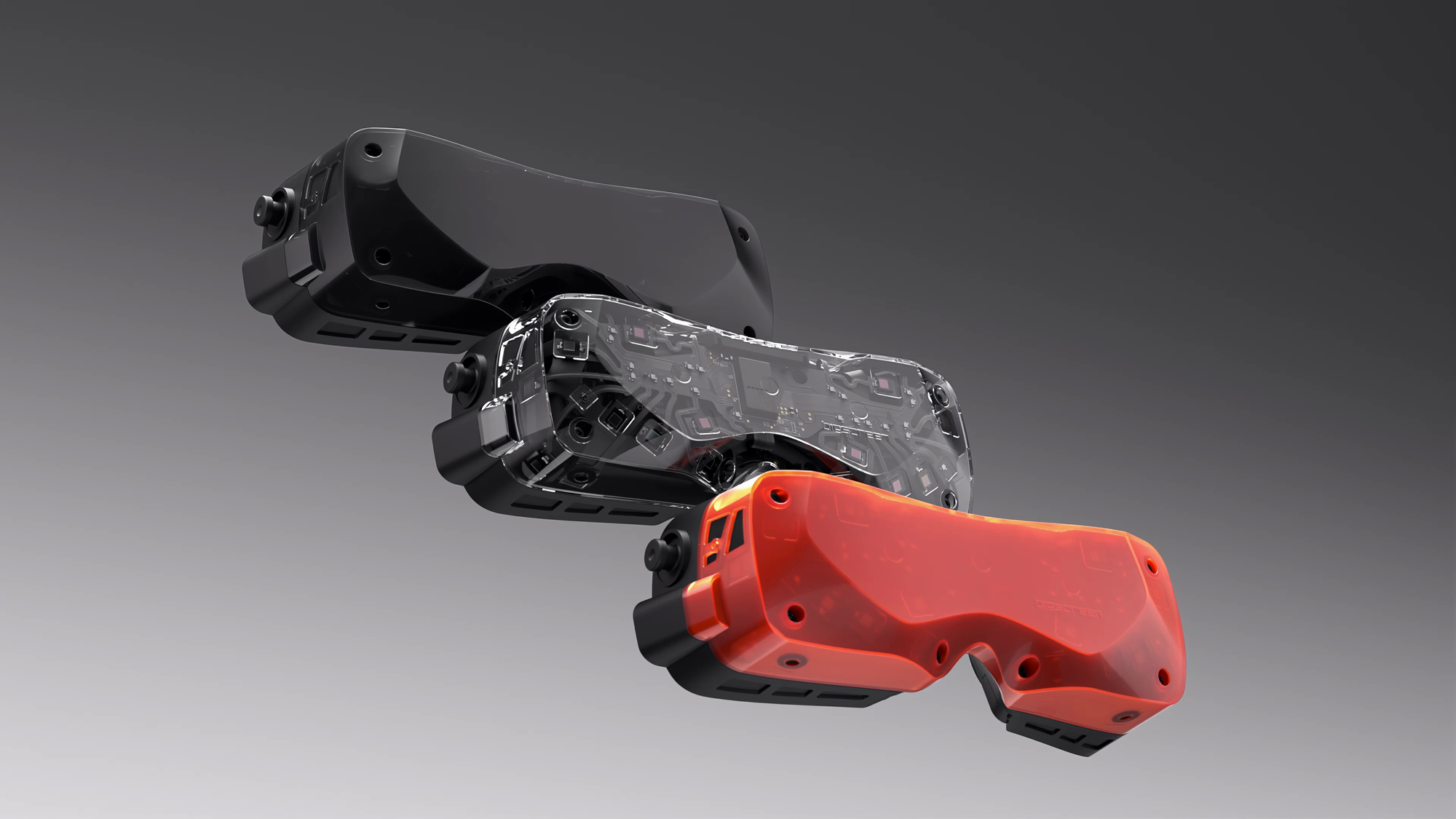 Bigscreen Beyond 2 requires a deck.
The Cyberdeck is the key missing from Bigscreen Beyond.
As long as you’re sitting in a chair and have plenty of clean power, conceptually speaking, when your headset touches your face, Bigscreen Beyond and your Framework laptop should put you in cyberspace.
Yes, you need a room-cleaning laser right now for Beyond. Adding network connectivity to this core experience has many benefits. Yes, just like an open computer, you can also add accounts, friends, entitlements, digital rights management, and thousands of other services and software packages.
Whether Beyond is running from a desktop PC or a Framework laptop is a secondary issue. What’s fundamentally important is that when you use VR, you have a storage device that keeps all your personal and favorite files organized, indexed, searchable, accessible, and playable, separate from your computer and at your fingertips.
As of this writing, data portability in the “cloud” typically means waiting hours or days to download a store of information from your provider. However, there is a more direct and extreme example of data portability, and removable storage systems have been providing data portability for decades.
If you have the freedom to disconnect both your content and yourself from the network and headset at a moment’s notice, you also have the freedom to take your content with you to places and locations such as VR.
From MP3 players and headphones to PCs and Assistants
Over the past quarter century, MP3 players became iPods and music libraries became the launching pad for iPhones. This is a new kind of hyper-connected deck full of personal information. From the iPhone to Android, our pocket deck has consumed nearly every product category in personal computing and reinvented several others.
Something new is happening in spatial computing, starting with virtual reality experiences and extending to pass-through views and mixed reality. Any surface can be turned into a touch-sensitive display. It also makes it even more convenient for existing touch-sensitive displays to accept touch input while turning off photon flow. Just send that data as bits over the network as needed. With skinnable pass-through views, that “deck” can be anything from a camera to a map to a tool for dragging objects. Even non-interactive displays can be a frame for new functionality. While you’re watching a movie with subtitles, your friend sitting on the same couch can enjoy the same movie in 3D without any text distractions.
It’s just for beginners. Now imagine that you hold your phone in your hand, look down at it, and swipe along its surface while in VR, but the screen is turned off in the real world. Or imagine yourself standing in Hyrule playing Breath of the Wild with a Seeker Slate in hand.
Like the term “virtual reality” before we could go there at any time, the term “cyberdeck” still exists mostly in the realm of fiction, except for people posting on creative subreddits. It’s still mostly a concept. But consider the possibility that VR, as a concept, has taken a very long time to be accepted by mainstream audiences. The reason is that we lack companion devices, data, and services as we roam through different worlds. To interact with VR, you hold a pair of controllers in place of your hands, instead of a cyberdeck that displays a map of your destination.
Take out your pack and access cyberspace with a terabyte between your headset and glasses. Meanwhile, Neuromancer is in production for Apple TV.
