

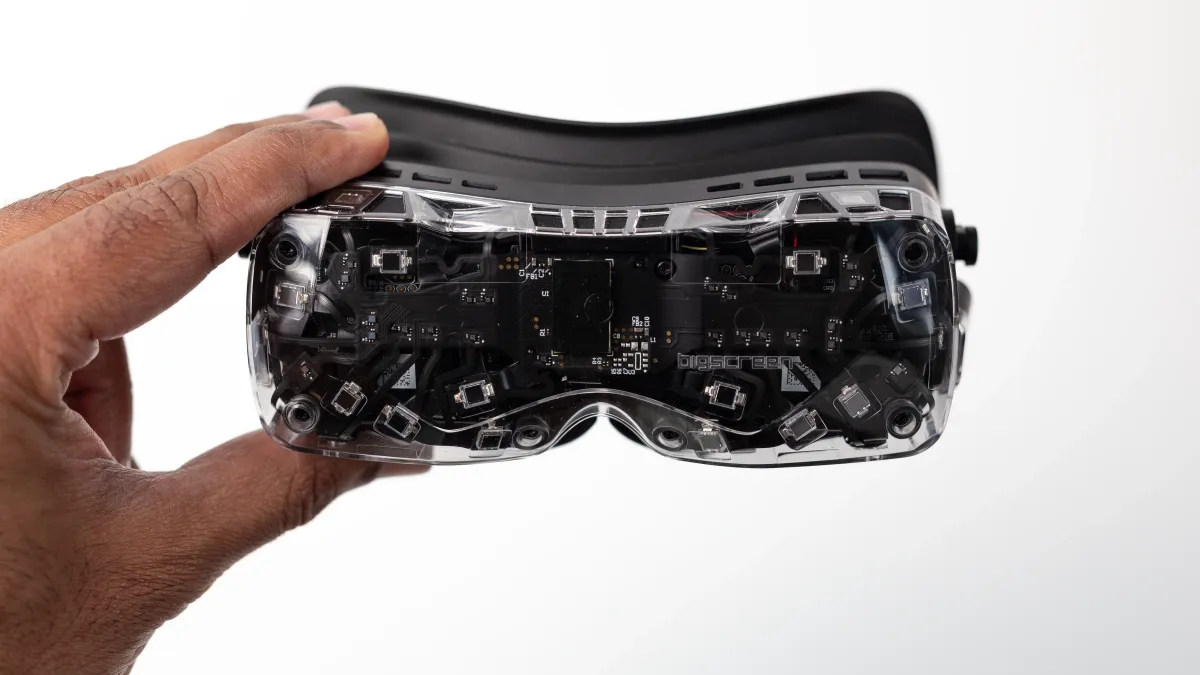
Bigscreen founder Darshan Shankar believes the Beyond headset could become one of the top five systems used on Steam in the next few years.
In the process, Shankar hopes to fully catch up to February’s demand for Beyond 2 headsets and “ship within 1-2 business days, including custom fit and universal fit orders.” In April, Bigscreen celebrated 10 years of shared co-viewing in VR on Steam, and Shankar suggested in an email that it would “perhaps keep the ‘beta’ tag forever.”
Shankar said Valve’s Steam Frame announcement coincided with “one of our biggest sale days,” and that “Beyond 2 has become an obvious upgrade path for users who want an ultra-lightweight, high-resolution micro-OLED, but still use their preferred SteamVR tracking/controller setup.”
As Valve prepares to launch its Frame headset, I asked Shankar if Bigscreen will support simultaneous flat screen viewing with devices like Steam Deck. Shankar replied:
“This has been a regular topic of conversation for the past 10 years. We continue to focus on VR and I think that’s our strength. Many other companies (especially Valve) will do a good job with PC and VR cross-play. We are focusing on areas where we think we have an extraordinary advantage in capabilities and knowledge. We can’t announce anything yet about software development. We need more time to develop 🙂 But we’re not sitting idle, that’s for sure.
Bigscreen has just released Dynamic Foveated Rendering for the Beyond 2e headset, available for early access at iRacing and DCS World, and is looking to be among the first to support the feature, promising “performance improvements with eye tracking.” I purchased the Beyond 2 without eye tracking and received it near the end of 2025 to keep the base station operational for several more years. I’d love to hear reports from 2e customers on actual performance using this feature.
“Hundreds of thousands of customers around the world are currently actively using SteamVR base stations and controllers with Valve Index, HTC Vive, and more, making Beyond 2 the obvious upgrade path for users who want an ultra-lightweight, high-resolution micro-OLED, but still use their preferred SteamVR tracking/controller setup,” Shankar wrote. “We are strongly committed to manufacturing Beyond 2 over the next two years using SteamVR Lighthouse tracking. We can say this with certainty as we have components in stock and a production line set up to run continuously. We have signed agreements with our enterprise customers because they rely on our hardware for their business.”
Beyond 2 was announced in March 2025 and began shipping in July 2025, with universal fit cushions shipping near the end of the year.
“December is our biggest shipping month, shipping more units in a single month than we shipped in a typical year for Beyond 1 in 2023 or 2024,” Shankar wrote. “Faced with much higher-than-expected demand, Beyond 2 has already sold nearly three times as much as Beyond 1.”
“We thought we would have inventory on hand for quick shipping by August or September, but demand was too high. Every time we increased supply/production, demand was increasing even more.”
As of this writing, the Beyond headset would have to overtake PlayStation VR2, Meta Quest Pro, and both Windows Mixed Reality and Oculus Rifts to break into the top five, according to Steam Hardware Research.
“It will probably be in the top five within a year or two, alongside the likes of Steam Frame and Quest 3,” Shankar wrote. “Beyond 2e’s built-in eye-tracking camera is the first computer vision-driven product we’ve shipped. It wouldn’t be surprising to see more cameras in Bigscreen Beyond eventually, but there’s no timeline for that. R&D on cameras started years ago, and we’re still years away from releasing anything. The bar for camera-based features is very high.”
“I think the size of the existing SteamVR ecosystem is underestimated. With Steam Frame ending support for Lighthouse, we’re actually seeing an increase in sales.”
Shankar said that in 2026, Big Screen will focus on expanding the company’s international presence.
“We currently sell in the US, Japan, Canada, UK, Europe, Australia, and New Zealand (over 50% of our sales are international). We plan to open a facility in the Netherlands in early 2026 to increase the speed of fulfillment and support in Europe,” Shankar wrote. “Currently, it takes three to 10 days to ship products within the EU from our Los Angeles factory, but we aim to reduce this to one to two days by working with our local European center,” Shankar wrote. “We’ve achieved meaningful scale as a company (we expect to exceed $100 million in annual revenue next year). We’re true to the values built by passionate VR enthusiasts, for VR enthusiasts, and we’re here for the long term.”
