

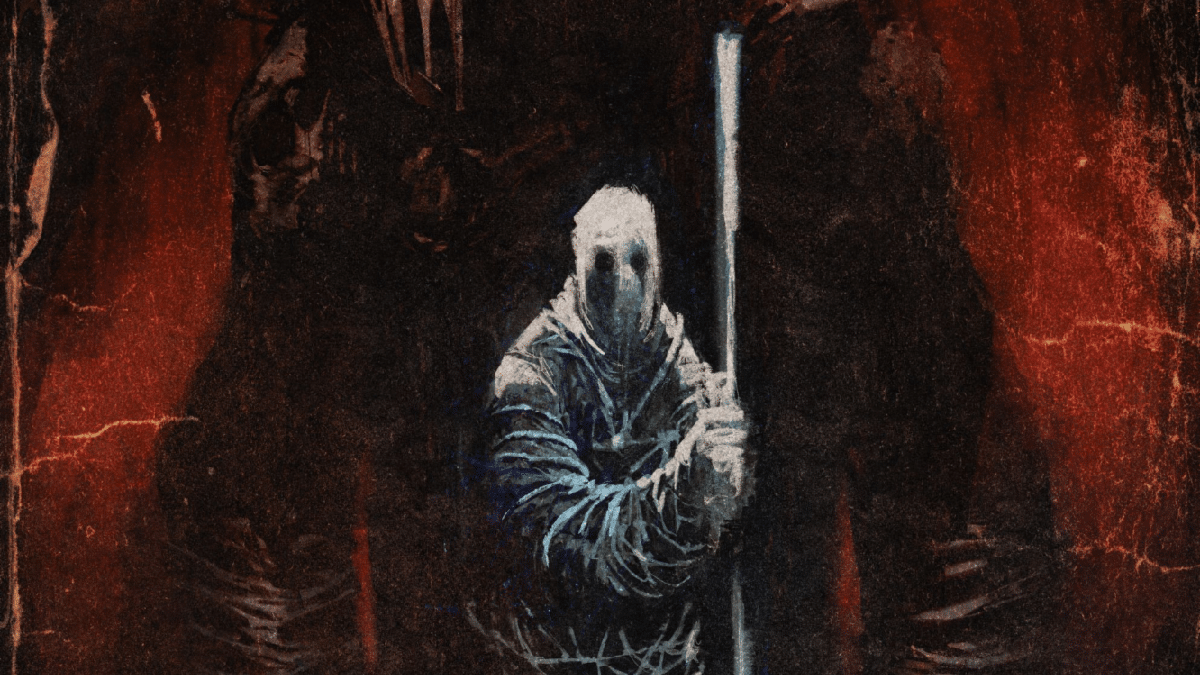

John Carpenter might have just made the case for every horror comic to be accompanied by its own soundtrack. When Storm King’s latest graphic novel was announced, John Carpenter’s Cathedral, it came attached with news of a new synth-metal album crafted by Carpenter himself along with musicians Cody Carpenter and Daniel Davies. It wouldn’t just serve as a standalone concept album. It would also act as the official score for the book.
After reading Cathedral with the music blasting out of my headset, there’s no denying that the combination of the two opens up a special kind of darkness that makes an already visceral experience more terrifying than I could ever have imagined. I can’t think of one without the other. And they scare better because of it.
Cathedral is Sandy King, andSean Sobczak, with art by Federico de Luca and Luis Guaragna. Sian Mandrakecolored the Underworld portions of the story and Marshall Dillonlettered it
The story follows Lieutenant Christine Marks, along with detectives Hernández and Mayfield, as they investigate a shockingly gruesome murder on the grounds of an abandoned cathedral. The man who was killed was Marks’ dad. Video footage reveals a massive monster on the scene that essentially turned the victim inside out, an image that artist Federico de Luca sets the story’s tone with and makes the most out of early on.
What follows is a nightmare that’s constantly pushing the boundaries of its own brand of horror, with things getting progressively more frightening page after page. The intensity ramps up the moment Marks and the detectives find an elevator that takes them down into a hellish underground that’s an extension of the abandoned cathedral, a violent place that houses a cathedral of its own. Once there, the search for the murderous creature really begins.
Carpenter, King, and Sobczak are quick to establish a kind of dream logic that sets the stage for an aggressively paced affair that aims to bombard the reader with a wide range of terrors that get uglier and uglier with each new discovery.
It’s very ambitious in this regard, and artists de Luca and Guaragna do their best to deliver on it. Their creatures are biblically demonic in scope, things that would feel right at home in a John Carpenter-directed version of Dante’s Inferno. Trees with eyes, toad-like monsters, and haunted ferrymen make the characters question their sanity at every turn.
Special notice should be given to de Luca’s character and creature designs. His ability to extract fear out of human faces and pure maliciousness out of his monsters is nothing short of impressive. Some of the most lasting images from the book come from his side, all of which lean on intricate line work to produce lived-in characters with a sense age and personal history.
Guaragna follows suit with imagery that evokes a more classic horror sensibility, albeit with twists of his own. It’s more evident in the objects he adorns his creatures with, especially the gory trinkets some of them carry on their bodies. It embraces a kind of weird that was prevalent in the dark fantasy offerings of the late 80’s and 1990s.
Cathedralcan be seen as an amalgamation of some of Carpenter’s most notable works, all of which are beautifully distilled by Sandy King and Sean Sobczak in their scripting. There’s a bit of Prince of Darknessin there, apparent in the demonic atmosphere that engulfs the abandoned cathedral. In the Mouth of Madnessechoes throughout in the way the Underworld reveals itself as a place that changes shape and form the deeper it goes. Some might even see shades of Carpenter’s “Cigarette Burns” from the Masters of Horror anthology series in terms of pacing and forward momentum.
The same can be said of Cathedral’s score. Each of the 14 tracks in it represents a story beat in the graphic novel. It’s both a mood-setter and a key storytelling element, and it incorporates sounds that Carpenter has experimented with before in his films.
The track called “Abandoned Cathedral” feels like it was formed around the same sonic palette that was used in Prince of Darkness. It’s heavy on organ-like synths that point to the coming of something ancient and evil. “Desolation in the Underworld” sounds like something a new Halloweenmovie could close to, ominous and meandering in ways that unsettle.
Tracks that go hard on the electric guitar remind of the opening theme from In the Mouth of Madness (like “Lord of the Underground”), while others might even offer a wink or two at Big Trouble in Little China(like “The Ferryman”).
And then you have a track called “Inside Out.” Fans of Goblin(the band behind the legendary Dawn of the Deadscore) will find a home in this one. It belongs in the family of 70’s Italian horror soundtracks with its low but quick marching beat that uses hard rock as a means to establish a sense of impending doom.
The score doesn’t attempt to match its runtime with the comic’s, though. Don’t expect Pink Floyd/Wizard of Ozlevels of pairing here. Cathedral’s score is meant to be felt as you’re reading. The tracks flow well throughout and complement each other, always serving the story no matter where it falls in the album’s order.
While readers can enjoy Cathedralas both a graphic novel and a music album separately, it’s hard to recommend one without the other once you’ve experienced the things they achieve together. In a sense, it points to legacy. Halloweenis Michael Meyers, but the iconic slasher just doesn’t feel right if his equally iconic theme music isn’t accompanying his menacing stride. That this works so well with a comic book speaks to the firm grasp Sandy King’s Storm King has on the genre in that medium and the things the publisher is willing to do to keep it fresh and exciting.
It’s as much a celebration of the director as it is of the comics publisher. As such, it must be experienced in its ultimate form. Nightmares this good demand nothing less.
