

The NBA is coming off a banner year.
Across all networks and streaming providers, the 2025–26 regular season delivered the highest average viewership in 13 years, up 35% over the previous season.
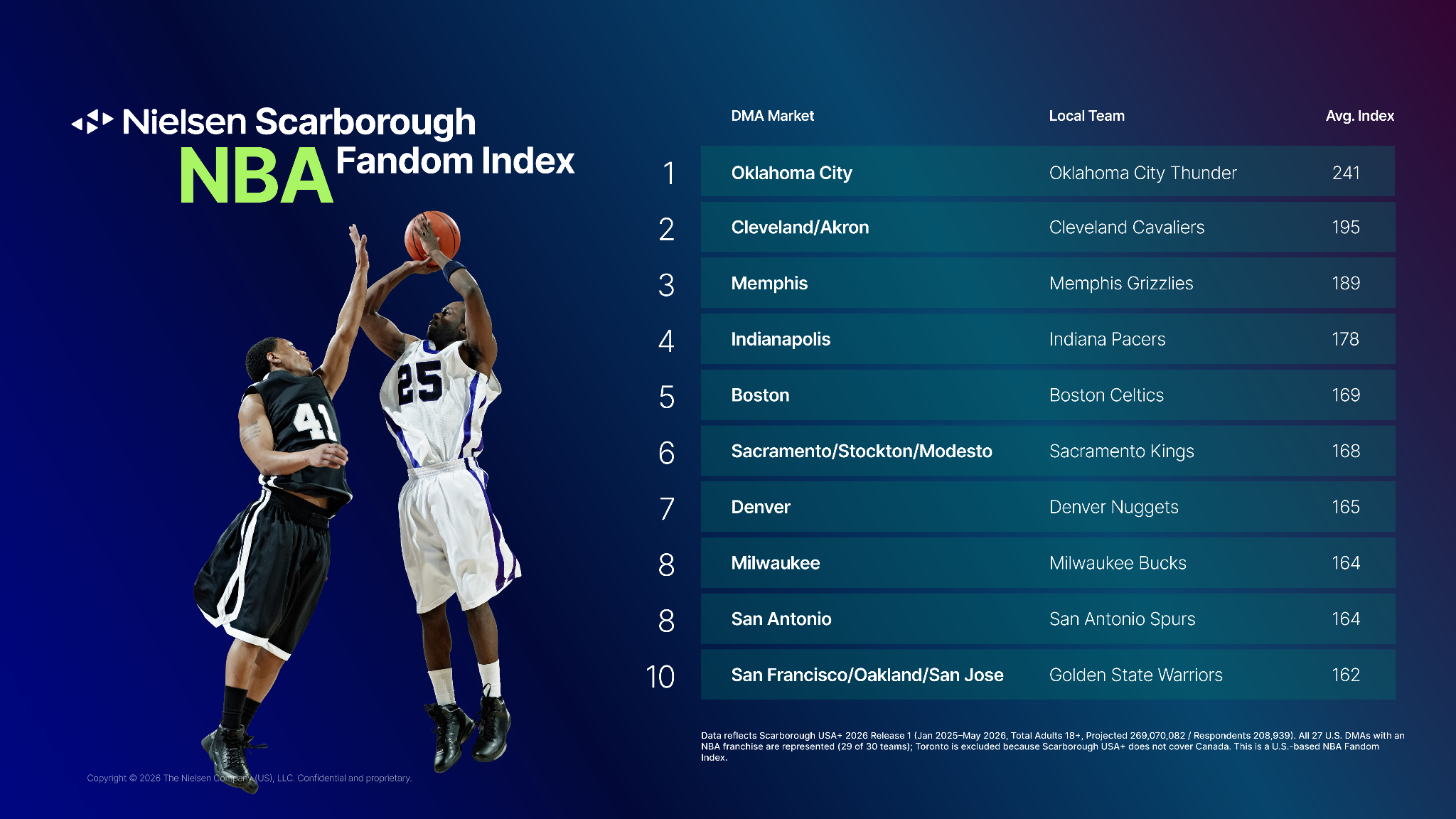
And as the new NBA season tips off, the newly released Nielsen Scarborough NBA Fandom Index reveals an eye-opening story about where the league’s top 10 most passionate fan bases reside.
Oklahoma City takes the top spot with an overall Fandom Index score of 241.
The home of the 2025 NBA champion Oklahoma City Thunder, OKC leads in six of the seven categories, with radio listening the lone exception.
Fans in Oklahoma City demonstrate exceptional passion, commanding the highest scores for apparel purchases with an index of 316. Not surprisingly, Shai Gilgeous-Alexander’s jersey ranked No. 7 overall on the NBA and NBPA’s official list for the 2025–26 regular season.
Oklahoma City also scored top marks in game attendance (362), social media engagement (229), TV viewership (185), and digital streaming (166).
In mid-sized markets lacking competing major professional sports franchises, single-team concentration creates an unmatched cultural anchor, where franchise merchandise and game-day rituals serve as vital vehicles for civic pride and community expression.
Following Oklahoma City, Cleveland/Akron claims second place overall with an index score of 195, and Indianapolis, in fourth at 178, joins it in showing high engagement through legacy broadcast channels.
Cleveland leads all markets in radio listening by a wide margin, with an index of 334, while Indianapolis follows at 278.
Radio continues to have the largest reach of any media platform in today’s ecosystem, and local market sports broadcasts play a big role in those usage patterns.
But radio is only part of what lifts these two markets.
Cleveland/Akron ranks third nationally in interest in the NBA (172) and fourth in TV viewership (153), with apparel purchases (178) in the top five and game attendance (242) well above the market average of 205, a sign of a fan base that follows the Cavaliers on every screen as well as the dial.
Indianapolis pairs its radio strength with one of the most digitally engaged fan bases in the league: its social media index of 211 is second only to Oklahoma City, its streaming index of 155 ranks third, and its attendance (228) also tops the market average.
Memphis ranks third overall with an index score of 189, driven by intense local fan dedication to the Grizzlies.
Memphis showcases a highly dynamic engagement profile, ranking second in apparel purchases (211), game attendance (314), and streaming (157).
Boston (169) rounds out the top five by showing up everywhere rather than leading one category.
The Celtics’ home market ranks third in apparel purchases (184), radio listening (223), and TV viewership (162), a rare example of a larger, multi-team market keeping pace with its smaller rivals.
Among larger, multi-team metropolitan regions, the San Francisco Bay Area displays remarkable consistency, maintaining top-ten positions across diverse channels such as social media, TV, radio, and apparel, and ranking second nationally in interest in the NBA (179).
The rest of the top 10 shows how many different paths lead to a high score.
On social media, San Antonio (191) ranks third behind Oklahoma City and Indianapolis, followed by Memphis (179) and Sacramento (175); San Antonio is in the top five on five of the seven measures, including apparel (183) and streaming (149).
Sacramento, which ranks sixth overall at 168, does not lead any single category but lands in the top ten on all seven.
Streaming and apparel are common threads across the list: the six highest-indexing streaming markets are Oklahoma City, Memphis, Indianapolis, San Antonio, Denver (145), and the San Francisco Bay Area (141), all top-10 markets.
Additionally, the eight highest-indexing apparel markets are top-10 markets as well.
Live attendance is where Denver and Milwaukee separate themselves.
Denver (301) joins Oklahoma City and Memphis as one of the few markets exceeding an index of 300, and Milwaukee (286) ranks sixth for attendance.
Milwaukee is also a traditional-media stronghold, with the second-highest broadcast and cable TV viewership (168), behind only Oklahoma City, and the fifth-highest radio listening (200)—a market where fans watch, listen and show up in person.
Ultimately, the Nielsen Scarborough data demonstrates that market size alone does not dictate fandom intensity—findings that mirror what we have seen with NFL and College Football fandom in recent months.
Taken together, the findings point to the same conclusion.
Where a team is the clear center of local identity and has fewer competing entertainment options and split loyalties, fans engage more often and across more channels than their market size would predict.
In the NBA’s smaller and mid-sized markets, professional basketball serves as a primary cultural driver, yielding denser fan concentration, higher per-capita merchandise investment, and stronger social and streaming engagement than larger, media-saturated markets can replicate.
