

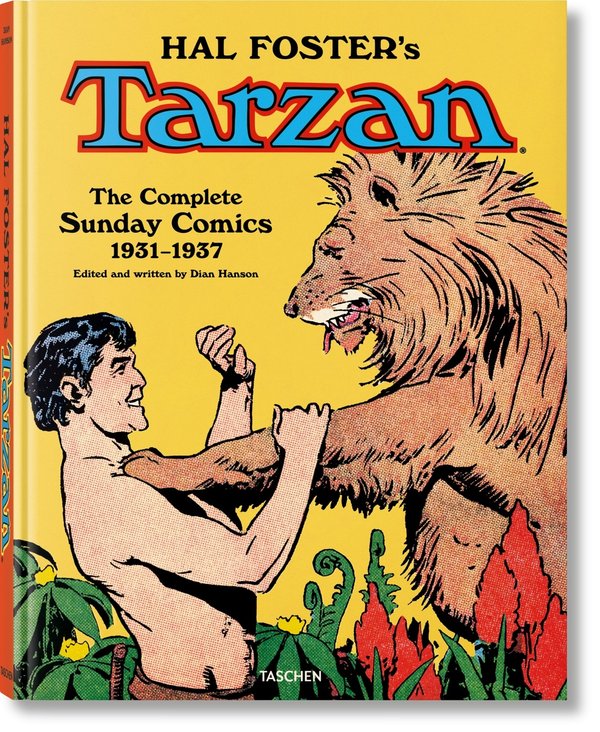
Harold Foster’s Tarzan (and Prince Valiant) are and aren’t comics. They’re sequential narratives told in words and images, but the symbiosis of the speech balloon doesn’t exist in the artist’s world. I’d call them 75% comics, and at their best (Prince Valiant in the 1950s) the work achieves an intelligence unique to American newspaper comics. Foster uses the omniscient narrator to tell a story and to comment on the assets and shortcomings of his characters. Val is often teased, by Foster the narrator, for his egotism, arrogance, hubris and denseness — surprising callouts for an iconic comics hero.
Prince Valiant was Foster’s reward for toiling in the fields of Tarzan, which he illustrated for United Features Syndicate as a Sunday comics page starting in September 1931. The Edgar Rice Burroughs source material is a byproduct of colonial racism and appropriation. It’s full of red flags for 21st-century readers — especially younger audiences who didn’t experience first-hand the onus of 20th-century collateral damage. Racism and sexism are hard-wired into much of 20th-century popular culture; as our shared tolerance of these as norms fades away, it’s difficult to encounter such material with an eye to its virtues.
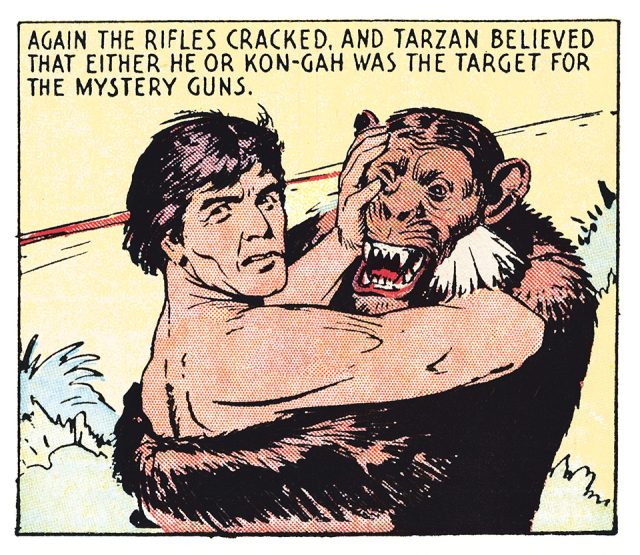 Progressive writers and commentators of the 1920s ragged hard on 19th-century media; I can now see their impetus. A work like the comic strip Tarzan (Foster’s illustration of Burroughs’ fiction, streamlined for an ongoing narrative) doesn’t go down easy anymore. It’s fascinating as a study of Foster’s progress from magazine illustrator to cartoonist, however, and rewards students of comic art who can stomach the crudeness of the narrative content.
His was a rustic frontier upbringing. Foster was a woodsman and an artist. Illustration took him out of a life of trapping and hunting, which he could then do for his own pleasure, when his workload let him. By 1928, as author and editor Dian Hanson details, Foster was a name in the world of advertising. When the agency that represented him was contacted about doing a comic strip version of Tarzan in 1927, Foster passed. He felt comic art was crude and lowbrow. But Joseph Neebe courted Foster and won him over.
The first run of Tarzan was a short weekday strip in stark black and white. This is illustrated text. Foster’s illustrations, in wordless squares, correspond to blocks of adapted narrative, and are dull, despite the historical importance. This sequence precedes the 1931-37 color Sunday sheets, which made Tarzan a Depression-era sensation alongside E. C. Segar’s Popeye.
After Foster’s first stint, Rex Maxon continued with the feature, now syndicated by United Features, for two feeble years. The strip’s young readers must have been thrilled by Foster’s return. Burroughs, who scrutinized each episode of the feature, hated Maxon’s art and nit-picked R. W. Palmer’s adaptation of his stories. Hanson excerpts the author’s lacerating feedback, which intensified when the color Sunday debuted in March 1931. The Depression brutalized the magazine market and when Foster was again approached, for low pay and work-for-hire status, he couldn’t refuse.
Foster begins in mid-story, and he made initial efforts to match Maxon’s blunt approach. Within a few episodes, however, kinetic grace replaces the stale tableaus, all delivered in a dozen same-sized panels that might, on occasion, expand to brief panoramas.
Foster’s look-and-feel for Tarzan is rugged; the lines live and breathe in a way the studied, painterly work of Valiant doesn’t. Figures in motion feel that way, whereas in Valiant, action scenes are elaborate friezes. Val’s images were intended for the reader to pore over, in expected awe. The matter-of-fact, vivid linework of Tarzan still generates an excitement almost a century after its publication. These six years of influential work are gathered in one massive, well-annotated volume published by Taschen Press.
Beloved by the first generations of comic-book artists, who swiped myriad poses and figures from its dynamic frames, the Foster Tarzan is not for fans of nuance. It delivers melodrama akin to a silent Doug Fairbanks movie, peppered with stock types (scheming, leering Middle Eastern baddies, sub-human Black Africans, damsels in distress and unctuous Anglo-Saxon cads). It is a boy’s vision of the wonders of the world. As noted, some of this is hard to stomach. Historical disclaimers aside, this is crude stuff rescued by lively, well-rendered comics art.
The page for Dec. 8, 1931, “Slaves of the Infidel,” sums up the early episodes: bold lines that suggest rather than render; all panels are long shots–no close or medium views. Staging is conservative; all linework is brisk and streamlined. The book’s large size helps recapture the novelty and excitement it gave its first audience.
A few months later, Foster loses his initial cynicism; you see him fall in love with comics and embrace its potential. He renders backgrounds with loving detail and strives to evoke the personality of each character. They gain a depth not felt in Burroughs’ prose. At his best, Foster shrugged off the pulp xenophobia of the source material and sought to heighten it with his illustrations. His graphic skill builds without the sacrifice of moving, living lines. If the reader can surrender to the blood-and-thunder narratives, despite their attitudinal flaws, Tarzan retains its breadline excitement — you get why young readers flipped over this strip and how its influence rippled through comics yet to come.
The strip of July 17, 1932, demonstrates the cinematic vigor that now defined Foster’s work. A full-width first panel captures the chaos of sudden action in a powerful sweep that uses what comics does best (words and images in mutual support), a judicious close-up of Tarzan’s hand in a struggle against mounting odds in panel three, and a final row that suggests the shock of sudden confrontation. Free of cringy elements, this page is visual dynamite. A child unable to read the text might still absorb its excitement and conflict.
One feels Foster’s constraint under the 12-panel grid. He needs a bigger canvas as his connection to comics grows. On Aug. 21, 1932, he renders a four-panel-sized splash that gives the white man’s violation of a sacred space a spectacle worthy of the later Prince Valiant. Such outbursts were yet rare, but by Feb. 12, 1933, we see Foster settled into his grid, with a command of varied scenes and angles, in one of the quirkiest pages of the strip’s run.
Egyptian and Middle Ages themes divert from the jungle episodes and show Foster’s attraction to historical themes. By 1935, he’s ready for a bigger project. A summertime Viking-themed sequence anticipates his major work so soon to come. He never slacks, even as the reader feels his impatience with the material. With the soaring airplanes of his final Tarzan page in May 1937, Hal Foster retreated from the pulp-fiction modern world of Edgar Rice Burroughs and into the dense and masterful narrative of Prince Valiant. Though the new strip’s early episodes seem simple and sparse, by 1939 the Sunday page became a weekly objet d’comic art.
This book is the first single volume I know of to house the full run of Foster’s Tarzan, and is well-reproduced. While pricey, it merits the sum. It’s all about the artwork — the pages are best approached for their visual kicks in spite of the reductive racism. Burroughs was fortunate to have an illustrator of this caliber in his corner. Tarzan continued with other artists of note (Bob Lubbers’ stint in the 1950s is my favorite), but Hal Foster’s work remains a foundational touchstone for adventure comics. Approach with caution, lovers of subtlety and refinement, but do have a look.
