

The following is a guest post by Gary Johnson, a Reference Librarian in the Newspaper and Current Periodical Reading Room.
Beginning in November 1941 through March 1985, Gus Arriola wrote and drew the newspaper comic strip “Gordo” which was syndicated to newspapers throughout the U.S. During its four-decade run, Arriola’s comic strip became a highly respected and beloved representation of Hispanic culture. Initially conceived as a humorous portrayal of a Mexican farmer named Gordo (a Spanish word for an obese person with connotations of endearment), Arriola soon realized that his comic strip presented an image of Hispanic culture to the American public and he began to include information about the history, culture, and language of Mexico.
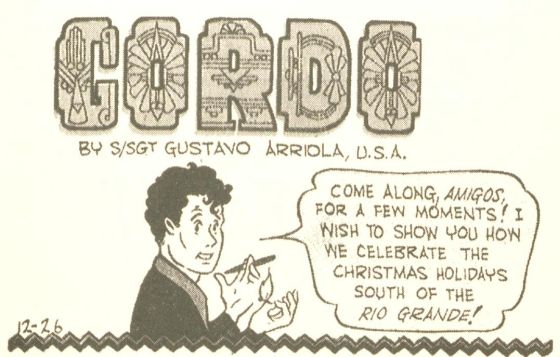
Arriola’s career in art began as a cartoon animator but he had a long-held desire to create a comic strip and, after tinkering with several concepts, Gordo Lopez, a Mexican bean farmer, and his nephew Pepito came into being. Arriola approached the United Features Syndicate to purchase and distribute the strip and by late 1947 it was published in about 60 newspapers.
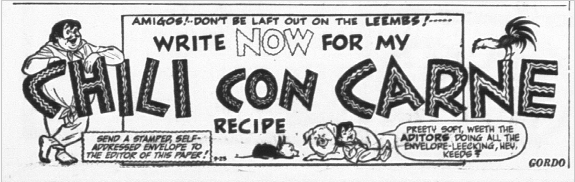
To demonstrate the strip’s readership—and its popularity—Arriola devised a Beans & Cheese Recipe promotion. On January 20, 1948, readers were offered a copy of Gordo’s recipe for Beans & Cheese if they would send in a request with a self-addressed, stamped envelope. Over 85,000 responses arrived and before long the strip was published in over 150 newspapers. The successful promotion was repeated several months later with a Chili con Carne recipe.
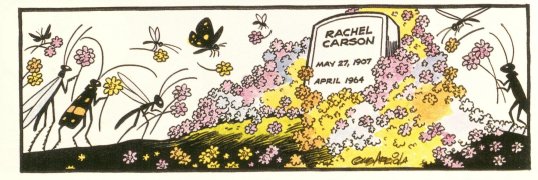
Arriola was an admirer of the marine biologist and conservationist Rachel Carson and drew tributes to her in the strip twice—in the daily strip on April 11, 1970, and in a color Sunday strip on May 27, 1984. For special strips Arriola would sometimes make up an author name with wordplay. He signed this Rachel Carson strip with the name “Frenda Mann” (friend to man).
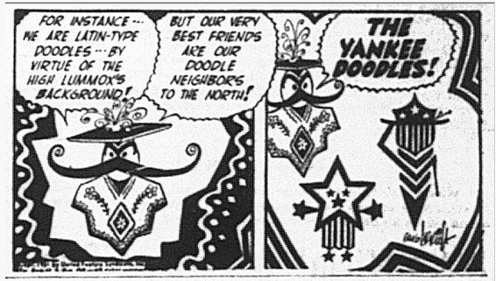
Despite a lack of formal art training, Gustavo Arriola developed a unique artistic style that was highly regarded by fellow cartoonists. Mort Walker, creator of “Beetle Bailey” and “Hi and Lois,” commented, “Gordo was an exceptional strip visually … his Sunday page was a work of art. He seemed to indulge himself in creating new visual techniques to charm the eye” (Accidental Ambassador Gordo, p. 5). During February 1951, Arriola drew a series of imaginative daily strips featuring talking doodles that sometimes ventured outside the borders of the cartoon’s panels.
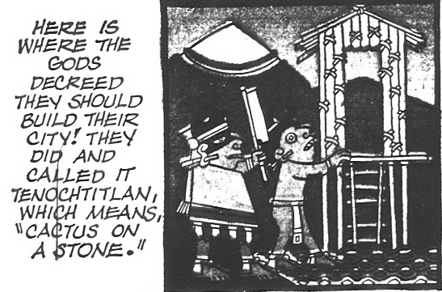
Within a few years Arriola has Gordo purchase a tour bus which gave him the opportunity to address a vast array of topics related to Mexican history and culture. His tour bus, nicknamed “La Cometa Haley,” carried Gordo and his guests throughout Mexico while he provided commentary. The panel above is part of a strip in which Gordo is explaining how the Aztecs determined the site of their capital city, Tenochtitlan, which today is the location of Mexico City.
Discover more:
Robert C. Harvey, with the participation of Gus Arriola, wrote the detailed and heavily illustrated history of the “Gordo” comic strip, Accidental Ambassador Gordo (2000).
Arriola’s “Gordo” cartoons were collected in several books including: Gordo (1950), Gordo’s Cat (1981), and Gordo’s Critters (1989).
“Gordo” is available in the microfilm collections in the Newspaper & Current Periodical Reading Room; in newspaper databases available onsite such as ProQuest Historical Newspapers and Periodicals, America’s Historical Newspapers, and NewspaperArchive; and in free re Newspaper Collection
