

Abstract
Objective
To evaluate the effect of virtual reality (VR) meditation on stress among parents of infants in the neonatal intensive care unit (NICU) and NICU provider stress and burnout.
Study design
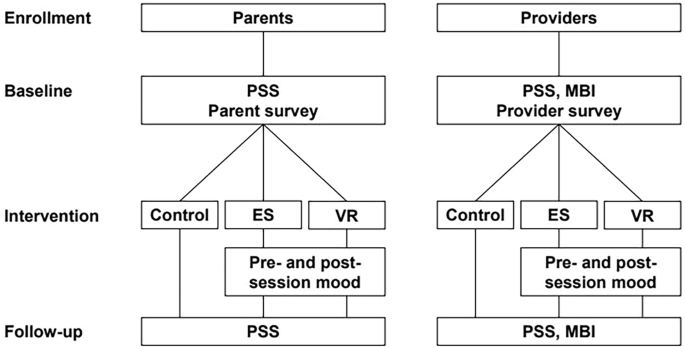
Parents and providers were randomized to VR meditation, eyeshade relaxation or control group. All participants completed the Perceived Stress Scale (PSS) at the start and end of the study and self-rated mood before and after meditation or relaxation. Providers also completed the Maslach Burnout Inventory (MBI) at start and end of study. Changes in scores were compared among groups.
Results
Self-rated mood increased in VR group parents and providers. Subgroup analysis showed fathers had greater improvement in self-reported mood following VR meditation. There was a significant decrease in VR group provider PSS scores.
Conclusion
VR meditation may furnish an immediate benefit, which may be sustained in NICU providers, and is a novel, accessible stress mitigation tool in the NICU.
Access through your institution
Buy or subscribe
This is a preview of subscription content, access
Access options
- Purchase on SpringerLink
- Instant access to the full article PDF.
Prices may be subject to local taxes which are calculated during checkout
Data availability
The datasets generated during and/or analyzed during the current study are available from the corresponding author on reasonable request.
References
-
Hendy A, El-sayed S, Bakry S, Mohammed SM, Mohamed H, Abdelkawy A, et al. The stress levels of premature infants’ parents and related factors in NICU. SAGE Open Nurs. 2024;10:23779608241231172.
-
Roque AT, Lasiuk GC, Radunz V, Hegadoren K. Scoping review of the mental health of parents of infants in the NICU. J Obstet Gynecol Neonatal Nurs. 2017;46:576–87.
-
Bernardo J, Rent S, Arias-Shah A, Hoge MK, Shaw RJ. Parental stress and mental health symptomsi n the NICU: recognition and interventions. NeoReviews. 2021;22:e496–e505.
-
Dye ME, Runyan P, Scott TA, Dietrich MS, Hatch LD, France D, et al. Small patients but a heavy lift: workload burnout of advanced practice providers and physicians in a level IV neonatal intensive care unit. J Perinat Neonatal Nurs. 2024;38:192–200.
-
Tawfik DS, Sexton JB, Kan P, Sharek PJ, Nisbet CC, Rigdon J, et al. Burnout in the neonatal intensive care unit and its relation to healthcare-associated infections. J Perinatol. 2017;37:315–20.
-
Galletta M, Portoghese I, D’Aloja E, Mereu A, Contu P, Coppola RC, et al. Relationship between job burnout, psychosocial factors and health care-associated infections in critical care units. Intens Crit Care Nurs. 2016;34:59–66.
-
Shankar R, Kumar FD, Bundele A, Mukhopadhyay A. Virtual reality for stress management and burnout reduction in nursing: a systematic review protocol. PLOS One. 2025;20:e0319247.
-
Tawfik DS, Phibbs CS, Sexton JB, Kan P, Sharek PJ, Nisbet CC, et al. Factors associated with provider burnout in the NICU. Pediatrics. 2017;139:e20164134.
-
Profit J, Sharek PJ, Amspoker AB, Kowalkowski MA, Nisbet CC, Thomas EJ, et al. Burnout in the NICU setting and its relation to safety culture. BMJ Qual Saf. 2014;23:806–13.
-
Kim KY, Hur MH, Kim WJ. Effects of virtual reality (VR)-based meditation on sleep quality, stress, and autonomic nervous system balance in nursing students. Healthcare. 2024;12:1581.
-
Schrempf MC, Petzold J, Petersen MA, Arndt TT, Schiele S, Vachon H, et al. A randomized pilot trial of virtual reality-based relaxation for enhancement of perioperative well-being, mood and quality of life. Sci Rep. 2022;12:12067. https://doi.org/10.1038/s41598-022-16270-8.
-
Harris KM, Gaffey AE, Schwartz JE, Krantz DS, Burg MM. The perceived stress scale as a measure of stress: decomposing score variance in longitudinal behavioral medicine studies. Ann Behav Med. 2023;57:846–54.
-
Cohen S, Kamarck T, Mermelstein R. A global measure of perceived stress. J Health Soc Behav. 1983;24:385–96. https://doi.org/10.2307/2136404.
-
Lean RE, Rogers CE, Paul RA, Gerstein ED. NICU hospitalization: long-term implications on parenting and child behaviors. Curr Treat Options Pediatr. 2018;4:49–69.
-
Poromaa IS, Comasco E, Georgakis MK, Skalkidou A. Sex differences in depression during pregnancy and postpartum period. J Neurosci Res. 2016;95:719–30.
-
Johansen R, Lyshol EspetvetMN, Clench-Aas H, Myklestad J. I. Mental distress among young adults – gender differences in the role of social support. BMC Public Health. 2021;21:2152. https://doi.org/10.1186/s12889-021-12109-5.
-
Guttmann KF, Raviv GN, Fortney CA, Ramirez M, Smith CB. Parent perspectives on communication quality in the neonatal intensive care unit. Adv Neonatal Care. 2024;24:382–8.
Acknowledgements
This research was funded by the Boston Children’s Hospital Medical Staff Organization Faculty Innovated Research Award. Boston Children’s Hospital nursing leadership, Cheryl Toole, MS, RN, CCRN, NEA-BC and Keri Kucharski, BSN, RN, CCRN, participated in development of the NICU parent and provider survey tool.
Authors and Affiliations
Contributions
Dr. Tierney M. Morrison led study design, study recruitment, enrollment, and completion of study procedures, data collection, and prepared the first draft of the manuscript and synthesized edits from co-authors. Dr. Anne Hansen was instrumental in conceptualization of the study, including study design and made significant contributions to the development of the manuscript. Dr. Henry Feldman made significant contributions in study design, statistical analysis and provided significant contributions to the development of the manuscript. Dr. Jeffrey Jacobson is the XR lead of Boston Children’s Immersive Design Systems and was instrumental in identification of the TRIPP virtual reality software, provided technological support throughout the study, and contributed to the final version of the manuscript.
Ethics declarations
Competing interests
The authors declare no conflicts of interest.
Additional information
Publisher’s note Springer Nature remains neutral with regard to jurisdictional claims in published maps and institutional affiliations.
Supplementary information
Scenes from TRIPP Virtual Reality Meditations (download PDF )
Rights and permissions
Springer Nature or its licensor (e.g. a society or other partner) holds exclusive rights to this article under a publishing agreement with the author(s) or other rightsholder(s); author self-archiving of the accepted manuscript version of this article is solely governed by the terms of such publishing agreement and applicable law.
About this article
Cite this article
Morrison, T.M., Jacobson, J., Feldman, H.A. et al. Evaluation of virtual reality-based meditation as a tool to mitigate stress among parents and providers in the neonatal intensive care unit.
J Perinatol (2026). https://doi.org/10.1038/s41372-026-02800-z
-
Version of record:15 July 2026
-
DOI
:https://doi.org/10.1038/s41372-026-02800-z
