

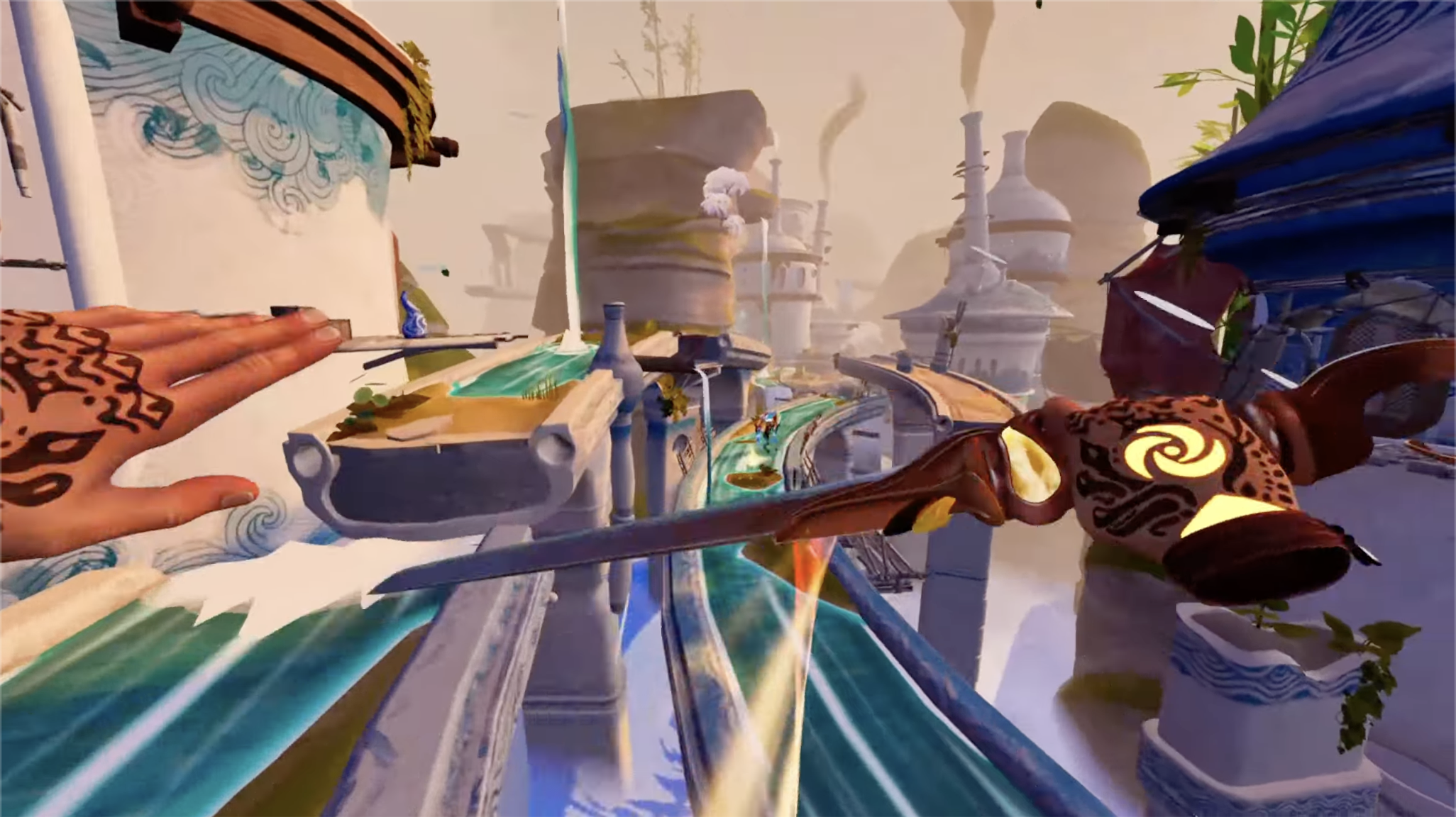
A new gameplay trailer for The Rifted Skies appeared at the <a href="https://www.uploadvr.com/everything-announced-at-the-vr-games-showcase-august-2026/” rel=”nofollow noopener” target=”_blank”>August 2026 VR Games Showcase, giving VR players their second extended look at DreamVR’s full-body parkour roguelite before its fall Early Access launch on Meta Quest and SteamVR. The studio is betting its eleven-year DreamVR LBE VR background — 80 projects and more than twenty location-based experiences shipped — against the convention that home VR players are content moving with a thumbstick.
The Rifted Skies is a roguelite action game set in a world being slowly consumed by a spreading corruption called the Rift. Players take the role of a lone warrior returning to their homeland, which has been abandoned and left to decay after an ancient conflict. The central challenge is not just combat — it is survival against a spreading threat that grows more relentless as each run progresses, closing in from behind until the Rift catches up and the run ends. The tone sits in a register of post-apocalyptic urgency: a dying world, a warrior who may already be too late, and a mystery about what the Rift actually is that the game has not yet answered.
Why Home VR Defaults to Thumbsticks — and What That Costs Players
Thumbstick locomotion is standard in home VR for a straightforward engineering reason: living rooms are small. Most consumer VR setups offer only a few square meters of safe physical space, making genuine room-scale walking impractical for games that require traversing large virtual environments. The thumbstick solves the space problem by decoupling the player’s physical position from their in-game position.
The cost of that solution is well-documented. When your eyes perceive forward movement while your inner ear detects that your body is stationary, the resulting sensory conflict triggers cybersickness — nausea, disorientation, and dizziness that affect a substantial portion of VR players. Studies suggest up to 80% experience cybersickness to some degree, and thumbstick locomotion produces higher discomfort than locomotion methods that involve physical gesture.
Arm-swing locomotion takes a different approach. Instead of using a thumbstick to move an avatar, the player physically swings their arms — detected frame-by-frame by the VR controllers’ position sensors — and the headset maps those controller movements to in-game velocity. The body stays stationary in the room, but the physical effort of swinging the arms generates a proprioceptive signal — the felt sense of exerting effort — that partially bridges the gap between what the eyes see and what the body feels. It is not a complete solution, and no home VR locomotion method fully eliminates the underlying conflict, but arm-swing consistently produces lower cybersickness than pure thumbstick input, as an arm-swing vs joystick study from ACM MUM 2025 confirms.
DreamVR CEO Denis Mazur, the game’s Executive Producer, described the studio’s perspective: “We were fortunate that our earliest projects were in location-based VR, where we could observe firsthand how real players interact with virtual worlds. And it’s so disappointing to see that even today, the majority of home VR experiences limit movement to thumbsticks. With The Rifted Skies, we wanted to take everything we’d learned from years of building LBE VR and create a game where movement isn’t a mere way to get around, but a core part of the experience.”
How The Rifted Skies Extends Arm-Swing Beyond What Gorilla Tag Proved
Arm-swing locomotion has a proven commercial track record. Gorilla Tag, the social tag game from Another Axiom, built its entire design around the same core principle — swing your arms, move your avatar — and crossed 100 million in revenue with more than ten million cumulative players.
What Gorilla Tag did not attempt was marrying that locomotion to combat. In most VR action games, engaging an enemy means slowing or stopping — at minimum, pausing traversal to target and strike. The Rifted Skies is designed so players can deflect incoming projectiles and cut through enemies without interrupting their parkour momentum: runs, wall runs, glides, grapples, and combat all operate in the same continuous flow.
The full traversal vocabulary runs from sprint (arm-swing) to jump (upward arm motion) through slides, wall runs, gliding, and grapple use — all accessible at full speed and chain-able together. Combat adds a katana and a bow with parry and charged strike options, all keyed to physical gestures rather than button presses. The game Steam wishlist page describes the goal as “minimal buttons and no motion sickness.”
The engineering challenge this creates is real. At the low speeds where Gorilla Tag operates, arm-swing’s proprioceptive signal reliably outperforms thumbstick locomotion. At the higher speeds of a fast-paced action game, the greater visual velocity may outpace what the proprioceptive signal can compensate, potentially increasing discomfort for some players — especially newcomers. This is precisely where arm-swing implementations have historically struggled. DreamVR’s stated design principle is that every mechanic must pass two gates before it ships: is it VR-native enough, and is it comfortable enough?
Game director Victor Tsai put it this way: “In many VR games, I found myself missing the very essence of VR, when every button press broke my immersion just a little. With The Rifted Skies, we wanted players to feel like they’re inside the game, not like a person with controllers. Every mechanic goes through two questions: is it VR-native enough? Is it comfortable enough? If either answer is not a strong YES, we go back and redesign it.”
What Is the Roguelite Structure Actually Doing Here?
The Rifted Skies uses a standard roguelite loop: each run builds a character through gems collected from ancient altars throughout the environment, unlocking and combining abilities on the fly. More than 100 run upgrades and unlocks are planned, including abilities like flight, a grappling hook, and a charged fist strike. Some upgrades synergize; others clash — an intentional design choice to keep experimentation central to each session.
The roguelite structure and the arm-swing locomotion system reinforce each other at a level the game’s marketing does not surface explicitly. Arm-swing locomotion has a learning curve that is genuinely motor-skilled — the fluid chaining of sprint, jump, and grapple at speed is the kind of embodied competence that builds through repetition, not explanation. A roguelite’s core function is mastery through repeated runs: you die, you try again, you are measurably better. That is precisely how physically learned skills develop. The game’s run-based structure is not just a replayability mechanism — it is also a practice framework for the body-movement vocabulary the game requires.
Each run ends when the Rift catches up, which means failure has a concrete, physical cause: not just dying in combat but running out of forward momentum. The escalating aggression of enemies as the Rift approaches applies simultaneous pressure to both combat skill and locomotion fluency. Players who cannot chain movement and fighting together will not outrun the corruption regardless of how skilled they become at each independently.
What Launches in Early Access This Fall
When The Rifted Skies arrives in Early Access on Meta Quest and SteamVR this fall, it will ship with two of three planned biomes, each with its own enemy roster and boss. The third biome, along with additional content, is slated for later in development.
Pricing has not yet been announced. A Pico headset version is in development with a release date to be confirmed separately. Players can wishlist the game now on the game Steam wishlist page and the Meta Quest store.
DreamVR was founded in 2015 and has shipped more than 80 projects across VR, mobile, and PC, including more than 20 location-based VR experiences in venues, arcades, and VR parks. The Rifted Skies is the studio’s first consumer home VR title.
Frequently Asked Questions
What is arm-swing locomotion and why does it matter for VR?
In arm-swing locomotion, the player’s physical arm movements — detected by motion controllers frame-by-frame — map directly to movement velocity in the virtual world. The technique matters because it generates a proprioceptive signal — the physical feeling of exerting effort — that partially bridges the sensory gap between seeing forward motion and feeling stillness in the body, which is the root cause of VR cybersickness in thumbstick-based games. Research consistently finds that arm-swing and other gesture-based locomotion methods produce lower cybersickness rates than joystick input, as an arm-swing vs joystick study from ACM MUM 2025 confirms, though no home VR method fully eliminates the underlying conflict.
What VR headsets will The Rifted Skies support, and what will it cost?
The Rifted Skies is confirmed for Meta Quest and SteamVR (PC VR) in Early Access this fall 2026. A Pico version is also in development, with its release date to be announced separately. DreamVR has not yet announced pricing for any platform. Players can add the game to their wishlist on the game Steam wishlist page now.
Is The Rifted Skies suited for VR beginners, or is it only for experienced players?
DreamVR has stated that every mechanic in the game must pass a comfort test as well as a VR-nativeness test — comfort is a co-equal design priority. That said, The Rifted Skies is built around sustained full-body physical activity: arm-swinging to run, jumping, and performing combat gestures while maintaining parkour momentum. Players with limited VR experience or sensitivity to motion should be aware this is a more physically demanding design than seated or thumbstick-based VR. The studio’s game Discord and wishlist links include access to monthly playtest sessions for players who want to evaluate the game before Early Access.
Why does the roguelite structure pair specifically well with a full-body locomotion game?
The arm-swing locomotion system in The Rifted Skies is a physically learned motor skill — the ability to fluidly chain sprint, jump, wall run, and combat at speed develops through embodied repetition, not just strategy. Roguelite games are specifically structured around mastery through repeated runs: you die, you restart, you are measurably more capable at the same challenges. That is exactly how physical skills are learned. The run-based structure here is not only a replayability mechanism — it is also how the game trains its players’ bodies to use its movement vocabulary fluently.
ⓒ 2026 TECHTIMES.com All rights reserved. Do not reproduce without permission.
