

Beyond reach: Why fandom is becoming the new brand-building advantage


Eshika Chopra
| 6 hours ago
Views: 582
Your browser does not support the audio element.
For years, brand building has relied on familiar principles such as segmentation, targeting and positioning. But as consumers increasingly gather around shared interests, creators, experiences and conversations, marketers have to rethink how they define an audience. Demographics may tell a brand who a consumer is, but they do not always explain why that person chooses a product, engages with a brand or becomes its advocate.
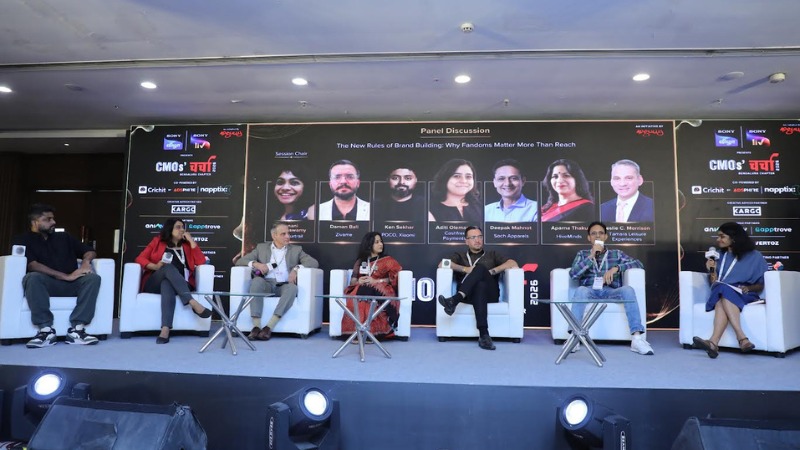
This was at the heart of a panel discussion at CMOs’ Charcha – Bengaluru Chapter 2026, titled ‘The New Rules of Brand Building: Why Fandoms Matter More Than Reach’. Chaired byJanani Kandaswamy, Head of Marketing, Pickyourtrail, the panel featuredAditi Olemann, Head of Marketing, Cashfree Payments;Aparna Thakur, Senior Vice President, HiveMinds;Daman Bali, Head of Brand Marketing, Zivame;Deepak Mahnot, Chief Marketing Officer, Soch Apparels;Ken Sekhar, Marketing Head, POCO (Xiaomi); andLeslie C Morrison, VP, Sales & Marketing, Tamara Leisure Experiences.
The discussion did not suggest that the fundamentals of marketing have become irrelevant. Instead, the speakers pointed to a shift in how brands need to understand people, moving beyond basic demographic profiles to motivations, psychographics, human tensions and shared interests.
Deepak Mahnotargued that the fundamentals still have a role to play even as the market changes. “The basics and the first principles never change,” he said, while pointing to the need to go deeper into the consumer’s mind and understand whether the brand’s offering is actually connected to her.
Ken Sekharbrought this challenge to life from the smartphone category. A consumer’s demographic profile, he said, may not explain what actually drives the purchase. Within the same broad audience, one consumer may care about the camera, another about performance and another about durability. “If I go just demographic, I’m actually not capturing why a person buys a device,” Sekhar said. The question for POCO, therefore, is what a particular type of user is actually buying the device for and how the brand can build communication around that motivation.
That deeper understanding also becomes important when the objective moves from acquiring consumers to building fandom.Aparna Thakurdrew a clear distinction between the two. “The key difference between a fan and a consumer lies in the fact that the fans take over the narrative,” she said.
For Thakur, a fan does not simply consume a brand’s communication. Fans promote the brand, discuss it and take the conversation beyond what the brand itself has said. This also changes the role of content, particularly as platforms increasingly allow content to find the audiences most relevant to it.
“That job is actually sitting with the content and that content could be brand created, that content could be fan created,” she said.
For Zivame, finding that common thread can be particularly difficult.Daman Balipointed out that the brand’s category is driven by highly individual needs, with every woman potentially having a different reason for buying a product. “Literally, every woman has a different need state as to why she needs to buy it,” Bali said.
Zivame’s approach, therefore, is to bring together the different data points around what women are experiencing and use those insights to identify a relevant need state. The brand’s original purpose of breaking taboos and making conversations around intimate wear more comfortable continues to provide a larger platform for those conversations.
The difficulty of finding a common problem statement is not unique to B2C brands. In B2B,Aditi Olemannargued that the people behind businesses have many of the same emotional needs as consumers. “Behind every B2B company there is an individual who has problem statements, who have challenges,” she said.
For founders of SMBs, for instance, there is a need for belongingness and for connecting with other founders facing similar challenges. Developers and other professionals can similarly benefit from platforms where they can share experiences.
“It’s not that B2B is this extremely opaque object where people don’t have emotions,” Olemann said. “B2B leaders, B2B founders also have the same problem statements because day in, day out they are facing some problems.”
The discussion then moved to whether brands can actually manufacture a community or fandom.Leslie C Morrison’s view was that brands can create meaningful connections by becoming part of interests and experiences that already matter to people.
Speaking about Tamara Coorg, he pointed to community engagement and sustainability initiatives around the property, including zero-waste management and the natural environment. Rather than relying only on paid marketing, the objective is to create experiences that people talk about and recommend within their own circles.
“See, when we do that, we actually create organic growth,” Morrison said.
In hospitality, that advocacy can extend well beyond a single stay. A guest’s experience can lead to recommendations for family visits, celebrations or other occasions, creating a network of potential customers through personal recommendation.
But while communities, creators and advocates can help amplify a brand, Mahnot believes they should not become bigger than the brand itself. “Brand has to be the protagonist in whatever they do,” he said.
Creators and community members can act as catalysts, helping make the brand more relevant and encouraging participation, but the brand should continue to lead the story. As Mahnot put it, if the creator is removed, the association should still represent the brand rather than the individual.
That does not mean brands should simply build communities and leave them to operate independently. Listening to those communities is equally important.
Morrison pointed to TripAdvisor and customer feedback as examples of how guests can become advocates while also influencing how a hospitality business responds to customers. Bali made a similar point from Zivame’s perspective, particularly given the sensitivity of the category.
“If you’re not going to be listening to the community, there’s no point of having that,” he said.
Sekhar provided the clearest example of community feedback translating into action. He recalled how Xiaomi, before entering India, identified 100 technology enthusiasts and spoke to them about what they believed Indian consumers wanted. When POCO was created in 2018, the brand similarly sought to appeal to consumers who did not want to remain part of the mainstream.
Community has continued to be a priority for POCO. Sekhar said that for two of the brand’s biggest launches this year, community members got access to the phone before media, KOLs and even partners.
More importantly, the relationship did not end with early access. Feedback from the community was taken back to the brand, with several points incorporated into the product being launched.
That is where the distinction between reach and fandom becomes clearer. Reach can establish visibility, but a community can create a two-way relationship. People can advocate for a brand, challenge it, provide feedback and, in some cases, influence what comes next.
The panel’s discussion therefore pointed to a shift in the way brands approach audiences. The objective is no longer simply to identify the largest possible group and communicate with it. Brands are increasingly looking for the motivations and shared experiences that can bring people together, while giving those people a reason to participate in the brand’s journey.
Fandom, in that sense, is not just about having more followers. It is about having people who care enough to carry the conversation forward.
Show More
Focus South03-Sep-2026CMOs’ Charcha – Bengaluru Chapter 2026Ken SekharDeepak MahnotDaman BaliAparna ThakurAditi OlemannJanani Kandaswamy
similar newsPredictive AI is here. Can marketers turn signals into action?
similar newsFlipkart, Bengaluru Traffic Police bring AI innovators together to tackle traffic
similar newsNetflix launches ‘Into The Southverse Collection’ In India
similar newsContext, intent, relevance: The new equation for advertising effectiveness
similar newsWPP Media, Acer, CereOne Media decode the evolution from GenAI to predictive AI
similar newsBeyond attribution: Why iOS is forcing marketers to rethink measurement
similar newsCheap inventory, costly waste: Kargo’s Nabajit Nath on the MFA website challenge for programmatic
similar newsAbhishek Shrivastava on how Digital Jalebi is redefining brand engagement through interactive tech
similar newsWe didn’t build VIZHA to sell ad spots: Akshay Agrawal on Sony’s bigger South market ambition
similar newsFrom noise to value: Jainam’s Aishwarya Gupta on winning the relevance game


1 Comment
Pingback: Absolute Batman next to Akira? The growing manga store chain Manga Spot thinks today's comics readers don't care about old boundaries - Comic Vibe