

Mobile gamers expect richer lighting, smoother gameplay, and increasingly immersive visual experiences without compromising battery life, thermal performance, or responsiveness. As those expectations continue to rise, developers need new ways to balance image quality, rendering cost, and performance within the constraints of mobile devices.
AI-powered graphics are becoming an important part of that equation. Over the past year, Arm has been advancing a portfolio of neural graphics technologies, including Neural Super Sampling (NSS), Neural Frame Rate Upscaling (NFRU), and Neural Super Sampling and Denoising (NSSD), while preparing the ecosystem for the next generation Arm Mali GPU which features dedicated neural acceleration through Arm Neural Technology.
But technology alone does not create an ecosystem. Making neural graphics production-ready requires collaboration across the entire game development stack, from game studios and engine providers, to developers, OEMs, and silicon partners. That is exactly where Arm is investing.
Enabling every layer of the gaming ecosystem
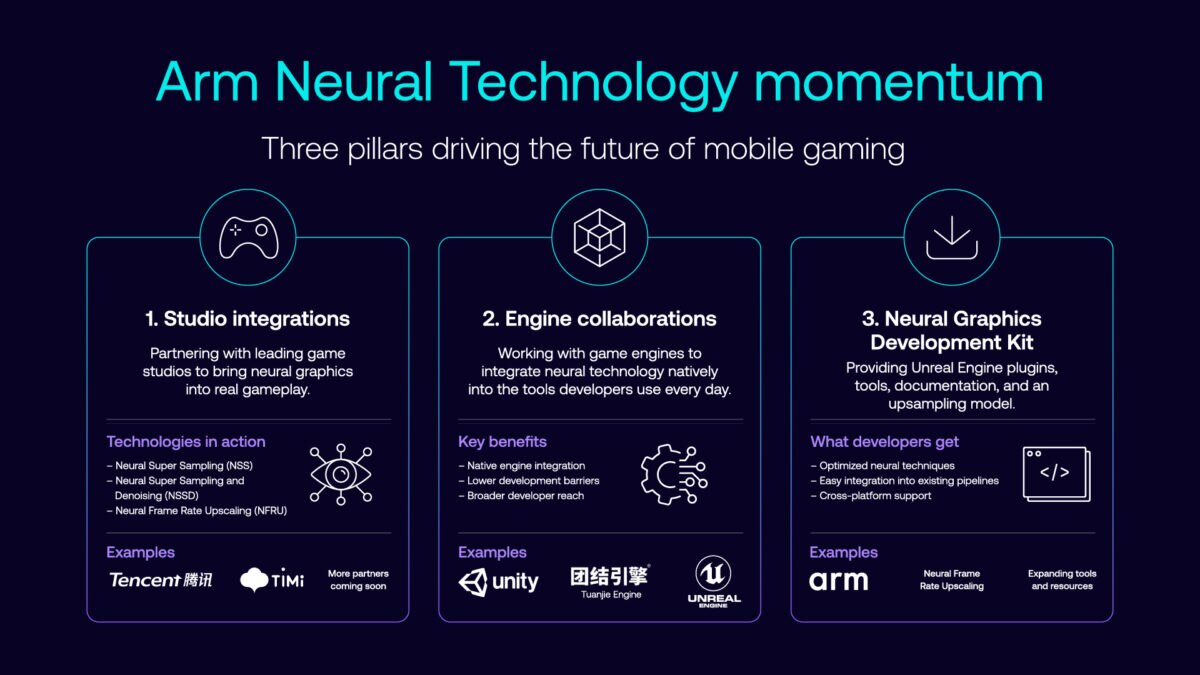
Arm’s strategy extends beyond developing new graphics technologies. It is focused on helping the entire ecosystem adopt them.
This means working closely with game studios to validate neural graphics in real production environments, collaborating with engine providers to simplify integration, expanding developer rerting OEMs and silicon partners as they prepare the next generation of mobile gaming platforms
Together, these collaborations are helping move neural graphics beyond technical demonstrations and into production-ready game development.
Working with game studios to validate neural graphics
The best way to prove new graphics technologies is in real games built by real developers. Arm has been collaborating with leading studios across the industry, including Tencent, NetEase Games, Infold Games, Paper Games, and Sumo Digital, to explore how neural graphics can improve mobile gaming experiences , while operating within real-world performance, power, and thermal budgets.
These collaborations allow developers to evaluate neural graphics techniques using production assets, commercial workflows, and genuine gameplay scenarios rather than synthetic demonstrations.
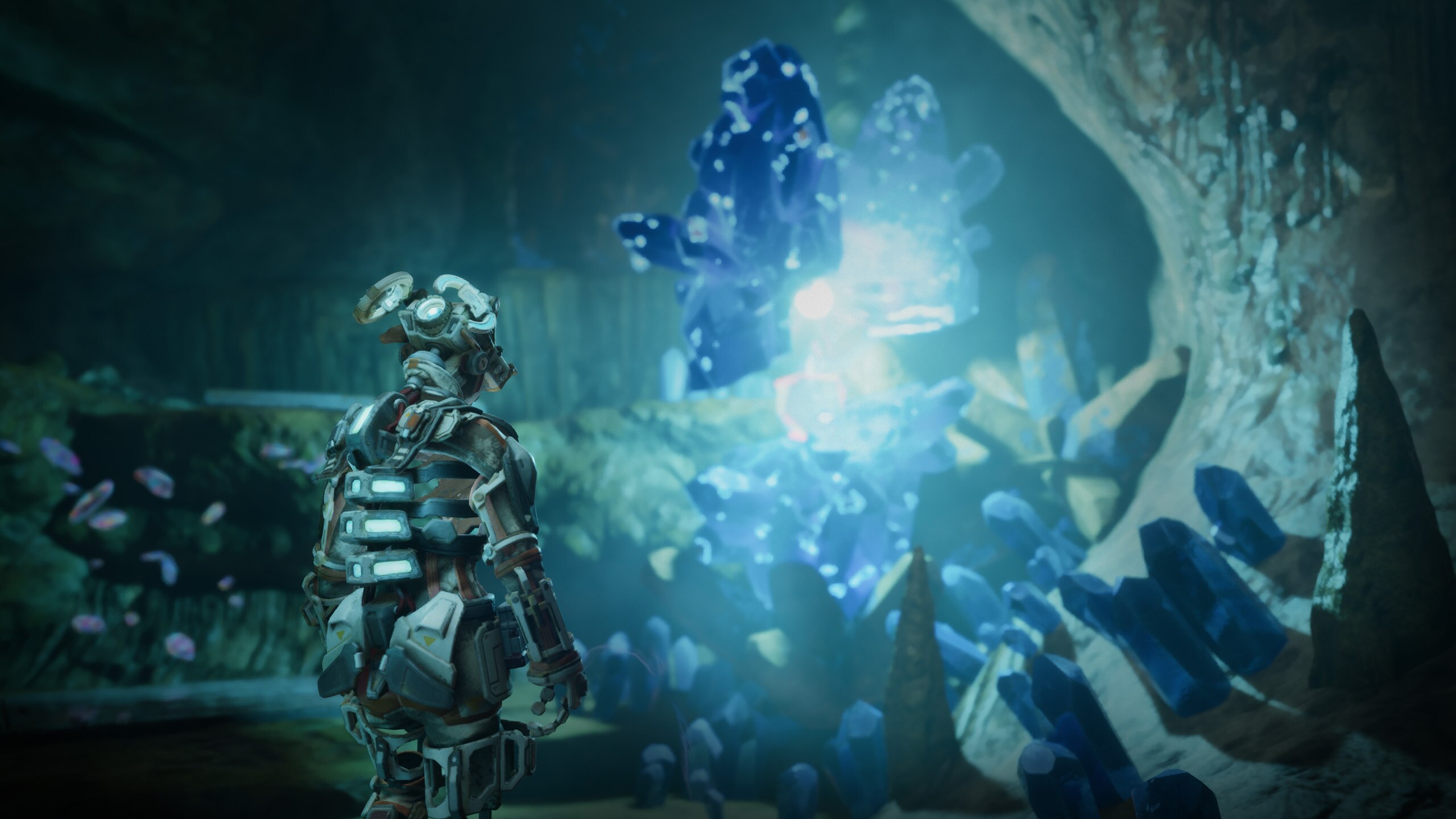
One example is Neural Dawn, the game project co-developed with Sumo Digital that showcases how Arm Neural Technology can enable desktop-quality graphics techniques, including advanced lighting, ray-traced effects and AI-powered rendering, within a mobile power envelope. As a fully playable experience, Neural Dawn provides studios, OEMs, silicon partners and engine developers with a practical demonstration of how neural graphics can be deployed on Arm-based mobile platforms.
Bringing neural graphics into every game engine
While studio collaborations demonstrate what is possible, game engines determine how quickly those capabilities reach developers. Arm is working across the game engines that underpin modern mobile game development, including Unreal Engine, Tuanjie Engine from Unity China and custom engines built using Vulkan. The work is particularly significant in China, the world’s largest mobile gaming market, where engine support can influence developers, publishers, OEMs, and hardware partners across the wider ecosystem.
A key recent milestone is Arm’s memorandum of understanding (MoU) with Unity China, which brings Arm Neural Technology into the Tuanjie Engine through technology alignment, co-development, native engine integration and broader ecosystem collaboration. At the same time, Arm continues to support Unreal Engine workflows, and studios using custom or in-house engines through the open source Neural Graphics Software Development Kit (SDK) for Game Engines, which is available as part of the Arm Neural Graphics Development Kit. Rather than being tied to a specific game engine, the SDK provides a Vulkan-based integration path for Arm neural technologies such as NSS and NFRU. It is also complemented by Vulkan ML tools for model conversion, inference, emulation, and debugging, helping teams to start building and validating neural graphics workflows today.
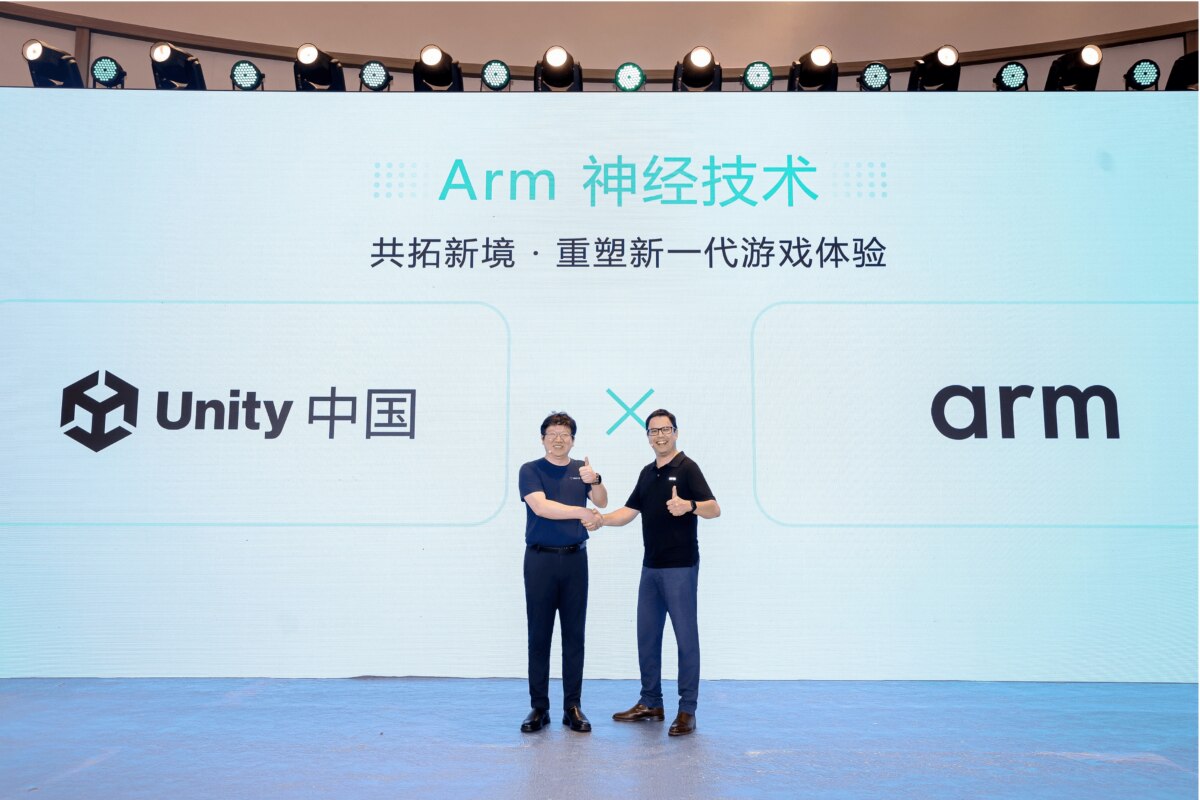
These collaborations make neural graphics capabilities available through the engines and workflows developers already use, reducing integration effort, and accelerating adoption across the industry.
Accelerating adoption with new additions to the Arm Neural Graphics Development Kit
Graphics technologies become significantly more valuable when developers can use it easily. That is why Arm continues to expand the Arm Neural Graphics Development Kit, which brings together the software components developers need to evaluate, integrate and optimize neural graphics within existing production pipelines. The Arm Neural Graphics Development Kit includes SDKs, tooling, plugins, AI models and supporting resources that help developers experiment with neural rendering techniques, tune performance on Arm-based platforms, and prepare games for future hardware.
A major new addition is NFRU, which is now available for the first time through the Arm Neural Graphics Development Kit. Together, NSS and NFRU enable games to render fewer frames at a lower resolution, then reconstruct higher-resolution images and generate intermediate frames for smoother gameplay at a lower rendering cost.
Rather than building custom implementations from scratch, developers can access these neural graphics technologies, integrate them into existing pipelines and evaluate performance using proven tools designed specifically for Arm-based mobile platforms. Combined with engine-level support and studio collaborations, the Arm Neural Graphics Development Kit helps move neural graphics from experimentation to shipping games.
From technology innovation to being production-ready
The future of mobile graphics will not be defined by hardware or AI alone, but by how effectively the industry brings them together.
In the case of Arm Neural Technology, Arm is working with game studios, engine providers, developers, OEMs, and silicon partners to make neural graphics production-ready across the mobile gaming ecosystem. For developers, this means richer visual experiences without fundamentally changing existing workflows. For studios, it creates a clearer path from experimentation to production. And for OEMs and silicon partners, it reinforces the value of Arm-based platforms designed to support the next generation of AI-powered gaming.
Together, these collaborations are making AI-powered graphics a practical part of mobile game development, enabling richer visuals, smoother gameplay, and greater efficiency.
Bring Arm Neural Technology to life
Start building games with Arm Neural Technology today
Explore now
By Arm Editorial Team
Share
Article Text
Copy Text
Any re-use permitted for informational and non-commercial or personal use only.
Editorial Contact
Arm Editorial Team
editorial@arm.com
Media Information

Media Contacts
Latest on X
Expanding the Arm compute platform is about adding another way to build and recognizing that different organizations innovate in different ways.
Because a greater flexibility to choose is what enables the industry to move into the next era of AI. 💪
From photon-to-torque latency to software portability and functional safety, building physical AI requires a systems-level approach.
@drewhenry joins Sophia Tung on the Ride AI podcast to discuss the engineering challenges shaping the future of autonomous vehicles and robotics.
👋 Meet Dynamic Insights in Arm Performix, turning runtime performance data into evidence-based recommendations for software optimization on Arm.
Dynamic Insights in Arm Performix are here, bringing AI-guided performance analysis to agentic development.
➡️ Runtime performance data
➡️ Arm-developed analysis guidance
➡️ LLM reasoning
Delivering evidence-based recommendations that help uncover bottlenecks, identify root
Modern infrastructure isn’t about thread count alone. What matters is sustained performance—and cost.
Video streaming puts both to the test. The Arm AGI CPU supports 256 simultaneous 4K/30fps streams without dropped frames, delivering 55% more streams per rack than a high-end
Robots are getting a new training ground. 🤖
@NEURARobotics is creating a new Physical AI training center with RWTH Aachen.
With @nvidia Jetson Thor, built on Arm Neoverse, supporting its robotics portfolio, NEURA is helping move physical AI from development to deployment.
Why did we expand the Arm compute platform?
Swipe through to see how more pathways to build on Arm are helping strengthen the ecosystem for the next era of AI.
AI-powered graphics only work if they’re available in the workflows game developers already use. That’s why our collaboration with Unity China is so significant.
We’re bringing Arm Neural Technology into the Tuanjie Engine, helping developers easily access AI-powered graphics
