

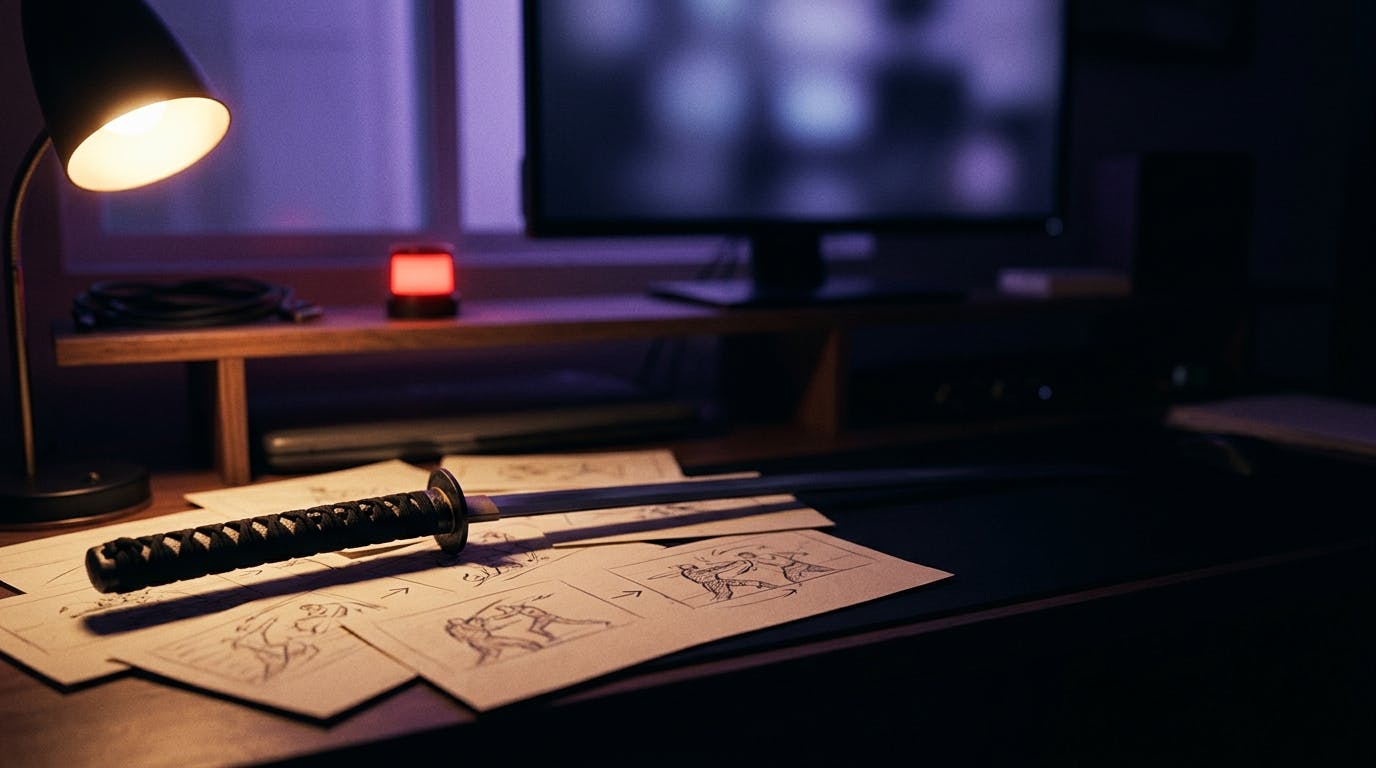
Runway and Google’s safety filters can’t tell a choreographed sword fight from the real thing. Rewriting the prompt, not the story, is what gets it through.
I sent a duel scene from Lost Garden into Runway last month. Two characters, blades drawn, a rooftop at dusk. Nothing on screen a Saturday-morning cartoon wouldn’t show. The generation came back rejected: flagged for graphic violence. I read the prompt back to myself and couldn’t find the graphic part. There wasn’t blood in it, wasn’t a wound in it, wasn’t even a word describing an injury. There was a sword and two people moving toward each other with intent, and that alone was enough to trip the filter.
That’s the answer to the question a lot of AI filmmakers eventually run into headfirst: AI video generators reject stylized violence because their safety filters score visual and textual patterns, like a blade plus fast motion plus contact, not the actual intent or art style behind the scene. A dark fantasy duel and a real assault can produce the same pattern match. Here’s what the major tools actually prohibit, why the filter can’t tell the difference, and the prompt-rewriting workflow that gets a legitimate fight scene through review without cutting the fight out of the story.
Why Do AI Video Generators Reject Scenes That Aren’t Actually Graphic?
Because the moderation layer isn’t reading your scene the way an audience would. It’s scoring the prompt and the output against a fixed list of harm categories, and it does that with an automated classifier looking for proxy signals, not with a human watching to see if the violence is stylized, implied, or clearly fictional.
Runway’s own usage policy, last updated March 6, 2026, is direct about this: it prohibits “graphic violence, or content that incites violence” and specifically calls out “gore, such as dismemberment, beheadings, mutilations, and exposed organs, bones, or muscle.” Runway also states plainly that its system “can also flag content that approaches these categories stylistically, even if the actual prompt is benign.” That line is the whole problem in one sentence. The filter doesn’t need your scene to be graphic. It just needs it to look adjacent to graphic.
A prompt that says “sword,” “strike,” and “fall” doesn’t tell the model whether it’s watching a tragedy or a stage rehearsal. It only knows those words cluster near the violence category, and clustering is enough to trigger a review.
What a director sees versus what a safety classifier scores. Diagram by ScreenWeaver.
What Do Runway and Google’s Policies Actually Prohibit?
Both companies publish their rules, and reading them directly is more useful than guessing. Runway prohibits terrorism and violent extremism content, graphic violence, and gore, in addition to the more familiar bans on sexual content involving minors, non-consensual imagery, and harassment. None of that language distinguishes between live-action and animated violence, which matters if your project is an anime, not a documentary.
Google takes a similar line but adds something worth noticing. Its Generative AI Prohibited Use Policy bars content that facilitates “violence or the incitement of violence,” but it also includes an explicit carve-out: “We may make exceptions to these policies based on educational, documentary, scientific, or artistic considerations, or where harms are outweighed by substantial benefits to the public.” That sentence exists on paper. It rarely exists at generation time, because the automated filter that actually blocks or passes your prompt in the moment isn’t the team that wrote the exception clause. It’s a classifier running in milliseconds, and classifiers don’t read context, they read patterns.
That gap between the policy’s stated intent and what a keyword-and-pattern filter actually enforces is the entire reason this problem exists for genre filmmakers.
Runway’s Usage Policy, last updated March 6, 2026. Screenshot: runway.com/safety/usage-policy.
Why Can’t the Filter Tell Stylized Violence From the Real Thing?
Google’s Generative AI Prohibited Use Policy. Screenshot: policies.google.com.
Because stylization is a judgment about tone, and tone is not something a safety classifier is built to evaluate. It’s built to catch the categories a platform has legal and reputational exposure for, at scale, across millions of prompts a day, with a strong bias toward over-blocking rather than under-blocking. A false rejection costs a filmmaker an afternoon. A false approval that lets something genuinely harmful through costs the platform a headline. Every major video model is tuned toward that asymmetry, which is exactly why:
- A weapon in frame raises the score before anything else in the prompt gets weighed. The presence of a blade, a gun, or a raised fist is itself a signal, independent of art style.
- Injury-adjacent vocabulary raises it further, regardless of context. Words like “wound,” “blood,” “gore,” or “brutal” score the same whether they’re describing a slasher film or a single dramatic beat in a fifteen-second clip.
- Fast contact motion between two figures reads as a fight even when the prompt never says so. Choreography and violence look identical to a model that has no concept of stage combat.
None of this means the tools are broken. It means they’re built for the median case, and a dark fantasy series with a genuine sword fight in it isn’t the median case.
The same fight beat, written two ways. Diagram by ScreenWeaver.
How Do You Write a Fight Scene Prompt That Survives Review?
You describe the genre before you describe the action, and you let the visual consequence stay implied instead of explicit. This isn’t about softening the story. It’s about giving the classifier something other than a raw violence pattern to latch onto first.
The rewrite I actually run now, shot by shot:
- Name the genre and medium up front. “Stylized anime duel” or “choreographed stage combat” in the first clause changes what the model is primed to expect from everything that follows.
- Replace literal injury language with impact language. “Blade clashes, sparks fly, both step back” describes the same beat as “he slices his opponent’s arm open,” without the words that trip the injury-adjacent flags.
- Cut away before contact instead of describing contact. A shot that ends on the swing, not the landing, tells the story and avoids generating the exact frame most likely to get scored as graphic.
- Keep the consequence in the edit, not the generation. A reaction shot, a dropped weapon, a held breath in the next clip communicates what happened without a single frame depicting it.
That last point is the one that actually changed how I storyboard fight scenes for Lost Garden. The violence stays in the story. What changes is where it lives: generated on screen, or implied in the cut. Most professionally shot fight scenes already work the second way. The cut sells the hit, not the frame.
The filter isn’t asking you to make a gentler story. It’s asking for a prompt that reads as fiction before it reads as a weapon.
What Do You Do When a Shot Still Gets Rejected?
Treat the rejection as information, not a dead end. When a shot fails review after a genre-forward rewrite:
- Reduce the frame to a single beat instead of a full exchange. A two-second clash reads differently to a classifier than a ten-second back-and-forth with multiple points of contact.
- Swap the specific weapon for a more neutral staging cue where the story allows it. Silhouette, distance, or a wide shot can carry the same tension with less literal weapon detail in frame.
- Log what got rejected and what passed, next to the shot it belongs to. This is the boring habit that actually saves time. Without it, you relearn the same filter boundary on every episode instead of once. On ScreenWeaver, that rejection note sits with the rest of the shot plan, so the next duel scene starts from what already worked instead of from zero.
- Accept that some shots have to be reshot as a different kind of shot. Not every beat is worth fighting the filter for. Sometimes the honest fix is changing the coverage, not the wording.
Does an anime or stylized art style help a violent scene pass AI video moderation?
Sometimes, but not automatically. Naming the genre and style in the prompt gives the model useful context, but a weapon plus fast contact motion can still score high enough to get flagged even inside a clearly cartoonish frame.
Can dark fantasy or horror content be made at all with mainstream AI video tools in 2026?
Yes, within limits. Runway and Google both prohibit graphic violence and gore outright, but implied, choreographed, or off-screen violence generally clears review when the prompt avoids literal injury language and explicit contact.
Is there an actual list of banned words for AI video prompts?
The platforms don’t publish one. What they publish are policy categories, like graphic violence, gore, and hateful content, and the practical list of trigger words is something you build through trial, rejection, and a log of what worked.
If you’re building anything with real stakes in it, a duel, a monster, a fall, expect the filter to flag the first honest version of that scene. Rewrite for genre before you rewrite for content, keep a record of what got through, and the rejections stop feeling random and start feeling like a boundary you can actually work inside.
