

As Wesley Snipes’ Blade once put it, “Some motherf***ers are always trying to ice-skate uphill.” That seems strangely apt for the short-lived “Blade” continuation series, which did its best to pick up where Snipes’ Blade film trilogy left off. Was he in it? No. Had the movies gotten better with each successive entry, thereby priming audiences for a TV sequel series? Also no. But “Blade: The Series” was, indeed, determined to ice-skate uphill anyway.
It might not always get its due, but 1998’s “Blade” was a watershed moment for Marvel and superhero movies in general. A year prior, even the cast of “Batman & Robin” knew they’d filmed a bomb that had undermined not only the franchise to which it belonged but the concept of the comic book film altogether. Then came Snipes’ Daywalker in a slick, strikingly violent superhero action thriller drenched in ’90s cool. Written by comic book adapter extraordinaire David S. Goyer, “Blade” was a great comic book movie at a time when comic book movies were in danger of becoming uncool.
After that, Goyer penned two film sequels (2002’s “Blade II” and 2004’s “Blade: Trinity”), each of which fared worse critically than its predecessor (though “Blade II” did perform somewhat better at the box office than the first “Blade”). But the writer and New Line Cinema didn’t give up. Though Snipes was out, Goyer’s Blade universe returned for the Spike TV show “Blade: The Series,” which wasn’t quite as bad as you might expect … at least, not as bad as, say, “Batman & Robin.” That said, it should have been a better showcase for a character who, ever since his 1998 movie, has suffered no shortage of Hollywood-inflicted injustices.
Blade: The Series follows Sticky Fingaz’ Daywalker as he returns to his native Detroit

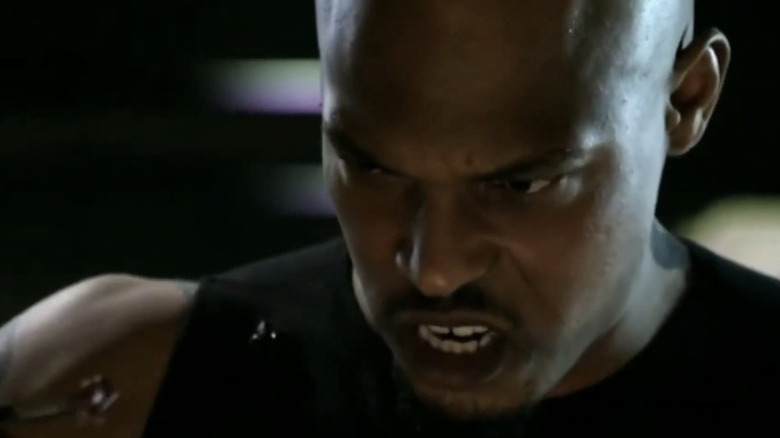
“Blade: The Series” debuted in 2006 as Spike TV’s first dramatic series. It shared continuity with Wesley Snipes’ Blade movies, taking place after the events of “Blade: Trinity” and following the titular vampire hunter as he continues his war against the undead. But Snipes, who infamously refused to film most of his “Blade: Trinity” scenes, was literally nowhere to be seen this time. Instead, Kirk Jones, aka. Sticky Fingaz of Onyx fame, played Eric Brooks/Blade, the half-human, half-vampire hero, as he returns to his native Detroit in the series premiere.
That same premiere sees Jill Wagner’s Krista Starr return from a tour of duty in Iraq only to find that her twin brother, Zack, has died. Of course, he’s almost certainly a victim of Detroit’s substantial vamp community, but Starr hasn’t yet encountered the undead hordes. After an encounter with the powerful vamp Marcus Van Sciver (Neil Jackson), however, she becomes very familiar with his kind and almost joins them after Sciver injects her with his blood. (For some reason, the vampires in “Blade: The Series” inject their prey rather than biting them, as the latter, according to one vamp, is “for savages.”) Blade and his sidekick Shen (Nelson Lee) — a poor replacement for Kris Kristofferson’s Whistler from the movies — then rescue her from the brink of vampirism by giving her a dose of the Daywalker’s own serum. After that, Blade teams up with Krista to get revenge on Marcus.
The premiere episode was scripted by David S. Goyer and comic book legend Geoff Johns. Goyer was just coming off co-writing Christopher Nolan’s Batman movie franchise reboot “Batman Begins.” Alas, his attempt to revitalize Blade failed to match Nolan’s reinvigoration of the Dark Knight’s cinematic fortunes.
Blade: The Series was essentially Wesley Snipes’ 1998 classic de-fanged
It’s no secret that the character of Blade has had a rough go of it in Hollywood recently. Marvel Studios’ long-gestating Mahershala Ali-led “Blade” movie endured setback after setback before being quietly scrapped altogether, as evidenced by studio head Kevin Feige admitting to feeling like a “loser” for not making the delayed superhero movie. Luckily, 1998’s “Blade” remains a classic and one of the most important movies ever made. If we never get another film based on the Marvel character, Wesley Snipes’ first outing will more than do.
Unfortunately, the Blade TV show was a pallid, toothless affair by comparison. It seemed like a determined effort to further sully the 1998 movie after two less than stellar sequels had already driven the stake most of the way in.
Today, the show holds a 50% critic score on Rotten Tomatoes based on 18 reviews, but considering it’s now 20 years old, that score likely isn’t based on all available reviews and, as such, isn’t the most accurate guide to its quality. Unfortunately, reading the actual reviews doesn’t really help its cause. The New York Times described “Blade: The Series” as “surprisingly inoffensive,” which should raise alarm bells for any fan of the first “Blade” film and its unapologetically bloody action sequences. Brian Lowry, reviewing the show for Variety, was similarly underwhelmed, writing that while Jones offered “a fair Wesley Snipes impersonation,” the series overall put “more emphasis on noise than smarts.”
“Blade: The Series” ran from June to September 2006 before being canceled after one season of 13 episodes. Today, it’s been mostly forgotten, though it does remain notable for an almost perfect tagline: “Some things are better left undead,” or, in this case, just fully dead.
