

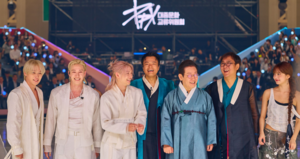
The plan, backed by state-private committee, is expected to draw 200,000 from abroad and an economic impact of more than W1tr
An 11-day K-culture festival built around K-pop concerts and an awards show centered on fandom will debut in December 2027.
The Presidential Committee on Popular Culture Exchange, co-chaired by Culture Minister Chae Hwi-young and JYP <a href="https://comicvibe.com/flutter-entertainment-to-report-q2-results-on-aug-5/” title=”Flutter Entertainment to report Q2 results on Aug 5″>Entertainment founder J.Y. Park, released its plan for the event, called Fanomenon, on Monday.
The festival runs Dec. 2 to 12, 2027, opening with a gala on the first night. It will be split between Seoul Arena in Changdong, northern Seoul, which is due for completion in May 2027, and the second exhibition center at Kintex in Goyang, Gyeonggi Province.
The name combines “fan” and “phenomenon.” The committee said it chose the term to frame fans as partners in spreading Korean culture rather than consumers of it, and has described the festival as a Korean answer to Coachella and Lollapalooza.
Seoul Arena will host concerts on six days across two weekends, with multiple acts on each bill. The awards show will be staged between sets on Saturday and Sunday, with nominees drawn from fields where fandoms have taken root. A midsize hall at the same complex will relay the main stage live, while the convention space houses an exhibition of nominees and fan events.
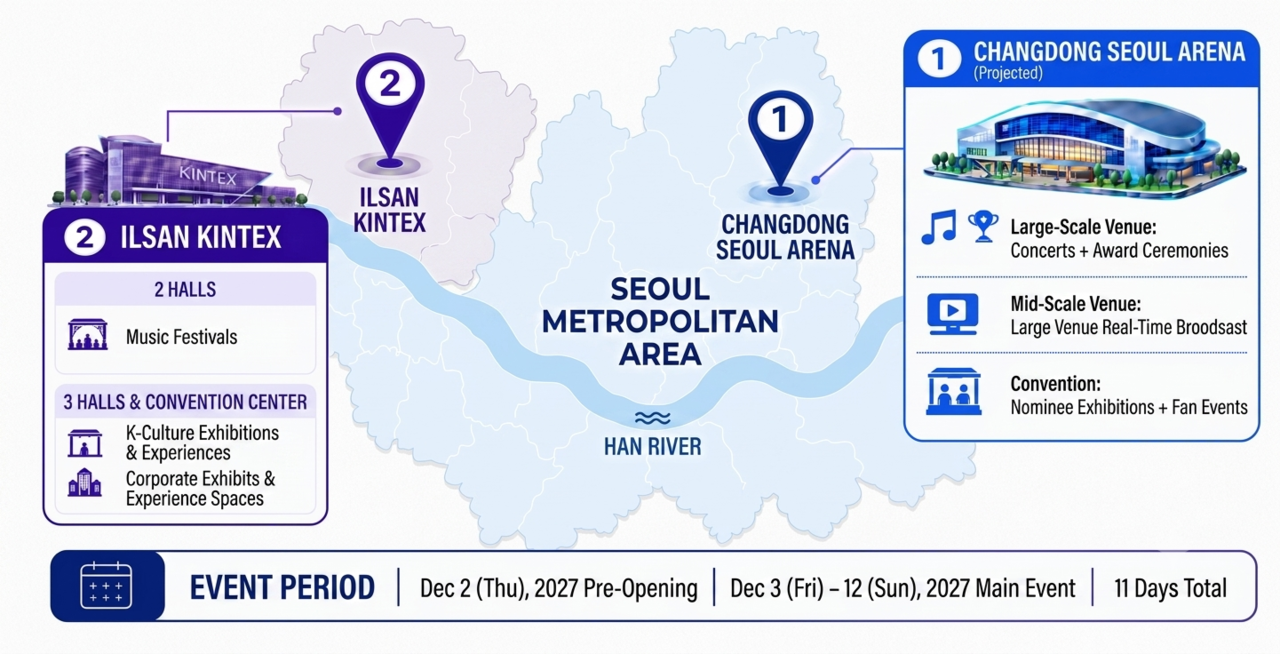
Two halls at Kintex will hold a music festival for about 20,000 people on weekends, widening the lineup beyond K-pop to jazz, EDM, rock, R&B, hip-hop, world music and traditional Korean music. On the four weekdays in between, the halls turn over to fan meetings, production presentations, screenings, esports tournaments, soundtrack concerts and business forums.
Three more halls will be given to exhibitions and hands-on programs from K-culture companies, spanning food, beauty and fashion as well as games, webtoons, film, video and animation. The committee said it wants categories with fan bases distinct from K-pop’s to broaden the audience.
Organizers project 520,000 visitors, including 200,000 from abroad, and an economic impact of more than 1 trillion won ($680 million). For comparison, the committee cited Coachella, which drew about 250,000 people over six days in 2025 and, together with the Stagecoach festival, generated about $700 million for California. It also pointed to BTS’ comeback concert at Gwanghwamun in March, which Hybe estimated drew 104,000 people in a single day and which Bloomberg valued at $177 million.
Under the plan, the private sector will handle programming, production and promotion, while the government will support the participation of smaller K-culture companies, promote inbound tourism and handle logistics such as immigration and safety. The committee will coordinate between the two and among the agencies involved.
Hybe, SM Entertainment, YG Entertainment and JYP Entertainment moved in April to set up a joint venture to run the festival, which they hope to take to other cities from May 2028. The government is also weighing whether to time other events, including Korea Grand Sale, to overlap with the festival.
The plan came alongside a broader outline of the committee’s work, including a hotline for companies to raise problems with customs, certification and the movement of staff and goods. Piloted from April, the hotline is to run in full from 2027.
The committee is also backing privately led K-culture centers built around K-pop venues in major overseas markets, and support for collaborations on intellectual property across genres and industries.
