

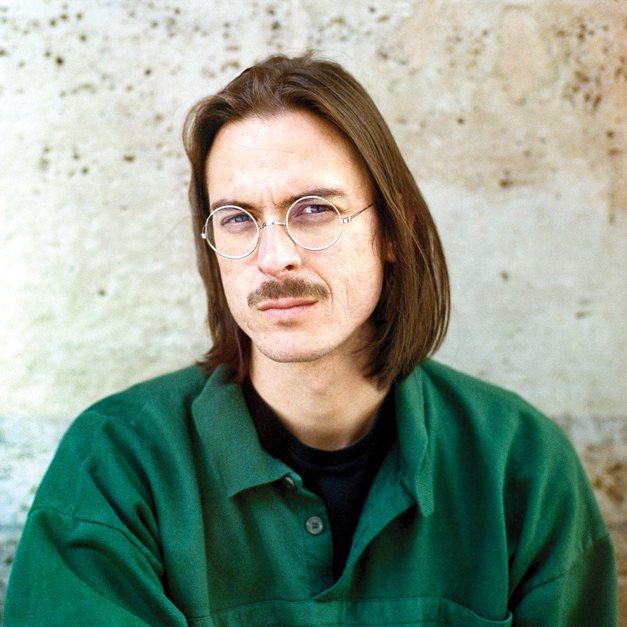
To Kick off our Fall Comics preview Issue, We spoke with the artist about his latest graphic novel, An existential mystery set in paris and one of our top picks of the season
It’s late June and Paris is in the grip of a heat wave. Speakingst Lucas Harari wears a green quick-dry towel over his bare shoulders. Two electric fans struggle to hold the heat at bay. “I use a wet towel and the ventilateur,” the 36-year-old explains. “In France we don’t have climatization everywhere.”
Given these circumstances, Harari found it especially appealing to visualize crisp autumn weather for the cover ofPW’s fall comics and graphic novels preview issue. “With this heat wave, it was very pleasant to draw some rain,” he says. Naturally, his thoughts also turned to Halloween. “For me, it’s a sign of fall.”
A graduate of the École des Arts décoratifs in Paris, Harari has published three graphic novels in his native France. Swimming in Darkness, an eerie tale set in the thermal baths of Vals, Switzerland, appeared in English in 2019. PW’s review called it a “stylish, atmospheric book whose deliberate pacing deliciously builds tension and mystery.” Next to hit the U.S. market will be The Case of David Zimmerman, out from Arsenal Pulp in October.
The concept for the book came to Harari one night as he drifted off to sleep. “I had this idea of two people making love and switching bodies,” he says. “I woke up the morning after with the idea that the switch was not just one switch, but more complicated—like a chain.”
Months passed before he found a path into the noirish character study the work would become. “I gave up several times,” he admits. Before abandoning the project, he described the premise to his filmmaker brother Arthur Harari, who cowrote the Oscar-winning screenplay for Anatomy of a Fall. Arthur phoned a week later.
“He told me that my ideas were turning in his head,” Harari says. “He wanted to make a movie with the story.” (The resulting film, The Unknown, debuted at Cannes earlier this year.)
Over weekly meetings at a Belleville café, the brothers developed The Case of David Zimmerman, setting much of its action in the same Paris neighborhood. Their protagonist, David, wakes after a charged encounter with a mystery woman to find her face staring back at him from the mirror. He learns that her name is Rachel Bluem, and that she has a German passport. As Rachel, he searches for clues to recover his physical identity, negotiating an unfamiliar gender along the way.
Having mostly written male protagonists, Harari was apprehensive about inhabiting Rachel’s perspective. “Maybe the solution for me was to create a character in this precise situation,” he says.
At the time he was working on the book, Harari and his girlfriend were expecting their first child. “I was very happy,” he recalls. “I was also destabilized. It’s this time when you realize that you’re changing. You were a son, and you will become a dad. Everything that builds your identity comes to the surface. I asked myself questions about who I am, where I come from.”
The experience brought clarity to Harari’s understanding of David’s situation—how family traumas and a tenuous connection to his Jewish heritage could be shaken loose by a more immediate rupture. “If something happens to you,” he explains, “it brings these unconscious questions to the front. This becomes the center of your life.”
Though its premise is fantastical, the graphic novel stays grounded in David’s disorienting experience. “This experience—it’s very traumatic,” Harari says. “It’s hard because it’s a mystery.”
Asked what he hopes readers will take from the book, he pauses before landing on an answer: “Maybe if readers can feel the vertigo of what it is to be.”
Return to main feature.
A version of this article appeared in the 07/20/2026 issue of Publishers Weekly under the headline: Cover Artist
