

The ’90s were some interesting times for technology, as it produced a lot of everyday items and gadgets, many of which you probably wouldn’t recognize as that old. An excellent example is the original Sony PlayStation, because when it launched in 1994, it completely changed the world of video games by introducing its new (at the time) CD-ROM format and 3D graphics with realistic polygons. Consoles like the Nintendo Entertainment System, SNES, and Sega Genesis used cartridges, not CDs, and were part of the 8-bit and 16-bit eras.
The PlayStation introduced a more modern home gaming experience that many of today’s consoles can be traced back to. It makes one wonder: what are some other everyday pieces of tech that most people don’t realize came out in the ’90s? Not the legendary gadgets that were born during that time, which pretty much everyone can call out, but instead, some more overlooked devices that everyone either still uses or that have influenced today.
PDAs and Palm Pilots
Business was a big deal in the ’90s, so wireless opportunities were booming thanks to the growth of the internet and relevant tech. Okay, all of that has always been a big deal, but back then it spurred the development of more powerful handheld devices: the early concepts of the smartphones and tablets used today. Those were Personal Digital Assistants (PDAs) and Palm Pilots, basically a mashup of devices that served as a handheld electronic organizer. They were also favored by people always on the move.
PDAs weren’t anywhere near as powerful or functional as the average phone from 2026, but they did include a lot of useful tools, and some even had touchscreen displays that worked with a stylus. The PalmPilot 1000 launched in 1996 with 128Kb of memory, a 16Mhz DragonBall processor, and a display resolution of 160 by 160 pixels. Imagine a contact book with addresses, a calendar, a personal agenda, email access, security tools, a calculator, a phone, and other digital add-ons all crammed into a palm-sized device.
Of course, there was no Siri, Alexa, or any other personal voice assistants. Moreover, they often had physical buttons tucked into the side or littering the face, and a lot of them were bulky, heavy, and pretty ugly by today’s standards, but they worked for the time.
Sega Game Gear
The Nintendo Game Boy from the ’80s and the Game Boy Color, which was released in the ’90s, hogged the spotlight and are still popular today with retro game collectors. But I would argue that the Sega Game Gear was the origin of a more advanced handheld gaming console à la the Steam Deck and its many counterparts. As a rival to Nintendo’s console, the Game Gear introduced full-color games with 8-bit graphics available to play on the go in 1990. It also incorporated a backlight for late-night and low-light gaming. Anyone who has ever tried to play the Game Boy during a late-night road trip in the back of the family van by the glow of streetlights understands why an internal light was a huge improvement.
Sony AIBO
Given the AI craze, push for a bevy of robot companions, advanced robotics solutions, and even online bots, you’d be forgiven for thinking these were all recent inventions, but robots have been around for a long time in one form or another. Take the Sony AIBO, a robot dog companion that was, admittedly, more akin to a toy. It could sit, walk, growl, and interact with owners on command. Sony also claimed it “could learn and grow up” over time thanks to simulated artificial intelligence.
It had 18 types of joints all over its body, allowing it to move its legs, neck, head, tail, upper jaw, and much more. When it launched in 1999, it was a stunner. The first generation, anyway. While it didn’t come cheap — and didn’t make it into every household for that reason — you’d be hard-pressed to find someone with memories from that era who doesn’t recognize the AIBO’s Robocop-and-metallic-esque form. The Aibo robotic puppy still exists today, but there are also a lot of other robotic companions that were inspired by Sony’s original.
The standalone dial-up modem
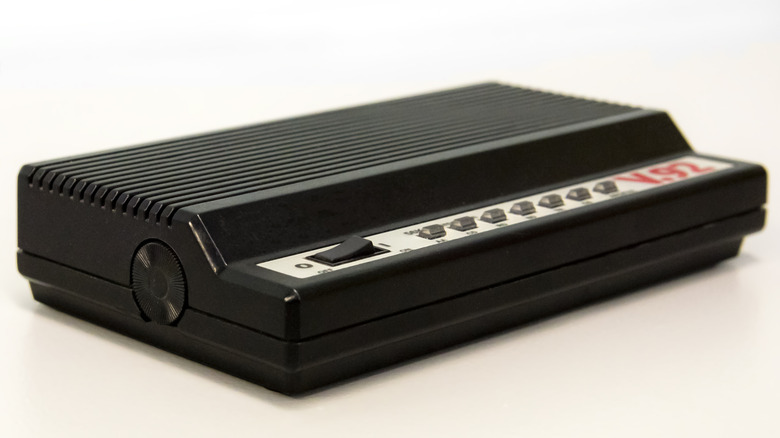
As the internet became a sensation throughout the ’90s, service companies introduced a handful of new ways to connect. One of them was a standalone modem that plugged directly into an available landline, and pretty much completely took it over when in use — meaning when someone wanted to get on the internet. Dial-up modems were essential computer accessories at the time, because you couldn’t get online without them. They came as a small box that you plugged into your computer, and then connected to a telephone outlet. When operational, it had a bunch of blinking lights on the front that told you what was going on.
These are also the devices that made those odd, scratchy, beepy connection noises you associate with retro internet hookups. Going by the visual descriptions alone, that probably sounds familiar, right? The modems used today are much more advanced, of course, and most don’t plug into phone outlets; they use cable ports instead, but the designs are still remarkably similar to the originals. They even have blinking LEDs on the front.
Home office and desktop all-in-one printers
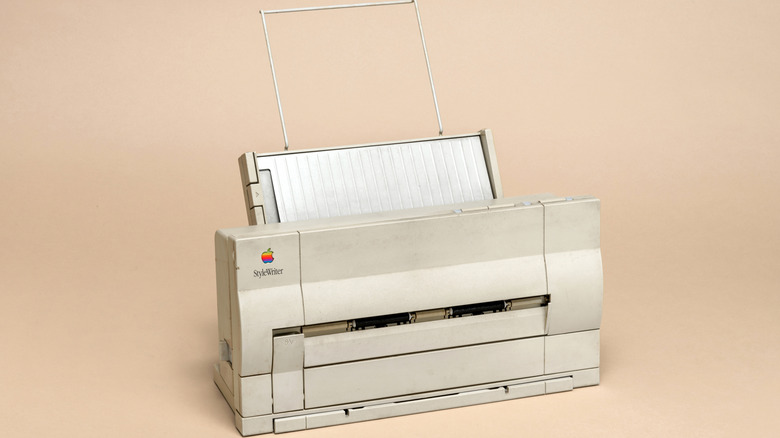
Right around the ’90s is when home office and desktop all-in-one printers became both available and more popular. Before then, loud, large, and unruly dot-matrix impact models were common. Laser printers did exist before then, too, but HP’s first, the 2680A, launched in 1980, was about the size of a food cart and cost $100,000, which would be over $405,240 in 2026. Companies like HP, Epson, and even Apple introduced inkjet and laser printers that were not only more compact than commercial counterparts, but also easier to use, affordable, and relatively quiet.
The HP LaserJet 4L, which launched in 1993, was a stunner for the time. It was still pretty big and hefty but only cost about $500. It was also the start of printers that could really fit on a desktop or tabletop surface, before then most printers were standalone and about the size of your average copying machine today. Wireless printers were also invented in the mid-90s, although they wouldn’t become available to consumers and prevalent until much later.
Thanks to the advent of digital technologies, there’s simply no need for home printers anymore. Printing is largely necessary for business, legal, and medical documentation. People still print on home office printers, of course, but you could easily get by these days without owning a printer at all.

2 Comments
Pingback: Upendra praises Yash’s Toxic amid growing debate over the film - Comic Vibe
Pingback: Black Panther / Namor: Doomed #1 Preview: Hell Trip with Doom - Comic Vibe