

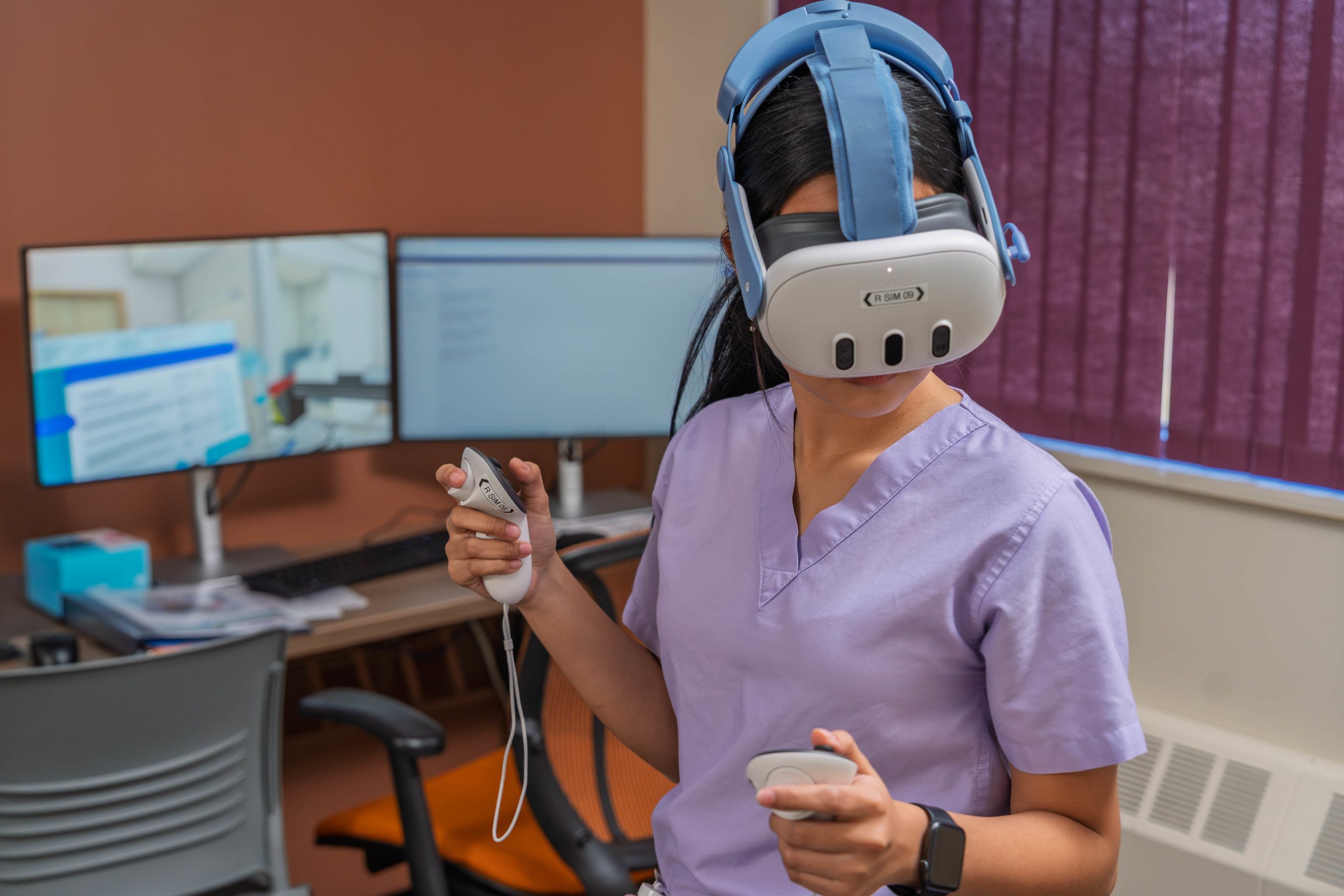
Students in the Saskatchewan Collaborative Bachelor of Science in Nursing (SCBScN) program are now using virtual reality more than ever to prepare for real-life health-care scenarios.
The SCBScN program — a joint venture between Saskatchewan Polytechnic and the University of Regina — is significantly expanding its use of virtual reality (VR) to enhance nursing education and better equip future health‑care professionals.
“Virtual reality is such a great opportunity for our students to learn in a very safe environment,” says Loreli Palandri, Sask Polytech’s Simulation Centre manager.
“It gives them so many experiences and the ability to really foster real-time critical thinking skills,” she says. “It is positive, engaging and interactive.”
Integrating VR into nursing education offers an immersive, interactive way for learners to not only build technical skills but also critical thinking and clinical judgment.
It exposes students to situations they may not encounter during clinical placements, helping them build confidence, reduce anxiety and feel more prepared for practice.
That has been the experience of Olami Akinfiresoye, a second-year SCBScN student at the Regina campus.
“It took out some of the anxiety that you would experience during a clinical setting,” she says. “It opens up a lot of space to make mistakes before we get out there and do the real thing.”
From pilot to full program rollout
A pilot VR program was launched in January 2025 with a small group of nursing students. After extensive feedback, the VR pilot program expanded that fall.
“The response has been really great — from faculty as well as students,” says Palandri. “We are now looking to fully launch the VR program across the entire SCBScN curriculum for the fall of 2026.”
She notes that the tech-savvy demographic entering the nursing program adapts quickly.
“They respond positively to our technological advances. They pick it up quickly and are able to fully immerse themselves immediately into that learning environment,” she says.
“That is a driving force behind what we are doing. We are always trying to be as cutting edge as possible, so we can meet these learners where they are.”
Students in the four-year program learn through a combination of classroom instruction, clinical practice and state-of-the art lab simulations.
Innovative applications
The program’s simulation centres are among the most advanced health-care learning environments in Saskatchewan.
While lab simulations use physical equipment and high-fidelity mannequins to mimic clinical scenarios, VR offers immersive, three-dimensional experiences accessed through headsets and handsets.
“They are usually put into high-stress situations that they wouldn’t necessarily get to be fully immersed in if they were in the hospital,” says Palandri.
For example, students may encounter simulations involving cardiac arrest, pediatric respiratory illness, post-operative complications or complex births.
“It really runs the gamut of care that a student might experience in a practice education setting,” she says. “The students get to work at the edge of their scope of practice in a very safe environment.”
VR also supports communication and inter‑professional skill development, such as calling a physician, sharing health information or collaborating with other health‑care disciplines.
Palandri says by providing real‑time feedback and multiple opportunities to learn from errors, VR helps ensure students graduate as more confident, capable practitioners.
Preparing for a health-care career
Akinfiresoye is driven by the desire to make a difference in people’s lives. She says nursing has been a long-time passion and a family tradition — her mother is a doctor and her four siblings are also pursuing careers in health care.
“I feel it is my calling to help people in need — I can’t see myself doing anything else that’s not in health care,” she says.
VR has strengthened her skills and boosted her confidence.
“It made things easier in real-life situations,” she says. “And it was fun — so that’s a plus.”
THIS STORY WAS CREATED BY CONTENT WORKS, POSTMEDIA’S COMMERCIAL CONTENT DIVISION
