

An old-school video game may offer a surprisingly futuristic option for stroke recovery.
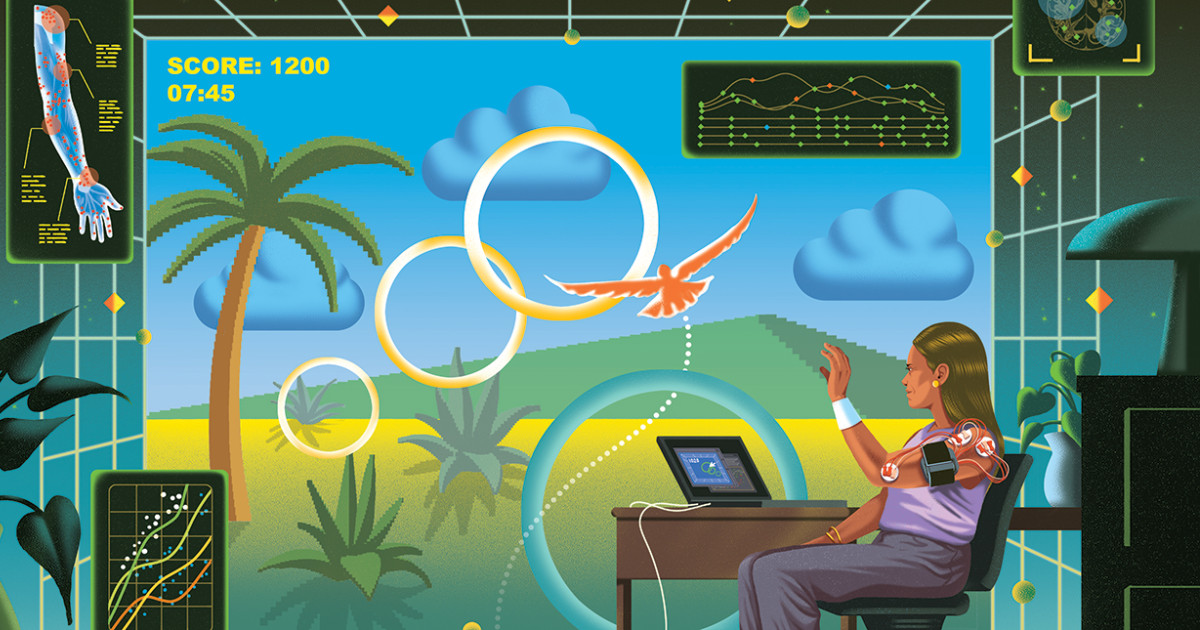
A Northwestern study recruited patients who were living with moderate to severe arm impairment — meaning they were only able to slightly move their arm and extend their elbow — due to a stroke that occurred at least six months prior to beginning the study. Participants played a ’90s-style video game on a laptop for 90 minutes a day, five days a week at home and one day in the lab for six weeks while wearing small sensors on their impaired arm. The sensors measured the speed and strength of electrical signals traveling through the participant’s nerves in their arm muscles. The sensors then translated those signals into movement inputs in the game. Players were asked to complete tasks in the game — such as flying a helicopter around the screen to land on a moving target — using only those electrical inputs.
A stroke can disrupt brain signals that control movement, causing muscles to fire in an uncoordinated way. Called abnormal coupling, this phenomenon can make it difficult for stroke survivors to extend an affected arm forward with a straight elbow. For example, someone might try to reach straight ahead, but their elbow bends because their biceps activate at the wrong time.
The video game and sensor system, called myoelectric interface for neurorehabilitation (MINT) conditioning, identifies abnormally coupled muscles and retrains them to move independently again.
The video game is customized so that electrical activity from each of the coupled muscles causes a cursor to move in perpendicular directions. For example, a participant’s biceps might move the cursor to the right and their deltoids move the cursor up. When those muscles are abnormally coupled, the cursor thus moves on a diagonal (up and right, like turning both dials on an Etch-a-Sketch).
“We have them hit targets that are farther and farther away from that diagonal until they have to separate their muscles and can only hit it by activating one of the muscles and not the other,” says the study’s co-corresponding author Marc Slutzky, professor of neurology and neuroscience at the Feinberg School of Medicine. The more the muscles decouple, the higher the person’s score in the game.
“Hearing participants report they’re regaining movement in their arm and that it’s helping them in their daily life is so rewarding.”
After six weeks of the game-based therapy, some stroke survivors improved arm function by nearly eight times as much as those in the control group. Being able to play the game at home allowed for better access to the therapy and increased arm extension reps. Participants also said the game made rehab more fun.
The study assessed improvement using a timed test that measures function in daily activities. The scientists noted that participants in the experimental group completed daily tasks more quickly than those in the control group. Participants in the experimental group also saw improvements in their impaired arm’s range of motion, and that functionality continued to improve one month after ending the therapy.
“We’ve been working on this approach to stroke rehab for 15 years, so hearing participants report they’re regaining movement in their arm and that it’s helping them in their daily life is so rewarding,” says Slutzky ’01 PhD, ’02 MD, ’03 GME, ’06 GME. The game was designed by members of the Slutzky Neuroprosthetics Laboratory at Northwestern.
Most stroke rehab today focuses on helping stroke survivors perform daily tasks, which often results in stroke survivors compensating for their impaired arm function. For instance, a patient might lean forward with their whole body to reach for an object rather than reaching for it with just their arm.
“We’re doing something different,” Slutzky says. Rather than working around the impairment, “we’re treating the impairment directly and measuring how much the arm improved.”

3 Comments
Pingback: Movie Scene Map puts film, game and anime locations on one world map - Comic Vibe
Pingback: 10 Superhero Weaknesses That Sound Made Up But Aren't - Comic Vibe
Pingback: Miami-Dade commissioner says proposed GTA VI partnership glorifies violence against police, pedestrians - Comic Vibe