

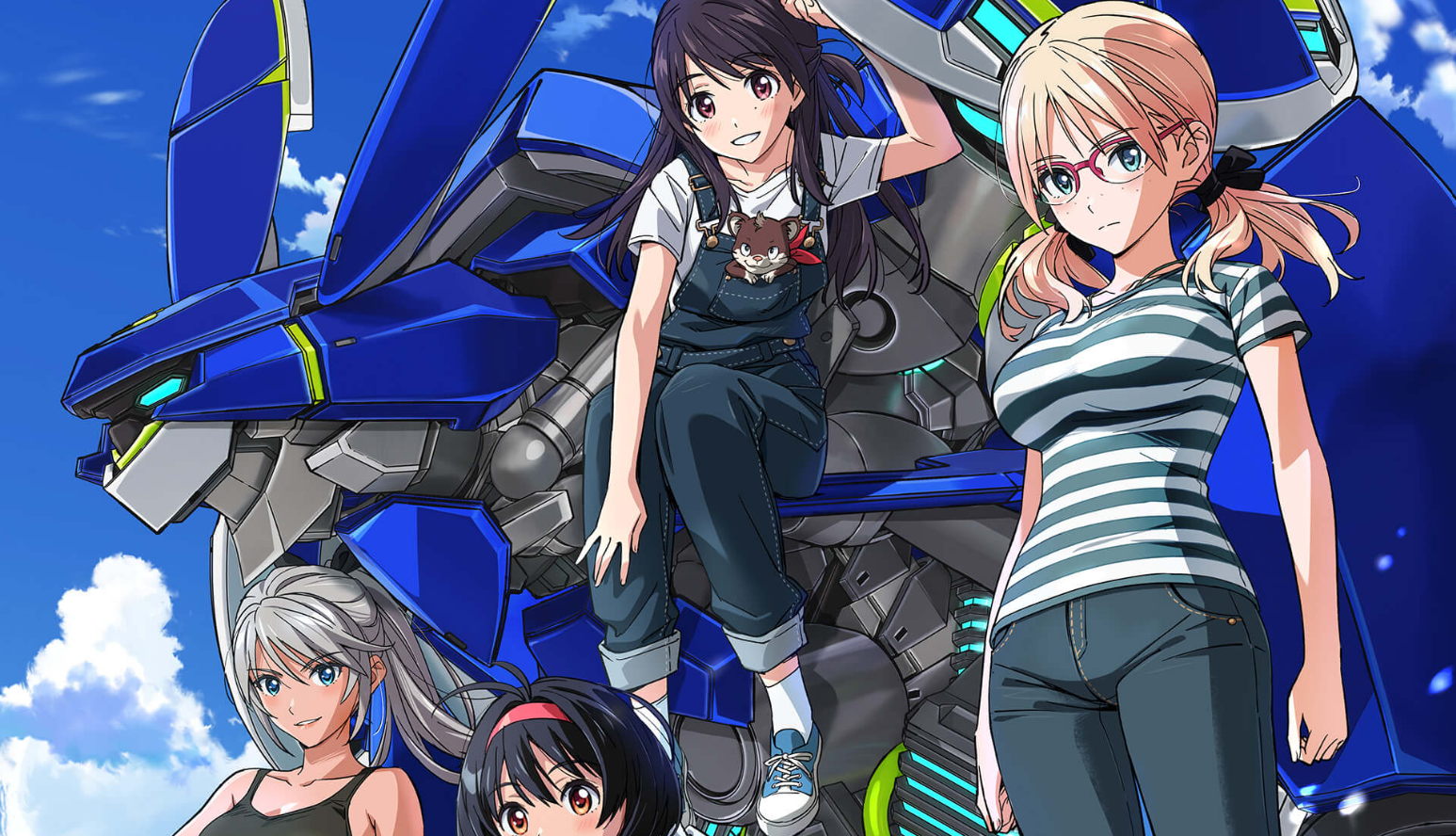
Vertex Force will premiere in Japan on October 3, 2026, and with a full five-person voice cast now confirmed — including Kaede Hondo and Rie Takahashi — the show is no longer an anticipation. It is an argument. Before a single episode airs, its promotional materials reveal a premise dense enough to reward analysis on its own terms: a heritable biological power that skips a male sibling to manifest in his older sister, mecha controlled from outside rather than piloted from within, and a civilization-scale conflict rooted in the most militarized, most colonized, most politically fraught geography in the Indo-Pacific. These are not genre decorations. They are specific, independently verifiable scientific frameworks embedded into the show’s DNA — sometimes literally.
From Hardware to Bloodline: How Vertex Force Mutates the Mecha Musume Formula
The mecha musume subgenre, established in its modern form by illustrator Humikane Shimada and refined across two decades of anime, has always been built on a single structural premise: cute girls merge with or wear military hardware, and that merger produces extraordinary capability. In Strike Witches — the template established by Vertex Force director Kazuhiro Takamura — teenage girls strap Striker Units to their legs, aircraft-derived mechanical systems that unlock their magic. The power is external. The girl and the machine are distinct things that combine.
Vertex Force breaks that formula at its foundation. The ENGINE — the series’ central power system — is not hardware that protagonist Haruka Todo wears. It is an inheritance. Her father passed it to her, and it manifests through her biology, summoned and wielded without any external equipment being donned. Her younger brother Akira received nothing. The power lives in Haruka’s blood and nervous system, dormant until crisis. Aniplex confirmed the full cast on July 24, 2026, alongside the October 3 premiere date and the complete plot framework.
This is a conceptual mutation. Takamura — who in Vividred Operation placed a Dirac Sea-based quantum energy system at the center of his worldbuilding — has a consistent career pattern of using real scientific frameworks as structural premises rather than as set dressing. Vertex Force continues that pattern, and here the framework is transgenerational epigenetic inheritance: the scientifically contested but increasingly documented phenomenon by which epigenetic modifications — changes to gene expression states, not to DNA sequences themselves — can be transmitted from parent to offspring across generations.
Research has established that epigenetic marks including DNA methylation patterns and histone modification states can, under certain conditions, survive meiotic reprogramming that typically resets such marks between generations. The selective expression of such a mark in Haruka but not Akira maps onto a real genetic mechanism called sex-limited penetrance, in which a trait is encoded in both biological sexes but phenotypically expressed in only one — often because expression depends on an interaction with sex-linked hormones or X-chromosome modifier genes. If the ENGINE’s compatibility is indexed to an epigenetic configuration that requires two copies of an X-linked modifier region to cross its activation threshold, Haruka (XX) crosses it and Akira (XY) does not. This is not magic. It is fictional genetics with a plausible mechanistic basis.
Standing Outside the Machine: The Neuroscience of External Control
Most mecha anime resolve the pilot-machine problem by putting the pilot inside the machine. Vertex Force refuses this. The ENGINE is controlled externally: Haruka stands apart while her mecha operates in front of her, summoned from what the promotional materials describe as behind her body — an interface geometry the show’s design compares, aptly, to the “Stand” paradigm of JoJo’s Bizarre Adventure, where psychic manifestations extend from the user’s immediate space into combat range.
The neuroscience of this design choice is more interesting than it might appear. Human beings maintain a body schema — an unconscious sensorimotor map of their body’s position, extent, and capabilities in space — and this schema is demonstrably plastic. The rubber hand illusion, established by Botvinick and Cohen in 1998, demonstrated that the brain can incorporate entirely artificial objects into its self-model given sufficient multisensory feedback. Research on neuroprosthetics has extended this finding: amputees using brain-controlled prosthetics integrate into body schema as primary somatosensory and motor cortical neurons adapt to respond to virtual touch applied to the prosthetic.
The peripersonal space — the region immediately surrounding the body that the brain treats as contiguous with the self, functional for body protection and goal-directed action — is where this integration happens. It can be shifted: studies have shown that peripersonal space shifts with ownership when body ownership is redistributed across multisensory feedback conditions. The ENGINE emerging from behind Haruka — from within her peripersonal zone, not from a distance — is therefore neurologically precise as a design choice. She is not piloting a remote vehicle. Her brain is, in the show’s fictional logic, extending its body schema to encompass a machine that was always already within the self-zone. The ENGINE is part of her in the same way a prosthetic becomes part of its user, except that the integration is biological rather than trained.
That the ENGINE’s compatibility varies between siblings — one inheriting it, one not — maps onto the documented phenomenon of BCI inefficiency, in which 15 to 30 percent of users of brain-computer interface systems cannot gain effective control regardless of training duration. Researchers attribute this variability to inter-individual differences in neural architecture — cortical folding patterns, white-matter connectivity, oscillatory coherence in motor-planning circuits — differences that twin studies suggest have a substantial heritable neural component. Akira’s inferiority complex — his sense that he cannot access what his sister possesses by birthright — is a recognizable emotional consequence of the neurological version of the same situation.
What Okinawa Is Carrying Into This Story
The series is set in northern Okinawa — a geographic choice the production team cannot have made accidentally. Okinawa hosts approximately 70 percent of U.S. facilities designated for U.S. military use in Japan while comprising less than 0.6 percent of the country’s total land area. The Kadena Air Base — the largest U.S. air installation in the Indo-Pacific — sits there. Yonaguni, the prefecture’s southernmost inhabited island, lies 110 kilometers (68 miles) from Taiwan, making Okinawa the front edge of any Indo-Pacific security contingency.
Before it was Okinawa, it was the independent Ryukyu Kingdom, a maritime trading state that existed from 1429 to 1879, simultaneously tributary to Ming China and economically entangled with Japan’s Satsuma domain. Japan formally annexed the Kingdom in 1879 through what is called the Ryūkyū shobun — an act of annexation that suppressed the Ryukyuan language, the noro shamanic tradition, and Uchinaaguchi cultural practices as part of a systematic assimilation campaign. The Ryūkyū shobun annexed the Kingdom against the documented wishes of its people and its foreign treaty partners. The Battle of Okinawa civilian death toll in 1945 reached an estimated 40,000 to 150,000 — among the highest civilian death rates of any Pacific War campaign. American occupation ran until 1972, when the islands reverted to Japan while the U.S. military presence remained and grew.
Okinawa has therefore experienced colonization, military devastation, foreign occupation, and administrative reintegration within living memory. Its residents carry a layered sovereignty — Ryukyuan, Japanese, American-occupied, Japanese again — that has no equivalent in Japan’s mainland experience.
The ENGINE power being transmitted as a family secret, passed down through Haruka’s paternal lineage and hidden from the world, is a structurally exact parallel for Ryukyuan cultural memory: a distinctive inherited capability preserved privately within families, transmitted selectively across generations of suppression by successive occupying structures, and becoming legible as a critical asset precisely when the dominant order faces existential threat. Whether the production intends this parallel explicitly or has arrived at it through the logic of their setting choices, it is present and operative.
Haruka, Akira, and the Politics of Inherited Power
Director Takamura established with Strike Witches established in 2008 and Vividred Operation (2013) a consistent authorial premise: young women of exceptional capability are the irreplaceable center of civilizational defense, while the adults around them — military structures, political institutions — function as support or as obstacle. Both prior series assigned humanity’s survival to adolescent girls who were visually coded as non-threatening, placing a question at the center of the genre that no one was required to state directly: why do societies demand that the vulnerable bear the weight of collective survival?
Vertex Force makes this question structural in a way those series did not. The ENGINE’s inheritance is involuntary — Haruka did not choose it and cannot refuse it. Akira’s exclusion is equally involuntary — he did not lack discipline or effort; he simply lacks the biological substrate. The show frames his resulting inferiority complex not as weakness to be overcome but as a legitimate response to a genuinely arbitrary situation. The character who is coded as the normative protagonist — male, younger, point-of-view audience surrogate — is explicitly positioned as someone who needs to be protected. He must find meaning in ordinariness alongside a sister who was always, by birth, the extraordinary one.
The mecha musume tradition has circled this question for two decades without quite stating it in these terms. Vertex Force states it in these terms before the show has aired.
“The Correct Answer Will Destroy the World”
The series’ official tagline — 「”正解”は、世界を壊す」, translated as “The correct answer will destroy the world” — is worth reading as a philosophical proposition. In ethics, a tragic dilemma is a scenario in which the action that satisfies all available moral criteria nonetheless produces catastrophic harm — a structure explored by philosophers including Bernard Williams in “Moral Luck” (1981) and Martha Nussbaum in “The Fragility of Goodness” (1986), and dramatized in the mecha genre most influentially by Neon Genesis Evangelion (1995).
The tagline encodes this structure explicitly. The protagonists will find the correct solution to the EDVA threat. That solution will be destructive. A world saved by a logic of sacrifice — whose sacrifice, chosen by whom — is what the show is building toward.
In Okinawa, this has not been a hypothetical. The “correct answer” of military necessity — Allied liberation, American basing, the security architecture of the U.S.-Japan alliance — has repeatedly and specifically meant the destruction of Okinawa and its people, from the 1945 battle to the ongoing land seizures, noise pollution, and violent incidents documented in the Okinawa Prefecture government’s 2026 report. The show may be asking whether a world saved by a logic of sacrifice, at a cost borne by those who did not choose it, is worth saving on those terms. That it is asking this from northern Okinawa, through a girl who inherited her power rather than earned it, is the kind of specific convergence that distinguishes a show with a thesis from a show with a setting.
Staff, Cast, and Premiere Details
Vertex Force premieres on October 3 confirmed at 23:30 JST on Tokyo MX, BS11, Gunma TV, and Tochigi TV. Streaming in Japan will be availableounced
The principal voice cast, confirmed on July 24, 2026:
- Akira Todo (13-year-old male protagonist, strong sense of justice, lives with inferiority complex about lacking the ENGINE) — Makoto Koichi
- Haruka Todo (16-year-old female protagonist, ENGINE-bearer, described as guileless and physically gifted) — Kaede Hondo
- Eleanor Northbrook (American-born character, described as competitive and hardworking) — Ami Koshimizu
- Lala Zudenstein (Swiss-born character, described as calm and aspiring to be a watchmaker) — Megumi Han
- Yoko Nishina (from Hokkaido, described as kind-hearted but carrying trauma) — Rie Takahashi
The international character names — Northbrook, Zudenstein — alongside the Okinawan and Hokkaidoan Japanese characters suggest a deliberately multinational ensemble, a common mecha anime device for signaling civilizational-scale stakes.
Production is led by director and character designer Kazuhiro Takamura at studio SMDE, known for the Shinkalion series and 3DCG animation. ENGINE mecha design is by Kanetake Ebikawa, whose Gundam 00 and Mercury designs include the GN-drive Gundams of Mobile Suit Gundam 00 and multiple units from The Witch from Mercury. ENIA design is by JNTHED, whose Gundam Aerial design for The Witch from Mercury — a unit with a possible quasi-emotional bond to its designated pilot — offers a precedent for what kind of mecha ENIA may be. Details on the <a href="https://www.animenewsnetwork.com/news/2026-05-08/vertex-force-original-anime-reveals-october-debut-main-staff-teaser-video/.237187″ rel=”nofollow noopener” target=”_blank”>full Vertex Force production staff were first published by Anime News Network on May 8, 2026. Masahito Onoda (Brave Witches, Strike Witches: Road to Berlin) serves as chief animation director; Nobuaki Nobusawa (Astra Lost in Space) composes the score.
Bandai Spirits will release a 30 Minutes Preference plastic model kit of the ENIA unit in November 2026, priced at ¥4,000 (approximately $25 USD).
Currency conversions are approximate based on exchange rates at time of publication.
Frequently Asked Questions
When does Vertex Force premiere and where can I watch it?
Vertex Force is scheduled to premiere on October 3, 2026 at 23:30 JST on Tokyo MX, BS11, Gunma TV, and Tochigi TV in Japan. Streaming will be availableng rights have not been announced
Is Vertex Force connected to Strike Witches?
Not in terms of shared characters or continuity — Vertex Force is an entirely original series. The connection is the director: Kazuhiro Takamura created Strike Witches and Vividred Operation, and Vertex Force is his third project in the mecha musume tradition. It revisits and significantly evolves the premise: where Strike Witches gave its girls external mechanical equipment to wear, Vertex Force makes the mechanical power an inherited biological property of the protagonist’s body — a structural departure that has significant implications for how the show thinks about gender, inheritance, and who gets to be extraordinary.
What is the ENGINE power, and how plausible is the science behind it?
The ENGINE is a mecha-summoning capability inherited patrilineally — passed from Haruka and Akira’s father to Haruka but not to Akira. In real-world biology, the closest parallel is transgenerational epigenetic inheritance: the transmission of gene expression states across generations through epigenetic marks (DNA methylation, histone modifications) rather than through DNA sequence changes. The selective expression in Haruka but not Akira is consistent with a phenomenon called sex-limited penetrance, in which a trait is encoded in both sexes but expressed only in one due to interactions with sex-linked genetic modifiers. The show’s premise is scientifically speculative but not scientifically incoherent.
Why does the Okinawa setting matter for understanding what this show is about?
Okinawa hosts approximately 70 percent of U.S. facilities designated for U.S. military use in Japan despite comprising less than 0.6 percent of Japan’s land area. Before Japanese annexation in 1879, it was the independent Ryukyu Kingdom — a maritime trading state with its own language, religion, and cultural traditions that were systematically suppressed under assimilation and nearly obliterated during the 1945 Battle of Okinawa. The ENGINE’s transmission as a family secret across generations of suppression is structurally parallel to Ryukyuan cultural memory: a distinctive inherited capability preserved privately, transmitted selectively, and becoming legible as a critical asset at the moment of existential crisis. Whether or not this parallel is fully intentional, it is built into the bones of the premise.
ⓒ 2026 TECHTIMES.com All rights reserved. Do not reproduce without permission.
