

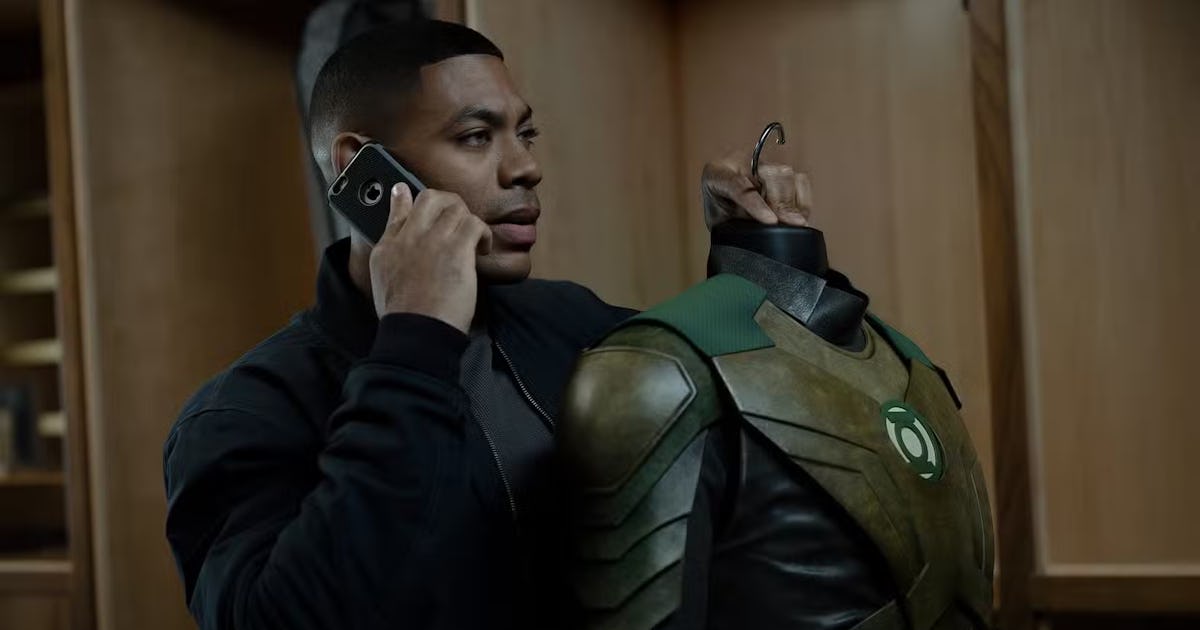
Lanterns Is Flipping The Relationship Between Hal Jordan And John Stewart
The HBO Max show is making some changes to their dynamic, but are they for the better?
There’s a tendency for comic book adaptations to unintentionally influence the medium they’re based on. Sometimes this works out for the better, like when Batman: The Animated Seriesintroduced Harley Quinn or revolutionized Mr. Freeze with a heart-stoppingly tragic change to his origin story. Other decisions, like retconning Kamala Khan into a mutant instead of an Inhuman for MCU synergy, are less successful.
One of the most overlooked changes to comic canon is a complicated one, because it comes from a beloved adaptation that spotlighted a character who’d been written rather inconsistently in comics. The animated Justice League series bucked comic book history by introducing John Stewart as the League’s sole Green Lantern, which elevated the character’s popularity and cultural recognizability, but sacrificed the social and cultural context he was introduced in by rewriting his origin to be that of a former military veteran. Now, 25 years after that cartoon aired, Episode 3 of the HBO Max series Lanternsis following in that retcon’s footsteps – and inverting the original dynamic between Hal Jordan and John Stewart.
John Stewart’s Black Power History
In 1972, John Stewart debuted in Green Lantern Vol. 2 #87, a story aptly titled “Beware My Power” — the character, created by artist Neal Adams and writer Dennis O’Neil, was only DC Comics’ third Black superhero. Deliberately colored to be darker than the lighter tones DC traditionally used for Black characters, and modeled after Sidney Poitier, John was introduced at a time when Green Lantern was being used to tell politically charged stories (courtesy of DC’s favorite left-wing anarchist, Green Arrow, becoming a series co-lead).
John’s origins initially reflected that. He was introduced as an unemployed architect chosen by the Guardians of the Universe to fill in as a reserve Lantern after Guy Gardner was injured in an earthquake. When Hal first encounters John, he sees him standing up to an aggressive police officer, and stereotypes him as a crass troublemaker (an assertion the Guardians call the result of Jordan’s “petty biases”). Hal attempts to teach John a lesson by assigning him to protect a racist senate candidate targeted by an assassin, and John’s seeming disinterest in the task only validates Hal’s opinion of him — until John saves the life of a policeman, and in the process exposes the senator’s plans to stoke a race riot by faking an assassination attempt.
Lanterns Is Inverting The Dynamic Between Heroes
John’s comic book origins, while a little dated, offer a glimpse at how comics reflected the socio-political and cultural circumstances of their time; John was an educated and radical role model for Black readers, and his experiences as a Black man contextualized his resistance to authority, up to and including his blue-skinned bosses. But when Bruce Timm introduced John Stewart in Justice League,he stripped the character of his radical beginnings and made him a former U.S. Marine, a retcon that jumped off the television screen and into actual DC Comics canon with the Geoff Johns era of Green Lantern. Johns was the first writer to establish that John was a former sniper, and as more and more writers built off that change, John’s original origins fell by the wayside.
Episode 3 of Lanternsreveals that the DCU’s John Stewart is not only a former sniper (his history as an architect is turned into a knack for drawing), but that he’s been trained by his parents since childhood to be the perfect Green Lantern, at the behest of the Guardians of the Universe. After John is dishonorably discharged from the military (the outcome of his decision to take the fall for an international incident caused by Hal Jordan’s recklessness), he’s finally recruited by the Guardians to observe and eventually replace Jordan, who has become a liability to the Corps since Sinestro’s coup. While the essence of John Stewart’s post-retcon origin is basically there, the show’s circumstances have put our leads in a weird reversal of their first appearance — Hal is the reckless hothead who resents authority, and John is now the “by the books” straight-shooter.
Episode 3 tries to imbue John’s “new” origins with commentary on the exacting nature of Black excellence and the exhausting challenge of forever bucking racist social expectations, but the self-serious jarhead Bruce Timm has left us with just isn’t as compelling or interesting as John Stewart’s original origin. Not only was it a loud statement at a crucial time, but it also provided a remarkable story for John — his world-weary perspective and anti-authoritarian scrutiny eventually forged him into a shrewd leader as a veteran Green Lantern who became the only mortal Guardian of the Universe. It’s clear that Lanternsis setting up an opposing arc for John, one in which he starts to question the authorities guiding him (be it his parents or the Guardians), which isn’t necessarily a bad idea. It’s just one far more derivative of the arc Hal Jordan underwent in the comics.
New episodes of Lanterns release Sunday on HBO Max.
- TV Shows
- Superheroes
- DC Universe

2 Comments
Pingback: Richard Gere celebrates 77th birthday with wife Alejandra Silva, 43, and young son in rare family photos - Comic Vibe
Pingback: 'Dark Matter' Season 2 Release Schedule: When to Watch Apple's Twisty Sci-Fi Thriller - Comic Vibe