

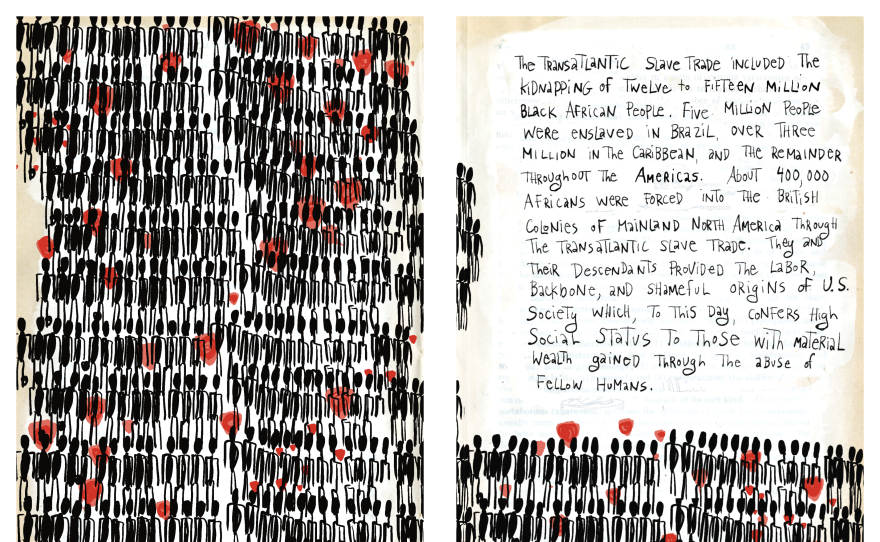
1 of 7 — the-book-of-genocides-the-genocide-of-black-americans-stephanie-kloss-2026.png
One of many unflinching images in The Book of Genocides by Vermont author Dana Mashoian Walrath. This image can be seen inside the book’s front cover and in the section “The Genocide of Black Americans.”
Stephanie Kloss / Courtesy

2 of 7 — the-book-of-genocides-art-installation-version-zoology-book-stephanie-kloss-2026.JPG
Images from the art installation that would later turn into Dana Mashoian Walrath’s The Book of Genocides. Much of the book incorporates her mother’s 20th century zoology book, including the “turn the flap” illustrations show here, alongside the actual textbook.
Stephanie Kloss / Courtesy
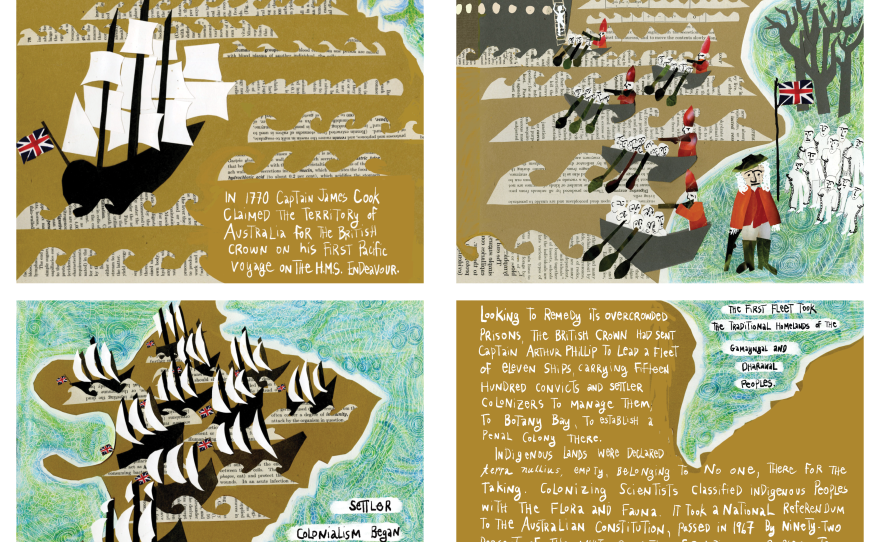
3 of 7 — the-book-of-genocides-the-genocide-of-aboriginal-australians-torres-strait-islander-peoples-stephanie-kloss-2026.png
Dana Mashoian Walrath’s illustrations in the section “The Genocide of Aboriginal Australians and Torres Strait Islander Peoples” in her new disaster comic, The Book of Genocides.
Stephanie Kloss / Courtesy
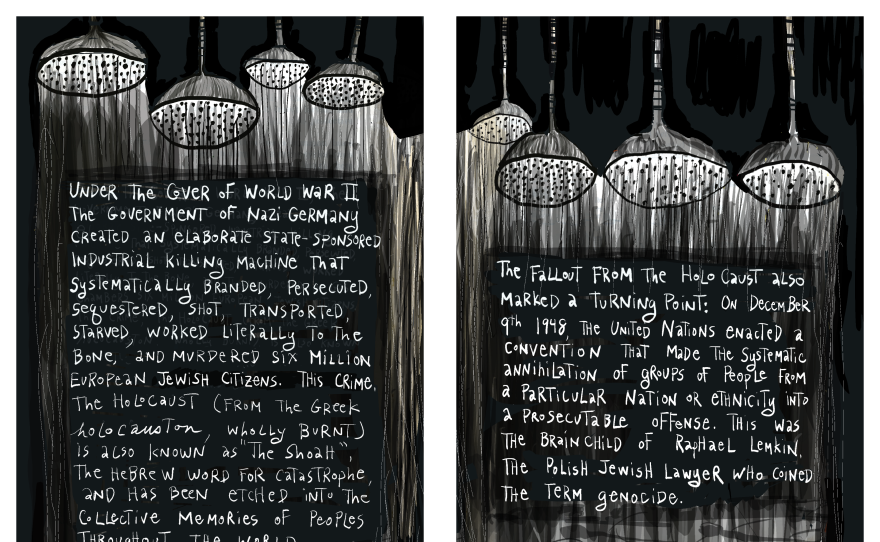
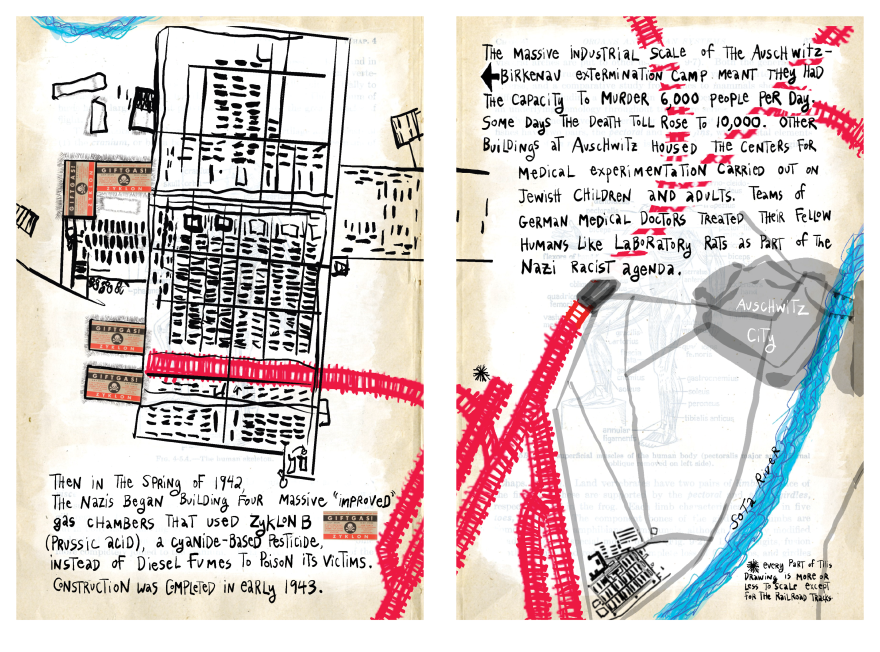
4 of 7 — the-book-of-genocides-the-genocide-of-jews-in-the-holocaust-showers-stephanie-kloss-2026.png
A visceral representation of the Holocaust in the section “The Genocide of Jews in the Holocaust” from Dana Mashoian Walrath’s graphic history The Book of Genocides.
Stephanie Kloss / Courtesy
5 of 7 — the-book-of-genocides-the-bosnian-genocide-stephanie-kloss-2026.png
Illustrations by Dana Mashoian Walrath in the section “The Bosnian Genocide” in her new graphic history The Book of Genocides.
Stephanie Kloss / Courtesy
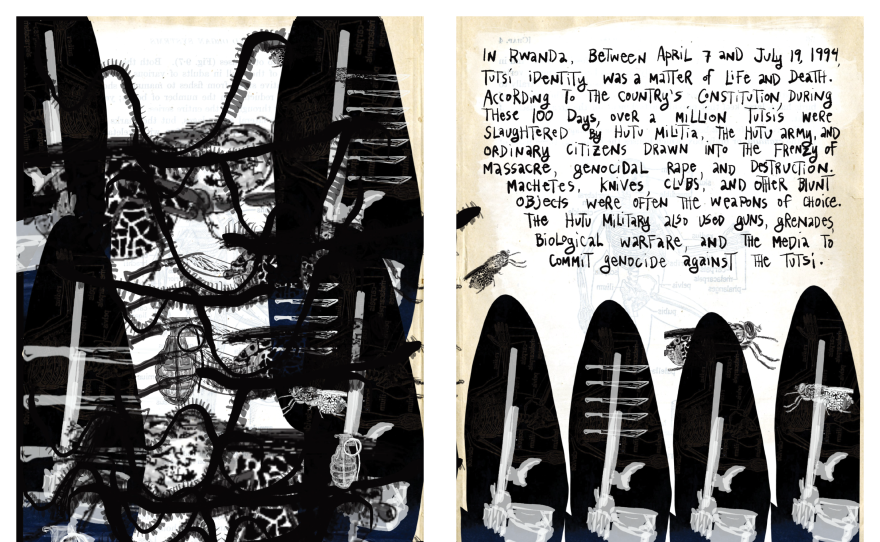
6 of 7 — the-book-of-genocides-the-tutsi-genocide-in-rwanda-stephanie-kloss.png
A collage of weapons used in a section on the Rwandan genocide titled “The Tutsi Genocide in Rwanda,” from the new disaster comic The Book of Genocides.
Stephanie Kloss / Courtesy
7 of 7 — the-book-of-genocides-the-palestinian-genocide-stephanie-kloss-2026.png
One full page from “The Palestinian Genocide” in Dana Mashoian Walrath’s new work The Book of Genocides.
Stephanie Kloss / Courtesy
To learn about history’s darkest moments, we often turn to textbooks or documentaries. In her newest book, award-winning South Burlington-based author, artist and anthropologist Dana Mashoian Walrath takes a vastly different approach.
The Book of Genocides is a graphic narrative, also called a “disaster comic,” that recounts some of the most devastating episodes in human history. It focuses on 10 genocides across five centuries, beginning with the First Peoples of the Americas to the ongoing Rohingya Genocide. Mashoian Walrath unearths patterns between each of the humanitarian devastations she covers.
The book also encourages readers to physically cut certain pages, creating an interactive “turn the flap” style sequence that illustrates how dehumanization develops.
For the author, this journey is deeply personal. Her grandmother survived the Armenian genocide of the early 20th century and was just 10 years old when she hid in an urn as her father — Moshoian’s great-grandfather — was publicly dismembered.
Stephanie Kloss
/
Courtesy
Dana Mashoian Walrath recently sat down with Vermont Public’s Jenn Jarecki to discuss The Book of Genocides.
Their conversation was produced for the ear. We highly recommend listening to the audio. We’ve also provided a transcript, which has been edited for length and clarity.
Jenn Jarecki: Thank you so much for being here and for your time. It’s strange, and maybe other people who have interviewed you have felt similarly, that it sounds almost a little uncomfortable to say “congratulations on this book,” and yet it is singular, unlike anything I have read on the subject. Period.
Can you take us back to the impetus behind the project, and at what point you said to yourself, “This book has to be written?”
Dana Mashoian Walrath: This book was a long time coming. The impetus to the project, before I was an artist, before I was a writer, was something that happened when I was a 10th grader. My beloved history teacher — it was my favorite subject; he was so talented — One day after class, he said, “So, what am I supposed to know about the Armenians besides the rugs?” It was a watershed moment for me that taught me that history has biases built in because of political processes. That my beloved history teacher did not know this very real history that I knew had scarred my family made me start wondering what other histories were hidden from all of us in plain sight.
It wasn’t until 2016 that I made an art installation for a show at Studio Place Arts in Barre. After I had lived in Armenia as a Fulbright scholar for a year, they were curious about the genocide and the history of it, and said, “Let’s do a show that can talk about borders and politics and so forth.”
Jenn Jarecki:I’d love you to describe for listeners, what is a disaster comic. Why did you choose to write The Book of Genocides as one? Why not more traditional prose?
Dana Mashoian Walrath:Comics, they’re such a powerful medium, and the term “disaster comics” comes from the great comic scholar Hillary Chute. She talks about in her book Disaster Drawn, how the comics medium keeps readers safe because they can always feel the presence of the narrator, not just through words, but through the actual act of a hand rendering it on a page. I read that after I had already discovered comics, which happened in 2009.
My mom and dementia were living with me, and I discovered comics, and quickly read the Fun Home and Maus and American Born Chinese and Stitches. And every single book that came into the house, my mother ate up. So, I started thinking about what can comics do that other media can’t, and they’re perfect for multi-layered, complex storytelling. You can, on a page, capture many, many contradictions.
And when something is controversial and traumatic, the way genocide is, and only controversial because people want to deny that it’s happening, but no matter what, it’s painful. I felt like it was the perfect medium.
Stephanie Kloss
/
Courtesy
Jenn Jarecki:So you focus on 10 genocides from the past 500 years. Will you share more about researching the book and how you ended up choosing those 10 events?
Dana Mashoian Walrath:I promised myself to go to every single place. So I was with the Rohingya in camps in Bangladesh because I wouldn’t have been allowed safely into the Rakhine State to find out anything about that genocide. But there are more Rohingya in Bangladesh than in Myanmar.
I went to Rwanda. I went to Bosnia. I coasted on my knowledge of Armenia and the United States from having lived here and spent so much time there. I had also spent time in Israel, Palestine in 2013, and so I didn’t go back in the middle of this war period. But I witnessed the wall and witnessed apartheid.
This book required me to go to Auschwitz and spend time there, and really kind of work through all of these various details. I spent time in Australia. I was welcomed into Indigenous communities there, and really learned from all of those experiences how I had to represent other people’s stories in the most respectful way possible. I had to really learn from community members in every case how to represent it.
Why did I pick those 10? It was hard, because there are so many I had to leave out, from the Ukrainian Holodomor to the first genocide of the 20th century of the Namaqua and the Herero by the German colonizers, but what I wanted to do was get good global representation. I wanted to be able to dive into the difference between peoples who had experienced genocide before we had a genocide convention and then after the genocide convention to really interrogate whether the convention is working or not.
There’s one more piece of the choice. I believe so strongly that we’ve got to separate governments from people. The actions of governments are what create genocide. We’ve got to hold governments accountable, but not perpetuate hatred against groups of people.
Jenn Jarecki: It has been three years since Hamas led an attack in Israel that killed 1,200 people, 251 were taken as hostages. That was, of course, followed by a war in Gaza. Last October, NPR reported that 11% of Gaza’s population had been killed or injured in that conflict, and last year a UN commission found that Israel committed genocide in the Gaza Strip, a finding that Israel rejects.
You include the genocide of the Jews during World War II and the Palestinian genocide, but as you’ve spoken to, this book was well underway before October 2023, and you make this clear in the book, but how did this ongoing situation influence or impact at all The Book of Genocides?
Dana Mashoian Walrath:It impacted it in a sad way, in that it was the moment to get it published. I mean that this heartbreak made this book timely. I’d been working on it, but this was the moment to really get it out and that kept me going for sure.
The original book, I had thought about writing a chapter that was going to engage with when do we call something genocide, why and why not, and really outline the political processes whereby something is labeled as “genocide” and something isn’t. But then when the book became fully a comic, I knew I had to just narrow it down and keep the same format, so that chapter got distilled.
Maybe it’s naive, but I really hoped that a book that emphasizes systems and structures and how impunity and denial lead to more violence, that if I had the Holocaust followed immediately by the Palestinian situation, that people could see patterns and systems and structures, and that it might help us have the conversations that we need to have peace.
I really have always believed that the purpose of the book is to spark conversations and subscribe to Rabbi Jonathan Sacks’ (former chief Rabbi of Britain’s United Hebrew Congregations of the Commonwealth) notion. He wrote in the beginning of his book, The Dignity of Difference, that the single best antidote to violence is conversation. So, it felt really important to come out strong at the same time that I told the horrific history of the Holocaust and how antisemitism was a part of that.
Stephanie Kloss
/
Courtesy
Jenn Jarecki: Before we got on the microphone, you mentioned that you have been accused of antisemitism with this book.
Dana Mashoian Walrath:I think it’s because we’re living in a time that the sheer mention of Palestine has people making those accusations.
The way I understand it, it has to do with whether you can encompass a broader amount of history, or if one is dealing with just the immediate history. I mean, I was old enough to remember the Olympics when the PLO held the Israeli team hostage, and really, as an Armenian, grappled with, “Is there a place for violence if your history is never honored?” and went through that journey and came out the other side and said, “There is no place for violence ever.” I’m against war. Period.
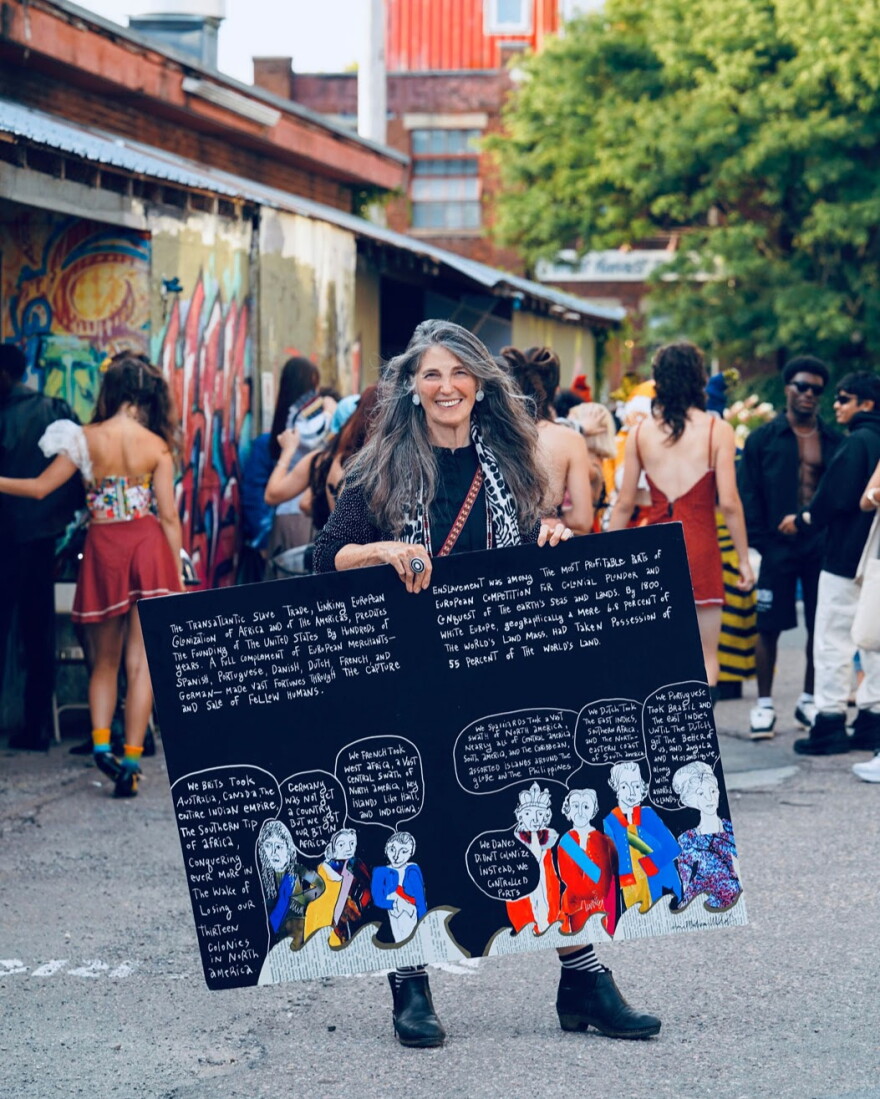
Jenn Jarecki: I’d love to turn to the book’s construction itself. Another fascinating choice is this idea that you actually want us to take this big and beautiful and heavy book and cut it up in multiple sections. Will you explain that? And I understand that you actually did this with a group of people at Art Hop recently. I’d love to hear what it was like to be doing this in community.
Stephanie Kloss
/
Courtesy
Dana Mashoian Walrath:It’s so powerful to do it in community, and it’s equally powerful to do it at home. The book is asking all of us to question all of the rules that have been given to us, and to ask ourselves, “Are these rules for the collective good, or are these rules harming some people?” In which case, they’re harming all of us because there’s no such thing as hurting someone without it impacting the rest of us.
When I first offered it at Art Hop, one person was ready to do it during the interactive book talk, and it was great. She was there cutting the pages while we were talking. Then, for the rest of Art Hop, I invited people who passed through the exhibit to cut a page and watching the people be able to do that and have that conversation about rules, because yes, we should honor books, but this book was made to be cut. We’re not tearing it up, and it works so beautifully, so you can experience the exact nature of the interactive art installation that I made in 2016 through the book.
I really hope that it leads people to reflect on what rules — such as: “war is OK” — should we actually be thinking about and pushing back against. So many of our rules are designed to help those in power and are actually hurting everyone else.
Stephanie Kloss
/
Courtesy
Jenn Jarecki: As you mentioned, you’ve traveled all over the world. Why was Vermont the right place to put [The Book of Genocides] together?
Dana Mashoian Walrath:Oh, if I did not have the nature of Vermont surrounding me, I would have lost my strength. I know every time that I was just not sure how to do something or brokenhearted, I could walk in the woods, and that really helped. It also helped that Vermont is a place of political tolerance and a place that believes in conversations across boundaries. I mean, I’m not born and raised here. I’m a New Yorker. I came up here the summer of 2000. I loved the notion of town meeting, and I loved that we have the capacity to talk to each other.
And, for example, when this book came out, I wrote to my immediate neighbors, and I just put out there. I said, “I know this might upset some of you, but I want you to know that I believe that it’s out there to spark conversations, and I’m here to speak with you.” And I think that tradition that Vermont has made this the perfect place.
It also helps that we’ve got good legislators, we’ve got good representation on a national level. I’m so grateful for Bernie and Becca and Peter and what they keep on saying in Congress. And you know, I think this book is a tool for them to use in their work.
Jenn Jarecki: What is your primary hope that people take away from The Book of Genocides?
Dana Mashoian Walrath:I think that the biggest hope, the primary hope, is that people start to believe that we’re not inherently violent, that the systems made us that way.
I hear all the time people are just like, “Ah, we’re doing it again, you know. Why don’t we ever learn?” And this is where my training as an anthropologist comes in really handy, because I’m used to dealing with vast stretches of time. So when I say, “Well, we’ve been doing this for five to 8,000 years,” that’s a blink of an eye. I really hope that people see its systems and structures and not our nature. It’s things that humans created, and then we’re taught to follow, and that means we can uncreate them and stop following them and create a world that’s better.

Stephanie Kloss
/
Courtesy
This conversation was originally broadcast live on Wednesday, Oct. 14, 2026, at noon; rebroadcast at 7 p.m.
Have questions, comments or tips? Send us a message or check us out on Instagram.
