

Study projects economic impact to reach $30 bil. by 2030
For global fans watching content creator Jittomeok, whose username is @daygamin on online platform TikTok, broadcast her Korean food “mukbangs,” falling in love with K-culture no longer stops at the screen.
Through live interactions with her 1.1 million followers — particularly across Southeast Asia — what begins as curiosity about a dish quickly transforms into everyday lifestyle choices, from buying Korean cosmetics in Thailand to booking flights to Seoul.
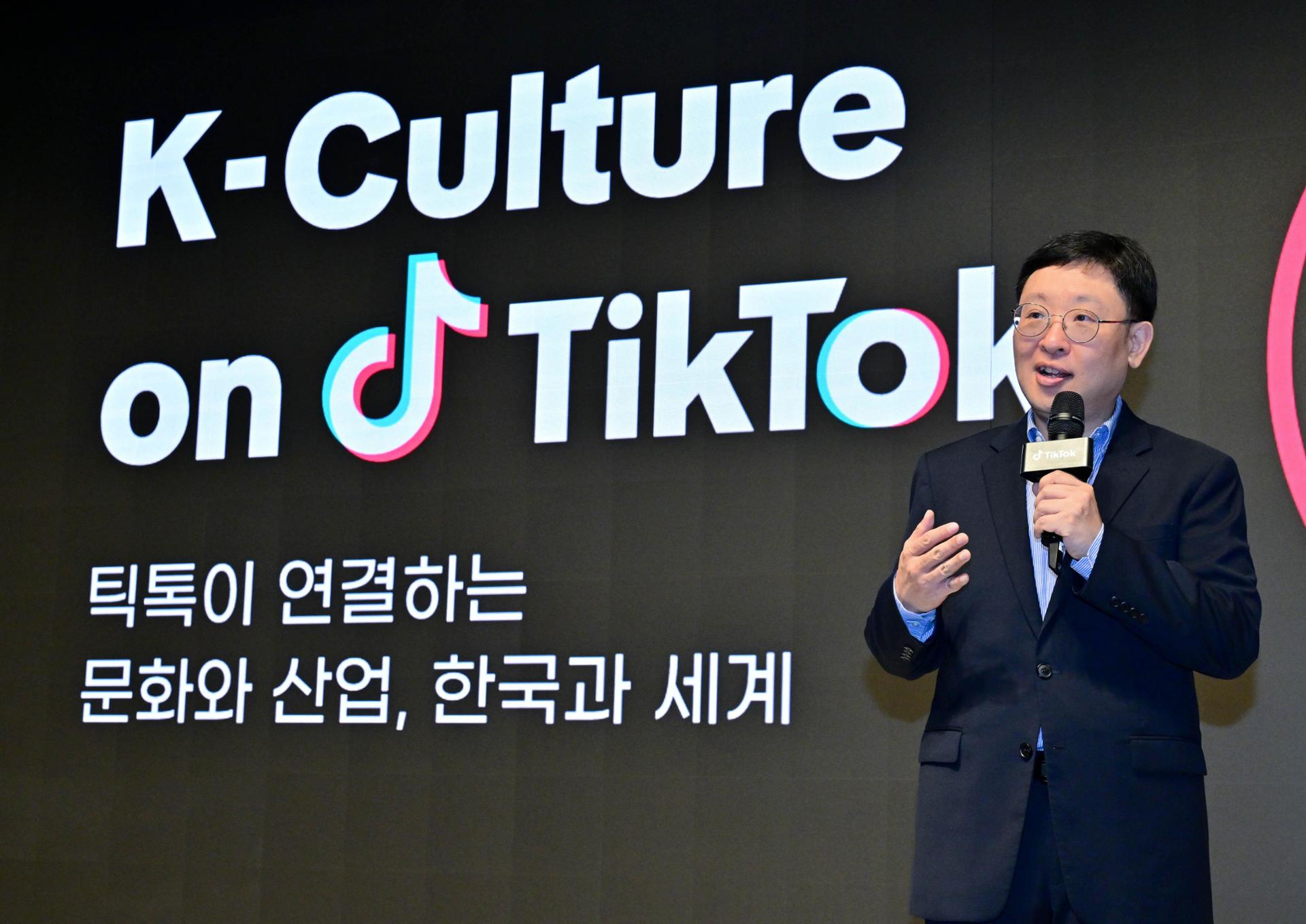
Her story offers a vivid window into a broader cultural shift. Speaking as an invited guest at a press conference at the Hotel Eliena in Gangnam District, Seoul, Wednesday, Jittomeok described how short-form video is reshaping global cultural exchange.
“I can genuinely feel the incredible popularity of K-beauty overseas,” she said during the press conference held to unveil the K-Culture on TikTok: Driving Global Economic Impact report, reflecting on how her online interactions led to selling Korean beauty products in Thailand and securing advertising contracts abroad.
“K-dramas and K-pop are already widely loved, but that interest is naturally flowing into fashion and travel,” she added. “Cultural interest has soaked into the daily routines of creators like me, expanding into a space where people truly understand cultural differences and share real connection.”

This shift marks what TikTok Korea and global management consulting firm Kearney classify as the era of “K-Culture 4.0.” Unveiling their joint study, representatives explained how Korean pop culture has evolved from “K-Culture 1.0,” driven primarily by television broadcasting, to “2.0,” characterized by the growth of social media-based fandoms, and “3.0,” when global over-the-top (OTT) and streaming platforms brought Korean content further into the mainstream.
Under this current wave, user-generated content (UGC) acts as an authentic bridge, converting digital entertainment directly into tangible consumer experiences and lifestyle habits worldwide.
To quantify this phenomenon, the study combines survey findings from 3,300 consumers aged 16 to 49 across 10 countries with a detailed economic impact analysis. The research polled audiences in the United States, the U.K., the Philippines, Saudi Arabia, Mexico, Brazil, France, Japan, Indonesia, and Vietnam. Covering six core areas — K-pop, K-media and IP content, K-beauty, K-food, K-fashion and K-tourism — the study examines how global engagement translates into direct revenue, domestic production and employment for Korean industries.
Overall, the report projects that the global economic impact of K-culture generated through TikTok will jump 30 percent from 31.37 trillion won ($23.5 billion) in 2026 to approximately 40.64 trillion won ($30.4 billion) by 2030. Within this total, global consumer spending is expected to expand from 10.75 trillion won ($8 billion) to 13.92 trillion won ($10.4 billion) over the same period.
Sector trends highlight that K-beauty leads direct global demand, generating the largest direct economic impact among all categories at 3.27 trillion won ($2.45 billion) by 2030. K-tourism represents the fastest-growing sector, surging 44.0 percent compared to 2026 while supporting 30,384 jobs, the highest employment creation effect among the six industries analyzed.
Geographic metrics show strong performance across both established and emerging markets. The United States will remain the largest overall market, with its direct economic impact rising from 1.8 trillion won this year to over 2 trillion won by 2030. Meanwhile, Brazil is projected to record the highest growth rate at 63 percent, and Indonesia is expected to see the largest total dollar-value increase in market size.
“This report demonstrates that TikTok is contributing not only as a content platform, but also to the global expansion of Korean culture and the creation of tangible economic value that supports it,” said Jung Jae-hoon, head of operations at TikTok Korea. “We will continue to support local creators and brands so their content reaches a wider global audience.”
Jo Hyung-jin, head of strategy consulting at consulting firm Kearney Korea, added, “The research confirms a virtuous cycle in which interest and engagement generated on digital platforms translate into consumer spending, which in turn creates broader effects on domestic production and employment.”
- Q.
- Q.
- Q.
