

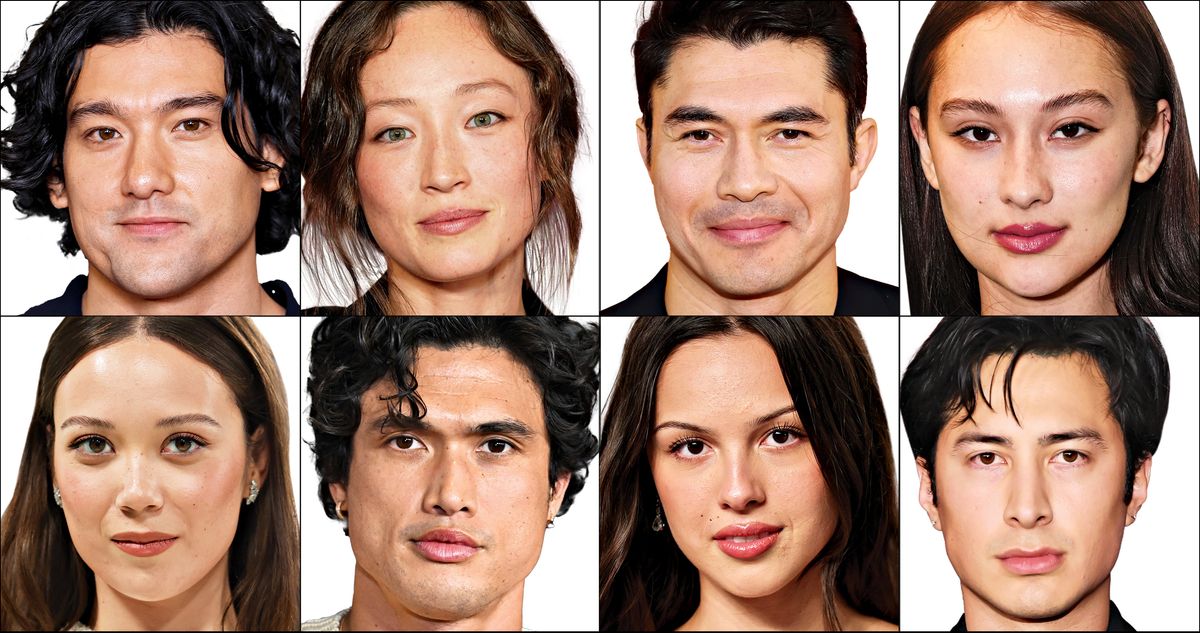
Over Taiwanese breakfast, Claira Janover, a lively 28-year-old working for the AI fashion start-up Phia, is explaining the latest vernacular from Wasia. For much of her life, Janover, who identifies as Chinese and Jewish, used the word hapa to describe herself, a Hawaiian term meaning “half” that was in common usage until arguments that this was cultural appropriation set it on the wane. Before Wasian there was Blasian (“Black and Asian”), popular during the height of Tiger Woods mania, when the pro golfer referred to himself as “Cablinasian.” In its irony-laced way, Wasian, a portmanteau of white and Asian, makes itself instantly knowable, like Cronut or Brangelina.
“Unfortunately, it’s kind of catchy,” says Janover. She continues: There’s quapa for people who are a quarter-Asian (like Keanu Reeves), and panda for “mixed-Asian squared,” i.e., someone with two mixed Asian parents (like the kids of Henry Goldingand Liv Lo). The linguistic taxonomy is coeval with a broader demographic shift. In the U.S., there are more multiracial Asians, specifically Wasians, than ever before. “I don’t think we existed culturally until the last, like, five, ten years,” says Janover.
What was once an isolating experience is now a mass coming of age. Asians are the fastest-growing major racial group in the U.S., hitting a new high of 26.4 million in 2024, well over double what it was in 2000. About one in five are multiracial, and of those, 82 percent are part white. The median age of multiracial Asians is just around the legal drinking age, with 44 percent of the population under 18 and 56 percent under 25. “What’s striking is how young this population is, which is also a signal of how much they will continue to grow in the coming years,” says Sahana Mukherjee, the associate director of race and ethnicity research at Pew Research Center, which provided the numbers.
The generational arrival was on display on Mother’s Day this year when an open invite to a Wasian meetup in Central Park landed on the home page of the invitation app Partiful. It was one of many planned in Wasian-dense cities — the first had happened the day before in San Francisco. The New York event was co-hosted by a slate of influencers and tech workers and began to take off after one of them, Niko Katsuyoshi, a square-jawed former Division I wrestler at Harvard with more than a million followers on TikTok and Instagram, promoted it. Katsuyoshi is arguably responsible for popularizing the word itself; back in 2019, he made a TikTok doing a peekaboo face reveal alongside audio saying, “Hey yo … Wasian check” that was memed thousands of times. As the attendee count ballooned, they changed the venue from Tompkins Square Park in the East Village to Sheep Meadow in Central Park. The flyer’s exhortation — “Let’s make the largest convening of Wasians in NYC
The meetup was a confirmation of Wasia’s pop-cultural ascension. A Wasian winter had become a very Wasian year: Alysa Liu and Eileen Gu were the reigning queens of the Milano Cortina Olympics; Hudson Williams parlayed the fervor of Heated Rivalryinto campaigns for Peloton, Balenciaga, and Bvlgari; Charles Melton got an Emmy nomination for the second season of Beef. Wasians were more visible than ever, in Gen-Z horror blockbusters Obsession and Backrooms (Megan Lawless and Lukita Maxwell), on Love Island (Carl Lee Schmidt), at the top of the Billboard “Hot 100” (Olivia Rodrigo), as the new Gerber baby (Cameron Chung), and on the playground in Fort Greene Park. The zenith was reached in April, when the Chinese Icelandic pop-jazz singer Laufey released the music video for “Madwoman,” starring some of her “favorite Wasian friends,” including Williams, Liu, The Summer I Turned Pretty star Lola Tung, and Katseye member Megan Skiendiel in a ’60s suburban fantasy she said was “everything I would have wanted to see when I was younger.”
The day of the meetup itself was beautiful — sunny and in the low-’70s. The organizers brought a bullhorn and some stools to emcee from. Attendees milled about with name tags on which they wrote their “mixes,” i.e., THAI MOM, WHITE DAD. There was a half-Asian bingo card with categories like “has at least one tiger parent lol” and a map of “Wasia,” which was really just a map of Asia with Pokémon stickers on it. DJs spun Wasian musicians, including Rodrigo, Mitski, and Japanese Breakfast. The crowd was mostly made up of young professionals with good jobs and dental plans. Everyone was Instagram ready. There were a lot of look-alike contests to get through: Liu, Williams, Laufey, Reeves, Conan Gray, Bruno Mars, and more. It started to rain in the late afternoon, but the DJ, Solomon Mankin, a finance guy by day, kept going. The initial flood of content from the Wasian meetup exists in this bubble of happy naïveté. “It was like being in a stadium of fans, but you’re rooting for each other,” says Janover. “Obviously, afterward there was an extraordinary amount of backlash.”
It had been in the Wasian meetup’s constitution to go viral. For weeks, it became a social-media land mine with algorithmic trip wires set in the path of anyone non-white. The responses began brewing in the days leading up to the event. The criticism revolved around whether it was exclusionary to mixed Asians who were not part of the white and East Asian duopoly, like Black, Latino, and South Asian people of various combinations. A few days before, the organizers changed the title to “a mass convening of the half Asians,” but the Wasian residue was everywhere from the flyer, featuring Laufey and Joseph Gordon-Levitt (who is not Wasian), to the early promotion and subsequent videos. Moreover, Wasian wasn’t an ethnic or a cultural designation but a racial one, which made everyone want to know: What exactly were they celebrating?
“There was even a part of me that rolled my eyes when I saw all the social media come out,” says Nicole, a friend of the organizers, who is mixed Asian and asked for a pseudonym. “It was like, Oh my God, welcome to Wasia. It could come off as privileged. Because there is a big proportion of half-Asians who are very well educated and come from good families.”
Aki Lee Camargo, a reporter at the News Movement who is the son of an ethnically Korean Japanese mother (known as Zainichi) and “a 5’7, bald, brown-skinned Colombian man,” went to the event to find out what united Wasia. One of the organizers told him, “We take pride in our beauty.” “Wasianness is hollow because it isn’t rooted in anything beyond phenotype,” Camargo wrote afterward in a Substack post titled “Start Wasian Hate?” “Because if Wasian identity begins and ends with aesthetics, that’s eugenics.” Commenters dogpiled on the attendees, calling them “diluted people” who were celebrating their “proximity to whiteness.” Others criticized them for often being the progeny of Asian mothers and white fathers, as though this were somehow their fault. The Wasian meetup was not built for this kind of discourse. And neither were the co-hosts, who felt their fun, feel-good, not-that-serious event was suddenly being accused of upholding white supremacy.
In the long sociological view, the Wasian moment might be seen as an inevitable step on the path toward assimilation. Since 1965, Asian Americans have become the banner group for the American Dream. For years, Asians have recorded the highest median household incomes of any racial group: $121,700 in 2024, for instance, well above the overall median of $83,730. (They also have the fastest-growing gap in income inequality: The top 10 percent make almost 11 times more than the bottom.) Economic success is bound up with assimilation: living alongside white people, sending your kids to the same schools, and working with them. Asians marry outside their race at a rate of about 21 percent and often marry white, a likelihood that increases if the person is U.S. born, college educated, or female. The numbers go up again for Wasians: About 70 percent marry a white person, and roughly half do not perceive those relationships as interracial. The two wealthiest newlywed pairings are Asian-Asian ones, at $158,000, and Asian-white ones, at $141,000. Members of the second generation have gone further than their parents: The class of 2029 at Harvard, the second year after affirmative action was struck down, is 41 percent Asian American.
Asian American identity itself was smithed in the fire of radicalism in the ’60s, when student activists at Berkeley thought they could build more power if disparate Asian people — from more than 40 ethnic groups and socioeconomic backgrounds — banded together. It was a philosophy built on solidarity, the idea that aligning your personal struggles with others’ would be a means of liberation for everyone. Wasians, by carving out a separate space within mixed-race identity, had the air of superiority, as though they were closing the door behind them as they left the ethnic ghetto. The expanding ecosystem of Wasian stars in Hollywood, sports, music, and social media only seemed to confirm this fear. An incoming generation, simply by their existence, dislodged a crooked anxiety that the new face of Asian America is Wasian.
A decade ago, you’d have to have some prior knowledge to spot a mixed-Asian actor onscreen. I kept a mental list of celebrities I thought of as stealth Asians, like Keanu Reeves; Mark-Paul Gosselaar, who played the wisecracking Sun In–blond Zack in Saved by the Bell; “1 Thing” singer Amerie, who has a lower-back tattoo of her name in Korean; Enrique Iglesias; and Darren Criss from Glee.Even if mainstream America didn’t know they were part Asian, that I did felt like its own secret win.
In 2018, I interviewed Criss during a press junket forThe Assassination of Gianni Versace: American Crime Story, in which he played Andrew Cunanan, the real-life queer half-Filipino serial killer who murdered Gianni Versace on the steps of his Miami mansion. It was the first time Criss had played someone who matched his ethnic background. I was curious if he claimed us the way we — or maybe just I — claimed him. Did he identify as Asian American? “No,” he said. “I think that’d be unfair. I think that’d sound like I’m reaching for the minority card on a college application.” Did being mixed affect his career? “I always say one of my favorite things about myself is that I’m half-Filipino but I don’t look like it. It’s always, like, an ace up my sleeve of, like, ‘Oh, really? How nuts,’” he said. “I just look like a Caucasian guy, which is nice. I’ve got the multiethnic thing going on. People think I’m, like, Italian or Mediterranean.” His answers were genuine and unguarded, dating from a kind of prelapsarian moment before publicists trained their clients to discuss race in blandly celebratory ways, if at all. After backlash online, he clarified in a tweet that his favorite thing was that he was half-Filipino, “PERIOD.”
In retrospect, that role, for which he would go on to win the Emmy for Best Lead Actor, was a hinge moment for mixed white-Asian actors. Criss later told People that when he thanked his mom during his Golden Globe speech, it was like he “came out” as half-Filipino. (In his next Ryan Murphy project, Hollywood,he would play a mixed Asian director, and he recently became the first Asian American man to win a Tony for the adaptation of a Korean musical, Maybe Happy Ending.) It was the beginning of the delinking of phenotype from ethnicity in an industry that prefers people to fit ready-made boxes. The same year, Ali Wong and Randall Park cast Keanu Reeves in Always Be My Maybe, which let non-Asians in on the fact that John Wick was one of us. That year was also the beginning of Jenny Han’s Wasian-girl universe with the first of the To All the Boys I’ve Loved Before movies, followed by the spinoff series XO, Kittyand The Summer I Turned Pretty, which will cap off its three-season run with a movie.
Hollywood is a business of aesthetics. Historically, if mixed Asians could pass as white or Black, they would (or otherwise get slotted into whatever race might be close enough). Those coming up in the ’80s and ’90s were often informed they were not “Asian enough” — that is, when auditioning for the few projects that called for an Asian actor at all. “I have experiences of wanting to cast biracial Asian actors in Asian roles and having my usually white partners be like, ‘They don’t look Asian to me.’ So then that actor is out,” says Diana Son, a playwright and longtime writer-producer of TV shows like 13 Reasons Why, Southland, and the Law & Order franchises. “As the parent of biracial Asian kids, I would feel very protective of the biracial actor.”
One path for mixed white-Asian actors was to find a foothold in Asia, where a Wasian appearance was prized in modeling and entertainment. Russell Wong started out in Hong Kong before doing Hollywood projects like The Joy Luck Club and Vanishing Son.Daniel Henney, the 46-year-old Korean and white actor, was working as a model when he was signed by an agency in New York that would send him out for small bit parts. When he went to Korea to shoot a commercial, he was scouted by a local manager and cast in My Lovely Sam-Soon as American doctor Henry Kim. The show was watched by more than a third of the nation and made Henney so famous that his last name became an object of wordplay. Casting directors began to seek a “Daniel Henney type”: someone suave, genteel, and clean cut — a Cary Grant for a globalizing people.
The 73-year-old actor Amy Hill, who is Japanese and Finnish, spent seven years living and working in Japan, where she felt readily embraced as native and was told she was beautiful for her light eyes. In the States, when she auditioned for Come See the Paradise, a 1990 World War II romance starring Dennis Quaid and Tamlyn Tomita, the director told her, “You don’t look Japanese.” Early on, she experienced something still common for mixed white and Asian actors, which is to be read as Latina. Hill had been sent out for a role in 1987 on the soap Santa Barbara, only to learn upon arrival that the part was a Nicaraguan nun. She was offered the role and took it, working alongside a Latina actress. “I didn’t know how to break it to her that I wasn’t Latina,” she says. She finally told her after they wrapped. “She was so shocked and pissed off,” she says. “That was the last time.” The Latinization of mixed Asians continued into the present. The comedian Julia Shiplett, who is Chinese and white, performed a one-woman show in July at Joe’s Pub called Ambiguous in which she talks about being sent out for Latina parts. “I have to be like, ‘I’m not Latina. So if that’s important to this story, I should not be involved,’” she says.
At some point in the 2010s, ethnic ambiguity became not just a useful way to broaden the casting pool but something fashionable. When the theater actor Zachary Noah Piser first arrived in New York in 2016, he recalls, some prospective agents were excited that he was “so ethnically ambiguous,” he says. “They’re like, ‘You can play anything. You can be white, you could be Asian, you could be Latino.’” He was invited to audition for everything from the Japanese-internment musical Allegiance to Lin-Manuel Miranda’s In the Heights.“For a young, impressionable person coming to the city, I’m getting the vibe that you don’t want me to attach myself to a certain heritage, race, or identity, so that I can be whatever you want me to be,” he remembers.
This was also the start of a brief era, culminating in 2018’s Crazy Rich Asians,that proved Asian Americans could make the leap to the big screen. In the years since, in a post-pandemic, post-DEI, corporately merged Hollywood, there are fewer Asian-centric worlds. Wasian characters, however, are easier to integrate into a story imagined as taking place in a white world. “Wasians can fill whatever POC thing you might need, but then it’s not necessary to talk about their POC experience,” says a mixed white and Asian screenwriter. “Like, checking a box on paper.” From a casting perspective, there’s the added bonus that they could have a white parent, who could be played by a more established actor — John Corbett in To All the Boys; Zach Braff in Hayley Kiyoko’s Girls Like Girls; Dylan Walsh in Heated Rivalry.
After years as racial chameleons, Wasians began to emerge as their own category with a firmament of new stars, including the A24-Neon fixtures Charles Melton, Havana Rose Liu, and Chase Sui Wonders and TV breakouts including Williams, Tung, and Will Sharpe from the second season of The White Lotus. “When it comes down to the look, Wasian people are beautiful. Mixed-race people are very beautiful,” says Andrew Ooi, the CEO and president of Echelon Talent Management, a Vancouver-based agency that represents Asian actors. “Maybe I’m being politically incorrect, but white people, especially in Hollywood, think, Oh, they look more like us, but they’re Asian enough. They’re more ‘acceptable.’” Even within a broad category like Wasian, there is a preferred look among decision-makers that is East Asian coded. “It’s powerful in a branding way because, let’s be honest, it’s a look,” says a writer-director who is Asian and white. “And that could feel exclusionary, because if you don’t fit that look, then you don’t get to participate in this celebration of Wasianness.”
The looming anxiety for some in Hollywood is whether Wasians will quietly replace Asian actors. They have a cosmopolitan sheen that could play in markets in Asia and the West. Mixed white-Asian male actors have already emerged as the preferred version of Asian masculinity, particularly as romantic leads. The proof is in the casting. After an extended global search for someone to play the Singaporean scion Nicholas Young in Crazy Rich Asians,casting chose Henry Golding, who had been working as a TV travel host and would go on to star in other studio films: the romantic comedy Last Christmas with Emilia Clarke, the titular Snake Eyesin a GI Joe franchise attempt. Melton’s first major movie role was as the romantic hero of The Sun Is Also a Star. In the 2022 Julia Roberts–George Clooney reunion, Ticket to Paradise, the plot involves their characters’ daughter, played by Kaitlyn Dever, falling in love with Gede, an Indonesian native, played by French Indonesian Maxime Bouttier, who is notably lighter than his parents in the film.
“In a world where both Wasian roles and Asian roles exist, the Wasians are going to dominate overall because they’re getting the Wasian roles and some Asian ones,” says the writer-director. Case in point: the upcoming film adaptation of Gabrielle Zevin’s best seller, Tomorrow, and Tomorrow, and Tomorrow, which features a Korean Japanese character who will be played by the mixed white and Japanese actor Sean Kaufman (Lola Tung’s brother in The Summer I Turned Pretty).
Tiffany Mak, the casting director of To All the Boys,has noticed a shift in sheer numbers since she began casting for that film in 2017. Strict rules of representation would have dictated that three mixed Korean and white actors of appropriate ages play the three Song Covey sisters. The actual result was a vast phenotypic range: Lana Condor, who is Vietnamese, played the lead Lara Jean; Janel Parrish, who is mixed Chinese and white, was her elder sister, Margot; and Anna Cathcart, also Chinese and white, was the youngest, Kitty. Respectfully, they did not look like family. “We probably had a couple hundred people for all three roles back then,” says Mak. “And now we’d probably be pushing a thousand or more who could be considered.” Recently, Mak released a casting call for two co-starring roles for college frat guys on a TV series, early 20s, open ethnicity — a good part for a young actor “looking to get their foot in the door,” she says. “I got, like, 400 submissions, which for Vancouver is a lot,” she continues. “And about 10 percent of the submissions were Wasian. These 40 people weren’t around nine years ago. That’s how quickly the pool can expand.”
“There is definitely a noticeable shift for me in casting,” says William Gao, an actor best known as Tao in Heartstopper. “Since Hudson Williams, there’s been loads of people trying to get in touch with me: suddenly, more self-tapes, more audition requests, more things coming in. I recently was in an audition room with four other Wasian men. It felt like an ‘Avengers, assemble!’ kind of vibe. I don’t know how to feel about it, because it’s positive for my career, but as a wider thing, it’s kind of predictable: Let’s just hop on this trend. It’s good, but it’s weird.”
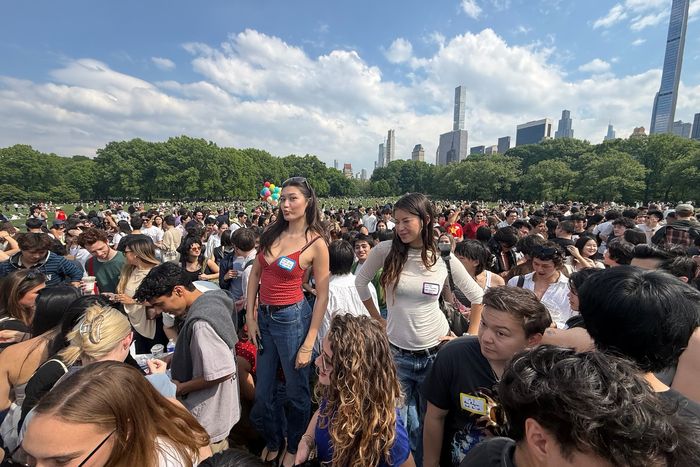
Wasian meetup organizers and attendees in Central Park on May 10.
Photo: Claira Janover
Increasingly, representational politics feels like dusty land that’s been dried up from single-crop farming. But then there are moments when it still has talismanic sway. “The first time it happened, the representation melted over me like gold,” says the Wasian writer-director. Last year, people would see a picture of Hudson Williams and tell him, “Oh, I thought that was you.” “We don’t look that much alike,” he clarifies. “He looks more like me than Brad Pitt does. And he looks more like me than Simu Liu does. And that is, I guess, the point. I’m grown up enough to laugh about it, but I will admit it felt so darkly pleasurable. I was like, ‘Is this what everyone gets to feel all the time?’”
Nowadays, mixed Asian and white kids can feel the gilded glow of representation. “There wasn’t a Hudson Williams or a Lola Tung when I was growing up,” Janover tells me at breakfast. “Watching The Summer I Turned Pretty, I remember thinking, If I had had this as a kid, I genuinely think I would have been more intrepid.”
She saw the demographic shift in real time during her years at Harvard, where she was the president of the student group HAPA, the Half Asian People’s Association; the name was a play on hapa, which older generations still use to refer to all mixed Asians. When she matriculated in 2016, the HAPA board had been modest, “like ten people.” Caroline Kristof, the daughter of New York Times Pulitzer Prize winners Nicholas Kristof and Sheryl WuDunn, recruited her. When Janover became co-president her junior year, she noticed an uptick. “The club got much bigger as time went on. There was a huge shift of interest when I was a junior,” she says. They got at least 15 applications for freshman rep, and the question became “How do we reject people?”
Janover and I head over to Tompkins Square Park, where we find a shady spot encircled by afternoon sunbathers. At my behest, she posted a mixed-Asian Bat-signal summoning some friends to chat about the Wasian moment. Her mother was a union organizer, and she has an instinct for bringing people together. When she moved to New York, she started a group chat for alums of HAPA called HAPA NYC that has since expanded to mixed Asians in the city more broadly. (It now has 287 members.) They have dinner and game nights, hold house parties, get dim sum, and have picnics like this one. “People would quickly dive into their experience of being half-Asian, and the commonality I saw, regardless of background, was we all would relate on what it feels like to grow up with a foot in each world,” says Nicole, one of the members. It felt intimate and warm. “I always leave feeling great.”
Janover knew most of the other meetup co-hosts from years prior. Niko Katsuyoshi had also been a member of HAPA when he was at Harvard, and she met Kathryn Cross when they both volunteered for the same city-council campaign the summer after their freshman year (Cross went to college nearby at Wellesley). Everyone exists at the nexus of the tech-creator-founder economy. Katsuyoshi is a fitness influencer who built a collectible trading-card app, and Cross founded Anja Health, which offers home kits where new parents can retrieve and bank stem cells from the umbilical cord for potential use; lately, she’s been filming AI how-to content on topics like how to get an AI assistant to buy you groceries so you can make Goop Kitchen’s Brentwood Chinese chicken salad at home. “When I was in my early 20s, we were all too busy getting drunk at the bar,” says Nicole, who is in her 30s. “We weren’t really, like, ‘How can I organize all these meetups?’ Now, everyone I meet in that age group, they’re all like, ‘I’m starting a business. I’m organizing this community.’”
Avery Kim, a 21-year-old senior at Harvard who is Korean and Jewish, walks up to join us. He was the president of HAPA last year. “We kind of run the New York scene, I guess. Or you do,” he says, laughing, to Janover.
“Are you at Goldman for the summer?” Janover asks.
“No, I’m doing quant,” he replies, which he explains is “trading stocks, but using math and algorithms and AI.”
“Didn’t even know you could do quant in college,” she says.
“Yeah, times are changing,” he says. “It used to be a lot of investment banking and consulting, but nowadays people are very into quant or AI labs.”
As they chat about the industry, others amble in, including a HAPA NYC organizer, Kevin Alvarez-Fung, 31, who is Puerto Rican and Chinese and runs an investment firm, and Amy (a pseudonym), 22, who is white, Lebanese, and Taiwanese. She grew up in Hong Kong but went to boarding school in the States because her father was worried about her “broken English” (she now speaks like a Valley girl at 2.5x speed). Kevin used to live in the Soho apartment Janover occupies with three others, two of whom are also mixed Asians; Amy is Janover’s former co-worker from Phia (they both left this summer) and one of the co-hosts of the Wasian meetup.
The idea for the event had originated not with the co-hosts but with Partiful itself. The app has lately pivoted to funding IRL gatherings on campuses through “college ambassadors” in an effort to become more of a social-media platform. A fresh-out-of-Stanford Partiful employee suggested the company host a series of Wasian meetups, an idea bolstered by their sudden pop-cultural relevance. The employee brought on Cross as one of the public faces of the New York event. (Partiful did not respond to requests for comment.) “It just so happened that Partiful had a half-Asian girl who was like, ‘Hey, what if we did one of these?’” says a friend of the co-hosts. The company’s team created the invite. “They were able to put it up on the front page and actually reach people. And then it kind of snowballed.”
Seen in the context of broader “meetup” culture, the Wasian one looks like just another random event staged for online consumption, such as the meetups for redheads, pug owners, or people named Ryan. Partiful, which initially sold itself as “Facebook events for hot people,” has always led with image. “Partiful embodies aesthetic as an adjective,” the co-founder Shreya Murthy told The Atlantic in 2022 after raising $20 million in Series A funding. The Wasian meetup was created using the same logic as the celebrity look-alike contests, beginning with the Timothée Chalamet one in Washington Square Park in 2024, a gathering so unruly it ended with four arrests. The Wasian meetup, too, was essentially a look-alike megaseries: The phenotype wasn’t not the point.
“I definitely would not have named it the Wasian meetup. I think that this would have protected us from a lot,” Janover reflects now. “This was prescribed by a company, and I stupidly never thought — and maybe this is because I’m half-white —Oh, that’s not inclusive of me. But I invited, like, everyone. I brought my friend who’s Blasian. I brought my friend who’s Latasian.” Still, she has a lingering desire to hold on to the word and seems to believe it can be flexible, like the word hapa. Janover turns to Alvarez-Fung to ask: “Really, genuinely, Kevin, do you not identify as Wasian?”
“Well, I read Wasian as white and Asian,” he replies. “And I don’t view myself as white. I view myself as Latin and Asian.” She takes this in.
Online, it’s easy for identity to become emptied of meaning — detached and ironic — to meet the demands of an algorithm. Whereas in the past, young mixed Asian kids might have gone to a hapa conference at Berkeley, now they’re largely figuring themselves out through social media. The nation of Wasia had been airdropped into Central Park from the technological ether, contextless and ahistorical. The meetup was a perfect storm: a tech platform capitalizing on the pop-cultural Zeitgeist as a group of 20-somethings went through the throes of self-discovery. For some of the co-hosts, however, the overriding concern is that Partiful is not damaged by association. “They have real money at stake,” says one. “I’m super-capitalist, so I believe in protecting businesses.” I say it seems unfair that they should bear the brunt of the blame when Partiful organized the event. “I feel like the people that made the negative discourse are responsible,” she says. “They’re responsible for hurting my feelings, not Partiful.” The backlash had left her bruised and cynical. “I always felt really proud to be Asian,” she says, “and then this whole thing made me feel like my identity is contaminated.” She pauses. “I don’t know why I feel like I might cry.”
A couple of months have passed since the meetup, but the organizers are still smarting from the fallout. Some lost friends, who wrote them long messages about taking accountability. Others got death threats. Some of the attacks were viciously personal, like about how a deceased family member deserved to die. “We got compared to Hitler,” says Amy, who tells me the angriest messages she got were from gay Asian men. “From the full Asian perspective, it’s like, ‘You’re so close to being white you’re almost there.’ But the thing is we’re not almost there.” She had grown up going to boarding schools in the Northeast, where a white classmate once said she would never see her as white because to be white was to be “pure-blooded.”
She also experienced hostility that felt specific to her Wasianness from Asians who were envious of her looks and thinking of getting plastic surgery to attain them. “It’s like you have certain features that just fit in with the beauty standard and then you get punished for it,” she says. “It’s like, ‘Wow, my face literally provokes you.’ I have to go out of my way to make myself uglier or dress myself down to not draw too much attention.”
Amy is an extremely specific archetype within Wasia, a cosmopolite who floats through a stratosphere of international schools and three-city Instagram bios. But there are as many experiences of mixed identity as there are people. “For every hot Wasian girl you see out there with her Chanel bag being super ‘Ooh, Wasia,’ most of these kids are just trying to understand themselves more,” says Nicole. “They’re trying to find people who could understand the journey they’re on.”
Alex Hoefer, a brooding 25-year-old aspiring filmmaker, is half-white, half-Kadazandusun, an Indigenous ethnic group from the Malaysian part of Borneo, and lived in Malaysia and Singapore until he was 11, when his family moved to Atlanta. He wanted to see if being surrounded by other people in this new umbrella category might lighten the feelings of solipsism that have weighed on his life. At the meetup, he talked to a guy who had competed in and lost the Conan Gray look-alike contest: Did he feel a sense of belonging? Hoefer saw him wince and “a light went out in his eyes.”“I don’t know,” Not–Conan Gray replied. “I’m still processing.” During the Hudson Williams look-alike contest, Hoefer zoned out as a large cardboard cutout of the Heated Rivalry star’s face bobbed over the crowd. “I wondered if everyone also being mixed was going to give me some kind of immediate recognition or belonging,” Hoefer says. “But when I was talking to people, I didn’t really feel that there was much.”
This is the cavernous gap between a hashtag and a lived reality. DidWasian describe the pain Hoefer has felt? Or was it simply, as Amy thought of it, a phenotypic marker that embraced its superficiality? In an essay he shared with me, Hoefer wrote, “Isn’t the only thing integral to the Wasian experience that, since we’re all different mixes, we are alienated from everyone else, including each other?”
What differentiates this generation from prior ones is that it has a peer group — at least in places like New York or California. Shawna, a mother to two Wasian children, 5 and 7, lives in gentrified, upper-middle-class Brooklyn, where many of her friends are Asian women with white partners. “It is slightly awkward to be in a group of five couples where I’m like, Everyone I’m hanging out with right now has a child that’s Wasian,” she says. Her eldest is already “extremely aware” of her identity. “In her class, there’s three other Wasian girls, and she goes, like, ‘Yeah, me and my Wasian friends; we’re the Wasians,’” Shawna says. “My friends that have full-Asian kids, I’m like, ‘Oh, wow, that’s rare now.’”
At a recent dinner, I was talking with one of those parents, a Filipina American woman who expressed a nagging concern that her daughter, who is fully Pinay, might develop her own beauty complexes. She is aware that in Cobble Hill, where she lives, her child is one of the rare ones. “We live in a bubble, and it is different from other parts of the city, Queens or Sunset Park, where you tend to see a lot more Asian families,” she says. “In our neighborhood, she’ll be more one-of-one at a playground, and I worry that she won’t feel comfortable in her own skin because she looks different than other kids at her school.”
At the extreme end of online discourse, Wasianness as a concept has taken on the language of optimization, metrics, and market value. Keyboard race scientists increasingly see a genetically edited version of the future as Wasian, glomming onto the success of Alysa Liu and Eileen Gu as models. One blue checkmark calls the latter a “human 2.0 prototype” with “biracial optimization”; another says she’s a “lab-grown Übermensch.” Liu, the gold-medal figure skater, and her four siblings were conceived via surrogate. In a now-deleted 2019 Sports Illustrated profile of then-13-year-old Alysa, the reporter writes that her father, Arthur Liu, chose white egg donors “because he felt his children would benefit from a diverse gene pool.” Meanwhile, an underreported aspect of numerous recent surrogacy scandals is that the babies of Chinese clients appear to be mixed race, often using white egg donors.
“I have the sense that for a lot of multiracial Asian donor-conceived people, their parents have positive feelings about the fact that their kids are part white, even if it wasn’t their choice,” says Max Tang, a therapist who also runs a social group for multiracial donor-conceived people. Tang and their fraternal twin brother are one such case. They grew up with Chinese-immigrant parents in Central Jersey who conceived them using a white egg donor. While Tang is visibly biracial, their brother is a head taller and more white-passing. “My dad has said heartbreaking stuff like, ‘I’ll never be seen as American because I’m yellow,’” Tang says. They recall their parents saying that being part white is a “good thing. It will keep you safer to look whiter.”
The desire to fit in is a powerful instinct, one that is externalized to varying degrees in our manners and relationships. Then, there is simply the act of living. The sociologists Richard Alba and Victor Nee have often said assimilation is something that “happens to people while they are making other plans.” It takes great effort to resist its pull. Another way to see the Wasian moment is less as a portent of Asians being absorbed into whiteness and more as evidence of the desire to not allow that to happen. The meetup may have been halting and filled with youthful hubris, but it revealed a hunger for mutual recognition. Afterward, the co-hosts started another WhatsApp community called NYC Halfies with more than 1,000 members and 93 subgroups divided up by region, ethnicity, and interests: “Single Wasians,”“Christian Half-Asians,”“Midtown Wasians.” There are groups for lifters, ravers, soccer players, mahjong aficionados, pool sharks, and the neurodivergent. Hoefer joined “mixedasia bookclub.” They read Michelle Zauner’s best seller Crying in H Mart for the first meeting, followed by Tomorrow, and Tomorrow, and Tomorrow.
“To those young people, it’s like, okay, you recognize you want to be a part of something,” says Aaron Stewart-Ahn, a 50-year-old screenwriter who is Korean and white and describes himself as an “elder Wasian.”“Now you’ve got to ask yourself, Am I going to accept easy lifestyle-branding boxes for me to live in that make my identity something I can not think too deeply about? Or am I going to put in the work to ask myself the essential question for any human being, which is, Who am I? A simple question, but it’s going to take you decades to figure out.”

1 Comment
Pingback: The Plastic Directive: 60 Years of Star Trek Toys - Comic Vibe