

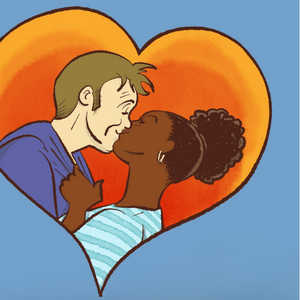
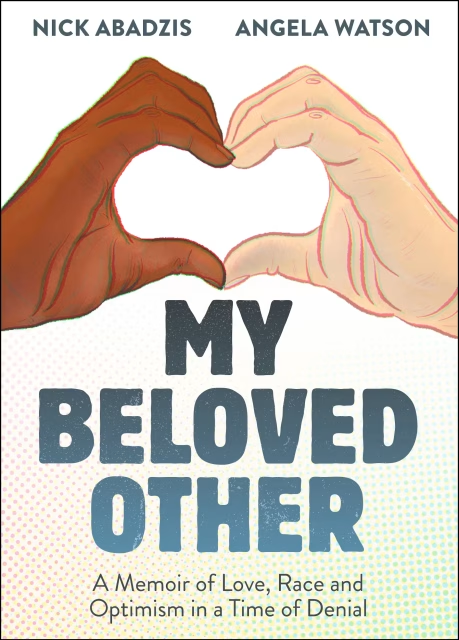
Nick Abadzis has been making comics since the late 80s. From creating the underground tales of Gen X wastrel, Hugo Tateto the bestselling, Eisner-winningLaika, he’s worked as an illustrator, editor and writer in his long and varied cartooning career. When I heard his next book was going to be in collaboration with his wife, the therapist Angela Watson, I was curious to talk to them both about it.My Beloved Otheris a graphic memoir exploring their nearly 40-year interracial marriage, weaving in the migration stories their respective families and their shared experience of moving from Britain to the United States in an age of unrest. We talked about their book over Zoom, in late May 2026.
SACHA MARDOU: Congratulations on creating this unique memoir. The fusion of your personal narratives with a larger story of race and family history is remarkable, and it’s a very enjoyable read, even as you’re tackling very thorny issues. I know it couldn’t have been an easy process to get there.
NICK ABADZIS: I haven’t even read it as a reader myself, yet. I sort of began to, and… I got freaked out. “Oh yeah, it’s real!” It’s that strange transformation from concept into artwork, and then gradually, it begins to take on a life of its own. That is what you hope for, anyway. It began as a project calledSkin Trouble,an idea I came up with in the aftermath of the publication ofLaika. Mark Siegel at First Second, my publisher, asked “Okay, what do you want to do next?” I posited a couple of ideas, which in the ensuing discussions became fused into one idea. We’d also decided to move to the USA so that was a big factor in making the process from idea to finished book a lot more difficult…
What year was the move to the States?
NA: Right at the end of 2009.Laikacame out in 2007 and became a big success pretty quickly. We did a mini book tour, I think, in early 2008, and that’s when Angela turned to me and said, “Should we live here for a bit, and see what happens?” So I put in for a for a green card and was granted the best one you can be given, which gave us a fair bit of flexibility. Basically, it meant Angela could work, too.
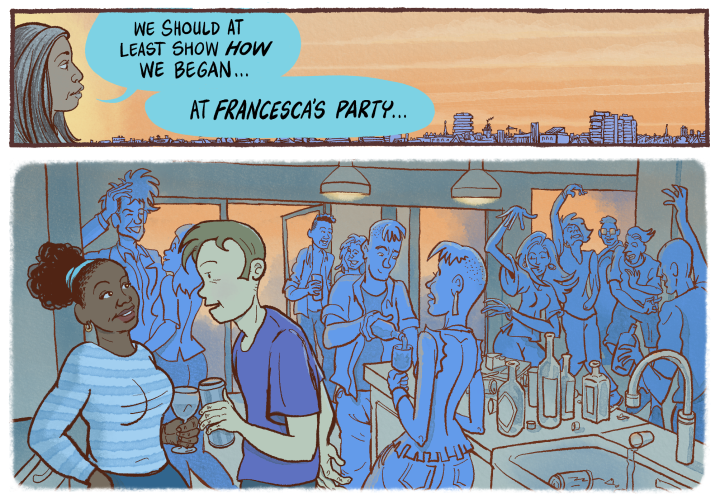
ANGELA WATSON: It was really important to me to be able to work, and it was quite hard to find a job in my field, here in New York City, where we’d chosen to move. I eventually did find a social work job. I really wanted to have a go at living in the US, because I grew up with American TV and films, which is what it’s like when you grow up in Europe. We get a lot of “Hollywood,” and it was all cool. In the 1970s, that was the only place that me and my family would see a lot of Black people, onscreen, in a positive sense, you know what I mean? Black people reading the news. I mean, in the UK, we had Trevor McDonald (the Trinidadian-British journalist and newsreader), but over in the States, it seemed as if there were Black people [in culture] that had money, who were middle-class, and affluent and that was great. It was just nice to look up to, as a young working-class Black kid growing up in the UK. Back then, where I grew up in Birmingham, Black and Irish people were very much the minorities.
It might be surprising to American readers that Black and Irish communities both experienced racism in Britain.
AW: Yeah, whether you were Black or Irish, you had more or less the same experiences. I didn’t feel as judged by Irish people as I did by English people. If that makes sense…
NA: You felt more judged by Anglo-Saxons than by Celts!
It does make sense, yeah. My best friend is Irish and lived in England for years and I remember the verbal abuse he’d get, in the early 90s, such as being accused of being IRA.
AW: Oh, yeah! The attitude of “Well, if you’re Irish, you obviously agree with those views, therefore you’re guilty of all of that, of all of those atrocities.” We had the Birmingham Pub bombings in the mid 70s [a terror attack by the Provisional IRA killing 21 people and injuring over 200], and hardly any Irish kids went to school the next day because they were too frightened to leave the house.
That attitude was reinforced by the mainstream culture back in the UK back then, wasn’t it? You had comedians like Jim Davidson making racist jokes on primetime TV. And the next day, all the school playgrounds would be full of kids repeating his jokes.
NA: “Chalky White.”(Davidson’s controversial, fictional West Indian character performed during his stand-up routines in the 70’s and 80s.)
Right, right! And years later Jim Davidson was asked if he wanted to apologize for the racist jokes he’d made and his response was, “Who exactly am I meant to apologize to?”
AW: That’s it. Yeah, yeah.
For me, your book seems to answer the question he dodges. You show the effect of that kind of stereotyping, and along with that you offer a (quite generous) definition of racism, as “People who haven’t learned to be fully human yet.”
NA: Yeah, that comes up fairly early in the book. It was a theme that persisted throughout every different iteration, the idea that none of us are born fully human. We’re all born with a basic set of emotions, which some people choose to develop and expand, while some people don’t. Some people evolve into, I guess, fully-rounded, experienced, flexible, empathetic humans. Some people just stay with the factory settings that they’re given, but then you run the risk of not really comprehending your own emotions and the signals they’re feeding you. We make a joke about that, and throughout the whole book, we try never to lose our sense of humor. There’s always a balance.
It’s all very deliberately told from our worm’s-eye point of view. I mean, there’s loads of things you can support with facts and data, but that’s all out there for people to find if they want to. We felt we should come at this with much more of an experiential angle, a sense of personal memory, folk memory, but also personal family history.
Obviously, Angela and I talk all the time, especially in the context of making this book. At first, we set out to fill in the blank spaces of our own personal histories and family histories for each other. That’s how we began to find our process, when we first started working together. We’d open a bottle of wine, start talking, and we just recorded ourselves.
So you actually recorded your conversations?
AW: Yeah. We do tend to talk a lot anyway, but sometimes it’s nice to do it with wine! This was talking, sharing with a very specific purpose. Nick knows a lot of my narrative, the major events from my past, but now we were attempting to recall details and come at them with, I dunno, the insight you earn through experience.
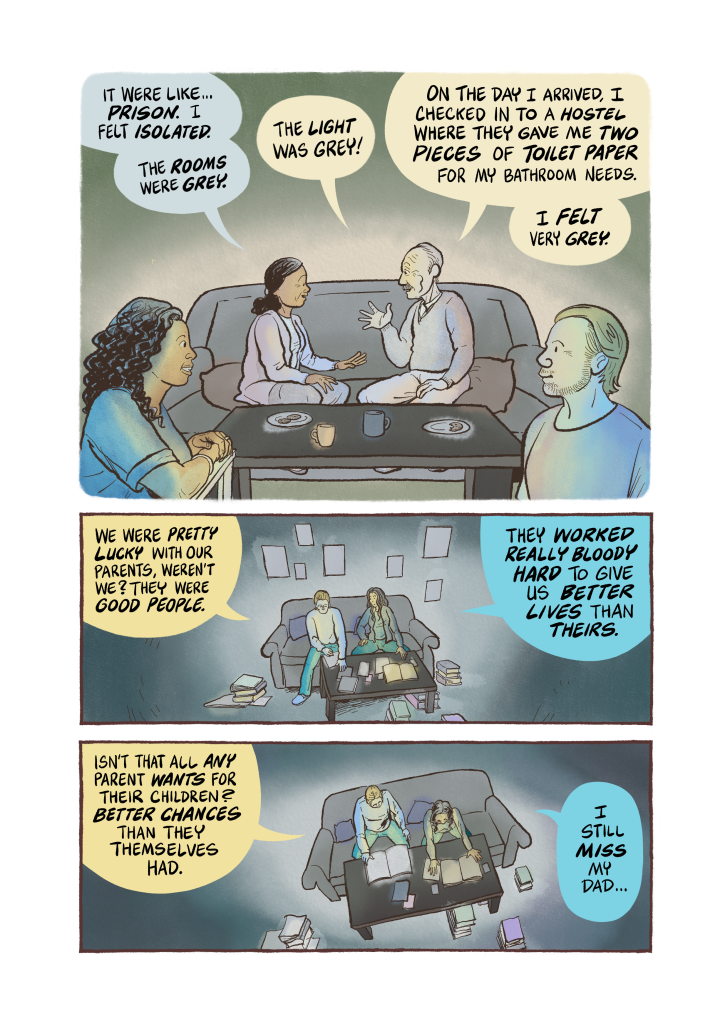
One of the things I remember during those sessions was us both remembering this one brilliant conversation – going way back – that we witnessed, which was between Nick’s dad and my mother. This would’ve been the early 2000s, this one time when they were both around at our house. They had this huge shared reminiscence about when they each migrated to Britain, in the late 50s.
That’s such a beautiful scene in the book.
AW: I wish we could’ve actually recorded that!
NA: Yeah, we didn’t have phones with recording devices on them back when that happened. I wish we had.
AW: It was so spontaneous. If we’d had our wits about us, we should’ve found a tape machine.
NA: That was quite an incredible exchange between our parents, wasn’t it?
AW: Yeah. Sometimes, when Nick was putting stuff together, he would come back to me for clarification, and then we’d have a longer conversation about what we were trying to get across, what the deeper point of a scene or sequence was.
That’s interesting. So, you were collaborating and finding the beats of the story in a pretty organic way, sourcing this material from your own lives. But when it came to crafting the structure of the story, was that collaborative too, or more of a solo thing for Nick?
NA: Well, I think an awful lot about story structure. That is, what to leave out, what to put in, both in “macro” terms of the whole book, and “micro” terms for each page. Figuring out the structure of a book is a puzzle, and I think very carefully about each interlocking segment. What’s the best way to create a structure, a backbone? Sometimes those things reveal themselves to you through research, through the process of simply compiling notes, searching through all the patterns that emerge as you do that.Some of that, a lot of it, is instinct, I suppose. Years of putting together both short stories and long stories. In different media too, not just comics. Mostly comics, it’s true, but through working and publishing as an editor and a writer..
Right. You’ve done a lot of editorial work.
NA: I do think that as a cartoonist, I was lucky in that I started out as an editor.
The short answer is to your question is, there was always an idea behind the structure of this book, from about 2008-2009. There were various early versions attempting to fuse together the two central ideas of migration, and race exploration, plus that sense of family history. Those early structures didn’t work, and they didn’t work for a lot of different reasons, as I discovered over time.
Back then, I don’t think I understood why they weren’t working, and because we’d just moved to America, we were also experiencing this situation of basic survival. We had to pay the rent, feed our kid, get used to a new country and we were just trying to say afloat without a network. Meanwhile, in the background, I was trying to get this magnum opus done, and it was impossible. I’d work on it, set it aside to do some kind of menial paying work to make the rent, work on it again, set it aside, and so on.
Before you know it, years have passed and I’d done umpteen unfinished drafts and never really found a structure that I was happy with. One day I thought, instead of trying to figure it all out on my own, why don’t I just get Angela on board as a co-writer? We could go back to the original idea, which was far more anecdotal in nature, and see what natural storytelling structures arise out of that, out of us just telling each other our life stories and filling in the bits we didn’t know. As soon as we started doing it, it flowed. Suddenly, we had a template, a backbone, and this also meant I could choose little bits and pieces from some of the older, unfinished drafts, and knit them together into a much larger and more coherent whole.
I’d always had a target, a creative ambition for the book, but never a shape. As soon as we started talking and messing around with things, it came together. I don’t think it would have happened if I hadn’t asked Angela to co-write it with me.
You’re always looking for a voice, and for me, that’s a search for the voice of characters. And finally, I realized that the most straightforward way of telling the story was to discard any and all ideas of usingcharacterto tell these tales.
I love that when Angela came on board, that’s when it started to knit together. It speaks to why the book is so unique. Robert Crumb and Aline Kominsky-Crumb made books together as a married couple, but they would each do their own thing and then juxtapose them. This is so different, it’s a fully fused-together story, yet with two voices.
AW: I found it hard, though, because it’s not my world.
NA: Comics, you mean?
AW: Yeah, comics. Comics is not my world. Even though it’spartof my world, because I’m married to Nick, it’s not the same as being in the world of comic book publishing. I couldn’t ever see myself being part of that world, not directly, but now I am. It was quite overwhelming, at first, when we began putting it together, because I am a private person. Having to be vulnerable, to be that open, was challenging.
It’s a bit like the way – as a psychotherapist – that I ask my clients to be vulnerable when they come to me to talk about what’s going on in their lives. Sometimes I say to them, in that situation, that they have to dare to be vulnerable, so that we can unpick their deeper emotions together. I had to use that same listening and storytelling technique that I use on my clients on myself.
AW: Yeah, yeah. Plus, I wanted to get across what it felt like to be an outsider, especially in the US. Because I don’t think that Black Brits are understood by Americans, by either Black or white Americans. It’s Black people as well. I faced lots of challenges around that, about their perception of Black British people, when we first moved to the USA.
You depict situations like that in the book, such as being assumed to be the nanny of your own child, rather than their mother. So was there a moment for you when the adventure of moving to America, just started to feel ‘off’ for you?
AW: Yeah, you know as a human being, you do go through those kind of experiences and at first, you think, “Oh, that’s a bit odd,” and then you kind of brush it away, ignore it. But instances like that build up. It begins to feel like a collection.
So when you first moved over here, Obama was president, and that felt different right?
AW: Yeah, and then, when we did eventually go for and get citizenship [it was under Trump], a lot of friends were laughing because you get a presidential signature on those certificates. That was a
Yeah, yeah.It’s kind of a sick joke, isn’t it?
AW: Yeah.
So I wanted to ask about, the timeline of the narrative. Angela, you came on to this story before George Floyd was murdered in 2020. As all that was unfolding, you were working as a counsellor, trying to help others in your company deal with this huge cultural flashpoint. Did you know at the time that this event had to go into the book?
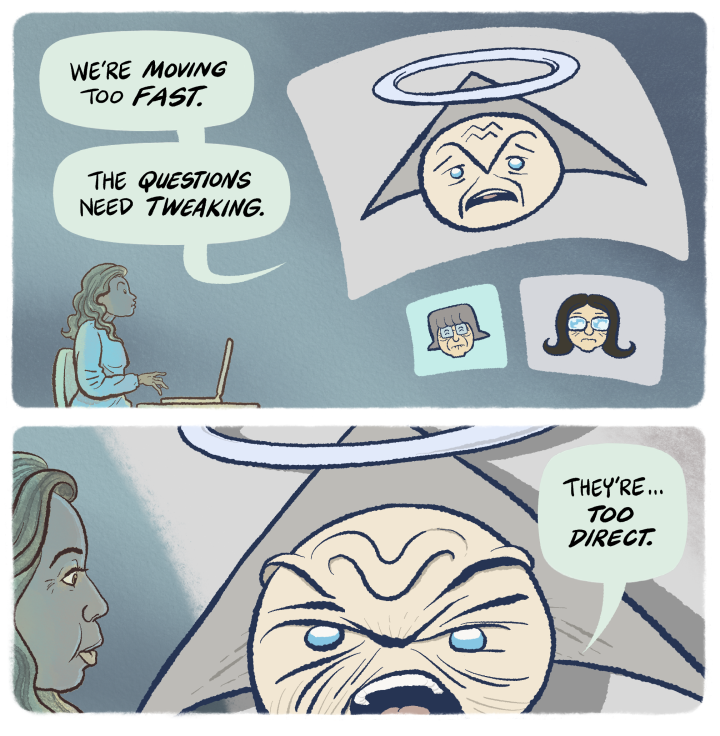
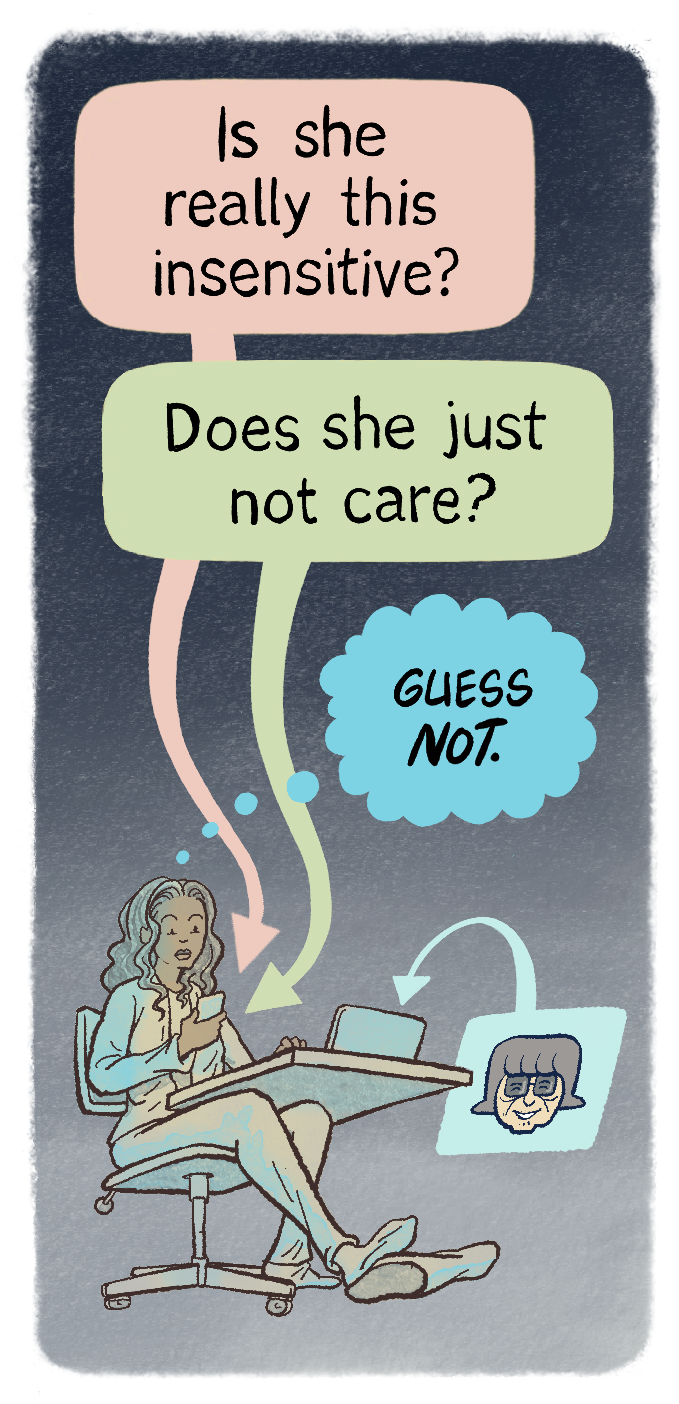
AW: I don’t think we’d even got to that, we were so busy… Well, I was so busy trying to get through what was going on at work. We were dealing with Covid, and that alone was a huge struggle. Nick saw how upset I was about George Floyd, and he suggested we include something about it. We’d talk about it, about what was going on all around us, in cultural and social terms. It was seismic. I had this strange feeling of wanting to get it out there, my own feelings about it, but I also didn’t want to talk about it, because I was having to deal with it on a daily basis. I mean, in terms of caring for and listening to colleagues and co-workers who were sensible, intelligent people who were also experiencing a sense of being ignored by the management structure. It was overwhelming, because I was going through this very hard time at work, and then we were sorting through the emotional aspects of it, the fallout, attempting to comprehend this sense of being bypassed. On top of that, we were, you know, trying to look at it dispassionately, logically, sort through it all together, and find a way of putting it into the book.
NA: On those occasions, with Angela’s approval, I’d ask,“Shall I tape this? Shall I record this?” We’d record it, and listen back to it, and it wasn’t fun, but that was how we worked through it.
In the book you show the absolute shitstorm unfolding in Angela’s workplace as you’re just trying to emotionally and psychically survive it.
NA: It’s important to say that a lot of the characters in that section of the book are inspired by real conversations, and are amalgamations of many different people, not direct representations of individuals. It all passed through the filter of me, but the truth of it, of what Angela was experiencing, was all taken down in real time. And then sequenced into the book. So yeah, that was a tough job. That was a very difficult thing to do.
Angela, you were dealing professionally with this huge cultural moment that was very emotional for you and making you question your future in America as a black woman. And Nick, you were trying to support your wife, but also be this presence that was recording it and witnessing a moment in history. That’s an incredible dynamic.
AW: Yeah, that’s good. That’s what it was. Yeah, yeah.
NA: Well, from our point of view, we’re basically two immigrants (in America), one white, one black. One female, one male. And… you don’t really comprehend, you don’t know all the invisible rules that are hardwired into Americans who were born here.
There is that old truism that British and Americans are divided by the same language. It’s true: a lot of British people make the mistake of thinking that because Americans and British speak English, that it means we have greater similarities in overall cultural terms than with Europeans, or with just other people from the British Isles. It is emphatically not true, not in my experience.
But to get back to… theexperienceof that time. We were making a book, and we were doing it in real time, so there was an element of reportage about it. You really had to keep your wits about you as to what the narrative thread of it all was, and in the middle of all this, I’m just also trying to be a supportive husband. I’m seeing my wife go through something that, quite frankly, she shouldn’t have been going through. There should have been more professionalism in the organization she was working at, and a recognition of each individual situation.
There was not, and that really pissed me off because there was nothing I could do, not regarding her job. But, on a larger scale, within the culture, I also felt relatively helpless. Except, there was one thing I could do, and that was to record it all, as best I could, from an emotional standpoint. I could do this, and include it, a “sense of the present,” in a book about our past and our family histories. It seemed very timely, very relevant, and it all came together, all the themes and patterns and undercurrents.
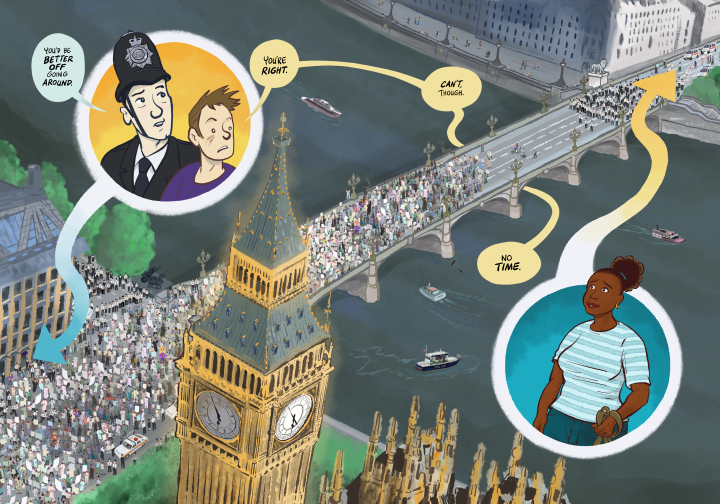
Your book opens on Westminster Bridge in London, with the two of you about to meet for your first date, just as a race riot threatens to break out. And with George Floyd’s death, we’re at another such moment of violence. Like the years have passed, but little has changed.
It’s easy to feel a little bit hopeless and yet, in sharing the story of your relationship, it’s like, you’re proving that there is another way that people can live and relate to each other. Sorry, that’s a comment, not a question!
AW: No, no, no, it makes a lot of sense. It’s true, you know: we have to have some hope. We have to, because otherwise I don’t know… what would happen?
NA: Nothing good. I mean, you know, we can take those lessons from history, but it’s seldom that people do.
AW: Sometimes, when I’m in my darkest sort of mood, I might think “Oh, my God, this is all awful. People hate me because I’m Black.” Sometimes you get lost in that, that whole manufactured, online narrative.
On the other hand, I was watching something on the BBC – it was a young black guy called Myles Smith, performing at a BBC Radio One gig, a “Young ’uns in the park” kind-of-scenario. The audience was almost all white, all these young white people in the audience adoring this guy. He went down to the crowd and he was high-fiving them and they were absolutely loving it. I kind of got quite emotional just seeing that, a young black guy, of Jamaican heritage, the same as me, his music appreciated and connecting to a huge crowd. That sort of thing gives me hope. I do have hope.
Yeah, and it feels as if the arts are a way to help change consciousness, to change culture, you know? I feel like art, including music and comics, can do something that politics just can’t do. I mean, particularly when politics is being used as a weapon or a cudgel.
AW: Yes. A hundred percent. Politics as a weapon rather than as a collective, representative force for good, for many people rather than the political elite themselves.
NA: Just as an aside, I think that’s a really important point. Angela’s used the example of music, as a great connector and connection. I mean, music is one thing… I think of comics like that, as an adjunct, a direct relative to music. I have a sense that my own comics are constructed in the same part of the brain that music comes from.
Or, they’re created in the same region of the soul, perhaps. They can be as abstract as you like, or they can be as succinct as you like, just like a song, like a piece of music, whether it’s instrumental or has lyrics. Music’s always been incredibly important to me in terms of the creation of comics, just as a sort of fuel for the creative fire.
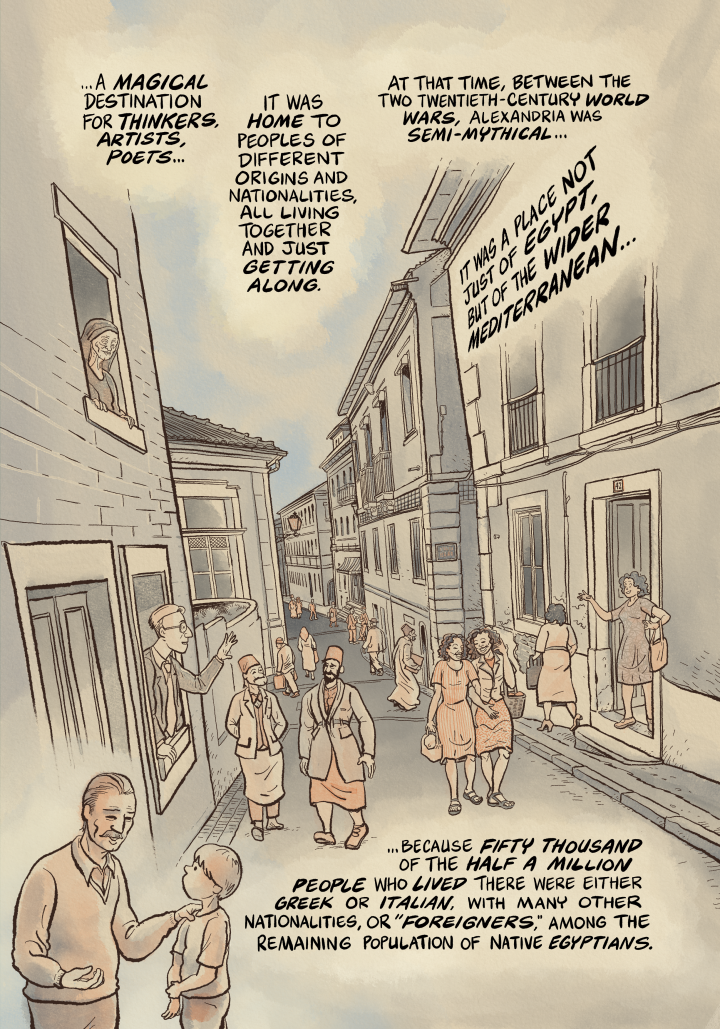
Let’s talk about the comics. I loved this page depicting the city of Alexandria where your dad, Pierre, was born in the 1920s. Can you tell me about how you created some of the images for this book?
NA: I have loads and loads of reference for Alexandria, none of which I really used. In the end, I went with my own imaginary Alexandria, the way that [my father] told it to me and it’s probably worth noting who some of the characters in the book, on that page are. The old woman in the window looking out – that’s actually my grandmother, Calliope, known as Manoula [“Mother”]. The guy in the window below her leaning out is Constantine Cavafy, one of Greece’s most legendary poets, who also lived in Alexandria around that period. The two girls walking along arm-in-arm are my Aunt Athena and my Aunt Marika; the girl across the alleyway waving from the doorway is my Aunt Aphrodite, whom I never knew. I never met her, because she was killed in an accident before I was born. That’s a detail, a tragedy that isn’t there in the book. None of this went into the final version. But they’re there, and I wanted to honor them.
Wow, I’m really glad I asked you about this. I didn’t realize you were mining even more of your family history through the images in this unspoken way.
NA: I think it’s important to do that, to lace any illustration with deeper layers. There’s always a thematic undertow to everything, every decision that you make in a book of this nature. It goes deeper than the two dimensions on the page. Yeah, that’s a bit of a family mythology that didn’t make it in, but all of that was invested in it.
Yeah, it’s interesting, because after I did Past Tense, my book uncovering family trauma through my personal therapy work, readers would ask me, was it emotional for me to draw my story like that? And it wasn’t, because I’d already processed my own pain in therapy. But the only time I cried when I was drawing my book was when I was recreating my grandmother’s wartime experiences from photos and WWII records. All this grief for her came up and I’m wondering, was it the same for you to delve into this?
NA: Sure, yes, and I think that’s a really, really interesting point that you touch upon, because it’s a part of research that nobody really talks about much. It’s easy enough, even if you don’t know the person in the photograph you’re researching, and you’re not related to them, to connect with them through your own emotional imagination. You do your research. You have a lot of facts and knowledge about their lives, but sometimes… If you do your research properly, there are these strange “ghost details” that arise that aren’t connected to anything, but they’re a personal story about this individual.
I’m actually thinking of Korolev inLaika, who I researched in a very detailed fashion, and there were things about him that I discovered that weren’t really anchored to any known event in his life. There are alotof official histories. But there were also these anecdotes, small biographical details that weren’t apparently anchored to anything, which I felt were actually important clues to his character. Small, everyday details.
Now, if you’re looking at, say, a picture of your dad, or a picture of a relative or ancestor that you didn’t know, such as, in my case, my Aunt Aphrodite, that’s a different kind of connection. But it’s a similar sort of process, where you make a connection with somebody from the past, and you start to imagine, based on real events, what their lives were like, or even what the events leading up to the ends of their lives were. Of course that’s an emotional experience, but you try and take that and use that as the basis for whatever drawing or text that you’re making in that moment. That’s how that works, for me, anyway.
Yeah, I’m curious, Ange, as a psychotherapist, did you have a similar experience that Nick did, in this sense of connecting to your family history like that?
AW: Yeah, definitely. It’s similar to that that idea in therapy, that trauma doesn’t really go away. It’s got to be worked on, as it can hang around. And therapyisstorytelling. You sit down with your client, and you listen to their story. There were certain stories within my family’s history, of what happened to them in Jamaica, who all the characters were, the traumas that went on there, the events and social movement that built to the reasons of why and when they left. Then, on to what happened when they arrived in the UK. There were stories of how women weren’t supposed to travel on their own on those ships making their way to the UK; that they should have a male relative with them, because all kinds of horrendous things could happen to a lone female on those journeys.
Lots of stories like that that came out, when we taped my mum. She told me and Nick a lot of stuff that didn’t make it into the book because we simply didn’t have the room.
NA: In the case of Angela’s mum, Babs, for all her sequences in the book, I had to imagine a younger version of her. I know her really well, she’s my mum-in-law, but I had to imagine what she was like when she was a teenager and in her early twenties. I never met Ang’s dad, who died before we got together, but in the case of Babs, I could ask her what she was like when she was younger. She’s a very good raconteur, a very funny storyteller, and she almost sort of regressed in time when she was describing herself as a young woman, going back into herself to relive those days.
It’s interesting, isn’t it, to approach your own family with that loving curiosity. Something does come alive. Also, the parallels are interesting, with Ang working with stories as a therapist, and Nick, working with stories as a cartoonist. I didn’t make that connection, that overlap in your professions.
AW: Yeah, I feel privileged that every day that I work, I get to hear all of these stories from people, that they trust me with that very personal information. Plus, how it’s interpreted and reinterpreted through our collaboration together, to get them to where they want to get to.
Yeah, it’s a really sacred thing. My therapist would always quote this, that “Good work is an equalexchange of energy.” This book is a good exchange of energy as well!
AW: A hundred percent.
Can we talk about some of the imagery you use? Like the golliwog, which was a very familiar piece of iconography in British culture. It was adopted by Robertson’s Jam as a brand mascot and it would appear on British jam jars up until the 2000s.
NA: When we were putting the book together as a draft, the golliwog was a huge part of Ang’s backstory. The more we looked at it, the more he came into being as a sort of negative force in his own right, a character in his own right. That’s why we wanted to distinguish it. These things still exist in culture, certainly in American culture, definitely in British culture, in colonial culture across the world. These things are iconographies of things past that we were completely used to. They were just a normal part of advertising and branding culture.
Right, yeah. There’s a bunch of American brands with similar iconography, like Uncle Ben’s Rice.
NA: Yeah, and they’re also mentioned in the book. We don’t go into it in any great detail, because there just wasn’t room. If I’d have had my way, I’d do a whole separate book about that.
There are going to be people out there who are going to be uncomfortable with this, but do you choose not to show it? Or do you show it, as we’ve attempted to? What it was used for, and how it was used? If politics is downstream from culture, maybe it’s been turned around these days, and culture is downstream from politics. However that particular truism goes.
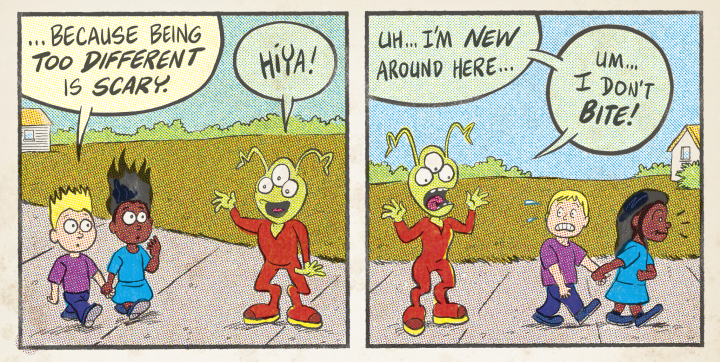
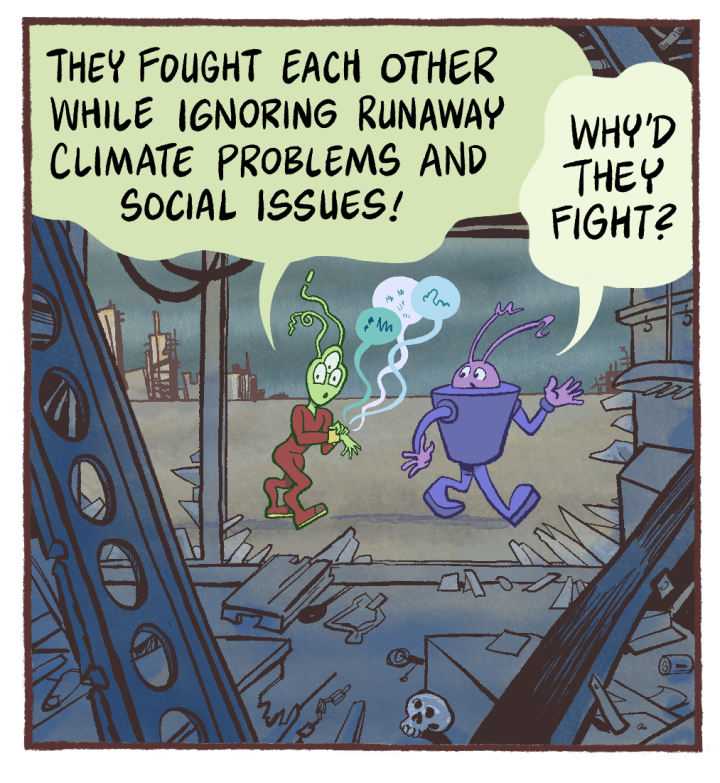
Nick, you alternate between different styles in the book, such as the cartoon alien that you use to talk about systemic racism and a more figurative style, among others. It’s like your work in children’s illustration and your graphic recording work all informed how you approached the material. Was it instinct guiding those choices?
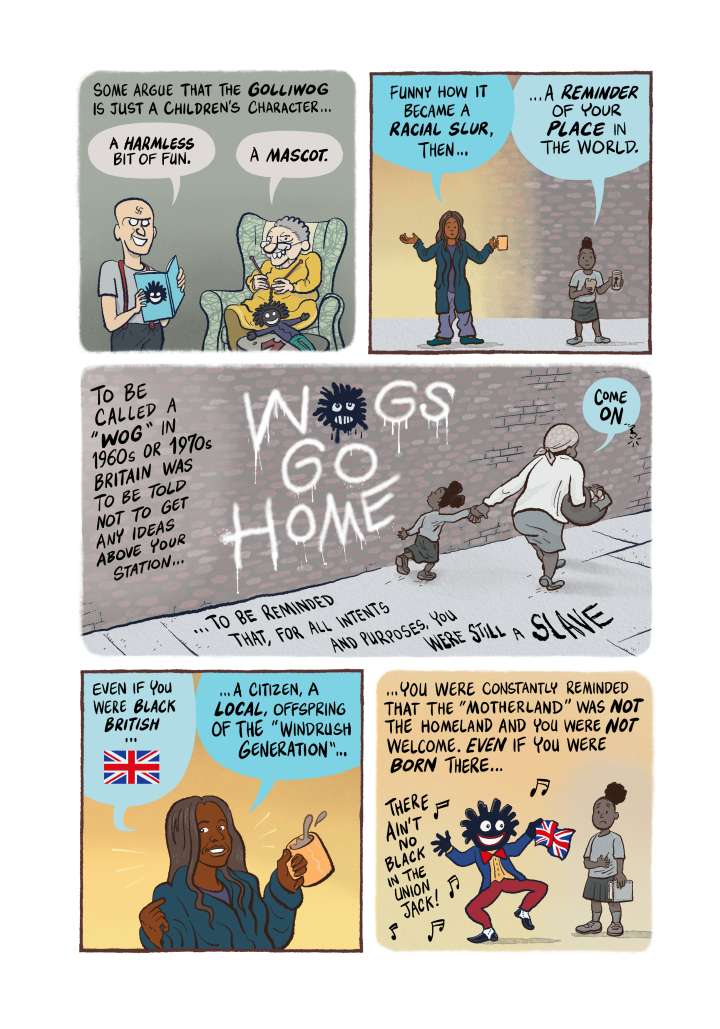
NA: Not all instincts, no. You make a lot of creative decisions, as you go, and there were so many in this book, and different sequences called for different approaches. The way we handled the golliwog in particular was, I’d show a sketch or a thumbnail to Ang’ and ask, “Should we do this? Can we do this? Are you comfortable with this? Does this work? Is it making the point that we want it to make?”
Angela will tell you this herself, but she would say, “I think we should do this, and show him as both cute and monstrous, because it’s shocking, and that is how it feels.” And I suppose, you know, when we were throwing ideas backwards and forwards, talking it through, I was always attempting to show it in terms of her discomfort. Also the way, culturally speaking,anybodycan feel discomfort about this kind of iconography, if they understand what it means, which is why this character keeps reappearing.
AW: And he was minimized when I was growing up. You’d get asked, “Why are you getting upset over him? It’s just thatBlack and White Minstrel Show* kind of thing!” You know, those appearances on TV and in culture are always glossed over, and you’re made to feel that your concerns or feelings are just trivial. There’s that scene in the book where, during that school field trip, the boys cut him out from the jam jar label and put him on my placemat. The whole attitude was like, “What? It’s funny. What are you getting upset about?”
*A British TV show that ran on BBC1 from 1958 to 1978 and was, as the BBC itself states, “arguably the BBC’s most glaring failure to understand the damage it could do when it traded in out-dated stereotypes.”
That speaks to the power of symbols, doesn’t it? My aunt used to cut out the golliwog tokens from those jam jars and send off for the little metal pins. It was so normalized and tri shocking again. Which it should have been all along! You’re returning it to its correct equilibrium
AW: Yeah. Good.
NA: That was the idea. You’ve nailed it. We were attempting to recontextualize it and say, okay, this is what this symbol actually means. And yeah, he can be cute, like he is in certain instances in the book, but what this thing actually is, is a distilled symbol of the sugar trade, as powered by the slave trade. That’s what it really is, a direct descendant of that kind of fearful control.
There’s a powerful page in the comic where Ang talks about getting used to the “very boring pain” of confronting these racist tropes over and over. It’s just done so well.
AW: Ah, yeah. When the golliwog pleads and says,“I’m just a children’s character. What’s the matter with you?”
NA: I mean, you used to say that, Ang. You mentioned that a lot, when we were figuring out how to do this – that if we showed him as just this cute thing all the time, “just a children’s character,” you wouldn’t be showing the deep roots of that kind of thinking, that excuses or fails to examine that kind of iconography. The golliwog is a colonialist artefact, not a cute mascot. The origins of this thing are in the slave trade. It’s actually horrifying.
When we were trying to kind of come up with a coda for the book, an epilogue of sorts, we wanted to so leave the reader with a sense of hope, as to how you begin to do that.
AW: Mmhmm.
NA: On the particular page that we’re discussing, you’ve got the black and white minstrels, as well as the gollies and then there’s Young Angela, upon whom they had such a terrible, crushing effect. There are a lot of other “branding ghosts” present on that page. Making it all work and knitting it together was quite a challenge, but hopefully we’ve pulled it off. I mean, they’re Angela’s words, and in the fifth panel – I remember you saying this, Ang – “I was as brainwashed by the culture I was immersed in as everyone else.” That’s the key.
AW: Yeah. We all were.
NA: Hopefully, the book is a way of kind of allowing the reader to, momentarily, just zoom out from the culture that they’re immersed in. See things from a different angle.
Well, because I made a comic book about therapy, I ended up in a lot of social media spaceswith other therapists. My experience during the George Floyd protests was that I saw a lot of white therapists calling on black therapists to educate them and tell them what the right thing to say was, in that moment. That was disappointing, because they were therapists, and I guess I expected them to understand that anti-racism is actually work you need to do on yourself to a degree; to not ask a Black person to educate you in a moment of high emotion, when they have all their own stuff to deal with.
AW: Thank you. Yeah, exactly that.
So do you feel like the field of psychology is equipped to offer this inner work to people?
AW: No. No. And there’s so few, there’s so few of us in the UK. Your goal as a therapist is to help clients, who come to you for self-improvement, to find a way to both mental and physical health, for help in resolving issues in their lives, to deal with difficult thoughts, tough emotions, and inevitably, race comes into all this. Some of the forums I’m on, a lot of when any issue concerning racism comes up, what you get is a lot of white therapists kind of opting out, saying, “Well, I don’t see color.” It’s a cop-out. People still say that in 2026, “I don’t see color. Why does this always have to come down to race?” That’s just upholding the structural racism that people of color experience.
My reason for asking about therapy and its role in the work of anti-racism is that people seem to have a lot of fear of having conversations and don’t even realize that there is inner work to do and books to read.
AW: Exactly. I’d rather people ask a question rather than this sort of vague… “Well, I don’t see color. I don’t. I don’t want to move”. No. I’d rather people just said, “I don’t know about this stuff, how to deal with it. Can we talk about it?” It’s okay to get it wrong, especially in what should be a safe space. Better that than totally sideline it.
As a species, I think we’re going further and further away from that, in the sense that we’re no longer able to distinguish between, say, anti-Semitism and Anti-Zionism. “Not allowed to, can’t talk about that!” Like… you’re either with us or you’re against us. Everything is binary, no gray areas, no complexity. Everything has to be simplistic, and that’s dangerous.
That’s also what goes on within some of the therapeutic spaces, on forums, on Facebook groups, and platforms like that. I dread it when something happens, some world-shaking event, and I look online and see a bunch of inane, self-absolving comments. “Here we go again!”
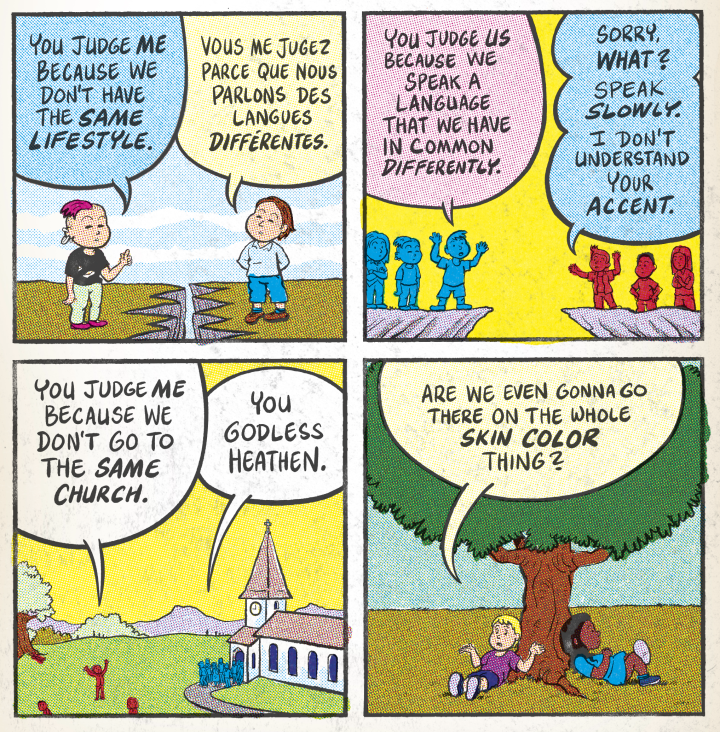
NA: We hope the book will be understood. It’s a plea for sanity, for consideration. Racism, and dealing with it, is a difficult, uncomfortable subject. In that sense, it may be a difficult book to market in terms of, “Well what’s it about?” Broadly, it’s about racism and anti-racism, and it is also about hope. Hopefully, it is about opening up spaces where people can converse, and converse in a way where they can actually listen to what’s being said, and the quality of what’s being said, rather than making judgements.
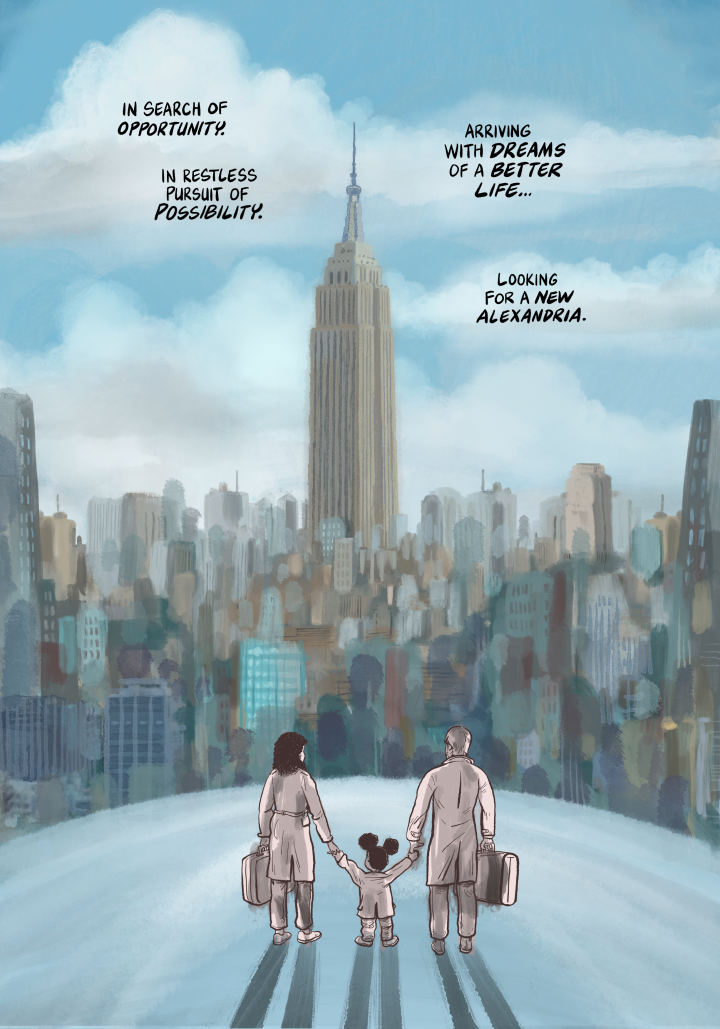
A Memoir of Love, Race, and Optimism in a Time of Denial (23rd Street Books, 2026) by Nick Abadzis and Angela Watson
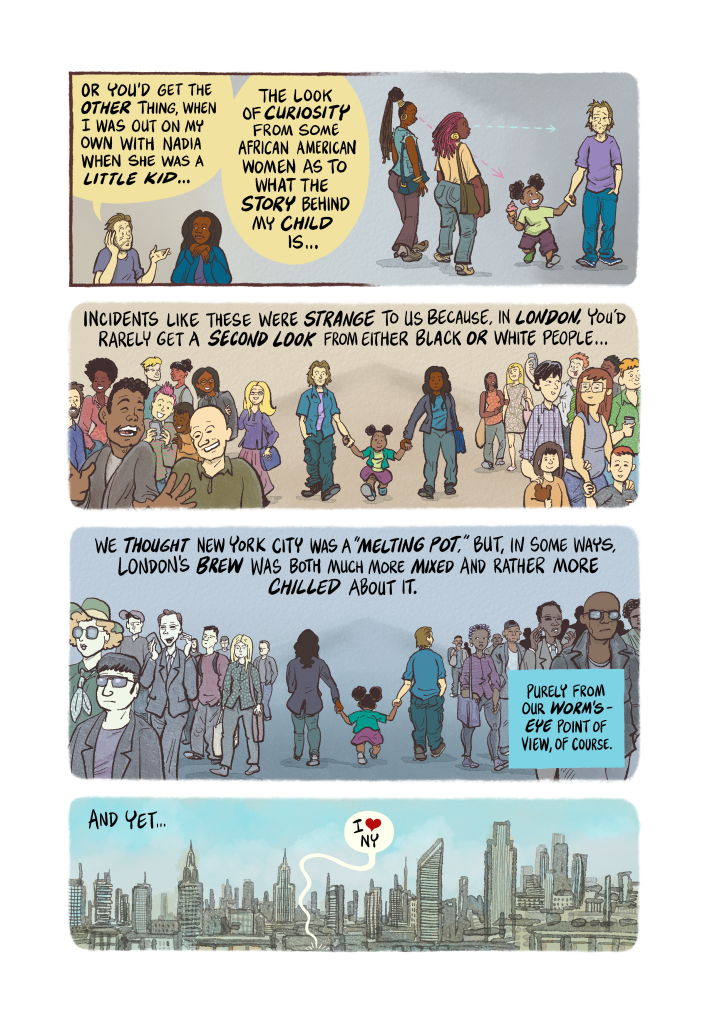
A Memoir of Love, Race, and Optimism in a Time of Denial (23rd Street Books, 2026) by Nick Abadzis and Angela Watson
