

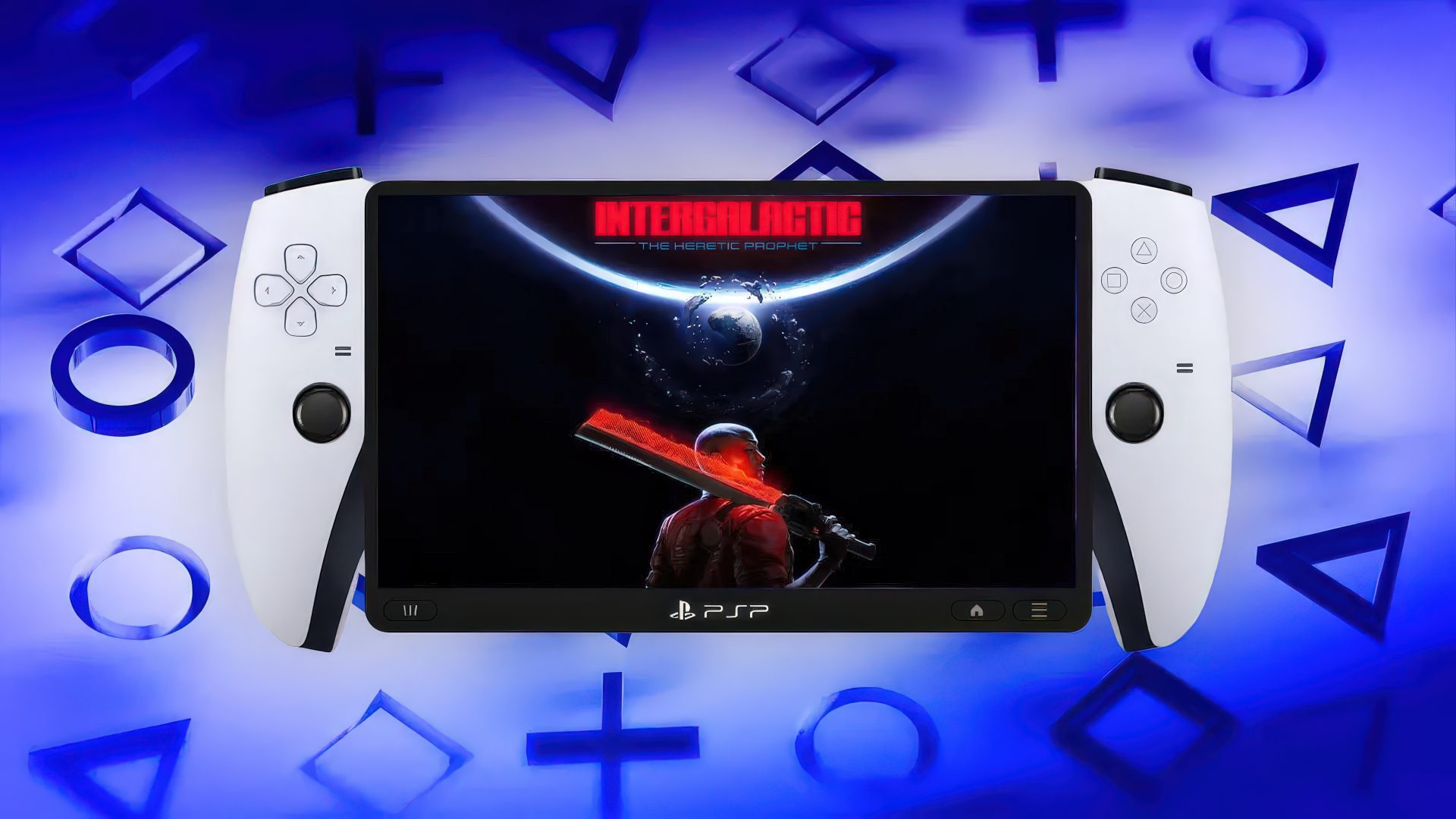



The featured image is a mockup.
PC hardware website GameGPU has shared a leakabout the PS6 handheld, known by its codename Project Canis and referred to as “PSP 3” in the article.
The article recaps the handheld console’s specs: a custom 3-nanometer AMD Canis processor featuring six Zen 6 cores (including four standard Zen 6c cores and two power-saving Zen 6 LP cores), paired with 24 GB of shared LPDDR5X memory using a 192-bit bus, and strict power limits between 15 W and25 W. The graphics unit is equipped with 16 Compute Units built on the newer RDNA 5 architecture, which supports Dual-Issue FP32 instructions.
When used as a portable device, the processor runs at1.2 GHz and delivers 4.91 TFLOPS of computing power. When connected to a dock, it speeds up to 1.65 GHz and reaches a peak performance of 6.75 TFLOPS. However, according to the leak, the handheld’s real ace up its sleeve will be the upcoming PSSR 3.0, which will deliver proper Frame Generation support on PlayStation consoles, as teased earlier this year by System Architect Mark Cerny.
| Specification | PlayStation 5 Pro | Project Canis (PSP 3 Handheld) |
|---|---|---|
| Custom AMD APU | Zen 2 Cores, 16.7 TFLOPs | Zen 6 Cores (4c Zen 6c, 2c LP) |
| GPU | 60 CUs (30 WGPs), custom RDNA 2/3 hybrid architecture @ ~2.18 GHz | 16 RDNA 5 CUs @ 1.2–1.65 GHz |
| System Memory | 16GB GDDR6 + 2GB DDR5 | 24GB LPDDR5X, 192-bit bus |
| Power | ~215–240W under load | 15W–25W |
| Upscaling | PSSR 2.0 (Standard) | PSSR 3.0 (Upscaling and Frame Gen Enabled) |
| Target | Native 1080p/1440p → 4K via PSSR 2.0 | Native 540p → 1080p via PSSR 3.0 |
| TFLOPs (Mobile/Docked) | 16.7 TFLOPs (fixed, no mobile/docked split) | 4.91 TFLOPs / 6.75 TFLOPs |
| Effective PSSR 3.0 TFLOPs | N/A | 10–11 TFLOPs (Mobile) / ~14 TFLOPs (Docked) |
According to GameGPU, when the Project Canis handheld is in mobile mode, its rigid TDP limits will force an internal rendering resolution of 540p, which will then be upscaled to the console’s native 1080p (FullHD) display. Thanks to PSSR 3, the website claims the effective teraflop count will reach 10-11 TFLOPS in mobile mode and 14 TFLOPS when docked, thus surpassing the base PlayStation 5 and getting quite close to the PlayStation 5 Pro’s 16.7 TFLOPS.
This confirms earlier leaks from insider Kepler_L2, who claimed that Project Canis is ahead of the Xbox Series S (which reaches 4 TFLOPS) in rasterization and is massively more performant in ray tracing and path tracing. Kepler_L2 also boasted that PSSR 3 would surpass even NVIDIA DLSS 4.5 in terms of quality, which bodes well for the handheld’s image quality.

Last but certainly not least, GameGPU adds that Sony is targeting a late 2027 launch for Project Canis. It is unclear whether its release window is tied to the big sister, the PlayStation 6, which may be delayed well beyond 2027, according to some rumors.
About the author: With over two decades of experience in gaming journalism, Alessio Palumbo has led the gaming vertical at Wccftech since August 2015. He started working at a young age for Italian websites like Everyeye.it, Gamestar.it, Nextgame.it, and Multiplayer.it before kickstarting the indie English-language publication Worlds Factory as its founder and Editor in Chief.
In the last decade, he has coordinated the overall output of Wccftech’s gaming section, managed PR relations, assigned reviews, produced daily news coverage, edited gaming content as needed, and delivered game reviews.
Arguably, his trademark content is the long series of exclusive developer interviews that have been cited by Wikipedia and by the biggest news media and gaming publications.
His passion for technology also makes him knowledgeable when it comes to gaming hardware and tech. His favorite genres include RPGs, MMORPGs, and action/adventure games.
Follow Wccftech on Google to get more of our news coverage in your feeds.
