

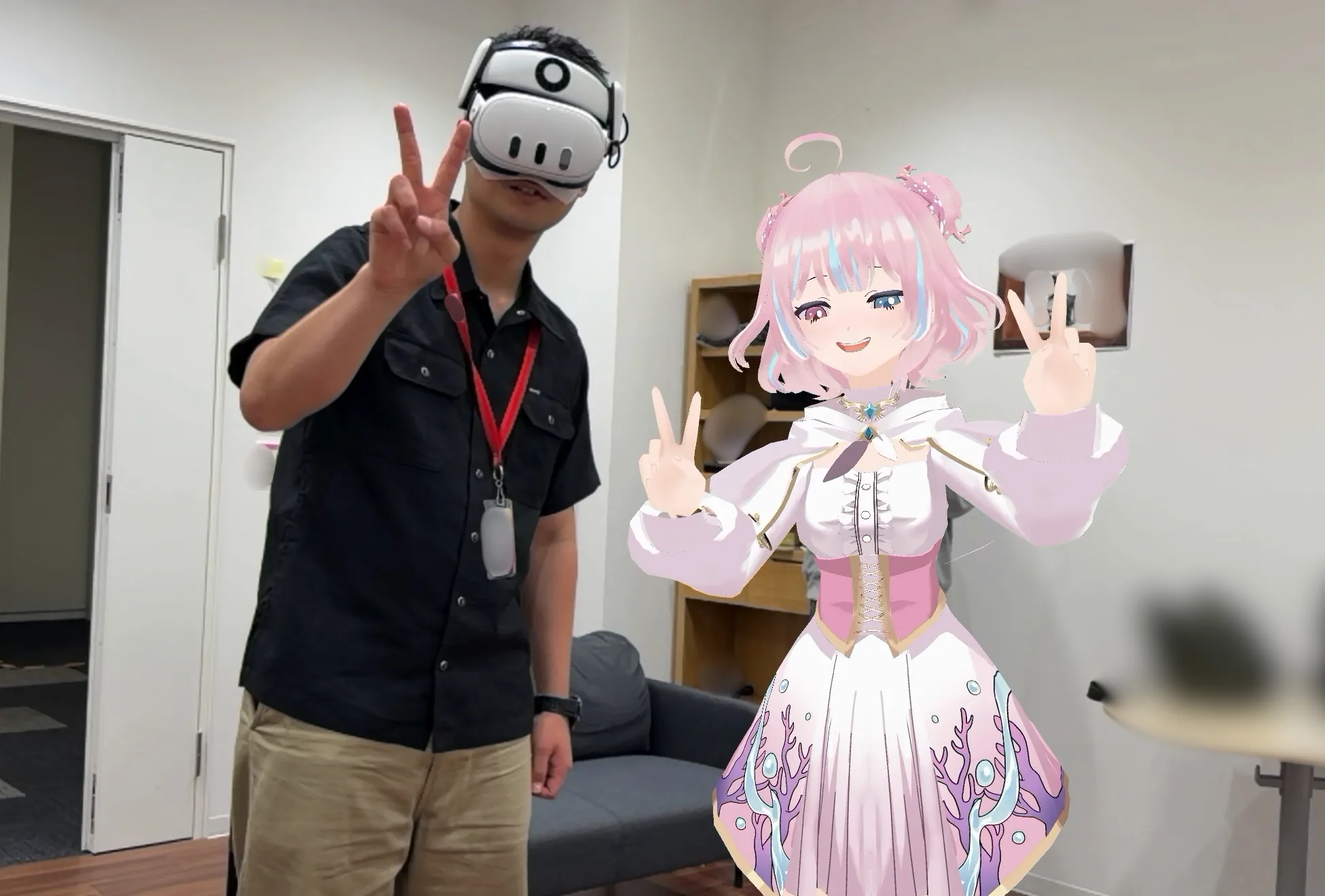
“Meet & Greet” has recently become a staple at VTuber events. This format allows fans to meet and talk with VTubers in person, whereas normally they can only communicate with them through chat on a screen, making it an irresistible event for fans
However, currently, most interactions at events take place through displays, and it’s rare for VTubers to look at you, move their bodies, or react to you. The fact that you’re only talking to a screen makes it difficult to experience the special feeling of “actually meeting” them, which is a major challenge
On the other hand, recently, some agencies have begun to adopt a format where their VTubers appear as real people rather than in their VTuber personas at real-world events. However, this format diminishes the appeal of the VTuber and also poses significant risks from a privacy protection standpoint
Amidst this situation, Sony has launched an intriguing initiative: “3D MEET & GREET,” a service utilizing MR (Mixed Reality) technology that allows users to experience a fusion of reality and virtual reality. It was also showcased at this year’s “SusHi Tech Tokyo 2026,” attracting the attention of many visitors
So what exactly is this service? This time, with the cooperation of Uruma Tamami, a VTuber belonging to PANDORA Inc., we actually experienced “3D MEET & GREET,” and here is our report. (Photography: Balt, Writing: Yuriika)
A VTuber “comes” to the space you are in
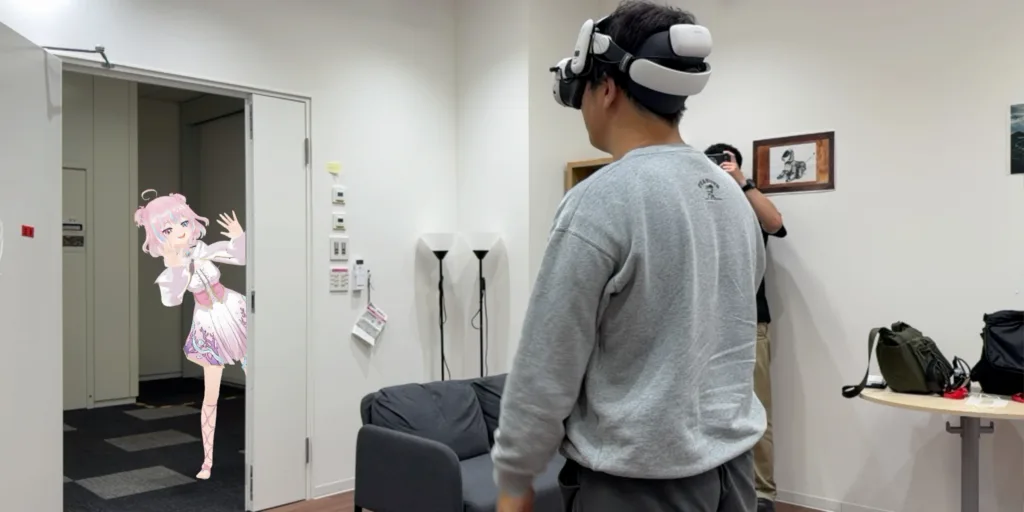
“3D MEET & GREET” is, simply put, a service where VTubers appear in real space and you can communicate with them in real time. As the author waited, wearing a Quest Meta 3 VR headset, VTuber Uruma Tamami peeked her head through the studio door
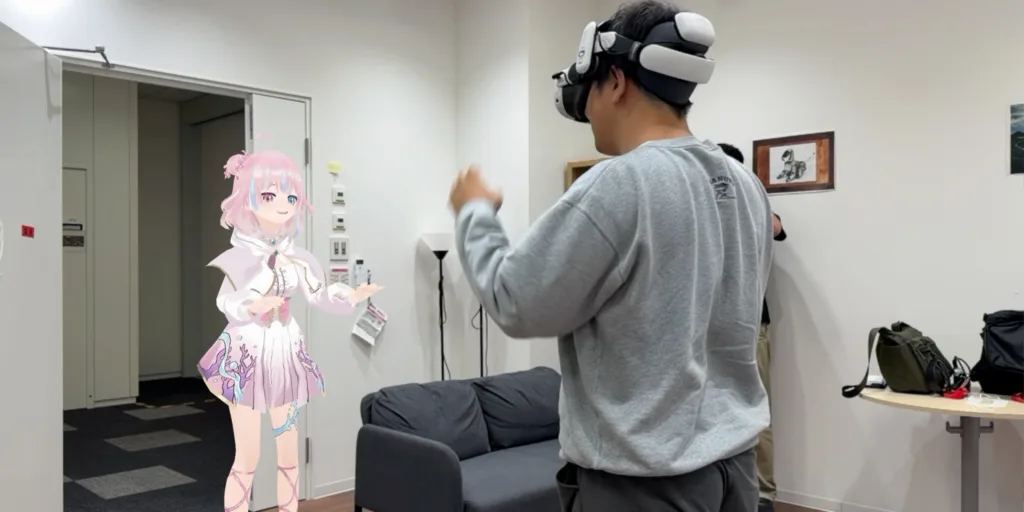
She gave me a slight wave and then walked towards me. When she stood in front of me, she greeted me with gestures. This entire exchange was, of course, in real time and not pre-recorded. Her movements as she entered the room were so smooth that I could tell she was aware of the room’s size (the distance from the door to where the participant was). Furthermore, Uruma Tamaba made an effort to meet my gaze, which conveyed that she was “watching” the participant
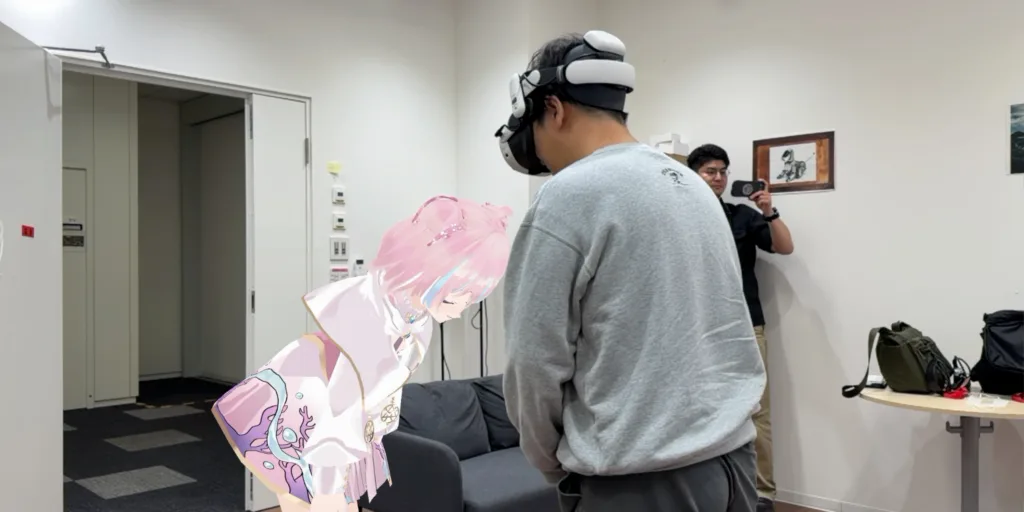
The sense of closeness with the VTuber is quite remarkable. This is partly due to the high quality of the MR effects on Quest Meta 3, but it felt as if you could even hear Uruma Tamami’s breathing
I tried some actions, such as having them place their hands on top of mine and stroking their heads.
This resulted in some light anime-style 3D effects, but what was even more impressive was the feeling of actually touching the VTuber’s body, even without wearing a controller. The fact that the VTuber also seemed to recognize that I was touching them and reacted accordingly also seemed to contribute to this high level of realism
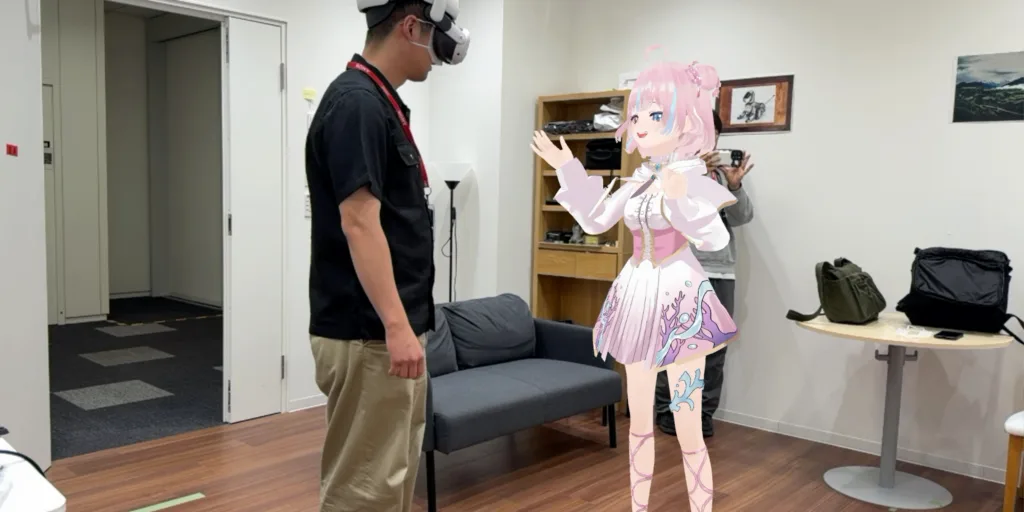
Although it was only a few minutes long, the experience gave a strong sense of having “faced a VTuber and communicated with them.” The author has experienced several face-to-face events with VTubers using MR technology before, but this one was of particularly high quality in terms of the sense of presence
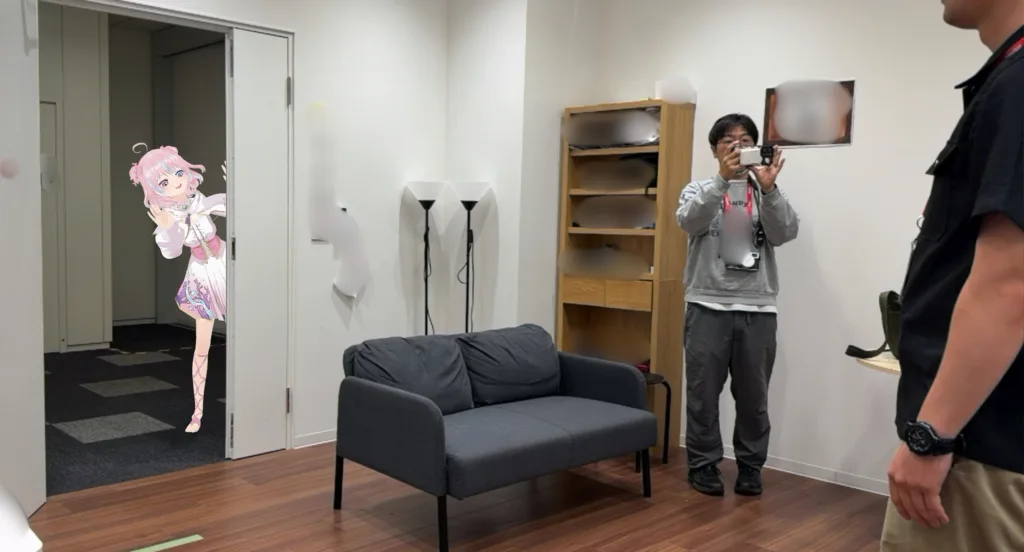
One reason for this is shown in the photo above. It depicts a scene where the VTuber pops out from behind a door. Notice how her body is “hidden” by the door. Normally, to create such an experience, occlusion (a technique for reproducing the spatial relationships of objects in the real world) must be set up to prevent the VTuber from overlapping with real-world obstacles (walls, people, etc.). To do this, it is necessary to scan the real space in advance and obtain information on where everything is located.
According to the studio staff, this project involves acquiring information about the studio (a digital twin) in advance and then overlaying and synchronizing it with another space where the VTuber is located, enabling actions such as “the VTuber appearing from a door.” This allows the VTuber to know the user’s location and walk towards them. The VTuber also understands where the user is standing and what they are doing, enabling smooth communication (Sony’s mocopi device is used for VTuber tracking). These are very small details, but it seems that their presence or absence makes a big difference in the sense of realism.
Commercializing a service that allows people to interact with VTubers face-to-face
Initiatives utilizing MR technology for VTuber interaction have been attempted several times in recent years. A well-known example is the pilot project conducted by ANYCOLOR, the company that operates the Nijisanji group. They also used Meta Quest 3 to conduct real-time talk and music live performances. Unfortunately, no follow-up projects are currently underway, but there is no doubt that this initiative sparked interest in MR technology not only among tech professionals but also among VTuber fans.
VTuberをリアルに“存在”させる技術はここまで来た! にじさんじMR新技術実証実験で、加賀美ハヤト社長のトークとライブを体感
このイベント、ファンには刺激が強すぎるのでは……!? にじさんじライバーのファンを思わず心配せずにはいられないほどの、実在感を伴った超至近距離。ステージ上のライバーと「目が合った」と錯覚するほどの近さ…
にじさんじ2025.02.19
Furthermore, Mawari Inc. showcased its MR technology initiatives at a special exhibition at the Kansai Expo, and has since conducted experiments displaying VTubers using AR glasses. Currently, they are preparing for full-scale implementation
VTuberが今ここにいる! ARグラス×5Gミリ波×新MRプラットフォームで実現した新しいライブ体験【現地レポ】
「現実世界で推しのVTuberを目の前で見たい」 そんなことを思ったことはないでしょうか。もちろん、自分がバーチャル空間内に入れば、VTuberに近づく機会もあるでしょう。しかし、自分のいる現実空間にVTuberが来…
VR体験施設2026.03.25
Amidst this situation, Sony is aiming to provide this VTuber interaction service in a way that allows general users to participate. What are their intentions behind this? We spoke to Hosoya Jun and Hasegawa Yuichi of Sony, who cooperated with us for this interview
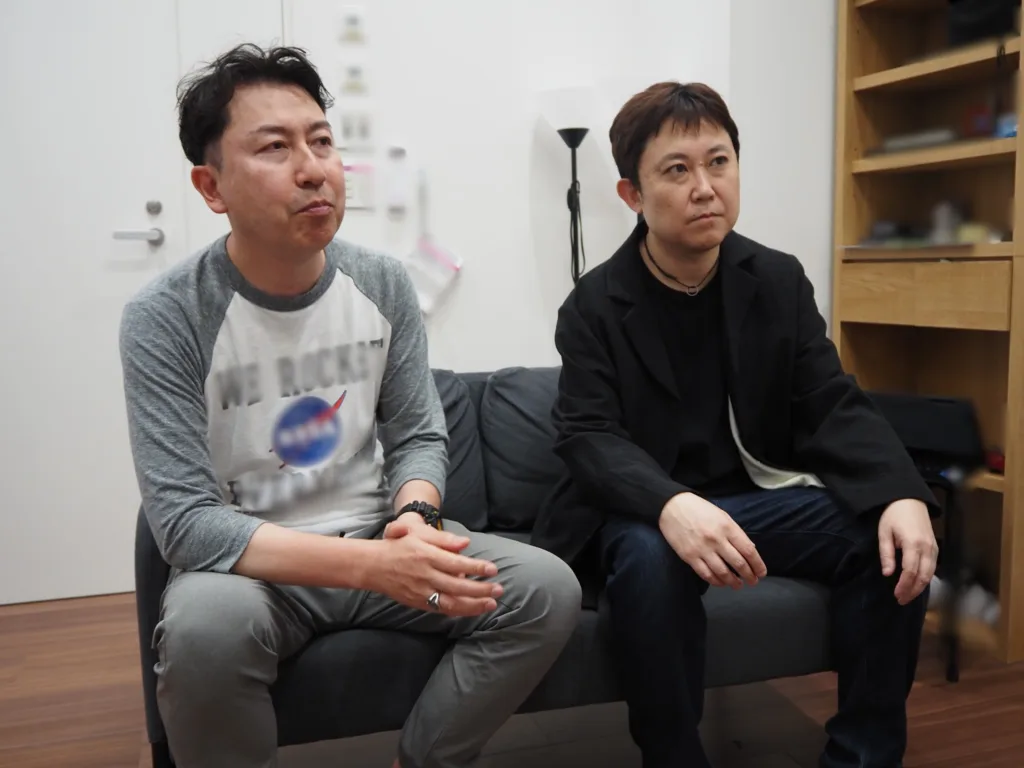
(Left: Hosoya Jun, Right: Hasegawa Yuichi)
—In what form do you plan to offer services utilizing this MR technology?
Hosoya:
Starting in July, we plan to offer this as a cafe where you can meet and interact with VTubers.
We are collaborating with the Shibuya flagship store of the karaoke chain “Manekineko” to create a limited-time space for interaction, resembling a cafe
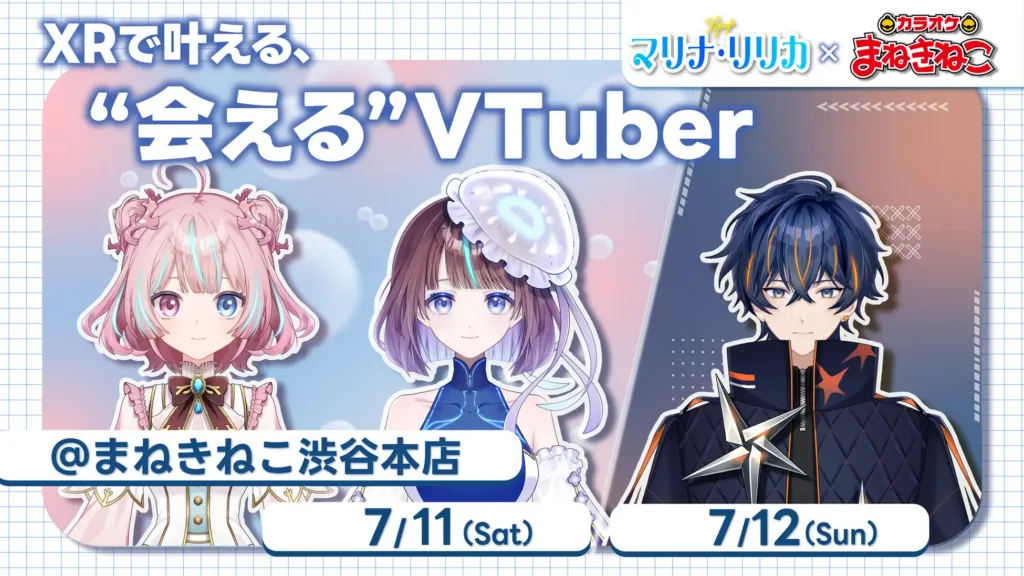 https://prtimes.jp/main/html/rd/p/000000031.000178734.html
Hosoya:
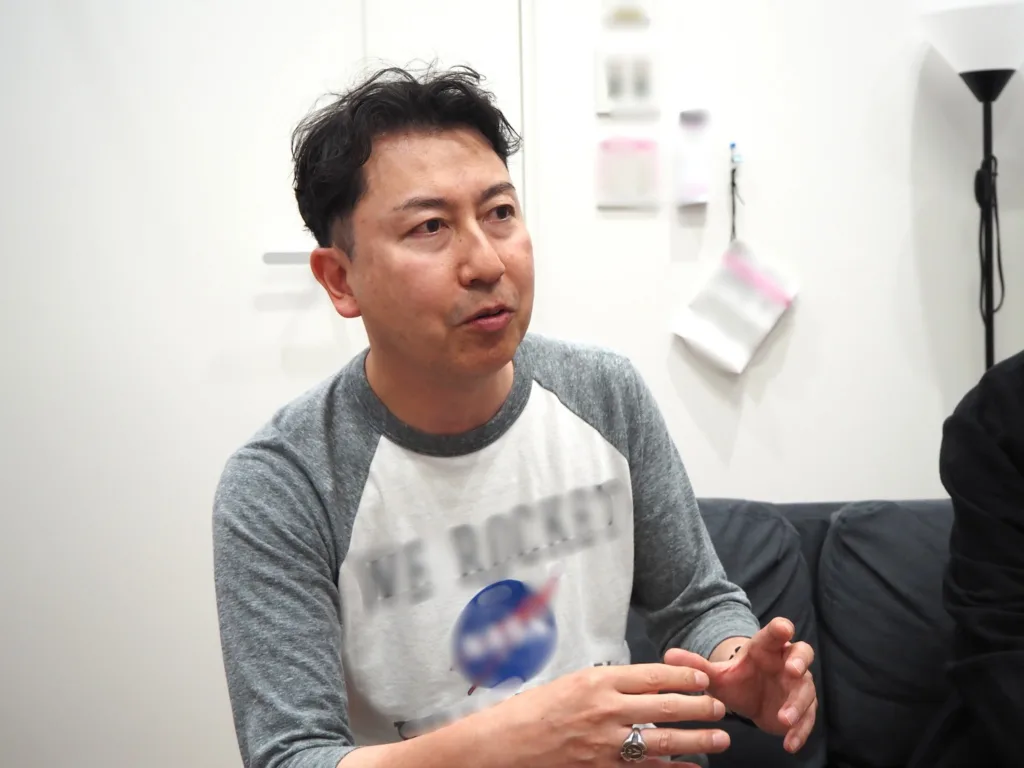
To begin with, it has become commonplace for entertainers performing live music shows to offer a meet-and-greet or farewell event at the end of their performances. This trend is particularly intense among K-pop groups and idol groups, with tickets for handshake events and online lotteries for opportunities to interact becoming established business models
I had always wondered if we could implement similar measures for virtual artists. So, in December 2024, at the first live performance of Anshin Misa’in (who was affiliated with our VTuber agency at the time, and is now independent), we experimentally sold “tickets with 3D meet-and-greet” that included an interaction event using MR technology like this one. To our surprise, even though it was a service that no one had experienced before, the tickets for the 3D meet-and-greet sold first, and on the day of the event, the fans were even happier than we had imagined. This is where we truly realized that “users really do want to meet VTubers in person.”
However, some challenges have also emerged. While real-life artists can smoothly interact with multiple people in a one-to-one setting, preparing 50 or more VR headsets for a VTuber presents significant operational burdens and limitations. Therefore, while this approach might work for highly loyal customers, we concluded that it would be difficult to accommodate multiple people at present
So, the next initiative we came up with was to offer a “cafe where you can meet up-and-coming VTubers.” In fact, places like the AKB48 Theater have a system in place where you can meet new idols, and we thought we could provide an opportunity for users to interact with and support new VTubers in a space like a cafe. Maintaining a large theater is difficult from a cost perspective, but we thought that by combining a small space like a concept cafe with MR technology, we could create a place where people can easily talk to VTubers. We hoped that in the future, a cycle would be created where people would “meet them at a cafe, watch their daily streams, and then go to meet them again.” In fact, we did a test run at a concept cafe in Akihabara at the end of last year, and it was very well received by the customers who came, and it also resulted in significant sales for the store.
—So, that’s how you came to aim to realize the idea of providing a place for people to meet VTubers?
Hosoya:Of course, there are many challenges, but based on customer feedback, I felt this was something worth pursuing. Therefore, we aim to implement this as a continuous initiative rather than just intermittent trial runs
—Where did the idea to use “Meta Quest 3” to utilize MR come from in the first place? Also, with various systems currently available for meeting VTubers, why did you choose MR technology?
Hasegawa:
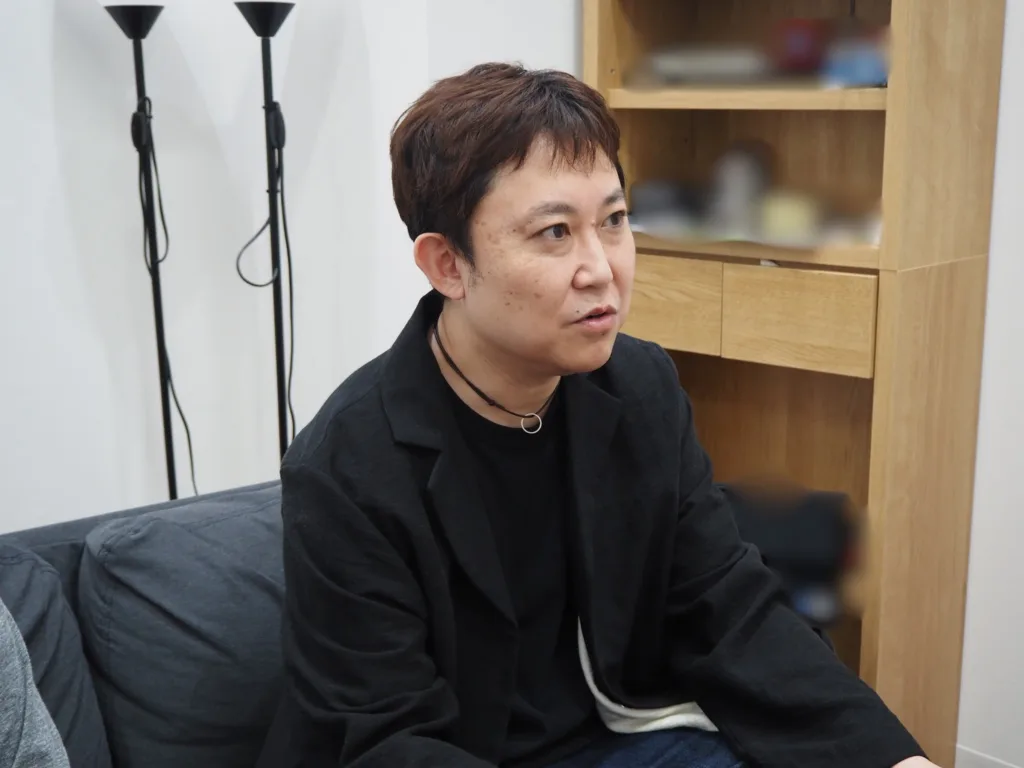
While some companies currently conduct VTuber “meet and greet” events using typical monitor-based interactions, I believe the biggest difference between those and our new MR technology initiative is “close-range communication.” By recreating a sense of closeness that makes you feel like you could actually touch them, and a real sense of their presence, users will be able to love VTubers and characters even more. I believe that headsets like the Meta Quest 3 are capable of providing this kind of experience.
—I just experienced it, and I found it very interesting because it involved interacting at a distance that you rarely encounter in real life. The real-time interaction was incredibly smooth, so I was impressed by the technical excellence. Was that a particular point you focused on?
Hasegawa:
That’s right. While you probably use various video conferencing tools like Zoom and Google Meet for remote work, those tools also have latency (delay). However, for everyday use,
I don’t think you need to worry too much about latency. That’s why we designed the VR headset to provide an experience with virtually no noticeable latency, comparable to a video call. Also, we put a lot of effort into the initial and final presentations of your experience
–That’s the scene where the VTuber pops their head out from behind the wall, right?
Hasegawa:
That’s right. For example, if a VTuber suddenly appears with a soft glow like a game character, or pops out the moment you put on a headset, I think it won’t feel very real. Through our experiments, we’ve learned that it’s better to have a performance where the VTuber appears and disappears from a space that’s seamlessly connected to the user’s own space, so we focused on that aspect. While I can’t go into the technical details, by saving the recorded space as a digital twin and performing appropriate rendering, we’ve made it possible for the talent to behave naturally without any special training.
—With traditional communication methods, you often enter a virtual space, essentially going to the other side to experience it. But with this, the feeling is more about the feeling of them “coming” to our world, so I found the concept very interesting
Hosoya:
So, what kind of business is this exactly? It’s a “business of presence.” We thought it was important to enhance the sense of presence by having VTubers come to this physical space where we spend our 24 hours a day, and to be able to spend time with them there
Hasegawa:
First of all, the slogan that the entire Sony Group has adopted is “Creative Entertainment Vision,” and one of its key elements is “further merging reality and virtual reality.” We believe that this activity is precisely one example of that
Hosoya:
Currently, unlike real-world artists, there is no physical feedback, which some may find lonely or unsatisfying. However, it is possible to add virtual-specific effects to bring out the individuality of each character, and for example, it is possible to subtly release a perfume inspired by the VTuber’s scent into the space. If people feel like they “sniffed that scent,” I think it will stick in their memories
Furthermore, with VTubers, it’s possible to communicate at a closer distance than in reality. In fact, in another demonstration experiment, we had a male VTuber named Hitode-kun perform a “kabedon” (a gesture where he leans against a wall and faces the person), and many people praised it, blushing, saying, “This is amazing!” (laughs). I think this kind of closeness is only possible with virtual characters that don’t involve direct physical contact. Of course, even in the virtual world, I think it’s important to maintain a distance and way of interacting that ensures psychological safety, so we intend to operate while paying attention to those aspects. With that in mind, I think this will be a very good service in that it allows us to find the right balance of communication while ensuring the safety of the talent. In the future, we aim to continue implementing this service while refining it, including technical aspects such as reducing communication lag.
–thank you very much
Focus on “experiences” rather than “product consumption”: To prevent the deterioration of intellectual property through the culture of fan activities
As mentioned in the interview, this initiative is a business that places emphasis on the sense of presence by “having VTubers come to you.” What the author found interesting was that it’s not a one-sided style where users support their VTubers through “fan activities” that don’t expect any response from the other party, but rather it’s trying to provide value in the “experience” of being able to communicate with each other. According to Izumi Yoshihiro of PANDORA, Inc., who was present at the site for the interview, this MR initiative also offers benefits from a talent management perspective.
Izumi:
In today’s VTuber market, about 70% of sales come from “merchandise” and “sponsorships (tie-ups),” essentially revenue generated within the context of “fan activities.” However, from a management perspective, this inevitably means selling off the talent’s value to fans to create a revenue model, which I believe ultimately depletes the IP (in this context, the value of the VTuber’s activities and image itself). However, this initiative has the potential to transform the consumption of goods into “experiential value for customers.” For example, purchasing merchandise could lead to an opportunity to greet XX, linking the purchase of goods to an experience. This would delight fans, and as a result, various campaigns could be conducted without diminishing the value of the IP. I believe this is innovative from a management perspective as well.――
In the future, as VTubers have more opportunities to interact with users not only through chat and voice-only conversations, but also in “real-world spaces,” it’s possible that significant changes may occur in the industry’s overall revenue system, and even in the very nature of VTuber activities. When it becomes commonplace for VTubers to come from the world of displays to our world, we will continue to closely monitor what changes will occur, including Sony’s recent initiative
[Meet VTubers in a karaoke room!] A real-world interactive XR event exclusive to Manekineko will be held at Karaoke Manekineko Shibuya Main Store from July 11th (Saturday)
A VTuber interaction event will be held at Karaoke Manekineko Shibuya Main Store. This event will utilize MR technology to provide an experience that makes it feel as if the VTuber is right in front of you. Why not participate in an event where you can “meet and talk” with a VTuber, whom you normally only see on screen, in the private setting of a karaoke room? At the end of the event, you can also take a two-shot instant photo with the VTuber. You can take home an unforgettable moment in a tangible form.
■Event Overview
Dates: July 11th (Sat) & 12th (Sun), 2026, starting at 12:00 PM *Each character
Venue: “Karaoke Manekineko Shibuya Main Store”
4F Shibuya Prime, 2-29-5 Dogenzaka, Shibuya-ku, Tokyo 150-0043, Japan
Tickets: Price: 3,000 yen per 20-minute slot (advance ticket reservation required)
Purchase tickets here: https://t-dv.com/marina-lyrica-manekineko
