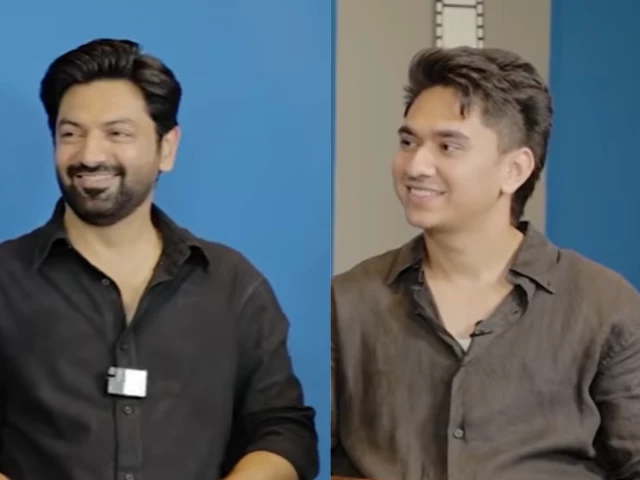
Actor and director discuss Jafri’s physical transformation, gritty visuals and the creative choices behind the serial
Life And Style DeskSeptember 10, 20264 min readPhoto: Youtube
Actor Samar Jafri and Director Fajr Raza reflectedon the transformation behind Raja London Ka, from bulking up and tanning for the camera to building a deliberately gritty world that they knew would invite criticism.
Jafri, who had spent years playing gentle, family-oriented characters, said Raja was designed to be the opposite. “The character I played previously was a family boy, a very gentle person,” describing Raja as carrying “anger and a roughness that is very different from my past roles.”
For Raza, making that transformation believable meant ensuring Jafri did not fall back into familiar territory. “I told Samar that I didn’t want a typical chocolate boy here,” he said, explaining that since Raja was written as someone from Landa Bazaar, the actor needed to “beef up a bit and get tanned so it looks like he works out in the sun day in and day out.”
The physical transformation, however, was only part of what Jafri had to change. “I had to completely switch off from the real-life Samar,” he said, adding that performing the show’s action sequences meant first convincing himself that “this violence is justified.”
Raza was equally particular about the world around his lead actor. “If we had shot on polished sets, the show would have lost its soul,” adding that the set needed to look “crusty and grungy so the character actually felt part of that environment.”
That visual approach extended to the way the cast was placed within the setting. Raza said that if the lead actors looked too clean, they would appear out of place, so he made sure they blended into “the brown tones and gritty textures of the background.”
He also used blocking as a storytelling tool, positioning Raja physically lower than his love interest, Rani, “whether on stairs or relative to a car,” so audiences would register the power dynamic between them without it being spelt out.
“Raja has to become worthy of Rani,” Raza said. “The story isn’t just about a hero showing up and winning the heroine; he has to build himself up mentally and socially.”
The visual choices were part of a wider gamble with the serial. Express Entertainmenthad billed Raja London Ka as a departure from its usual slate, blending romance with action and thriller elements rather than relying on the family-drama template that commonly dominates Pakistani television.
Raza acknowledged the risk of that approach, particularly in choosing an aesthetic that was intentionally rough around the edges. “People might say it should have looked cleaner or more typical, but real life isn’t always polished,” he said. “We intentionally chose a grungy tone because that’s what the show demanded.”
That instinct also shaped the way Raza approached scripts. “I don’t select a script based on a risk assessment,” Raza said. “I look at whether the story excites me. If I am genuinely excited by it, the audience will feel that excitement too.”
For Jafri, meanwhile, stepping into Raja meant confronting a side of performance that was unfamiliar to him. Describing himself as non-violent by nature, he said the show’s action sequences tested him in ways his earlier roles had not.
“In real life, I am a very non-violent person,” he said, recalling that he felt guilty every time he had to kick or punch a co-star during a fight scene.
Making those sequences convincing mattered to him as much as performing them. “If action looks fake, it ruins the whole scene,” adding that every hit needed to carry weight to look “earned and believable on screen.”
With little time for rehearsal, much of the choreography came together on set. “We didn’t have weeks for extensive rehearsals,” Jafri said, crediting action director Azam and DOP Imad for designing camera angles on the spot each morning.
Beyond the physical demands of the role, Jafri also reflected on how his relationship with the industry had changed over the years. Early in his career, he said, there had been constant pressure to prove himself and carve out space. “But now it feels like a family,” he said. “There is a comfort zone on set where you can express yourself freely.”
He credited a sense of gratitude with helping him keep that pressure in perspective. “I rely heavily on Tawakkul,” Jafri said, referring to trust in God, adding that focusing on gratitude and the process rather than external validation stopped industry pressure from becoming overwhelming.
His approach to working with Raza was similarly rooted in trust. Jafri said he deferred to the director’s judgement even when their interpretations differed, since a director was working with “the entire map” rather than a single character’s arc. Disagreements, he added, were simply part of reaching a version of the project that worked for everyone.
Raja London Ka cast Jafri in a role far removed from the soft-spoken leads he had built his career on. The serial brought together romance, action and thriller elements in a departure from the family-drama template, with its deliberately unpolished visual world forming a central part of that experiment.
LATEST