

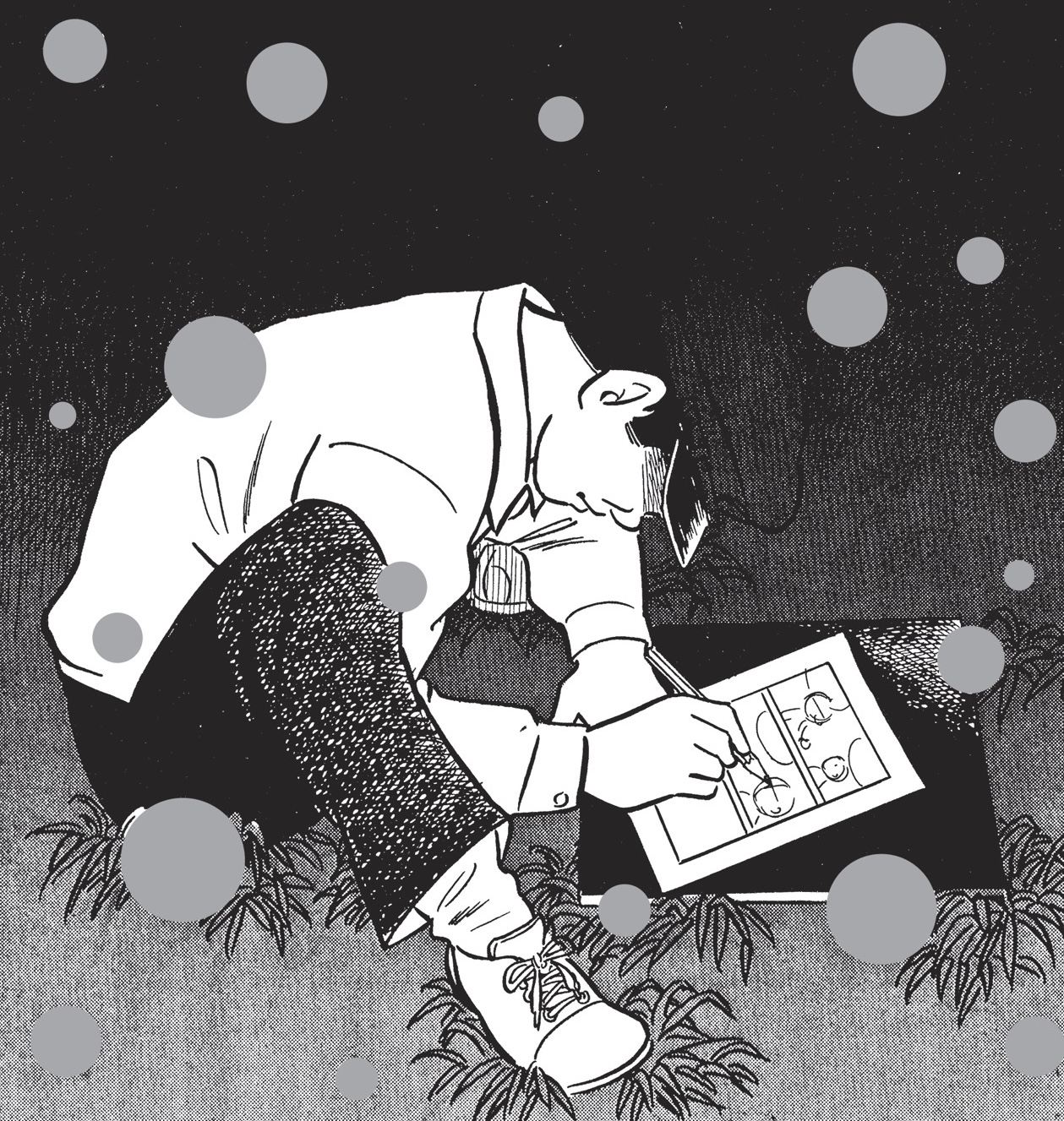
Implicit in the authoring of an autobiography is the assumption — justified or otherwise — that one’s life story is worth telling. Implicit in the translation of an autobiography is the assumption — whether justified or otherwise — that the merit of the work endures even divorced from its original geographical-cultural context.
In this regard, the translation of Yoshihiro Tatsumi’s 850-page A Drifting Life,1 originally serialized over twelve years in the in-house magazine of the Japanese second-hand collectibles chain Mandarake, then published in English by Drawn & Quarterly (with a translation by Taro Nattleton), has certainly benefited from its time out of print. Between the time of its original English publication in 2009 and its reprint in November of last year, English-language readers have received a far wider — though, naturally, in no way full — view of alternative manga past and present, thanks not only to D&Q but to newer publishers like Breakdown Press and Glacier Bay Books, allowing readers of a more exegetical inclination to better situate Tatsumi within the historical landscape.
A Drifting Life covers a period of fifteen years in Tatsumi’s life, from the age of ten to the age of twenty-five. More specifically, it focuses on Tatsumi’s growth within comics, from a voraciously-reading kid to a budding cartoonist who began to achieve success in his teenage years and by his twenties had become a fixture of the rental-books sector. But it starts, above all else, with a contrivance: when writing about his own artistic growth and innovation, the author changes his stand-in’s name from Yoshihiro Tatsumi to Hiroshi Katsumi, and writes about himself in the third person, while leaving just about everyone else’s name — certainly every name the reader might recognize in the manga field — intact. There’s an inescapable note of pomposity in this à clef half-measure: a celebration of self, tenuously masquerading as a celebration of another.
This tension, between recollection and self-congratulation, defines much of A Drifting Life. In the interview in the back of D&Q’s third Tatsumi collection, Good-Bye, conducted by Adrian Tomine, Tatsumi refers to his A Drifting Life stand-in as “an untalented boy.” This is, I would argue, more than a bit disingenuous; in point of fact, the question of “talent” scarcely figures into the book’s authorial perspective, and while Tatsumi does enjoy portraying himself as somewhat dopey and clueless — particularly in the romantic field — the overall focus is on his ambition, his desire to drive comics forward into a new mode of expression, and his hard work more or less paying off.
Where Tatsumi’s so-called “talentlessness” does figure in is in the way Tatsumi engages with the cartoonists around him. In particular, one of the most interesting aspects of the book is Tatsumi’s conflict with his older brother, the cartoonist Shōichi Sakurai (real name Yoshiyoki Tatsumi; the book refers to him as Okimasa Katsumi in the familial context and as Sakurai in the professional). As the book portrays it, it is “Okimasa” who initially inspires Tatsumi to pursue comics, but when the older brother falls ill his productivity plummets. Gradually, as Tatsumi’s magazine submissions gains traction, the older brother grows increasingly resentful, tearing up some of his younger brother’s pages and letters. After “Okimasa” makes his recovery, he serves as Tatsumi’s guide and mentor while ardently disagreeing with the younger brother’s lofty artistic ideas and, here and there, venting his resentment (“Must feel good, especially for someone with no talent,” he says when Tatsumi receives comp copies of his first long-form publication). On occasion, however, he lets his combative façade slip: when he returns to making comics, Tatsumi offers to show his publisher his brother’s work, and “Okimasa” thanks him profusely. “I may seem brazen,” he says, “but the truth is, I don’t have the courage to take it in myself.”
In this regard, the chapter titled “Experimental Work,” about halfway through the book, is particularly telling. As Tatsumi philosophizes about his desire to expand the formal idiom of comics by integrating cinematic influences—mostly manifesting as decompressed atmospheric pacing, going against the rapid-fire efficiency prevalent at the time—his brother quickly knocks him down a peg: “I appreciate your drive, but don’t you think that what you call ‘experimental’ might simply be ‘self-indulgent?’” he says, and “Why can’t manga simply be manga?” The function of this exchange is obvious: soon enough, the wave of “anti-manga manga,” as Tatsumi initially terms it (later he comes up with the term gekiga), will pick up enough steam to completely nullify Sakurai’s conservatism, essentially forcing him to join Tatsumi’s gekiga group, published by rental-market publisher Hinomaru, and it is “Hiroshi,” not “Okimasa,” who will be vindicated.
This dynamic is curious from a historiographical standpoint, as it betrays, perhaps unintentionally, Tatsumi’s underlying authorial intent: to keep those around him “in check.” Sakurai is, by far, A Drifting Life’s most complex character, easily surpassing the bumbling, clueless “Katsumi,” yet the aspects that Tatsumi focuses on — his tantrums, his barbed remarks, his lack of artistic vision — boil him down to a seethe of brotherly resentment and envy; he is a handy foil precisely because he is toothless, posing no real danger.
Later, Tatsumi uses a peer of his, Masahiko Matsumoto, in a rather similar, if less extensive, fashion. As soon as he encounters Matsumoto’s work, he is completely enamored, and when they publish work together Tatsumi is struck with envy: everything that Tatsumi had told his brother in “Experimental Work,” all of his half-baked ambitions to drive manga forward — Matsumoto has beaten him to the punch, achieving the same vision with greater clarity. As Hinomaru’s crew of cartoonists picks up steam, a certain schism occurs: where Tatsumi wants to refer to his “serious” manga as gekiga (roughly dramatic pictures), Matsumoto uses the term komaga (panel pictures, a contrast to manga in the heretofore-prevalent sense of whimsical pictures). Matsumoto insists on his own terminology for a while, until the rest of the crew reaches such a level of cohesion that Matsumoto must choose whether to compromise or to be left behind entirely. In a rare departure from visual literalism, Tatsumi draws Matsumoto physically pushing away the term komaga, written in bold blocky letters taking up most of the panel, and embracing gekiga. Again, the underlying intent is clear: the artist who once outpaced Tatsumi now sees no choice but to conform. (Elsewhere, in a cutaway from the plot-line of “Katsumi” himself, the cartoonist goes out of his way to show a certain Yoshiharu Tsuge finding one of Tatsumi’s anthologies in a bookshop and immediately becoming inspired.)
At the end of A Drifting Life, in 1960, “Katsumi” is just 25 years old. This choice of end-point,2 to me, serves a purpose of optics: largely triumphant, having birthed a whole new idiom of comics, the artist can rest easy, with no acrimony or personal conflict. In reality, he arguably stops before the parts of both his personal history and the history of alternative manga that are actually interesting. In the immediate years following the end of A Drifting Life, the full-on gekiga boom would more or less leave Tatsumi behind, to struggle with self-publishing and fester in his own frustration while his former peers thrived (in 1967, Tatsumi would author Gekiga College, a manifesto on the history and aesthetic language of gekiga, in part to retain control of the narrative3). This would lead him, as something of a compromise, to join up with the influential gekiga anthology Garo. Later, as the hype surrounding Garo gradually died down, he would remain consistently active, continuing to produce not only shorts but also several multi-volume releases, as well as collaborations with other writers (including the Japanese Buddhist scholar Hiro Sachiya, with whom Tatsumi, non-religious and with little interest in Buddhism, produced a slew of Buddhist-themed comics), but increasingly he would find himself left behind by the rest of the manga world around him.4 I think these latter-day developments are what motivate A Drifting Life behind its polite façade — fifty years after the fact, and far more jilted (by the passage of time, more than anything else) than the 1960 cut-off would have one believe, Tatsumi finds it more important than ever to state that most of gekiga’s successes, if not all of them, would never have happened if not for him.
And yet — I suppose this is where the “untalented boy” comes in again — for all of his ostensible achievements, A Drifting Life struggles to make the case for “Katsumi” as an individual of any intrinsic merit to speak of. At no point does he demonstrate any philosophical rigor to speak of, whether on the artistic front or just in life; for the most part, he simply trundles along, from magazine submission to publisher assignment, yet the reader learns very little about the work Tatsumi was putting out at the time, his artistic growth, his reception. His monologuing about “anti-manga manga,” too, remains almost entirely in the abstract — the problems he faces on the creative front are technical (“How do I make sure the barrels I draw are of a consistent size?”) or logistical–material (a publisher offering an advance then revising the offer to make it substantially lower).
This cold practicality, stripped of observation, makes the occasional emergence of sentimentalism rather hard to buy. In a moment of rumination, the narration offers: “Why do I make manga?” Certainly, it was to make ends meet. Hiroshi began to feel, however, that there was more to it than that. For this 19-year-old boy with no guarantees for his future, the only place where he felt alive was in the realm of his imagination.” The tonal aim is soaringly, swellingly romantic; the execution, however, is nigh-parodic, for the simple reason that at no point before or after does Tatsumi give any indication of holding “imagination” in any great esteem.
Last year, in the context of Dan Nadel’s biography Crumb, I wrote that:
a good biography, generally, is a rule-follower: it presents a thorough, well-researched chain of events that outlines a human life. A great biography, on top of the above, offers a cogent and compelling critical perspective (‘critical’ not in the laudatory-or-denigrative sense so much as in the pattern-observation-and-analysis sense) that enriches one’s understanding of the ‘dry data’ by placing it within its surrounding context (social, cultural, political, and so forth). It appeals not only on the intellectual level but, ideally, on the human level as well.
There is, of course, a difference between an autobiography, subject to memory and bias, and the supposed objectivity of the third-person biography. But the relativistic nature of memory, here, can serve not as a burden but as a benefit, as the author places the reader in a state of emotional dissonance, pitting how he felt at the time against how he feels in hindsight. This seems particularly pertinent to an artist like Tatsumi, who lays claim to “cinematic” cartooning techniques, which slow down the passage of time on the page in order to evoke an emotional and psychological headspace, as his own innovations.
And yet consider, just in the way of an example, the following incident: a collaborator and supervisor of Tatsumi’s, Kuroda, has vanished, mere days before a deadline, leaving the next issue of one of Tatsumi’s anthologies without a cover artist. Tatsumi himself is asked to draw the substitute cover. “I don’t want it to look like I stole Sensei’s job while he was gone,” he thinks to himself. “What do I do?” There’s a real, proper dilemma here: do you risk fucking over your friend and peer, or pissing off your boss and potentially ruining your own employment prospects? It’s a good, salient question, with moral and emotional heft.
Or, rather, that’s what it could be, if it weren’t answered with a simple panel transition: the very next panel shows the cover already drawn, with Tatsumi thinking, “Well, the cover’s done, but … I just don’t feel right.” This is more or less indicative of the book’s overall emotional tone, as Tatsumi abstains not only from melodrama but rather from all drama; even moments of deep distress have no lasting impact, no residue. This tendency toward dry reportage certainly contributes to an efficient narrative pace, but at the expense of lingering human interest. Given the laid-back nature of the narrative and the chronological focus, Tatsumi’s reluctance to dwell on feel, impact, or atmosphere is perplexingly atypical.
At this point it would be prudent to examine the makeup of Tatsumi’s moral and psychological worldview, at least as can be gleaned from Drawn & Quarterly’s three chronologically-ordered collections The Push Man and Other Stories (published in collecting stories from 1969), Abandon the Old in Tokyo (2006, collecting 1970), and Good-Bye (2008, collecting 1970–1971), all three translated by Yuji Oniki, and the Landmark Editions collection Midnight Fishermen (2013, collecting 1972–1973, translated by Mariko Usuba Owen). At his best, Tatsumi’s fiction perfects what I would term the art of artlessness; his refinement on the cartooning front is both contrasted and complemented by a cruel, prosaic bluntness. His men, more often than not, are laconic, put-upon proles, politically and sexually impotent, either at the brink of violent collapse or desperately searching for comfort, which the world at large invariably robs them of;5 his women, more often than not, are either “my bitch wife” types,6 sex workers disillusioned to the point of alienation, or, rarely, symbols of unattainable beauty, simultaneously glorified and dehumanized. By no means is he a writer of individuals; his protagonists are less characters than recurring types thrust into scenarios that vary on the surface level while maintaining an unwavering cosmic or karmic consistency. Generously, one might argue that this strict adherence to types is a case of form following function, that Tatsumi sees the character as the ‘world’ sees them, as all-but-faceless cogs, and rusty ones at that; less generously, it may be seen as a clear crutch toward point-making.
To his credit, when the story does aim for the point, for the message, it rings loud and clear, even if that message is uniformly ugly in a way that implicates its author;7 it’s when Tatsumi shoots for the “artistic” — the lyrical, the symbolic — that he typically fails. For an easy example, we may consider the short story “Beloved Monkey,” collected in Abandon the Old in Tokyo. Here, a factory worker disillusioned with the chokehold of modernity drafts a resignation letter, but before he can get the chance to deliver it to his manager his arm gets stuck in the machinery. When he regains consciousness, he learns that, in the wake of the accident, his bosses found his letter and were all too glad to let him go. Now both disabled and unemployed, he is forced to say goodbye to the one thing he loves and cares about, his pet monkey, but when he delivers the monkey to the primate inclosure in the zoo the other monkeys no longer recognize the domesticated animal as one of their own, and they beat it to death. If the symbolic projection is lost on you, don’t worry, as Tatsumi makes it detrimentally clear: in the next scene, the rattled, down-on-his-luck factory worker walks on the street as he faces the crushing crowd at a crosswalk; as the masses walk toward him, he flashes back to the dead monkey’s corpse and screams in panic. That last sequence is Tatsumi’s weakness in a nutshell: a lack of confidence in his own symbolism, forcing him to restate subtext so loudly that it becomes text.
Similarly, though Tatsumi demonstrates a strong intuition in his storytelling, he generally proves to be a fairly weak thinker on the formal–theoretical front, as evidenced by his late-period book Fallen Words (English translation by Jocelyne Allen, D&Q, 2012), which draws on the tradition of rakugo, a Japanese form of oral entertainment noteworthy for its minimalism: a rakugo show consists of one performer, sitting down in front of the audience with two props (a paper fan and a small cloth) and serving as both the narrator and the cast of characters. Right away, the bare-bones nature of the art-form, whose suspense of disbelief is entirely reliant on the strength of its performer, opens questions of formal–narratorial perspective; Tatsumi, however, ignores these questions outright, opting instead for an all-substance-no-style approach. In his afterword, Tatsumi states that gekiga and rakugo are innately similar because “both put great importance on timing: how a rakugo story is performed, and how a gekiga story flows from panel to panel” — not entirely inaccurate, but only inasmuch as most art, certainly most narrative art, relies on timing; if comics and rakugo, specifically, share any deeper bond, it is comes and goes completely without notice, as the cartoonist himself makes little adjustment in tackling this new font of material.
The worldview of Tatsumi’s comics, crucially, is inextricable from gender, or, rather, from an aggressively traditional gender dichotomy, and what happens when the protagonists attempt to breach this dichotomy is noteworthy in itself. In two separate stories— “Make-Up,” collected in The Push Man and Other Stories, and “The Woman in the Mirror,” collected in Good-Bye— the male protagonists make attempts to move from one group to the other by presenting socially as women. While Tatsumi writes this transition with a perhaps-surprising note of empathy (in both cases it is presented as a lifeline, a desperate comfort, even though the titular “Woman in the Mirror” of the latter story finds her premature death under unrelated circumstances), the act nonetheless stems from that same place of gender roles and an inability to fulfill them. “Here’s what I think now,” says the narrator in “The Woman in the Mirror,” “The women in the protagonist Ikeuchi’s family made him feel like he had to be a man, and it was too much for him … he tried to escape by shedding his manhood. That was his only way out.” Tatsumi’s man/woman dichotomy, then, is so absolute, and has so much to do with inherent responsibility, that any attempt to breach it is viewed as a sign of weakness — impotence followed to its logical conclusion.
Given that Tatsumi’s work is so tied up in an all-encompassing moral worldview, peopled as it is by politically-alienated underdogs crushed by the weight of the systems around them, perhaps the most shocking thing about A Drifting Life is how utterly unworldly it is. Throughout the book, Tatsumi scatters references to recent events, political and cultural, in a way that addresses the reader without figuring into the lives of the actual characters. While the thinking behind it is obvious and intuitive — the comic does, after all, span fifteen years, so some mooring in widely-recognizable history is, at least on paper, a boon — the references in practice are so far detached from Tatsumi’s focus as to become superfluous. For example, though Tatsumi informs the reader that the end of the postwar era had been declared, little effort is made to evoke any sense of contrast before and after. On a more immediate level, his repeated allusions to such-and-such book advance or per-story rate likewise ring hollow, simply because Tatsumi does not really establish any concept of a standard of living. The economy of life (a crucial aspect of life for an up-and-coming artist, mind you, certainly one who only works in art) is so nonexistent in Tatsumi’s depictions that a thousand yen more or less means little more than “wow, that’s a big number!”
It is precisely in this context that Tatsumi’s comic Black Blizzard (English translation by Akemi Wegmüller, D&Q, 2010), and the circumstances of its creation, becomes interesting to me. In a 2011 essay for TCJ, Ryan Holmberg details the forgotten — or, rather, obscured — history of Black Blizzard as an unauthorized, and by-and-large faithful, adaptation of a story by Japanese pulp author Kazuo Shimada, titled “Black Rainbow.”8 While Holmberg’s well-argued essay certainly casts Tatsumi’s claims of innovation into question — though the formal and stylistic techniques are what distinguishesBlack Blizzard, it’s hard to credit yourself with “originality” when the story itself isn’t original — I would nonetheless argue that the book serves as something of a cipher to the rest of Tatsumi’s body of work, specifically given the handful of divergences from the source as detailed by Holmberg.
As Holmberg explains, the characters in Shimada’s original “Black Rainbow” are deeply rooted to their real-world, real-time circumstances in postwar Japan: the protagonist, Takiguchi, is a combat soldier in Manchuria who has just returned from a four-year stint in a Russian labor camp; his counterpart, the card-shark Kurokawa, fought in Manchuria up until 1931 but, given his pre-service criminal record, received no honors whatsoever and was left in the lurch by his wife and daughter. Note the implication here: the upright man went to save his country, and all he got was frostbite bad enough to ruin his dreams of becoming a pianist; the “corrupt” man went and fought for his country, and even that wasn’t enough to redeem him — no matter one’s moral stature, the system of the world does not care about you. The end of the story, a self-sacrifice from the card-shark to save Takiguchi, thus gains some poignancy: if the corrupt man cannot redeem himself in the eyes of the state, at least he can redeem himself in the eye of his fellow.
In Tatsumi’s adaptation, these political circumstances — and, indeed, virtually all indicators of “real life” — are entirely omitted. The would-be pianist, here named Yamaji, is a young man in his twenties, and the gambler is a career criminal, a five-time convict; at no point is army service mentioned, nor any war, nor, really, any “Japan” in any specific geopolitical sense. This omission of Shimada’s original political context unmoors the narrative from the “real world” and gives the book a whiff of boyishness, of a tenuous grasp over maturity.
This, to me, is Tatsumi’s defining trait. In 2012, Bill Randall — among the Anglosphere’s earliest and most rigorous manga critics, and an on-record Tatsumi skeptic — commented:
Tatsumi’s story in English is about marketing and a lack of context. D&Q has marketed Tatsumi and “gekiga” very well, though it’s worth noting that the term “gekiga” first appeared in issue 12 (1957) of “Machi,” a rental manga, as a blurb on a Tatsumi title page: “GHOST TAXI” has the title, “Mystery Gekiga” (Encyclopedia of Contemporary Manga, p. 62). It feels closer to “Ghost Taxi Mystery Theater” to me than, say, an equal of any of Kurosawa’s gendai-geki or jidai-geki from the period.
Though I enjoy Tatsumi’s fiction more than Randall does, I would largely agree with this characterization. Much has been written about the common gekiga approach of hyper-rendered photorealist backgrounds and environments against cartoony, simplified character work, often attributed to Shigeru Mizuki and his Mizuki Pro assistants, but I would argue that Tatsumi, specifically, embodies the apotheosis of this contrast: though his work seeks to portray the seedy, hopeless underbelly of the “real world,” in truth it is, for better or worse, strikingly avoidant and reactionary; it has more in common with the tenuous-at-best signifiers of Frank Miller than with, say, Joe Sacco.
Notably, the Tatsumi does have something of an on-page political awakening in the very last chapter of the book, as he is swept into a public demonstration against the recent Security Treaty signed between the U.S. and Japan, though, if anything, the focus of his internal monologue betrays a note of opportunism: “That’s the element that gekiga has forgotten … anger!” he thinks to himself. Except there are two problems with this enthused rallying cry. First, that choice of word, “forgotten,” would imply that anger is an element gekiga once possessed, which A Drifting Life doesn’t indicate at any point, with its consistent emphasis not on gekiga’s philosophical sensibilities but on its formal–stylistic qualities; second, choosing this note as the end-point, specifically, is more or less a clever cop-out, ascribing the political urgency of the whole movement (including, for one, Shirato’s The Legend of Kamui,which in real time struck far more of a chord with Japan’s politically-disillusioned youths than Tatsumi’s work did) to Tatsumi himself while not having, within the pages of the book itself, to put one’s money where one’s mouth is. Whether intentionally or not, this final scene is perhaps the single most pointed confession in A Drifting Life: more than he seeks anger — it is the anger of others that he seeks.
Does this take away from the work itself? Not necessarily — stories like “Good-Bye,” in which a Japanese woman abandoned by yet another American G.I. grows so disillusioned with men that she sleeps with her own father, and “Telescope,” in which a disabled man finds himself in essentially a cuckold–voyeur dynamic, remain upsetting, and downright ugly, in their bleakness. But between that bleakness and the “gather ‘round, kids, it’s story time from Pee-paw!” tone of A Drifting Life is a gulf of difference, and the autobiography’s refusal to contextualize that difference, or even to simply reflect it (or upon it), rather undermines the book’s sweeping claims of achievement. Far from contextualizing the body of work that came before it and the worldview that fueled it — A Drifting Life goes to great lengths to hide this worldview entirely.
In a four-page epilogue, Tatsumi seems, at least for a fleeting moment, aware of the book’s own shortcomings. The epilogue is set thirty-five years later, in 1995, on the seventh anniversary of the death of Osamu Tezuka. “Katsumi” — still à clef after all these years — attends the memorial service, only to leave early, beset by despair. Tezuka arguably embodies in miniature that same tug-of-war between reality and frictionless representation that defines A Drifting Life (while in the book’s “present day” he is presented as an affable mentor to the young Tatsumi, some years later, in the ‘60s, the “God of Manga” would come to detest the Garo gang and the threat they posed to his theretofore-indisputable stature and influence), though Tatsumi naturally makes no mention of this. Tezuka here, understandably, is less a person than an icon (one that is rigorously maintained as such, even — especially — in death: goody bags are handed out at the memorial service, including merchandise and his widow’s autobiography). Nonetheless, the tone is markedly different from the rest of the book before it: arbitrarily flitting back and forth between first-person thought balloons and third-person narration, Tatsumi/“Katsumi” thinks to himself,
Tezuka sensei… time swallows up everyone, without distinction between the genius and the ordinary. I’ve been feeling so tired lately. Ah… the rental book days, when I was flooded with energy, are long gone. (In his youth, Katsumi had poured all his passion into the specter that was gekiga. In retrospect, he was happy then.) I’ve drifted along, demanding an endless dream from gekiga. And I … probably … always will …
In this world-weary, disillusioned perspective, the writer of lines like “To survive in the crowd, you have to struggle alone” (“The Burden,” in The Push Man) or “It’s a filthy city. Everything here is trash. Eventually someone’s gotta burn it.” (“Black Smoke,” ditto) is far more identifiable than the young starry-eyed idealist of thirty-five years prior. Immediately, the gap between A Drifting Life and its epilogue becomes the most intriguing part of the book. But intrigue comes far too late, and the obvious question—how did we get from there to here?—is left unanswered. One last time, for better or worse, the reader is left just as Tatsumi wants them: completely and utterly adrift.
- A case of modification in translation: taken literally, the Japanese title translates to “adrift” in gekiga.
- In the interest of fairness, Tatsumi did have plans to discuss this era, in some form: one of the many comics in 2015’s Drawn and Quarterly: Twenty-Five Years of Contemporary Cartooning, Comics, and Graphic Novels is a twenty-page excerpt from a would-be follow-up to A Drifting Life, of which, according to former D&Q publisher Chris Oliveros, Tatsumi had completed about 200 pages, covering “a much broader timeframe” up to the Anglosphere’s discovery of Tatsumi’s work in the 2000s. To date, the Drawn and Quarterly: Twenty Five Years… excerpt is the only part of this follow-up to see the light of day, and hardly improves on the issues that permeate the book that came before it.
- Gekiga College was authored when the success of Garo— and Tezuka’s competing magazine, COM— was causing an aesthetic trickle-down into the mainstream sphere, causing a dilution of the gekiga ‘brand’; the manifesto was an attempt to wrest control of the narrative both from the mainstream and from the more “palatable” contingent of the movement proper, like Takao Saitō.
- As writings on Tatsumi from before the autobio’s release tended to inform readers, by the time of his English debut — itself inspired by a bootleg translation from Catalan Communications, published in the ‘80s without the cartoonist’s knowledge or consent — Tatsumi’s work was largely relegated to the dustier aisles of history’s library; in 2008, only two volumes of his solo work were still in print in Japanese.
- Often, these blank everymen are drawn to look like Tatsumi himself.
- See a rather telling exchange from Gary Groth’s interview with Tatsumi for TCJ:
GROTH: The women in [The Push Man and Abandon the Old in Tokyo] are almost always depicted as opportunists or parasites, and I was wondering why you made that decision, or if you even agree with my description. [Laughs.]
TATSUMI: Really? Are the women parasites? [Laughter.] [Looking at his wife.] No, it’s partly to do with my personal experience that I can’t really express right now. [Laughter.]The last remark is possibly a reference to Tatsumi’s as-yet-untranslated prose autobiography, Life in Gekiga, which covers a wider timeframe. While A Drifting Life does feature some anecdotes of Tatsumi’s romantic life, the prose counterpart does not; in the afterword, he states that his wife had told him to remove these parts (about 100 pages in all), as “they had nothing to do with comics.”
- In a way the apt comparison here is none other than R. Crumb, long celebrated for the “confessional” and “expurgatory” nature of his work. I prefer Tatsumi, though, for one simple reason: where Crumb’s key weakness is his charade of self-awareness-as-self-absolution, Tatsumi is entirely blunt and unassuming; there is little indication that he is trying to remove himself from the human world he is railing against.
- Holmberg, in his essay, does hint at the possibility that Tatsumi “lifted” other stories or elements without acknowledgment; critic Tom Gill, for his part, has written about the porous boundary between “influence” and “plagiarism” in the context of Tatsumi and his fellow Garo cartoonist Tsuge Yoshiharu.
