

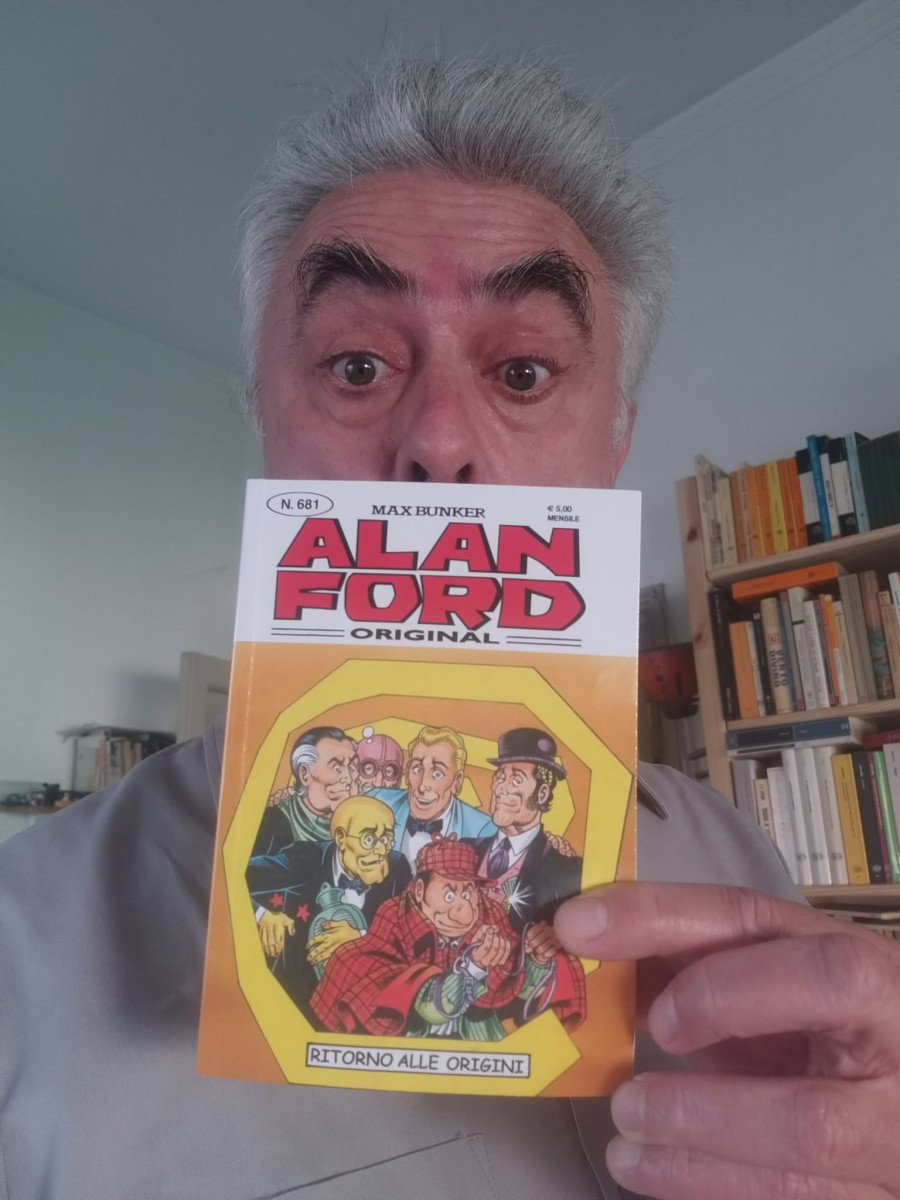
For more than half a century, the comic strip “Alan Ford” has been present in Serbia and the former Yugoslavia, and this artistic creation by writer Max Bunker (real name Luciano Secchi) and artist Magnus (Roberto Raviola) has become more than a cultural and sociological phenomenon in this region. There is no generation unfamiliar with sayings such as “If you intend to win, you must not lose” or phrases like “Hello, Bing”… It is fair to say that we grew up, and are still growing up, with “Alan Ford”. Five and a half decades after its launch, Max Bunker, or Luciano Secchi, decided to hand over the helm and writing of the cult comic to his son, Riccardo Secchi, himself a respected Italian comic-book writer. In an exclusive interview with NIN, Riccardo Secchi speaks about the new beginning of “Alan Ford” and about why the comic is so deeply rooted in the collective consciousness of people across the former Yugoslav region.
What does it feel like to become the lead writer of “Alan Ford” and take over that role from your famous father, Max Bunker, after more than 50 years?
– In a way, I still have not had time to stop and fully grasp what is happening. My father asked me to take over “Alan Ford” toward the end of 2025, and since then I have been working at a truly relentless pace, with very few breaks. Of course, I feel the weight of an enormous responsibility; “Alan Ford” is one of Italy’s longest-running comics — it began publication in 1969 — so there is a historical, and inevitably a cultural, dimension that must be respected and preserved. I am trying to give it my very best.
Did your father give you any particular advice before you started working on the new episodes?
– No, there was no advice. When he asked me to write “Alan”, I took a week to think about it. Then I presented him with a clear idea of how I would shape its new era, along with a few story outlines. Fortunately, he liked my work, so I began writing the first script — which was also the only one Max actually read. He told me it was good, but after that he did not want to see any others, saying he would simply read the printed issues.
Do you remember the time when you were a child and your father was writing Alan Ford comics? Did you enjoy reading them then?
– No, I was too young. When “Alan Ford” first appeared, I was seven — far too young to understand it — although I later made up for that, of course. Let us just say that the comics my father wrote were mostly forbidden to me — I mean the “fumetti neri” (Italian dark crime comics), especially “Kriminal” and “Satanik”. I loved comics, but at that age I was more drawn to the Disney world; I read the weekly “Topolino” (Italy’s long-running Disney magazine), just like the vast majority of Italian children.
Group TNT is finally returning in the new episodes you are writing. How are readers reacting to that return, and does it mean Alan has lost his wife Minuette forever?
– Yes, one thing was entirely clear to me: relaunching the Alan series had to coincide with a return to the state of affairs from the beginning of the series. That is why I wanted the first episode to be titled “Return to the roots” — I wanted the message to be clear and unmistakable: these new stories mark a return to Alan’s original roots. For me, that does not mean simply recycling an outdated formula; I believe that telling stories from the perspective of those on the social margins is highly relevant, given the times we are living through globally. As for Minuette, I cannot reveal anything. She is not currently in the comic — just as she was not there at the beginning of the series — but in a way she represents the version of “Alan Ford” that existed immediately before the relaunch, and perhaps, from a certain perspective, it would not be right simply to forget her. We shall see.
“Alan Ford” enjoys cult status in Serbia and the countries of the former Yugosla
– I have been aware of that for a long time and, yes, it may be difficult to fully grasp what “Alan Ford” has become in the popular culture of Serbia and other countries of the former Yugoslavia. I recently experienced it first-hand when I attended the Comics Festival in Herceg Novi, Montenegro, for the first time. Love, respect, and a shared view of the world and of life — that is how I would describe it. I am greatly honoured by that. I hope I will prove equal to a legacy with such deep roots. I could not say exactly why “Alan” has become so deeply woven into the cultural fabric of the Balkans; there are certainly factors that contributed to that, linked to often very difficult historical circumstances — situations Italy also went through, and which Magnus and Bunker (both born in 1939) experienced as children. It was a time of great post-war hardship, when people owned nothing and had to rebuild everything from scratch, living from day to day, yet still retaining an ironic view of things — a perspective that can save your life.
“Alan Ford” often criticised social and political developments in Italy. Did its creator ever face problems because of that?
– Yes, social criticism is one of the key aspects of “Alan Ford” — one of the foundational elements of the series. One need only look at its most famous villain, Superciuk, who steals from the poor to give to the rich — a characterisation that perfectly reflects this comic’s attitude to social issues. In recent years, the series lost some of that critical spirit, but I wanted to bring it back. For example, in episode 685, titled “Urban renewal”, Group TNT deals with a scandal in the real-estate sector that strikingly resembles the one that has hit Milan, my city, in recent years. Max Bunker did, however, face certain problems as early as the beginning of the 1960s — not because of “Alan Ford”, but because of his “dark” characters, Kriminal and Satanik, who appeared in situations involving sex and violence depicted far more explicitly than in other comics of that time.
You also worked with the legendary publisher Bonelli on the series “Nathan Never”. That comic is also very popular in Serbia. What was your experience of working on that project?
– “Nathan Never” is the Bonelli character for whom I wrote the largest number of stories, although I also wrote scripts for “Dylan Dog” and “Zagor”. It was an extremely valuable experience for me, largely thanks to the editor of “Nathan Never”, Antonio Serra. When I first approached the publisher, I had independently published only my own character, Gabriel (a nun with superpowers), so “Nathan Never” was my first real professional job. Antonio believed in me as a writer before I believed in myself, and he truly taught me a great deal.
You also worked on Disney comics for the cult magazine “Topolino”. What is it that makes Disney comics and films timeless?
– Yes, my collaboration with “Topolino” and other Disney publications was a very important chapter in my career. I wrote a great many stories and truly enjoyed it. Incidentally, not everyone knows that 90 per cent of Disney comics featuring the “standard characters” — Mickey Mouse, Donald Duck, Scrooge McDuck, Pluto and so on — are produced in Italy, thanks to Italian authors, who are the best in the world. That is because “Topolino” has appeared on newsstands every week since 1949; it has quite literally accompanied generations of Italians as they grew up, becoming deeply rooted in that country’s culture. I believe its longevity rests above all on its ability to keep pace with changing times.
Which writers and books did you read in childhood and adolescence? Do you know any Serbian writers?
– The books associated with my childhood certainly include Collodi’s “Pinocchio”, Vamba’s “Il giornalino di Gian Burrasca” (an Italian children’s classic), which is a true masterpiece in my eyes, and some works by Verne, especially “Around the World in 80 Days”, I would say. For my teenage years, I would choose Conan Doyle; reading “Sherlock Holmes” for the first time was a powerful experience for me. I would also mention Edgar Allan Poe, whom I discovered early and with whom I have remained on friendly terms as a reader ever since. As for Serbian writers, I know Dejan Stojiljković; I met him at the Comics Festival in Herceg Novi and have remained friends with him. He gave me a copy of one of his books in Italian, and that will be my next reading.
Are you planning to visit Serbia and see for yourself how much “Alan Ford” is loved and respected here?
– Yes, I would very much like to. I hope the opportunity arises.
Register and continue reading premium content.
Register
You already have an account? Login
