

PixAI Releases Tsubaki.3 and Publishes Technical Report on Preserving Style Diversity in AI-Generated Anime
There were 1,956 press releases posted in the last 24 hours and 492,302 in the last 365 days.
PixAI Releases Tsubaki.3 and Publishes Technical Report on Preserving Style Diversity in AI-Generated Anime

Tsubaki.3 is here: from character design to manga and posters, all in one place
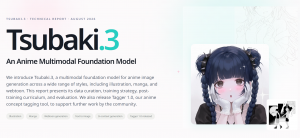
PixAI Tsubaki.3 Tech Report Abstract
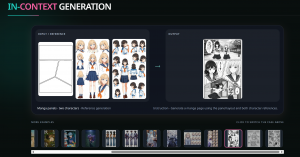
PixAI Tsubaki.3 Tech Report In-Context Generation
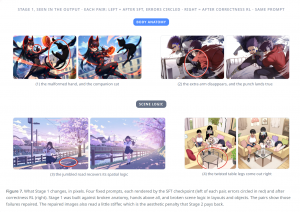
PixAI Tsuabki.3 Tech Report: reinforcement learning – Stage 1: multi-task correctness
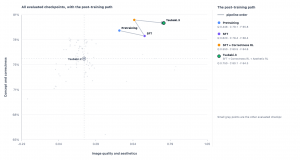
Each point is a Tsubaki.3 training checkpoint, scored on image quality and aesthetics (horizontal) and concept coverage and correctness (vertical). Aesthetic post-training recovers the visual quality lost during correctness training while keeping correctn
In-house foundation model covers illustration, manga pages, and video; PixAI also open-
NEW YORK CITY, NY, UNITED STATES, September 28, 2026 /EINPresswire.com/ — PixAI, the anime-focused AI creation platform with more than 16 million users worldwide, has released Tsubaki.3, an all-in-one anime AI creation model covering illustration, manga, and video. Tsubaki.3 was developed from the ground up by PixAI rather than fine-tuned from an existing public model.
Alongside the model, PixAI published a full technical report detailing how Tsubaki.3 was built and how each capability was evaluated, and open-ta pipeline
General-purpose image models struggle with anime. The medium relies on thousands of specific art styles, character designs, and visual conventions, many of which have no plain-English description and are known only through fan community tagging systems. Tsubaki.3 was trained to recognize and reproduce these distinctions rather than blur them together.
The model handles text-to-image generation and in-context generation in one system. Creators can generate images from text, edit one part of an existing image while leaving the rest untouched, or build a new image from a reference that supplies a character, pose, expression, sketch, page layout, or style.
Tsubaki.3 is designed to take part in the creative process, not only the final image. From a single reference image, creators can produce expression sheets, multiple angles, outfit changes, and age variants while keeping the character’s face and build consistent, without additional training. The model can also work step by step from line art to grayscale to flat colors to a finished piece, and can generate production materials such as three-view character sheets, pose references, and perspective roughs. Natural-language edits adjust hair color, hand poses, props, or on-image text.
Beyond single illustrations, Tsubaki.3 can turn an illustration into a manga page with panel layouts, speech bubbles, and dialogue, including screentone and action camera angles, and renders on-image text in Japanese, Chinese, English, and Korean. In addition to generating video from text, it can generate video from existing illustrations or manga panels, adding facial expressions, hair movement, action, and camera work to still characters. The aim is to let creators move between illustration, manga, and video without switching models, keeping the same character and art style throughout.
The technical report documents the full pipeline behind Tsubaki.3. On the data side, roughly 500 million raw image-text pairs were refined to about 50 million through three-stage quality filtering, copy-detection deduplication, dual-format recaptioning, and concept balancing, so rare styles are not crowded out by common ones. The pipeline runs on SigLip-Anime, a version of SigLIP 2 SO400M that PixAI fine-tuned on deduplicated public anime data.
The report also addresses a problem it calls style collapse: the tendency of reinforcement learning to push image models toward a single bland, averaged look. After supervised fine-tuning on about 7,000 human-curated images, PixAI’s two-stage approach first corrects body anatomy, multi-subject scenes, character interaction, and text rendering, then optimizes for visual appeal as illustration. A companion language model, Prompt Helper, translates short, casual prompts, often written in Japanese or Korean, into the detailed descriptions the generator expects, while leaving every explicit user choice untouched.
“We believe that showing what is inside a model, in a form others can verify, is how AI creation tools earn trust,” said a PixAI spokesperson.
PixAI also released Tagger 1.0, an open-racters, series, styles, and visual attributes. Built on the SAM 3 image backbone, it improves character tagging accuracy (micro-F1) by 10.4 points over the previous version. Tagger 1.0 is free for research and development use on Hugging Face
Tsubaki.3 is available now on PixAI. As part of PixAI’s 4th anniversary, running through October 20, 2026, every user receives a free Tsubaki.3 trial card on login, Premium members can generate with Tsubaki.3 from text without spending credits, and annual plans are 50 percent off. Details are on the 4th anniversary event page.
About PixAI
PixAI is an anime-style AI art platform. Powered by its proprietary image foundation model Tsubaki.3. Since launching in October 2022, PixAI has grown to more than 16 million registered users worldwide, with strong communities in Japan, Korea, North America, and Taiwan. Beyond the Tsubaki model series, PixAI offers Mio.2, a conversational AI creation agent, PixAI Edit Pro, a natural-language image editing model, and PixAI Studio, a node-based creative workspace connecting image, video, text, and audio generation and editing.
alison long
Mewtant inc.
+1 929-541-9770
email us here
EIN Presswire provides this news content “as is” without warranty of any kind. We do not accept any responsibility or liability
for the accuracy, content, images, videos, licenses, completeness, legality, or reliability of the information contained in this
article. If you have any complaints or copyright issues related to this article, kindly contact the author above.

