

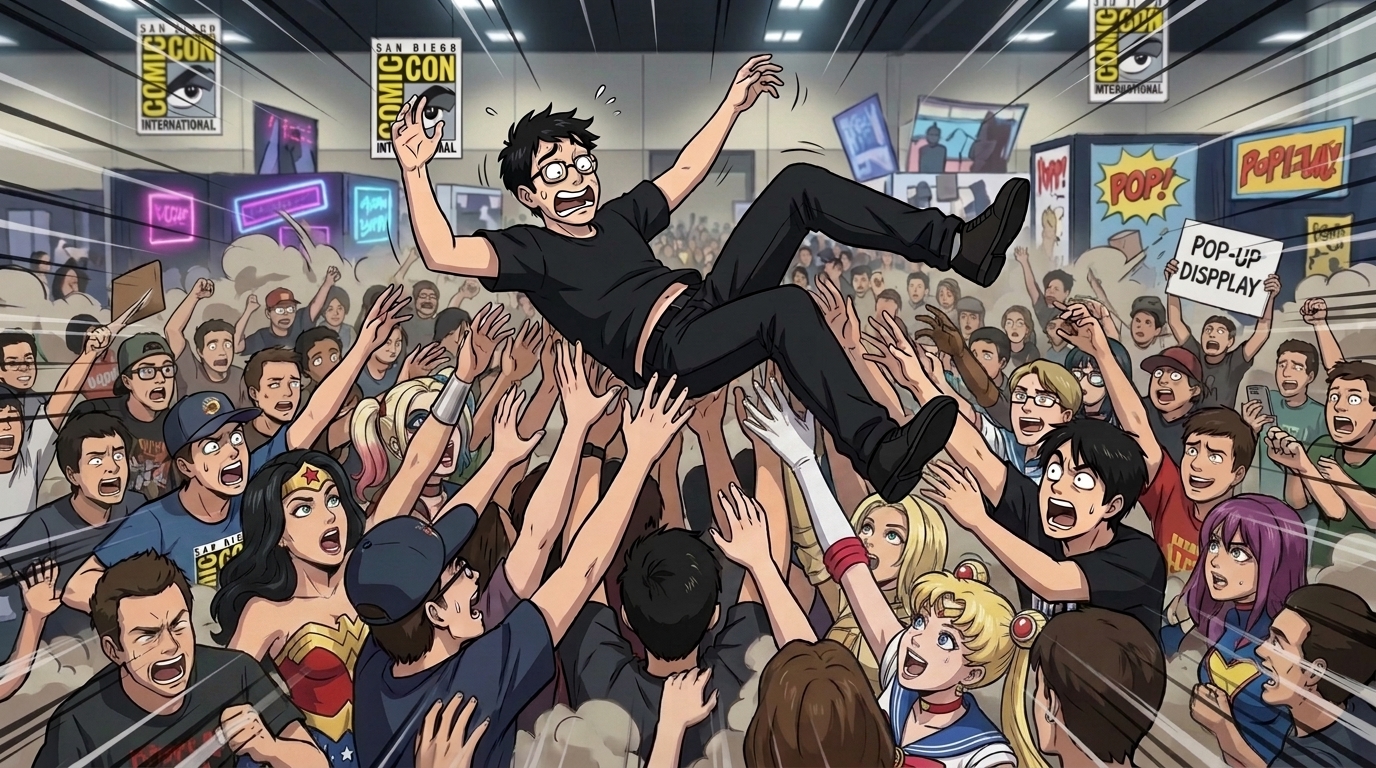
Prologue: 2:30 AM and the Long Flight West
My alarm went off at 2:30 AM on Thursday. By 3:30, I was in an Uber rolling through the pitch-black Central Texas night toward Austin-Bergstrom International Airport.
My driver was a great guy, and as soon as he heard I was heading to San Diego Comic-Con, his eyes lit up. He’d always wanted to go. We spent the thirty-minute ride talking about his love of Dragon Ball and Attack on Titan, sharing that pure, unpretentious enthusiasm for stories that pull you out of everyday life. It was an immediate, grounding reminder of what this culture actually means to real people before you step into the corporate machinery designed to monetize it.
Then came the Alaska Airlines flight.
If you’ve ever tried to catch up on sleep in a cramped coach seat while running on fumes, you know the specific flavor of slow torture I’m talking about. I was exhausted, the seats were brutal, and by the time my boots hit the tarmac in San Diego, I wanted to run screaming out of the jetway. It took me a good twenty minutes just to unpack the knots in my neck and back.
But San Diego greeted me with bright sunshine, cool ocean air, and my mom, a resident of the town, waiting at the curb.
We drove straight down to the harbor for breakfast burritos by the water. My grandmother, her mother, had passed away only a week prior, so sitting there in the quiet morning light, just the two of us eating breakfast by the harbor, was a moment of peace, serenity, and reflection on what really matters. We were both just grateful to be together at a time when we emotionally needed it most, sharing a quiet, grounding meal before stepping into the convention madness.
Act I: Ghosts of Artist Alley and the Floor in Zombie Mode
Navigating the San Diego Convention Center after twelve years away is an exercise in sensory overload, especially when operating on three hours of sleep.
My first challenge was just figuring out where to pick up my program participant badge. As I stood there staring at the floor map like a confused tourist, a woman named Tracy noticed my hesitation and helped steer me in the right direction. It turned out Tracy was in town assisting voice actress Erica Fett (I think that’s who it was, anyway), who was set to appear on Sara Frazetta’s Frazetta’s Fiercest Females panel later that weekend alongside legendary pin-up artist Olivia De Berardinis. Having known and interviewed Sara (the granddaughter of pulp cover artist and legend Frank Frazetta) previously, hearing her name right out of the gate was a cool, unexpected tie-in. Comic-Con has a strange way of dropping those small-world connections into your lap before you even cross the threshold.
“That full-circle moment meant more than any studio photo-op ever could.”
Badge secured, I stepped out onto the show floor in full zombie mode.
The last time I attended Comic-Con was back in 2012, and my first visits stretch back to 1995 or 1996. Walking those aisles today is a jarring reminder of how drastically the landscape has shifted. Thirty years ago, Comic-Con was a sanctuary for craft. You could stand at a table in Artist Alley and have an unhurried, genuine conversation with the titans of the comic book medium, giants like Dave Gibbons, John Higgins, Eddie Campbell, and Dave McKean. You talked about line work, narrative rhythm, and ink. Today, much of that old guard has been priced out or pushed to the margins to make room for giant corporate activations, streaming tents, and endless lines for plastic consumer clutter.
Still, if you look closely enough, the heart of the medium is still beating in the quiet corners.
I wandered over to the Alex Ross Art booth and ran into Ross’s manager Sal Abbinanti. Years ago, when I was first trying to figure out how to make movies, Sal was generous enough to let me interview him and gave me crucial early encouragement. I walked up, shook his hand, thanked him for believing in me back when I had nothing to show for it, and handed him a physical copy of my first feature, The Quantum Terror. He was genuinely thrilled to see it. Running on fumes as I was, I forgot to ask for a photo with him, but that full-circle moment meant more to me than any studio photo-op ever could.
From there, I swung by the Big Man Comics booth (Booth 1705), the staging ground where Chris Gore and Alan Ng would later be signing Film Threat gear. While checking out their setup, I introduced myself to writer Mike Baron, the legendary creator behind Nexus and The Badger. Mike happens to be good friends with my close collaborator Val Mayerik (who illustrated some of the classic Badger runs), so we spent a few minutes catching up, and I picked up a copy of his newest book.
I kept moving, trying to stay ahead of the fog in my brain. I stopped by Billy Tucci’s Crusade Comics booth to pick up a copy of Shi. I chatted with his wife, Deborah, who was incredibly welcoming, but Billy was coming and going, slammed with fans, so I told her I’d loop back later. In the sheer madness of the afternoon, I completely forgot to make that second trip, a mistake I’m still kicking myself for, especially given the upcoming Shi action figure collaboration with Frazetta Girls.
I missed a few other favorites, too, including Sara herself and Ashley Wood, but the artists holding down Ashley’s Underverse booth were world-class talents in their own right, and we spent a good twenty minutes swapping contacts and talking shop.
After a quiet meal with my mom, my brother, and her boyfriend, I crashed onto an air mattress and slept like a rock. The brutal flight was behind me, the floor was scouted, and when Friday morning broke, I was awake, clear-headed, and ready for the panel.
Act II: The Merchant’s Eye, The Digital Circus, and The Aisle Blockade
Friday morning brought a fresh start. Fully rested and fueled by good coffee and breakfast, I walked down to the harbor toward the convention center. San Diego’s waterfront is stunning in the morning light, though the view carries a heavy, unmistakable shadow, the stark crisis of homelessness left to proliferate across the downtown area. Seeing that human struggle, right outside the glittering doors of a multi-million-dollar pop-culture cathedral, is a sobering reality check, one that speaks volumes in regard to how ignorant California is of its own ecosystem.
Once inside, I took my time exploring the floor with a clear head. I chatted with cosplayers about their builds, always fascinated by the obsession, time, and craftsmanship people pour into creating something purely for the joy of it. I browsed through original comic art pages, admiring the raw line work that started it all.
A major focus of my floor walk was scouting the licensed toy and collectible booths. Merchandising is at the top of my mind for my upcoming sci-fi movie, Escape From Planet Omega-12. Ever since George Lucas built his independent empire by keeping the licensing rights to Star Wars in 1977, I’ve understood that physical goods aren’t just extra revenue; they are the lifeblood of creative independence.
You can see that exact playbook being executed today by outfits like Glitch Productions with The Amazing Digital Circus. When I saw The Last Act in a packed theater, the entire crowd pulled out their phones as the credits rolled to scan the screen’s QR code and order plushies and vinyl figures while still in a heightened emotional state. That direct-to-consumer merchandising engine generated massive revenue that rivaled, and likely eclipsed, their theatrical box office. If you want to build a sustainable micro-empire outside the studio system, collectibles are non-negotiable.
“Physical goods aren’t just extra revenue; they are creative independence.”
With the afternoon approaching, I headed upstairs to scout Room 24ABC early. The San Diego Convention Center is vast, and navigating the dense currents of moving crowds requires getting your bearings ahead of time. After confirming the room location, I had a little time to spare and headed back down to the main hall.
That’s when I ran straight into the physical manifestation of Hollywood’s anti-AI crusade.
I walked past a booth where Guillermo del Toro was holding court, surrounded by a wall of people holding up phones to record him, completely choking the aisle. Looking at him standing there blocking the flow of traffic, a thought flashed in my head: “Hey Guillermo, I’m an independent filmmaker fulfilling my dream of making a sci-fi epic without Hollywood, using AI as part of my work pipeline, and there’s not a damn thing you can do about it.”
Don’t get me wrong, I’ve appreciated a lot of his earlier work as mid-tier, wannabe Tim Burton-style dark fantasy that had heart. But it’s rich watching a multi-millionaire director, who takes massive streaming checks from Netflix to re-tread comfortable public-domain IP like Pinocchio and Frankenstein, turn around and fire shots at independent creators trying new tools, and then play the victim like some third-world terrorist state lobbing rockets at his neighbors. He lectures from a high castle while acting like those making their own opportunities are somehow the soulless ones who should be stamped out.
It reminded me of Christopher Nolan, another studio favorite who loves to preach about the “purity” of the medium from behind an IMAX camera. This is a guy whose most iconic, memorable cinematic beats are lifted almost frame-for-frame from directors far more innovative than himself: Satoshi Kon’s psychological dream logic (Paprika, Perfect Blue), Michael Mann’s clinical heist mechanics (Heat), and Alex Proyas’s gothic, shifting architecture (Dark City, The Crow).
Seeing the legacy gatekeepers literally blocking the hallways of Comic-Con was all the motivation I needed. I turned around and headed back up to Room 24ABC.
Act III: Room 24ABC and the Real Reason We Build
I got to the room early and hung out in the hallway, talking with more cosplayers while the crowd began to gather. Before long, the rest of the panel arrived: Chris Gore, Joseph Kahn, April Wright, Jim Agnew, and Alan Ng. Chris got us organized quickly, and we took the stage in front of a nearly full room.
The panel was a blast. While the legacy industry spends its time panicking over changing models, our table offered practical, battle-tested advice on bypassing gatekeepers entirely. We spoke directly about how terrified the gatekeepers are, how now is the time to bypass them, with me adding the use of open-source software, local AI models, and hybrid practical-digital pipelines to close the “viability gap,” proving that an independent creator working out of a garage can now deliver cinematic scale without taking a studio leash.
The true impact of the trip, however, happened after the microphones were turned off.
When the panel ended, a group of five or six men approached me outside Room 24ABC. We stood in that hallway for forty minutes, where I talked about what is possible with these new tools, while they shared what they were hoping to create. I encouraged them to scan my QR code so they could follow my process on Substack and reach out directly if they ever had questions along the way.
“This isn’t about saving money or replacing jobs. It’s about human agency.”
Among them was a gentleman on prosthetic legs. He explained that due to his physical disability, being on a traditional, grueling 14-hour physical film set was nearly impossible for him. But with local AI tools, performance capture, and digital pipelines, those physical barriers are mostly dissolved. For the first time in his life, with the introduction of this software, he was realizing that he didn’t have to abandon his dream of directing his own feature film. He had the power to sit in his office and build his vision directly.
That single conversation validated every single article I’ve written, and every hour I’ve spent testing open-
This isn’t about “saving money” or “replacing jobs.” It’s about human agency. The legacy gatekeepers want you to believe that art only belongs to those who can secure a ten-million-dollar budget and survive a brutal physical studio machine. But for that director on prosthetic legs, and for thousands of independent builders like him, open-ors back their voice
Act IV: The Hangover, The Void, and The Micro-Empire Ahead
After the hallway conversation wrapped up outside Room 24ABC, I headed back down to the convention floor to check in at the Big Man Comics booth. Chris Gore and Alan Ng were hard at work signing merch for Film Threat fans, and the energy around the table was great. I had a chance to catch up with YouTuber “Press M to Start” and a few other creators standing nearby, and I made sure to thank Chris and Alan again for putting the panel together and bringing me into the fold.
A little later, I ran into a friend who was running his own booth on the floor, and he ended up introducing me to two toy developers. We talked shop about what was possible for an indie creator like me, as I showed them my binder full of designs for characters, robots, and aliens, adding another crucial piece to the puzzle for how I’m going to roll out the physical line for Escape From Planet Omega-12.
I spent my final hour on the floor doing some quick shopping for my family, grabbing gifts to bring back to Texas while soaking in the sheer volume of art, collectibles, and passion crammed into every square foot of the hall. Before I knew it, it was time to meet my ride.
The next morning, I was back at San Diego International Airport for my flight home to Austin. Sitting in the terminal, I was already kicking myself for leaving without making that second stop at Billy Tucci’s booth to grab his new Shi book, but overall, the trip had been a massive success.
Yet, stepping back into my quiet office in Texas that afternoon, I was hit by a very specific, heavy psychological reality: the post-convention void.
It’s an odd, quiet emptiness that almost every creator feels after an event like Comic-Con, even when things go amazingly well. One minute you’re inside a high-voltage pressure cooker of pure possibility, standing on a stage, speaking to a nearly full room, and connecting with people whose lives might be touched by the possibilities your words offer them, and less than twenty-four hours later, the noise completely stops.
“No gatekeepers. No permission slips. Just the work.”
You’re back at your desk. The room is dead silent, your body is still recovering from airplane seats, and you’re scrolling through social media, seeing all the things you missed or the opportunities you didn’t quite have time to chase. It’s easy to let that sudden contrast feel like a letdown, like you walked away leaving money on the table.
But the truth is, that void isn’t a sign of failure; it’s just the friction of stepping out of the arena and back into the workshop.
The high of the stage is fleeting, but the work is permanent. San Diego Comic-Con proved that the hunger for true creative independence is real. The artists, the fans, and the people who realized they can finally direct their movie. They don’t need a blessing from the studios. They need proof that an independent builder can carve out a path, own their IP, and deliver something extraordinary using the power of consumer tech, open-
Now, the heavy lifting begins. I have a film to finish, toys to manufacture, articles to write, and a micro-empire to build right from my desk in Texas.
No gatekeepers. No permission slips. Just the work. Let’s get to it.
Christopher Moonlight is an animator, special effects artist, and the director of the ‘Award This’ winning movie, The Quantum Terror. His upcoming animated sci-fi adventure, Escape From Planet Omega-12, combines traditional film-making special effects with AI to create something never seen before in independent film. You can follow the behind-the-scenes, including tutorials, tips, and tricks, on his YouTube Channel, Substack, and christophermoonlight.productions website.
Read More
Warner Bros. has not had an easy time restarting the Batman franchise. So much ill-will was generated by 1997’s “Batman & Robin” that riots the likes of…
News
Read More
Zack Snyder has got a pretty sweet little website going for his newest film “300.” The film is an adaptation of the Frank Miller graphic novel which…News
Read More
Surfing. Saint Arnold Beer. Cinema. If you like any one of those three things (and you oughta being at this site), you’d better attend Aurora Picture…
