

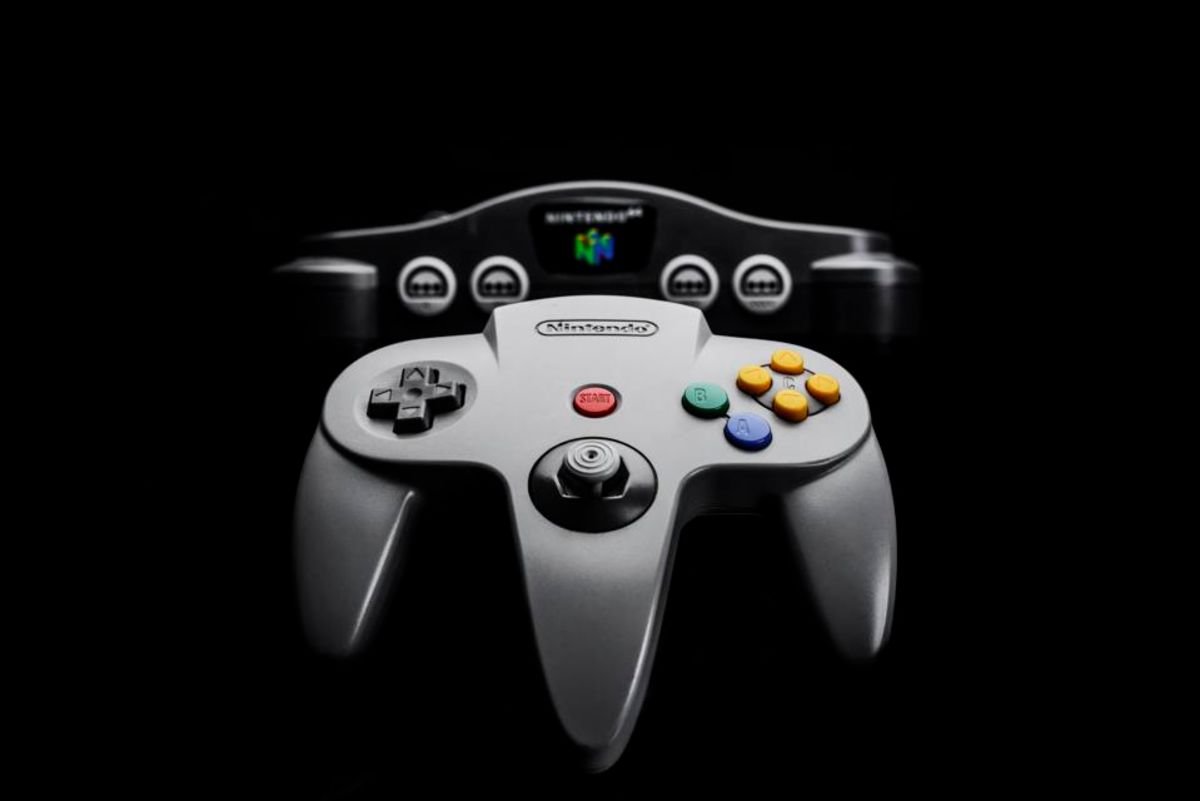
30 years ago today, on an unassuming Thursday morning in 1996, extinct plaything purveyor KB Toys decided to infamously break the North American N64 street date—September 29—and go completely rogue.
Essentially, the retailer began selling the anticipated 64-bit cartridge-based console to eager early adopters, three whole days before its scheduled Sunday launch. And, according to an official statement from KB Toys, the decision to do so was actually a mistake. Even today, street dates get broken with games and hardware relatively often, so it’s not difficult to imagine this sort of thing happening during a more technologically quaint era.
In the end, Nintendo supposedly gave the sanctioned go-ahead and allowed all retailers to either begin or continue selling the console early, probably because the polygonal cat was already out of the bag. The IGN article I’ve linked, which contains an interview with then KB Toys vice president Tom Alfonsi, is very much worth a read. It’s a total time capsule and gives a real sense of where the gaming industry was during the mid-’90s.
Alfonsi mentions that the N64 is basically selling at a one-to-one ratio with Super Mario 64, which isn’t all too surprising, since the machine initially launched with only two games in the States: Super Mario 64 and Pilotwings 64. To this day, Super Mario 64 is arguably one of the greatest video games of all time, so if your new system can only offer two launch-day titles, there has to be some comfort in knowing that at least one of them is a stone-cold classic, if not a paradigm-shifting behemoth.
At another point in the interview, Alfonsi is asked why KB Toys never carried Sega’s ill-fated (at least in North America) Saturn, and his response is another glimpse into gaming’s before-times:
“Going back to E3 in May 1995, when Sega decided to launch early, the company excluded us from its list of retailers, and that has hurt them tremendously. It hurt them really bad. Based on that alone we decided not to carry Saturns. And that decision even changed Sega’s relationship with the retailers it distributed games with. Saturn won’t be in the final race, it’ll be a two-way race.”
KB Toys did eventually make amends with Sega and proudly carried Dreamcast stock, even drumming up hype for pre-orders while on the road to the console’s epic 9/9/99 launch. I suppose Alfonsi’s words regarding the Saturn proved prophetic for the Dreamcast, too, as the groundbreaking 128-bit machine ultimately conceded to Sony’s PS2 in 2001, as well as Microsoft’s Xbox and Nintendo’s GameCube.
While I never owned an N64, I had friends who did, and I remember those years fondly. Seeing Super Mario 64 for the first time was truly mind-shattering and it changed how we perceived video games, honestly. Plus, I actually liked the N64’s trident controller. It was strange and innovative, and I loved all the brightly color variants, including the Funtastic series that arrived later on.
Sure, the N64’s visuals could be foggy and soft, and it no doubt lacked solid RPGs, but I’d argue that the console made up for it with great multiplayer capabilities and excellent first-party offerings. The PlayStation definitely gave it a run for its money, though, and this particular generation saw Nintendo’s market dominance begin to shake and shift.
But with that, let’s wish Nintendo’s blurry wonder a very happy 30th North American birthday. And let’s wish my aching back some relief, because we’re definitely getting old, fam. So, so old.
This article was originally published onForbes.com
