

Bill Ingalls
/
NASA
Isaacman donates $500,000 to support STEM scholars at Embry Riddle
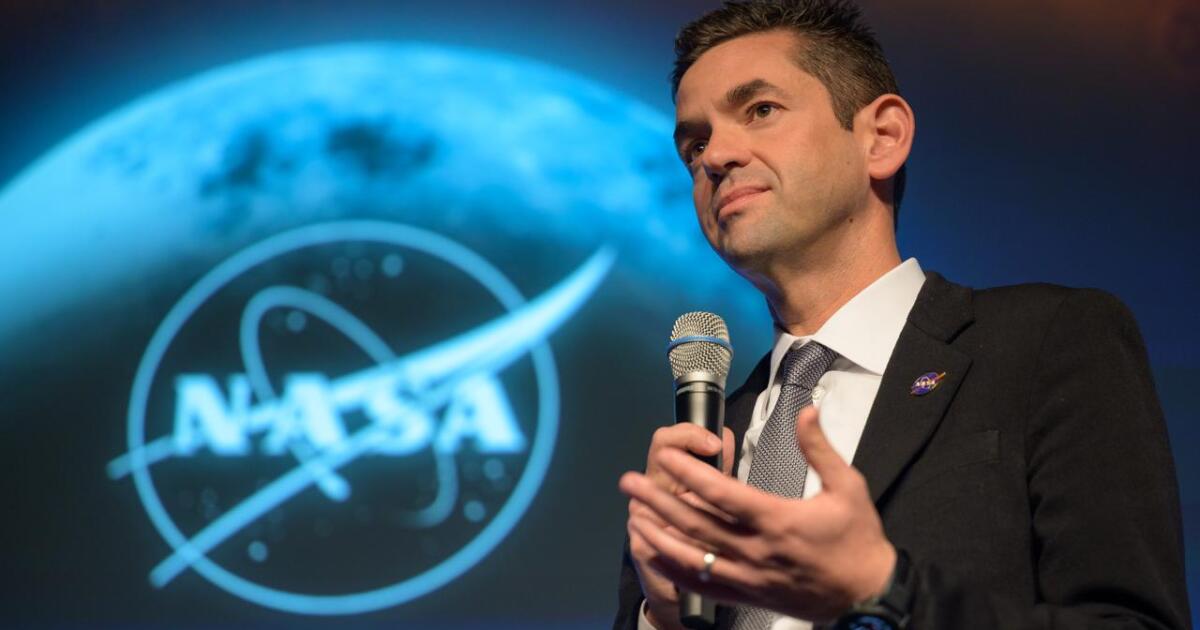
NASA Administrator Jared Isaacman has pledged $500,000 of his own money to a foundation supporting students at Embry Riddle Aeronautical University.
The Astronaut Scholarship Foundation, or ASF, awards scholarships to rising juniors and senior college students in science, technology, engineering and math, and serves as a network for mentorships and career development. Scholarships can reach up to $15,000 per scholar.
Isaacman said in a prepared statement that he’s excited to champion “students who take risks, tackle hard problems and pursue bold ideas. … These students are the Artemis generation, and their potential is limitless.”
CEO Colleen Middlebrooks said this donation is the largest the nonprofit foundation has ever seen and it validates the work ASF does to help STEM students.
“The single best thing that can happen for ASF is for someone to step forward and endow a scholar award at a school, because then we never have to fundraise for it again, ” Middlebrooks said. “We just draw the money off of that large amount, and we can support scholars forever at that school. “
ASF was founded by six of the original Mercury 7 astronauts back in 1984 to help the U.S. maintain a strong role in science and technology leadership. Two scholars from the organization became astronauts, including Christina Koch, who flew around the moon on the Artemis II mission.
“We’re 42 years old, founded on the premise of supporting America’s best and brightest in STEM,” Middlebrooks said. “The name is misleading because it’s “Astronaut Scholarship Foundation.” I like to say founded by astronauts and fueled by astronauts but not necessarily creating a bunch of astronauts.”
ASF has two other endowed scholarships, including the Lovell family at Rice and Charlie and Dottie Duke at Tarleton State University.
Middlebrooks explained that Isaacman is a 2011 graduate of Embry Riddle, so his five-year pledge reflects his support for the foundation and his Alma Mater.
“I hope that his gift encourages others to follow his lead and support students in STEM,” Middlebrooks said. “My personal goal would be that all 56 university partners have an endowed scholarship at their university.”
With various networks, mentorship and educational opportunities, Middlebrooks said the foundation connects scholars with opportunities for life.
“We provide professional development opportunities,” Middlebrooks said. “Our scholars speak at different space centers across the United States conferences. They sit on panels. We bring them back to help us volunteer at the Astronaut Hall of Fame and at our Innovators Symposium. … Throughout their life, they can reach back at any point if they’re working on a patent or any of those things, or just maybe they’re moving into a leadership role within their company. They can still get a mentor as they go through their career.”
Embry Riddle Aeronautical University is a financial sponsor of Central Florida public media but has no editorial control over our news coverage
New exhibit uses VR to bring people to space
In collaboration with the Smithsonian Astrophysical Observatory and Fever Hub, an exhibition and experience center in the Florida Mall in Orlando, a new exhibit takes visitors on a journey through the universe with virtual reality technology.
Smithsonian Starstruck: An Immersive Experiencebrings telescopes, missions, stars and galaxies a little closer to Earth.
Fever Hub’s general manager Stephanie Lucas said the experience is like no other, bringing photos of space and objects in our universe up close.
“They take all of these scans and photos and pictures and videos that these telescopes that are already in space are gathering and giving to us, and they essentially stretch it and make it into a 3d model,” Lucas said. “With the Smithsonian Starstruck, it’s not just you’re walking through seeing all these things, it’s interactive.”
During the experience, guests can touch galaxies, pick up different equipment and overall use their hands more than maybe other virtual reality experiences. While it’s fun and interactive, she said it’s also educational in a way that makes space easier to connect with.

NASA, ESA, and M. Livio and the Hubble 20th Anniversary Team (STScI)
/
NASA
“Space is one of those things that isn’t quite a foreign concept, but it’s still one of those that there’s so much we don’t know,” Lucas said. “So, this way it brings it more to a perspective of there’s more than just Earth, there’s more than just our moon and our sun. “
Luis Caban visited Fever Hub and completed the Smithsonian Starstruck experience. He said the technology makes it feel like you’re really in space.
“This is like you’re actually in there, seeing the Pillars of Creation so, so close,” Caban said. “It’s unbelievable, like you dream these things, and now it’s so possible with the VR technology. It’s fantastic.”
Towards the end of the experience, guests go into a black hole and end up looking at Earth with the VR gear. Caban said in that moment, he reflected on how humans treat our own planet and space.
“You are basically given the chance to explore the galaxy, to even go outside of the galaxy, look at the galaxy from the outside,” Caban said. “Then that immensity and everything looks sterile. Everything looks so outwardly and suddenly you come back, and you see home, and you see this little, tiny dot in the middle of this immensity of the universe, and it makes you reflect. Really makes you reflect on being more proactive, keeping our planet, alive.”
